GlobalFoundries to produce silicon interposers for TSMC’s CoWoS in the US — Five-year agreement valued at $2 billion


GlobalFoundries and TSMC have entered into a five-year manufacturing agreement valued at $2 billion under which GlobalFoundries will produce silicon interposers for TSMC’s CoWoS advanced packaging technology. The arrangement will establish a U.S.-based manufacturing source for these components, which will enable TSMC’s clients to brand their products as completely made and packaged in America. Volume production is scheduled to ramp up in the first half of 2028.

“By providing manufacturing service using GF’s trusted U.S. manufacturing footprint, we are creating a secure, scalable source of essential advanced-packaging elements that will help customers accelerate innovation and strengthen the semiconductor supply chain,” said Ed Kaste, senior vice president of CMOS Business at GlobalFoundries.


Source link

Brooklyn median sales price reached $1.15 million on fewer deals in the third quarter


Brooklyn’s median sales price climbed in the third quarter as buyers competed for fewer listings.

The median sales price increased 5.4 percent to $1.15 million compared to the third quarter of 2025, according to Douglas Elliman’s sales market report with analytics from Marketproof.

There were fewer deals: sales fell 9 percent annually. “Recorded sales show some of the lagging effects of earlier caution,” the report said. Buyers have been spooked by continued high inflation, rising mortgage rates, and low inventory.

New listings were down 2.9 percent year over year, with inventory concentrated at the lower end of the market: 47.8 percent of listings are priced under $999,000 and another 45.1 percent are in the $1 million to $3 million range, the report said.

Stronger fourth quarter expected

Despite “elevated mortgage rates and economic uncertainty,” signed contracts expanded in the third quarter, increasing 8 percent year over year, according to Corcoran’s Brooklyn sales market report. (Contract activity is an early indicator of where sales are headed in the next quarter.)

Some pricing bands saw increases in inventory, as per Corcoran: Entry-level listings under $350,000 jumped 43 percent, and listings from $350,000 to $500,000 rose 25 percent.

With inventory expanding at more accessible price points, “buyers have greater flexibility than they’ve had in recent years. Still, pricing has remained firm, and homes are spending less time on the market,” said Michael Sorrentino, senior vice president and general sales manager for New York at The Corcoran Group. Days on market decreased by two percent annually.

Average vs. median sales price

In her firm’s Brooklyn sales market report, Bess Freedman, CEO at Brown Harris Stevens, explained why the average apartment price increased 3 percent over the past year to $1,176,072, yet the median sales price saw a decline. Stronger sales of luxury properties skewed the average price, while the median price reflects the market’s midpoint, she explained.

Brownstone Brooklyn neighborhoods Boerum Hill, Brooklyn Heights, Carroll Gardens, Cobble Hill, and DUMBO saw an 11 percent year-over-year increase in the average co-op price per room, as per Brown Harris Stevens. And the average price in Park Slope, South Slope, and Windsor Terrace ($1,476,897) was 7 percent higher than the year-ago quarter.

Looking ahead to the fourth quarter, Freedman said, “the Brooklyn apartment market faces several challenges. Mortgage rates have risen sharply since March and are back over 7 percent. Brooklyn also faces low inventory in many of its neighborhoods. These two factors, along with concerns about the war in Iran, inflation, and the upcoming elections, led to a sharp reduction in signed contracts last quarter.”

Demand for houses in Queens

Compass also released sales market reports for Brooklyn and Queens, taking note of a rise in sales of townhouses in North and Northwest Brooklyn, which saw 1.2 percent and 5 percent more closings year over year.

Overall, inventory of houses was down in Brooklyn with 17.3 percent fewer properties on the market. Median sales price for houses was $1,699,000, a 1.1 percent increase from a year ago.

Queens saw 4,446 deals in the third quarter, a 1.2 percent year-over-year increase. Houses led the growth, with closings up 8.7 percent year-over-year. Northeastern Queens, including Bay Terrace, Bayside, Auburndale, Flushing, and Glen Oaks, posted the largest increase in sales.

Buyers were most active at the top of the market, with luxury homes priced at $1.5 million and above seeing 28.4 percent more closings, the Compass report said.

“If inflation cools and mortgage rates ease, buyers who held back this summer could return” to the market, the report said.

Paying more for the same size condo

Coury Napier, director of research at SERHANT, said in his firm’s sales market reports for Brooklyn and Long Island City that “scarcity pushed prices higher across every [Brooklyn] property type.”

Contracts for Brooklyn condos were nearly flat from the spring, down just 0.9 percent and buyers are paying more at the top, the report noted, with $3 million-plus contracts commanding an 11.1 percent higher average price per square foot and the average price of $3 million-plus condo closings up 26.9 percent.

Condo closings in Long Island City rose 8.7 percent year-over-year, up 29.4 percent from the spring. The average price per square foot was up 10.8 percent and the median price up 10.4 percent even as unit sizes were nearly unchanged.


Source link

Renovate or Relocate? What To Know Before You Decide To Age in Place


You’ve spent years making your house feel like home, celebrating milestones, making each room your own, and turning neighbors into friends. As you look ahead to the next chapter of your life, it’s natural to wonder if this is still the place you want to spend it.

Whether you’re leaning toward staying in your house as you get older or moving to a 55+ community, the goal is the same: a home that fits the life you want, with more time for the people and things you love. So, here’s what to consider before you decide.

What It Can Take To Stay Put

Wanting to stay in a house you love and are familiar with makes sense. But most houses need at least some updates to make aging in place easier.

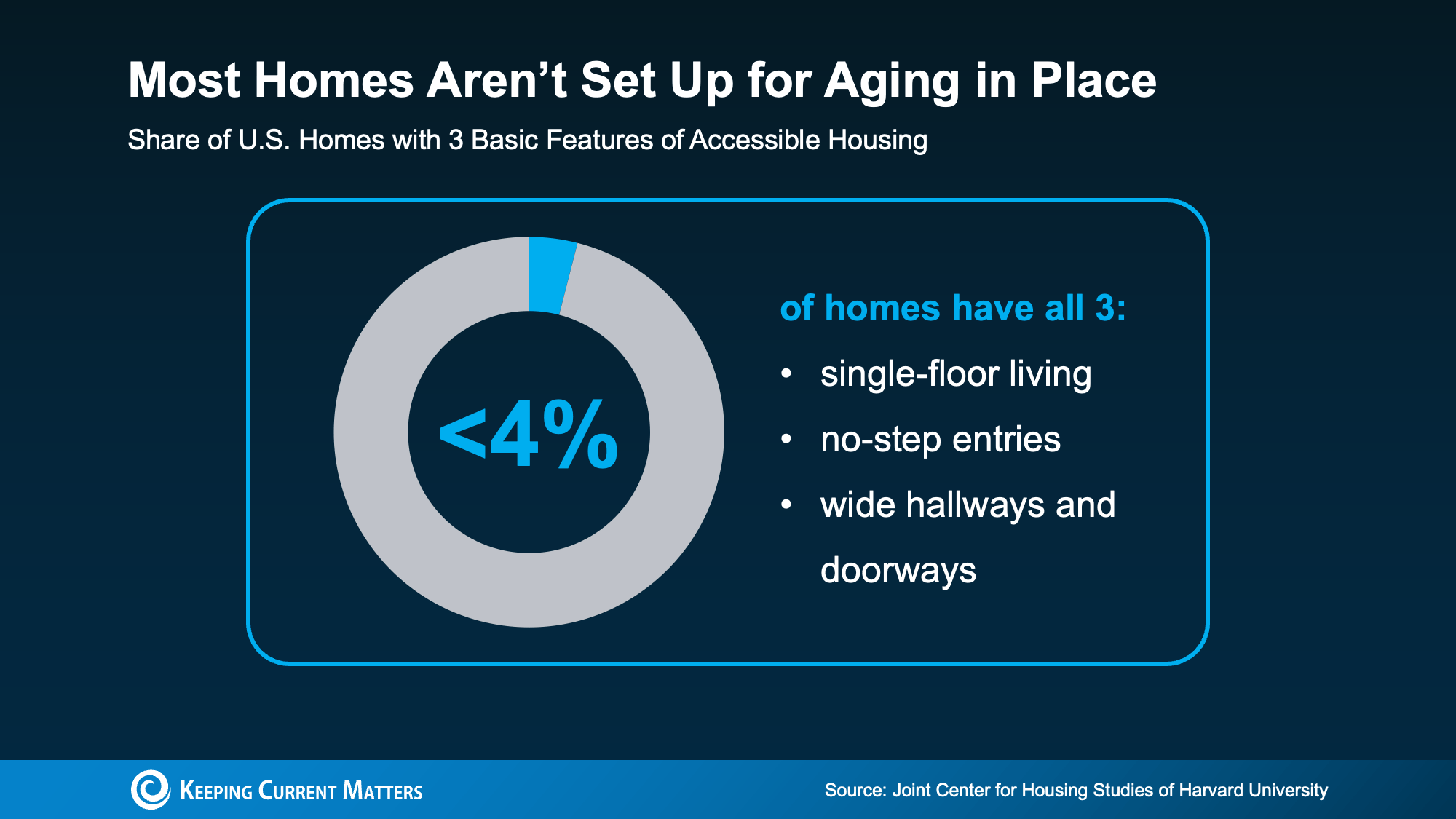
In fact, the Joint Center for Housing Studies of Harvard University (JCHS) finds that fewer than 4% of homes have the basics, like single-floor living, no-step entries, and wide hallways and doorways (see graph below):

a diagram of a pie chart

That means for most homeowners, staying put means doing a remodel.

The National Association of Home Builders (NAHB) reports more than half of remodelers (56%) take on this kind of work. Some of the most common projects are installing grab bars, curb-less showers (walk-in showers with no ledge to step over), and wider doorways.

Now, that’s not to say you can’t go this route. You most certainly can. But if this is how you’re leaning just know you’d be living with contractor noise and dust until the work gets done. Some people don’t want to live in a construction zone. Not to mention, having to manage the contractors and schedules, etc.

Your Equity Could Pay for Your Next Move

If that sounds like something you’d rather avoid, here’s the good news. The money for your next home may already be sitting in your current one. It’s called equity, which is the difference between what your house is worth and what you still owe on it. After years of mortgage payments and rising home values, it adds up. Jess Catorc, Co-Founder of Carry, explains:

“The way home equity builds and is used changes a lot depending on your stage of life. . . . For older homeowners, decades of mortgage payments and home-value growth can turn equity into a financial cushion.“

When you sell, that cushion can go toward a home that’s ready for this stage of life. No demo required. You just get the keys and it’s all there, ready for you. That means less time on projects and more time for living. And one option you may consider if you’re entertaining a move is a 55+ plus community.

Why 55+ Communities Are Worth a Look 

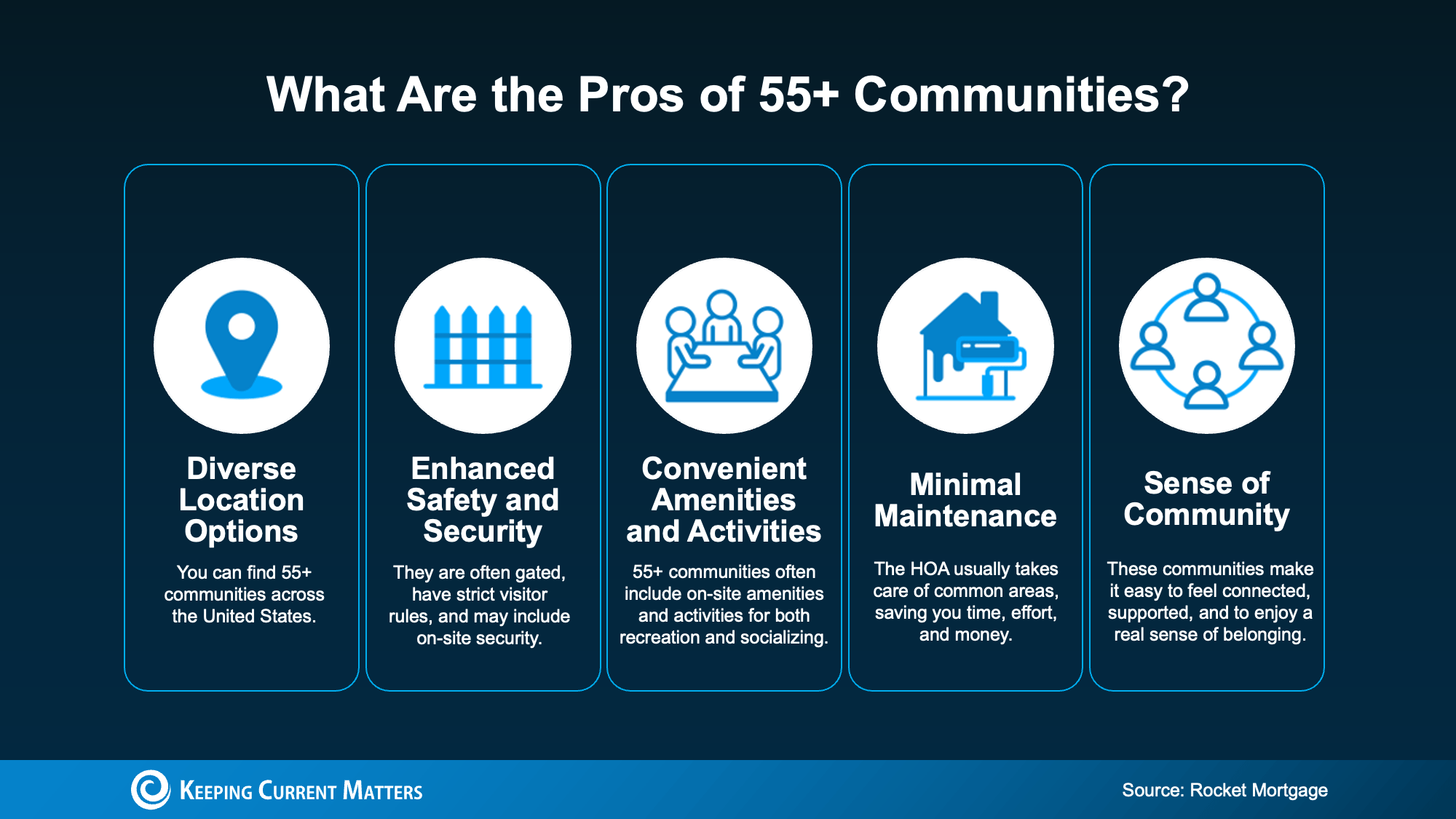
From the homes to the shared spaces to the activity calendar, these communities are planned around this stage of life. And that means everything you need is already rolled into one place. Rocket Mortgage lists some of the biggest perks (see visual below):

a blue and white diagram with white text

Instead of spending time and money to make your house easier to live in, you’d move into a community that’s designed with that in mind from the jump. That frees you up for the good stuff, like a morning walk with a neighbor, a game night down the street, or finally trying the hobby you’ve been putting off.

Bottom Line

Staying and moving can both be good choices. What matters most is finding the place where you’ll feel comfortable and at home for years to come.

A local real estate agent can help you weigh the two by showing you what your house could sell for and what 55+ communities in your area have to offer, so you can decide what feels right for you.


Source link

Myth vs. Reality: Does the Fed Control Mortgage Rates?


You’ve probably heard the Federal Reserve (the Fed) is raising rates again. And if you’re planning to buy or sell a house, you may be wondering what that means for you.

With all the headlines, it’s easy to think the Fed sets mortgage rates. That’s actually a common myth. But the Fed’s decisions can still have an impact on them.

So, where does that leave you? The next few months could get a little bumpy. But the Fed is playing the long game. And with the right plan, you can still make a move that works. Let’s break it down.

Why the Fed Is Raising Rates

It all comes back to inflation. With prices rising fast, everything is getting more expensive – and that leaves buyers with less spending power and makes homes cost more to build.

So, the Fed raises its key short-term rate (the Federal Funds Rate) to slow down inflation. And that’s where a lot of people get tripped up.

  • MYTH: The Fed controls mortgage rates.

  • REALITY: The Fed has an impact on mortgage rates, but it’s only one piece of the puzzle.

As NerdWallet explains:

“The Federal Reserve influences mortgage rates, but doesn’t set them. . . Mortgage rates are influenced by many elements, including the inflation rate, the pace of job creation, and whether the economy is growing or shrinking. The Federal Reserve’s monetary policy is a factor, too . . .”

Here’s the simplest way to explain how it all fits together. Mortgage rates tend to follow something called the 10-year treasury yield. That’s the return investors get for lending money to the government for 10 years. And that yield moves up and down based on what investors expect from inflation and the economy.

Right now, one of the biggest things moving that yield is the conflict in Iran. It’s pushed oil prices higher, which has investors worried about inflation. That’s why any news about the conflict can move mortgage rates. If there’s resolution in Iran, that could take some pressure off inflation and mortgage rates. But the timing is hard to predict.

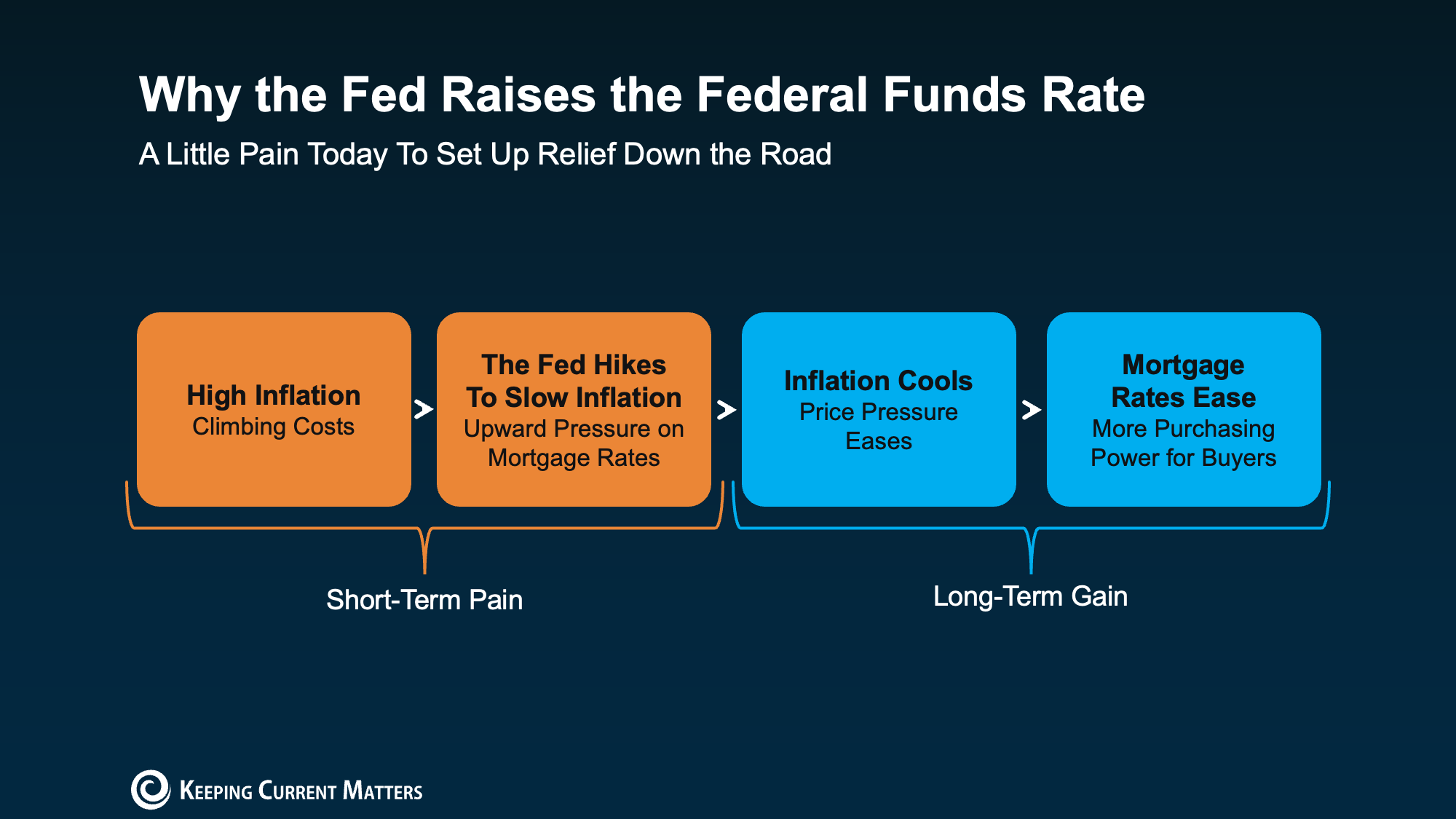
What the Fed does can move that yield, too. When they hike the Federal Funds Rate to fight inflation, investors pay attention. That can push the 10-year yield up, and mortgage rates usually follow. But once inflation cools, the yield has room to come back down, and mortgage rates can, too. That gives buyers some of their purchasing power back (see graphic below):

a diagram of a federal funds rate

Think of it as a little pain today to set up some relief down the road. But how long could that short-term pain last? A lot depends on what the Fed does next.

There’s a Strong Possibility the Fed Will Hike Again This Year

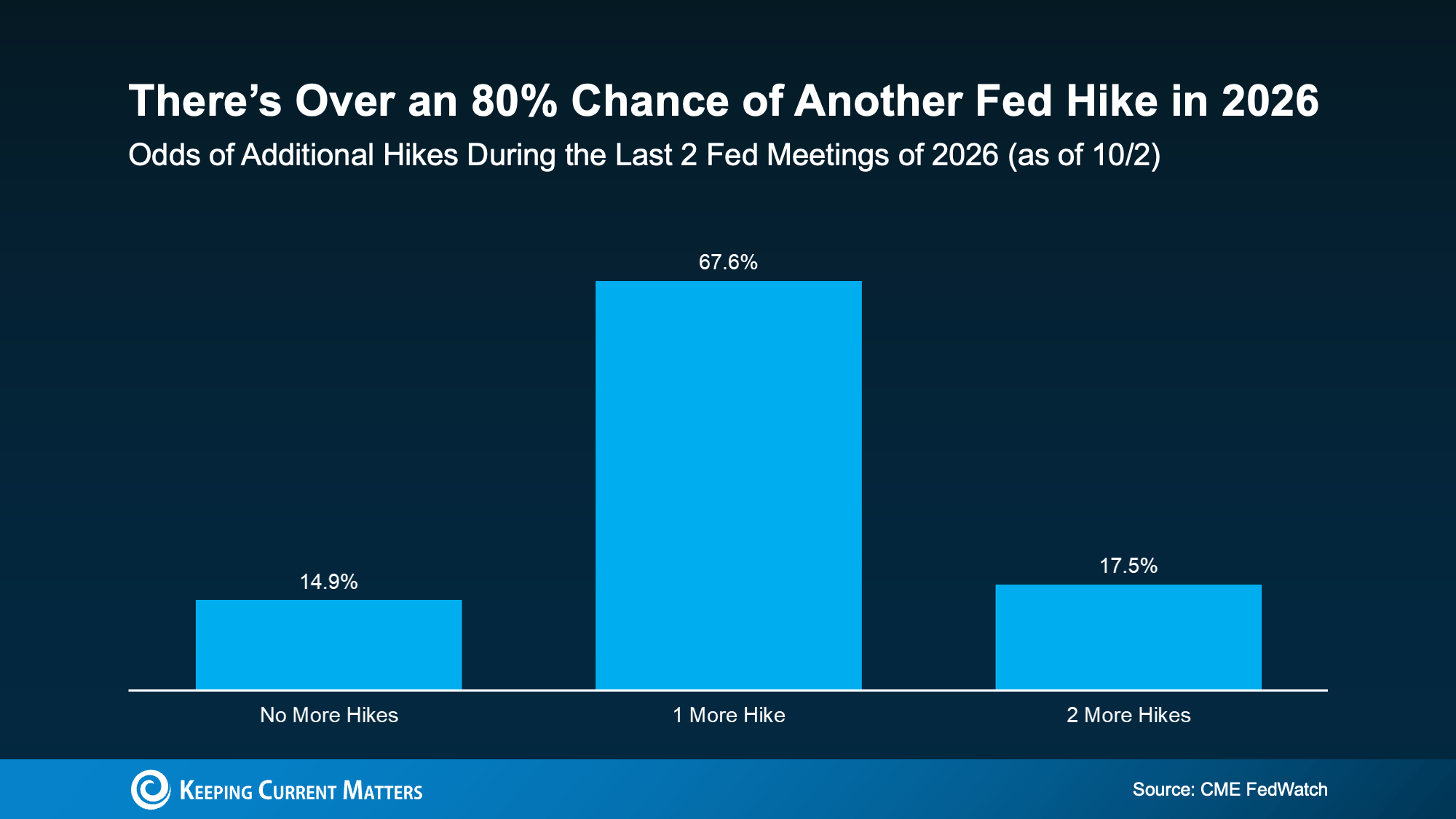
According to CME FedWatch, there’s over an 80% chance the Fed hikes their federal funds rate at least once more before the end of 2026 (see graph below):

a graph of hikers with blue squares

Remember, the Fed doesn’t set mortgage rates. But another hike will likely keep upward pressure on them in the short term. So, should you wait it out? Sam Williamson, Senior Economist at First American, says this:

“Over time, firmer Fed action could help steady the bond market and open the door to lower mortgage rates, but only if investors become more confident that inflation is coming under control.“

And there are some early signs that’s starting to happen. Inflation cooled faster than experts expected in August:

  • PCE inflation dropped to 3.4%, down from 3.7% in July.

  • Core PCE (the Fed’s preferred measure which leaves out food and energy prices) fell to 3%, down from 3.3%.

That’s a step in the right direction, and it’s part of why the odds of a hike at the Fed’s October meeting have come down recently. But inflation’s still above the Fed’s 2% target, and it’s been that way for about 5 years. So, lower rates could still take a while. Your best bet is a plan that works at today’s rates.

How To Make Your Move Work Right Now

While this rate hike cycle isn’t the headline you want to see, it doesn’t mean you have to wait. There are still ways to move, even now.

  • If you’re buying: Get pre-approved so you know your real budget. Ask your lender about your options to get the best rate possible. And once you’re under contract, lock your rate so a jump before closing doesn’t raise your payment.

  • If you’re selling: Decide what matters most to you – a quick sale or top dollar. Each one can call for a different plan. Price for today’s buyers, whose budgets are smaller with higher rates. And think about offering a rate buydown or other concession. They can do more for a buyer’s budget than a price cut.

Bottom Line

The Fed doesn’t set mortgage rates, but its hikes can keep them higher for a while. The goal is to bring inflation, and eventually rates, down over time. With more hikes likely this year, waiting may not pay off. So, connect with a local real estate agent to map out a plan that works at today’s rates.


Source link

What to do if your NYC apartment doesn’t have heat or hot water, or the radiators blast too much heat


When the temperature drops below 55 degrees, your building’s heat is supposed to be on. Making your apartment a comfortable temperature is not something landlords can ignore. That’s because New York City’s heat season officially began October 1st and runs until the end of May.

During this period, if the outdoor temperature drops below 55 degrees during the day (6 a.m. to 10 p.m.) your landlord has to turn up the heat so your apartment is at least 68 degrees. At night, the temperature inside your apartment must be at least 62 degrees, regardless of the temperature outside. Building owners are legally required to provide hot water at 120 degrees year-round.


[Editor’s note: A previous version of this article was published in October 2025. We are presenting it again in case you missed it.]


If your heat is on, great. Your building is compliant with the city’s housing laws. But if your radiator is cold, and you are not able to resolve the situation with your landlord, super, or building management, you may need to file a complaint. So if you’re looking for solutions because your place is too cold, or even too hot, read on.

What to do you don’t have heat in your NYC apartment

If you don’t have heat, contact your building owner, managing agent, or super, and let them know that it’s time to turn up the temperature. 

If they don’t honor your request or otherwise fail to respond, you can call 311, submit a complaint online, or use the app 311Mobile. Hearing-impaired tenants can register complaints via a Touchtone Device for the Deaf at (212) 504-4115. Filing a complaint can get the Department of Housing Preservation and Development involved. HPD may come to the building and stick your landlord with a costly violation. 

In 2022, HPD issued over 4,800 heat violations and 8,000 hot water violations, and initiated more than 750 heat cases in Housing Court.

If you’re not getting any response from the management company, the agency will send a contractor to fix the problem. This is a cost your landlord will likely want to avoid. In 2022, HPD completed a total of $4.4 million in heat-related emergency repairs. These are costs that are billed to the property owner. 

If the issue is a broken boiler or other problem with the heating system, you may be entitled to a break on your rent for the days you spent shivering, since landlords—under the warranty of habitability—are required to provide heat to tenants. 

It’s not advisable to automatically withhold rent in these situations. In a worst-case scenario, you could wind up in housing court for failing to pay, and even if you’d likely win, it could cost a lot in legal fees. A better option is to negotiate with the landlord for a rent abatement for the following month, and get the agreement in writing. 

What to do you have heat in your NYC apartment, but you’re still cold

If your radiators are on but you still want to boost the temperature, consider getting an electric space heater, but be sure to take the necessary safety precautions. For example, space heaters should never be kept near anything that could burn, such as furniture and rugs; don’t set them up in bathrooms or kitchens because of the proximity of running water; and don’t place them on uneven or raised surfaces because they might tip over. 

Also, avoid overloading your electrical outlets—plug space heaters into a dedicated outlet, not a power strip.

Space heaters suck up electricity that will increase your utility bill. There are plenty of creative and affordable ways to stay warm at home, including insulating the windows with bubble wrap and cooking with a crock pot (the warmth will permeate the room). You can also put down rugs if cold air is coming up through an uninsulated basement. 

If you want to see exactly how much power an electrical appliance is drawing check out smart home gadgets that can track and display power usage and help you save money. 

If your air conditioner is still in your window, it could be letting cold seep in, so it’s worth taking it out and storing it until next year. 

What to do if it is too hot in your NYC apartment

Most prewar buildings in NYC use a steam heating system and this typically doesn’t allow you to individually control the heat in your apartment. This means units on different floors and of different sizes all experience the same temperature and renters can often get tropical levels of hot air blasting out of their radiators even when it’s quite warm outside. 

There are two types of steam heating systems—one pipe and two pipe. With a one-pipe system, you can install a thermostatic radiator valve on the radiator that will essentially let you regulate the heat by trapping air in the system. When steam stops coming through the system, the radiator stops working. Radiators need to be retrofitted with this equipment so you may need to ask a super or plumber to install it for a few hundred dollars. (They may also require maintenance every so often and replacing every five to 10 years.) 

If you want to regulate a two-pipe system, you need a different valve that stops steam from coming in. When installed, along with a thermostatic control valve, it produces the same effect as the valve on the one-pipe system—it regulates the heat—but it can be more expensive to put in. 

There are also wifi-enabled, thermal radiator covers that let users regulate their own heat through an app—although this option is currently only available for full-building installations.

—Earlier versions of this article contained reporting and writing by Lucy Cohen Blatter and Donna M. Airoldi. 


Source link

Get $500 off this sweet Ryzen 7 7800X3D and RTX 5070-powered gaming PC at just $1799 — 32GB of DDR5-6000 comes standard too at a 22% discount


We’ve seen some sweet deals on entry-level and high-end prebuilts during this Prime Day event, but a great midrange system has been a little harder to find. We’ve uncovered some treasure, though, in the form of Skytech Gaming’s Harpy prebuilt. This PC pairs a Ryzen 7 7800X3D CPU with a powerful GeForce RTX 5070 graphics card and 32GB of DDR5-6000 memory, all for just $1799 right now.

Source link

The 1871 Jacob J. Lissner House at 125 East 78th St: An early owner was well connected with Tammany Hall


Have you ever passed by an interesting residential building in New York City and wanted to know more about its history? In this series, Brick Underground teams up with Tom Miller, creator of Daytonian in Manhattan, a blog about Manhattan buildings and other historic architecture. Each week, we run an excerpt from the Daytonian’s archives with a link to the full article.

Among the early developers who began transforming the mostly rural land east of Central Park at the end of the Civil War was Nicholas McCool. Around 1871, he erected a row of three-story, brownstone-fronted homes on the north side of East 78th Street between Lexington and Fourth avenues (renamed Park Avenue in 1888). 

The three-bay-wide homes were identical, their brownstone stoops protected by substantial cast iron railings and newels. On either side of the fully arched entrances were foliate carved corbels that supported Renaissance-inspired triangular pediments.

McCool sold 125 East 78th St. to real estate operator Dennis Loomie who in turn sold it to Jacob J. Lissner for $17,000. Six years after purchasing the house, he and his family moved to Madison Avenue and 99th Street.

The family of John Byrnes next moved into 125 East 78th St. Born in Dublin, Byrnes was the principal of the National Surety Company and was well-connected with Tammany Hall. He and his wife, Rose, had at least three children: Matthew, Mary Cecelia, and Thomas F. 

Despite the family’s affluence, John Brynes had a stain on his reputation. Three years earlier, in 1877, he was appointed the city’s chief of the Supply Bureau and the following year he was Tammany Hall’s nomination for alderman. The New York Times sneered at his nomination, saying that Byrnes, “is a fair sample of the class of men Tammany Hall seeks to place in power in this city.” The article then revealed a shocking incident that occurred in 1869: he had “exposed his person” to a young woman “in a most indecent manner.” He told her he “would like to have some pleasure with her,” according to the victim. She broke free and had Byrne arrested.

On October 20th, 1897 Cecilia was married to Joseph W. Lawrence in the Church of Jean Baptiste on East 74th Street near Lexington Avenue. John Brynes’s earlier indiscretion seems to have been forgotten. The social status of the two families was reflected in the reception held in the East 78th St. house. 

John Brynes’s ties to Tammany had been advantageous to his son, Thomas, who was appointed Police Commissioner in 1880, the year the family moved into 125 East 78th Street. But in 1895, the new president of the New York City Police Commission, Theodore Roosevelt, forced Thomas to resign as part of a corruption purge. Thomas Byrnes would later become an insurance investigator.

In 1967, 125 East 78th St. was remodeled, creating a retail space on the ground floor and one apartment each on the upper stories. A one-year renovation initiated in 2019 returned the structure to a single-family home.

For more on the property and the interesting people that lived here, check out the full article.


Source link

Two Moves That Can Get You Into Your First Home Sooner


For a lot of first-time buyers, owning a home can feel perpetually a few years out of reach. Saving for a down payment takes time, and each year you spend renting can make owning feel further off.

But buying your first home doesn’t have to happen to feel like a far away goal. Two choices you control can bring your first home years closer, even with affordability as tight as it is right now.

How Long Buying Really Takes

First, one quick definition. “Breaking even” is the point where owning has cost you about the same as renting would have over the same period. And after that point, owning starts to cost less than renting. Kara Ng, Senior Economist at Zillow, puts it this way:

“Buyers should think about not just when they can afford to buy, but how long they’d need to stay before owning makes more financial sense than renting.“

So how long does reaching that point usually take? And what are the shortcuts? Let’s do the math.

According to Zillow, it usually takes about 8.5 years to save for a 20% down payment, then roughly 6.2 more years before owning costs the same as renting. Together, that’s just under 15 years. But that math relies on two assumptions: that you’re buying a mid-priced home, and that you’re putting 20% down. 

Change either one and your timeline gets shorter. Change both and it can shrink fast. It also varies widely by market, since local prices and rents are different depending on where you live. 

A Starter Home Can Get You There Twice as Fast

A starter home usually means a home in the lower third of local prices. They’re often condos, townhomes, or single-family homes a little smaller or older than others in the area. 

Choosing one over a mid-priced home can cut your wait down by a lot. And while that might sound obvious, you may not realize just how much it shortens your timeline. Because if you’re buying a more affordable home, you don’t have to save up as much or as long.

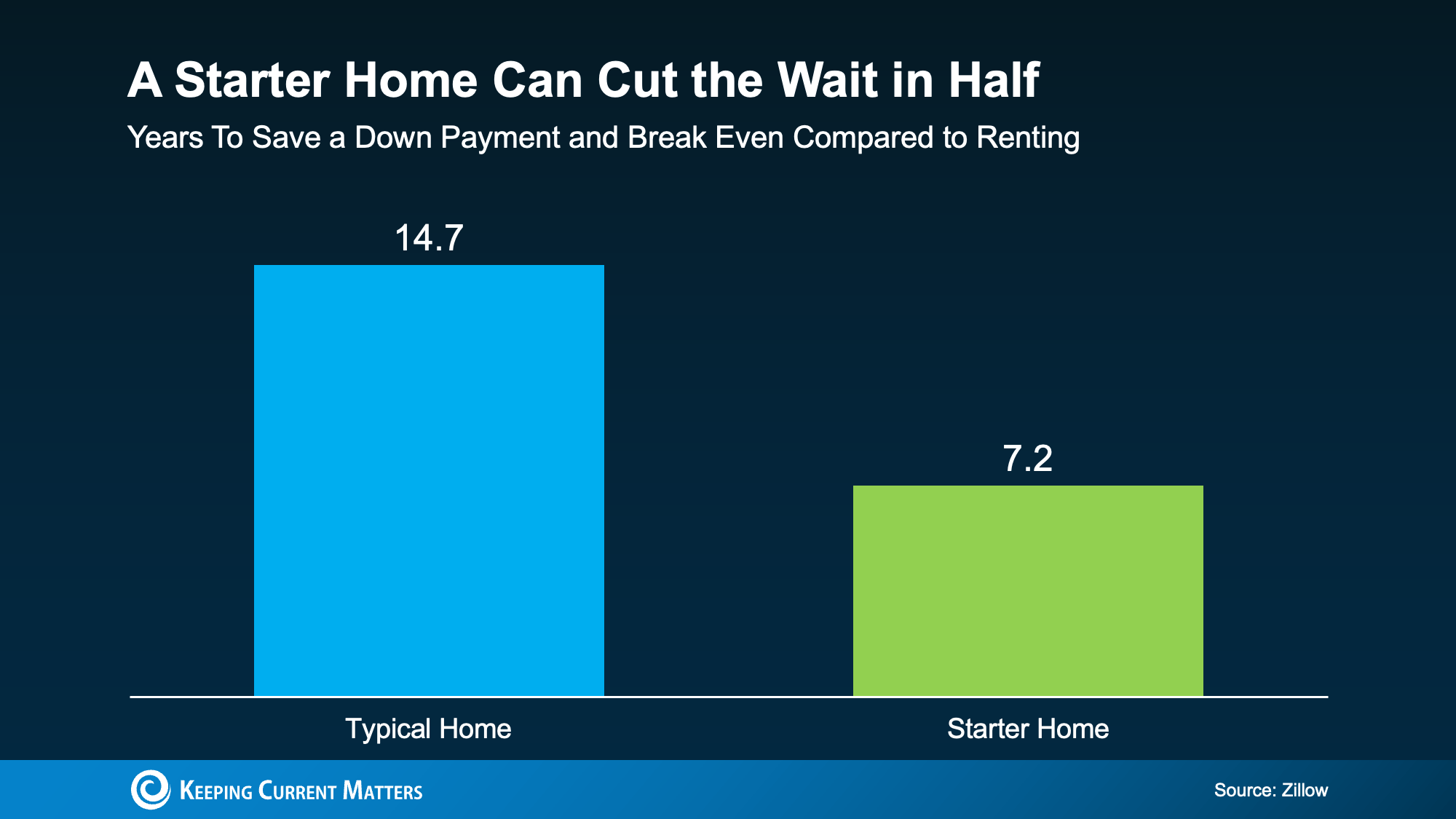
Zillow found that nationwide, a starter home takes half the time – about 7.2 years – to save for and come out ahead on, compared with renting (see graph below):

a graph of a number of squares

That works out to about 4.6 years to save and 2.6 years to break even. It won’t erase every affordability challenge, but it can take years off the wait. And if you’ve already been saving for a while, it could get you closer to making it a reality.

You Usually Don’t Need To Put 20% Down

You, like many first-time homebuyers, might assume you need a 20% down payment to even consider buying. But a lot of the time, you don’t. 

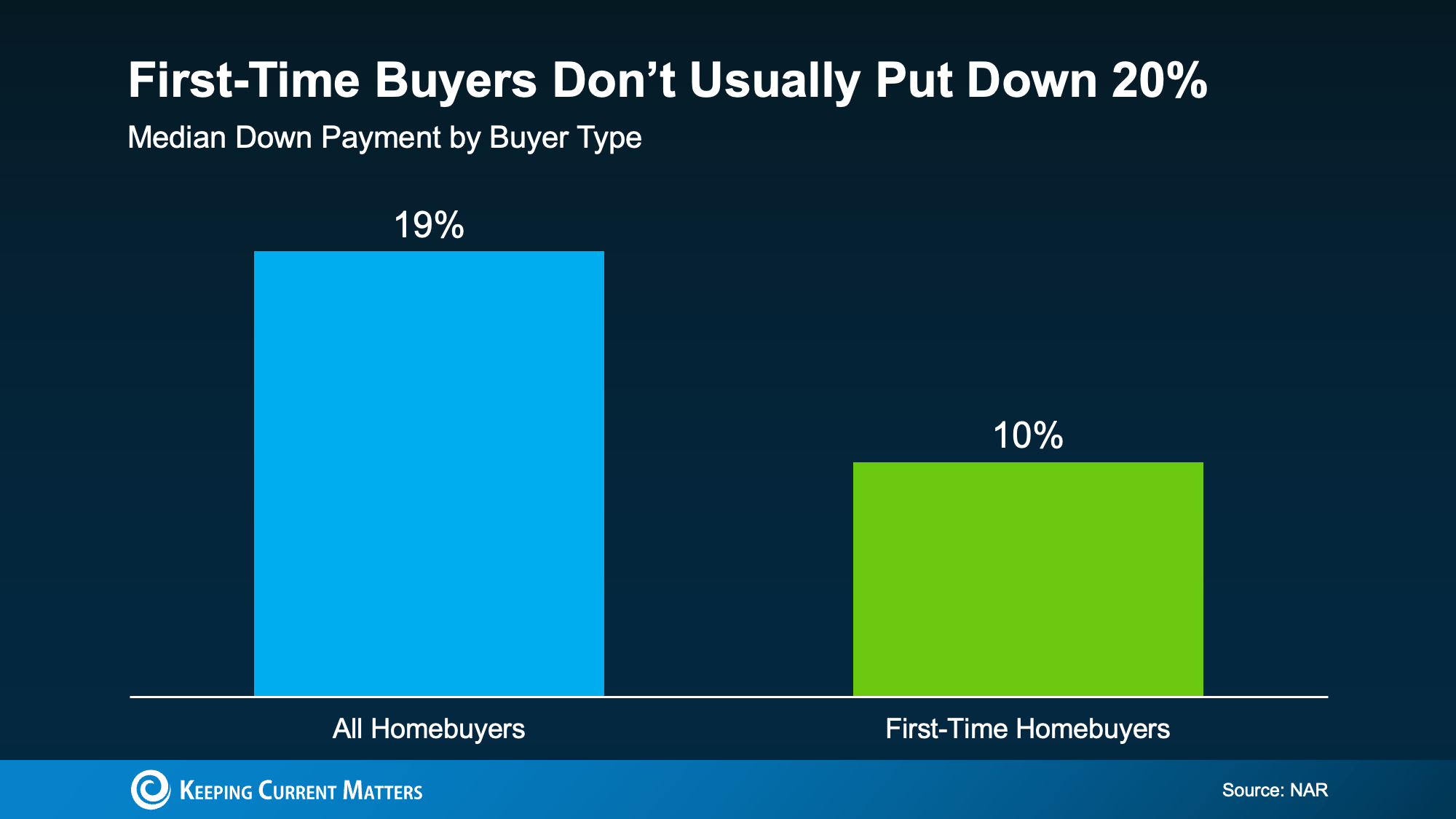
Most first-time buyers don’t put down anywhere near that. The National Association of Realtors shows the median down payment for first-time buyers is 10% (see graph below):

a graph of a sales report

And the minimums go lower still. Some buyers put down as little as 3% on a conventional loan or 3.5% on an FHA loan, and eligible veterans or buyers in certain rural areas can put down nothing at all.

There’s help with the upfront costs of buying, too. Down Payment Resource counts 2,746 assistance programs nationwide, and some are even stackable:

“Some homebuyers can layer multiple sources of assistance to reduce their upfront costs. Layering means combining more than one eligible source of funding as part of your home purchase.”

Put those together – a lower price point, a smaller down payment, and help covering it – and the years you thought you needed start to come down.

Bottom Line

Your first home may not be as far off as it feels. When the numbers make sense for you, buying a starter home and putting down less than 20% can get you there years sooner. 

Want to see which starter homes in your area could fit your budget? A local real estate agent can show you.


Source link