Epic Games has a new launcher available to download now, which was redesigned with AI. The company says it “vibe coded” the new launcher, and claims it’s “way faster” than the current version, as well as 46% faster to start up compared to Steam. Epic Games has set up a landing page where you can download the new launcher, as well as browse its new enhancements.
“Programming is hard. So, instead of doing that, we vibe coded a new Epic Games Launcher that’s way faster and more responsive than the current one, and has a new look,” wrote Epic Games in a blog post discussing the new launcher. The launcher is currently in “preview” phase, which is somewhat of an open beta. Epic is gathering feedback, and anyone is free to download the launcher. In the future, it plans a stable release after it gathers and addresses feedback.
Although the headline startup figure is what Epic focused on its blog post, the updated launcher comes with several additional features, many of which are preset on Steam but weren’t previously available with Epic. There are dedicated pages for games in your library now, for instance, as well as a unified downloads page. The app also includes collections, a big feature of Steam, allowing you to organize your library into different categories. On the landing page, Epic claims the new library is “30x faster,” though doesn’t provide any details beyond that point.
Latest Videos FromTom’s Hardware
Although the launcher has new features, it’s still rough around the edges. For instance, the new social menu now follows you around from the store to your library, with no option to close or resize. Epic also highlights that “certain social features and account management options” are missing from the new launcher. The company says it’s working toward “feature parity.”
Additionally, Epic Games suggests developers working on Unreal projects, as well as competitive players in Fortnite and Rocket League continue to use the old launcher. It’s not clear why Epic is pointing these groups toward the older launcher, but it raises some red flags about what gaps might be present in the new, vibe coded launcher.
(Image credit: Epic Games)
Epic says its new launcher is 46% faster than Steam from a cold start, as well as 14% faster when restoring from the system tray; though, the latter metric only accounts for a whopping 0.06 seconds. Epic commissioned the testing from Keywords Studios, somewhat of a matchmaker in the video games and entertainment industry for a variety of services (including benchmarking, apparently). Epic says its results were gathered from five tests across 13 Windows platforms.
Interestingly, Epic didn’t provide any performance details about the new launcher compared to the old one, outside of saying the new launcher is “way faster and more responsive.”
Get Tom’s Hardware’s best news and in-depth reviews, straight to your inbox.
The Epic Games Launcher preview is available to download now, with native versions for Windows, macOS, and Linux. Windows 10 and 11 are supported, as is macOS 12 or newer. On Linux, you’ll need at least Ubuntu 22.04 LTS, Fedora 43, or Debian 12.
Epic has recently pivoted to an AI-first company, at least according to Epic boss Tim Sweeney. The company has reportedly delayed a Disney-based shooter, with another director telling staff that there should be “no more handwritten code” and that art will be “generated with full AI workflows.”
Mortgage rates being back above 7% isn’t exactly the news most people wanted. But it’s changing the market in ways that matter whether you’re buying or selling.
The number of homes for sale is growing faster than it was this time last year. And interestingly, the main reason isn’t a flood of new listings. It’s because homes aren’t selling as quickly.
Here’s why – and what that means if you’re thinking about buying or selling.
Inventory Growth Is Picking Up Steam
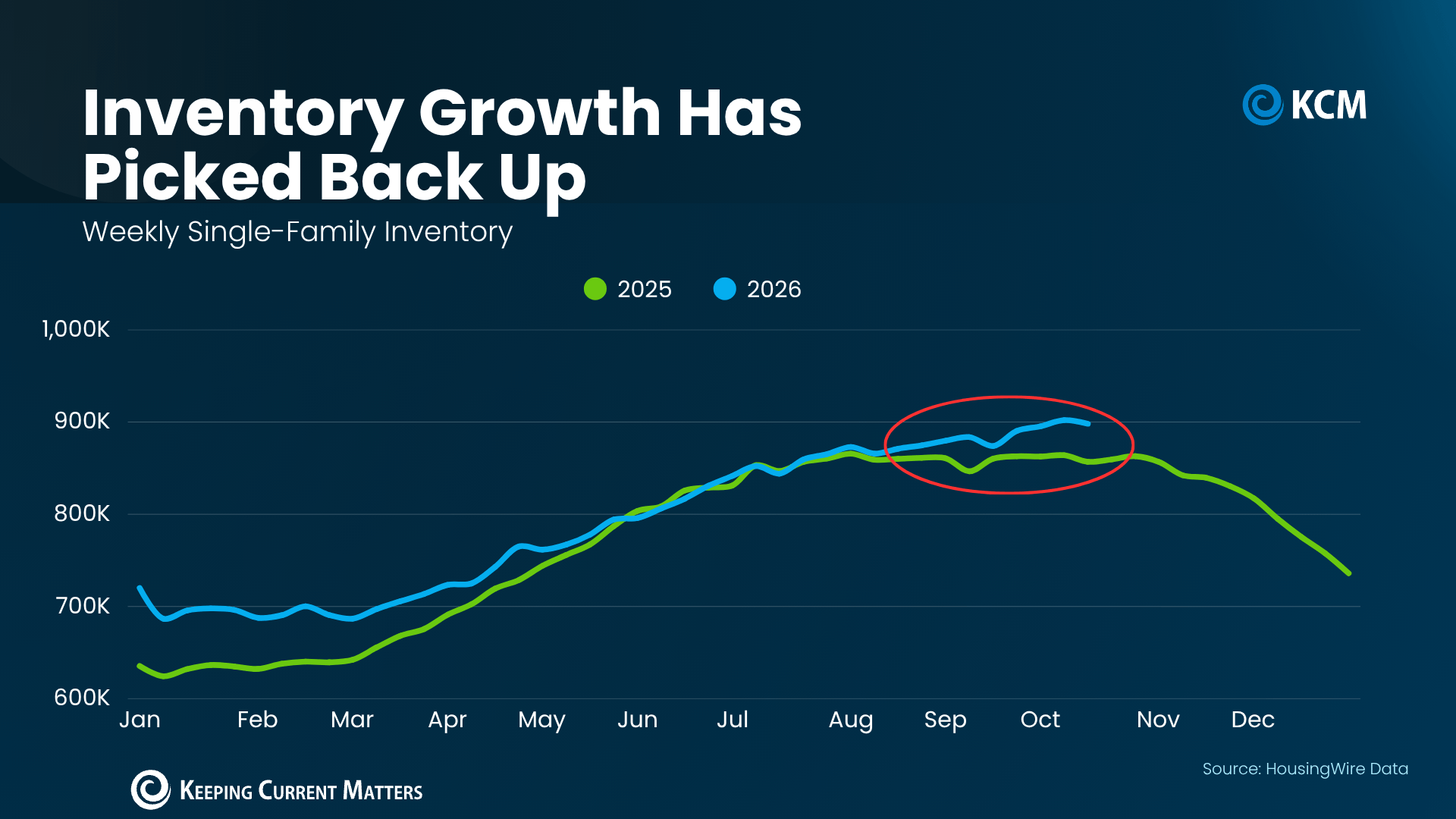
According to HousingWire Data, after inventory growth slowed down for most of the past year, it’s accelerated again in recent weeks. You can see that in the graph below. Just look at the blue line:
And what’s behind this shift might surprise you.
When rates rise, some buyers hit pause. That means fewer homes sell each week. And as those unsold homes stay on the market alongside new listings, the number available starts to grow (see the blue line in the graph below).
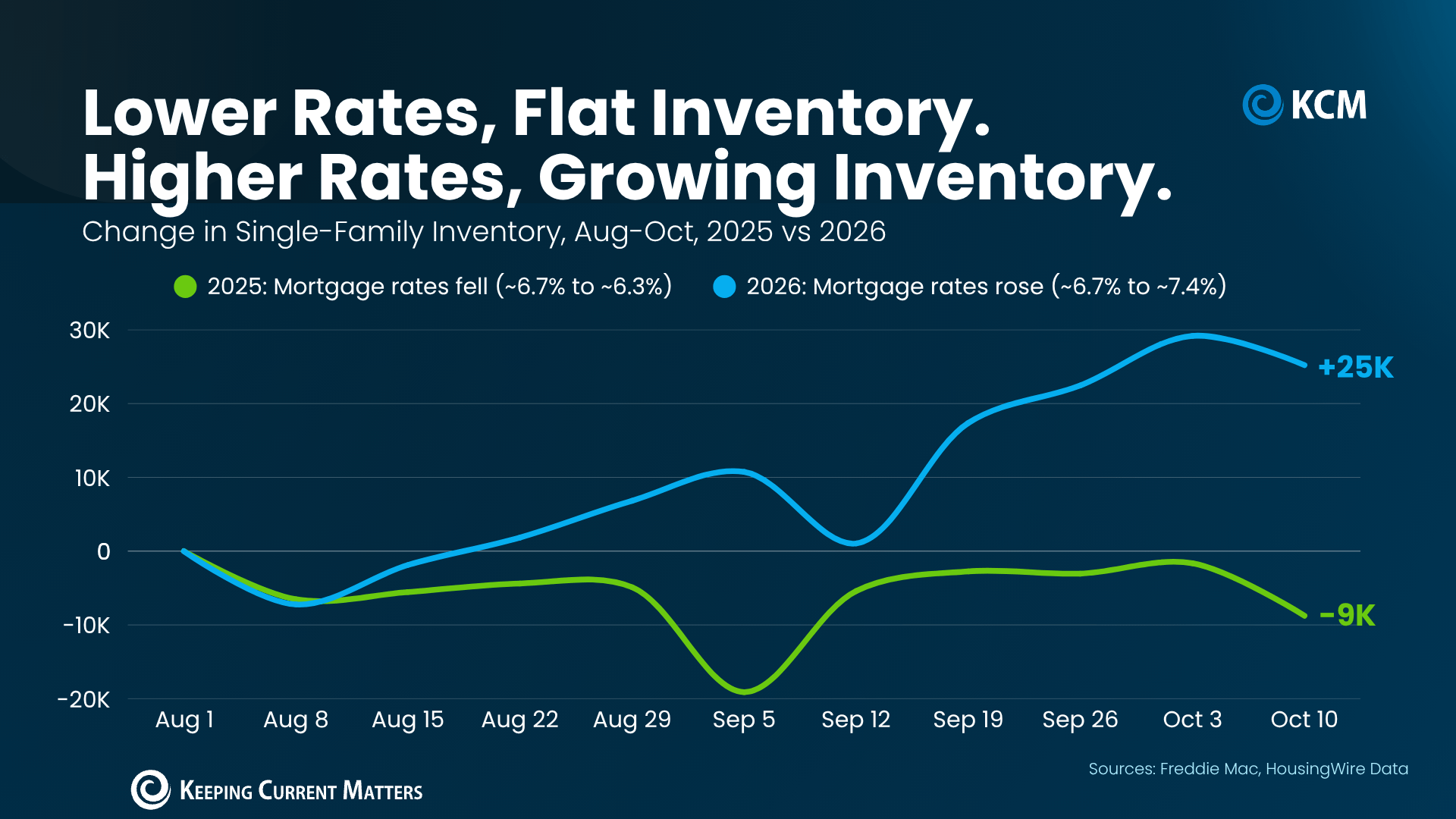
Here’s another way to look at it to make it even more obvious. The graph below shows the relationship between rates and inventory. Again, this year is the blue line. Last year? That’s the green.
With rates inching up this year, you can see inventory has grown by about 25k. But when rates went down this time last year, buyers jumped back in, and inventory actually dropped by about 9k.
Logan Mohtashami, Lead Analyst at HousingWire, explains how that’s flipped from 2025 to 2026:
“With mortgage rates over 7%, demand tends to soften and inventory rises . . .”
Homes Are Spending More Time on the Market
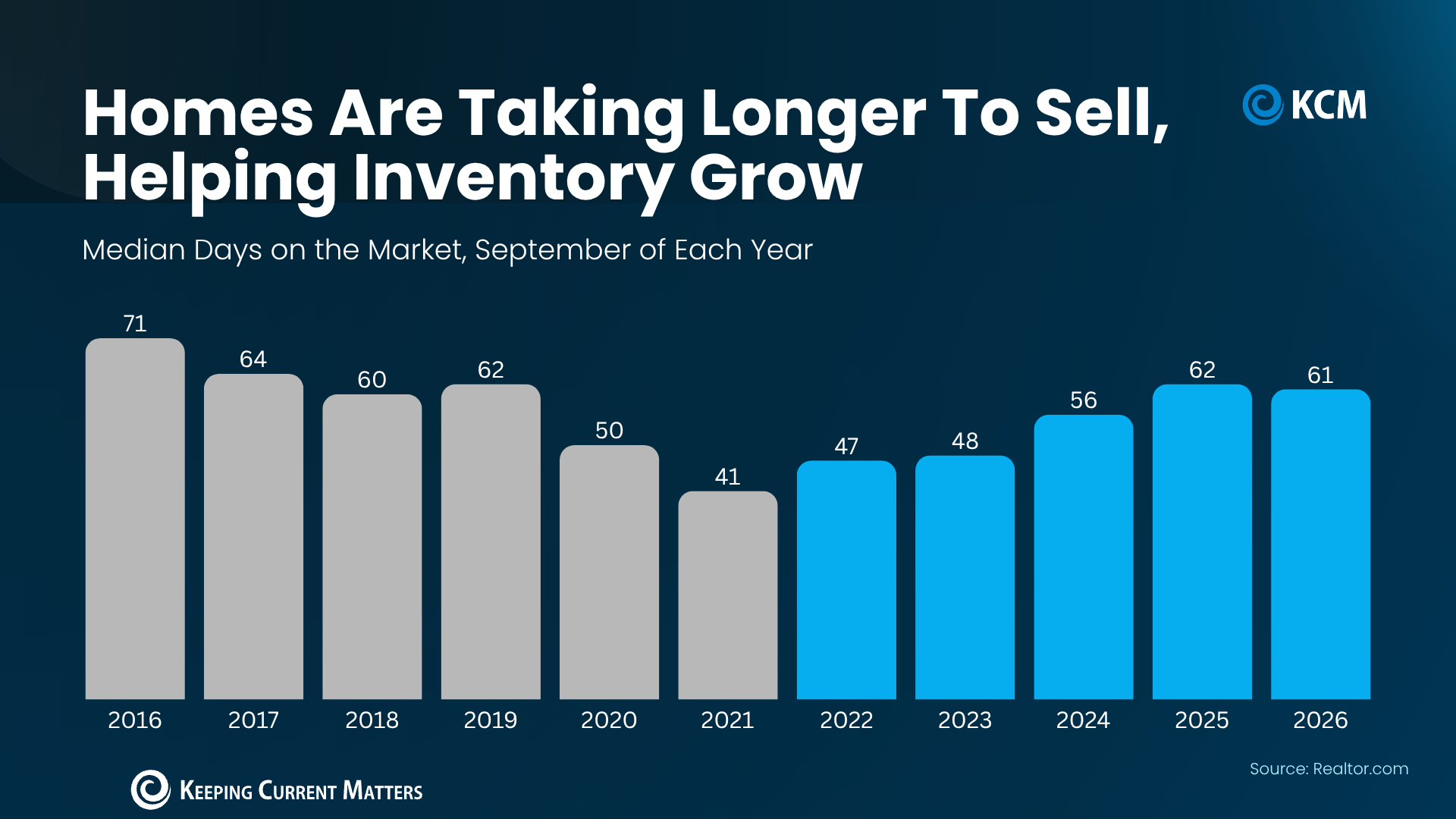
Here’s another metric that shows the impact rates are having: time on market. Data from Realtor.com shows the typical home spent 61 days on the market this September. Back in September 2021, it was just 41 days (see graph below):
Here’s what that tells us. In 2021, when rates were low, more buyers were active, and homes sold fast. But now that rates are a bit higher, not as many buyers are interested, so it takes a bit longer to close a deal.
How To Make This Market Work for You
So, what does all of this mean for your plans? That depends on which side of the move you’re on:
If you’re buying, more homes for sale means more choices and less pressure to rush. And more room to negotiate too. A house that’s been sitting for a while could have a seller who’s more willing to talk – not just about price, but repairs, closing costs, or even helping buy down your mortgage rate.
That doesn’t mean every seller will play ball. But compared to the frenzy of a few years ago, buyers have more leverage now.
If you’re selling, the right strategy can make all the difference. Buyers have more homes to choose from, so making yours stand out is especially important. That starts with pricing it right from day one, making a great first impression, and working with your agent to highlight what makes your house worth choosing. Buyers are still buying and homes are still selling. The key is making sure yours is positioned to attract the right buyer.
The market hasn’t stopped. It’s just moving at a different pace. And whether you’re buying or selling, your strategy needs to move with it.
Bottom Line
In many places right now, inventory is growing and homes are taking a bit longer to sell. And that’s information that should shape the strategy you use going in.
Whether you’re buying or selling, connect with a local real estate agent to look at how long homes are taking to sell in your neighborhood, so your offer, or your price, fits today’s market.
Have you ever passed by an interesting residential building in New York City and wanted to know more about its history? In this series, Brick Underground teams up with Tom Miller, creator of Daytonian in Manhattan, a blog about Manhattan buildings and other historic architecture. Each week, we run an excerpt from the Daytonian’s archives with a link to the full article.
Following the end of the Civil War, development crept northward into the Yorkville district. Access to the neighborhood was greatly enhanced when the IRT Third Avenue subway line opened in 1878. That year, a four-story double flat (two apartments per floor) was erected at 237 East 79th St.
Faced in brownstone, the neo-Grec design included a rusticated first floor above a short stoop. The centered entrance was crowned with a triangular pediment. At the upper floors, French windows were framed by elaborate architraves that sat upon bracketed sills. Scalloped lintels with incised decorations upheld prominent molded cornices. An ornate pressed metal cornice completed the design.
An advertisement described, “six light rooms and bath, modern improvements.” Among those improvements would have been running hot and cold water.
The eight families in the building were middle class and affluent enough to afford at least one servant. An advertisement in The New York Herald on December 30th 1879, for instance, that read: “Wanted—A girl for housework; two in family; wages, $7 per month.” (The wages were not overly generous. They would equal $233 in 2026.)
Amos K. Hadley, a former New York State Attorney General, and his family occupied an apartment here. Early in October 1880, Hadley notified the landlord, J. P. Huyerman, that he would be moving out. The New York Evening Telegram reported, “He, however, was indebted to Mr. Huyerman for a small balance of rent and Mr. Huyerman refused to allow him to move until the amount due was paid.” Hadley told him he had was “about to collect some bills” and he would pay the outstanding money when he received the necessary cash.
On moving day, October 18th, Hadley went downtown. When he returned home, he found his family and a guest of his wife imprisoned in the apartment. Huyerman had locked the doors and refused to allow them to leave until the balance of rent was paid. Hadley rushed to a police station and had Huyerman arrested for disorderly conduct.
The landlord’s obsessive behavior over the outstanding rent cost him. Justice Smith fined him $10 (about $325 today) and “required him to furnish $500 bail for his good behavior for six months” or serve three months in the Workhouse. The judge announced, “it was about time that landlords learned that they do not own their tenants, body and soul.” According to the article, as Huyerman was led out of the courtroom he muttered, “We’ll see about that.”
In 1936 the building was updated, however the exterior was left almost entirely untouched. A renovation in 1970 cut the apartments in half—now four per floor—and the 1878 neo-Grec exterior elements were removed. The brownstone was slathered with stucco, eliminating almost every hint of the original design other than the cornice.
With everything going on, it’s understandable if you’re wondering if you’d regret buying right now.
Everyday expenses cost more. Mortgage rates are higher than you’d like. And when the economy feels uncertain, taking on a mortgage can feel like a much bigger leap. But here’s some perspective that may help…
Most people who already made that leap would do it again.
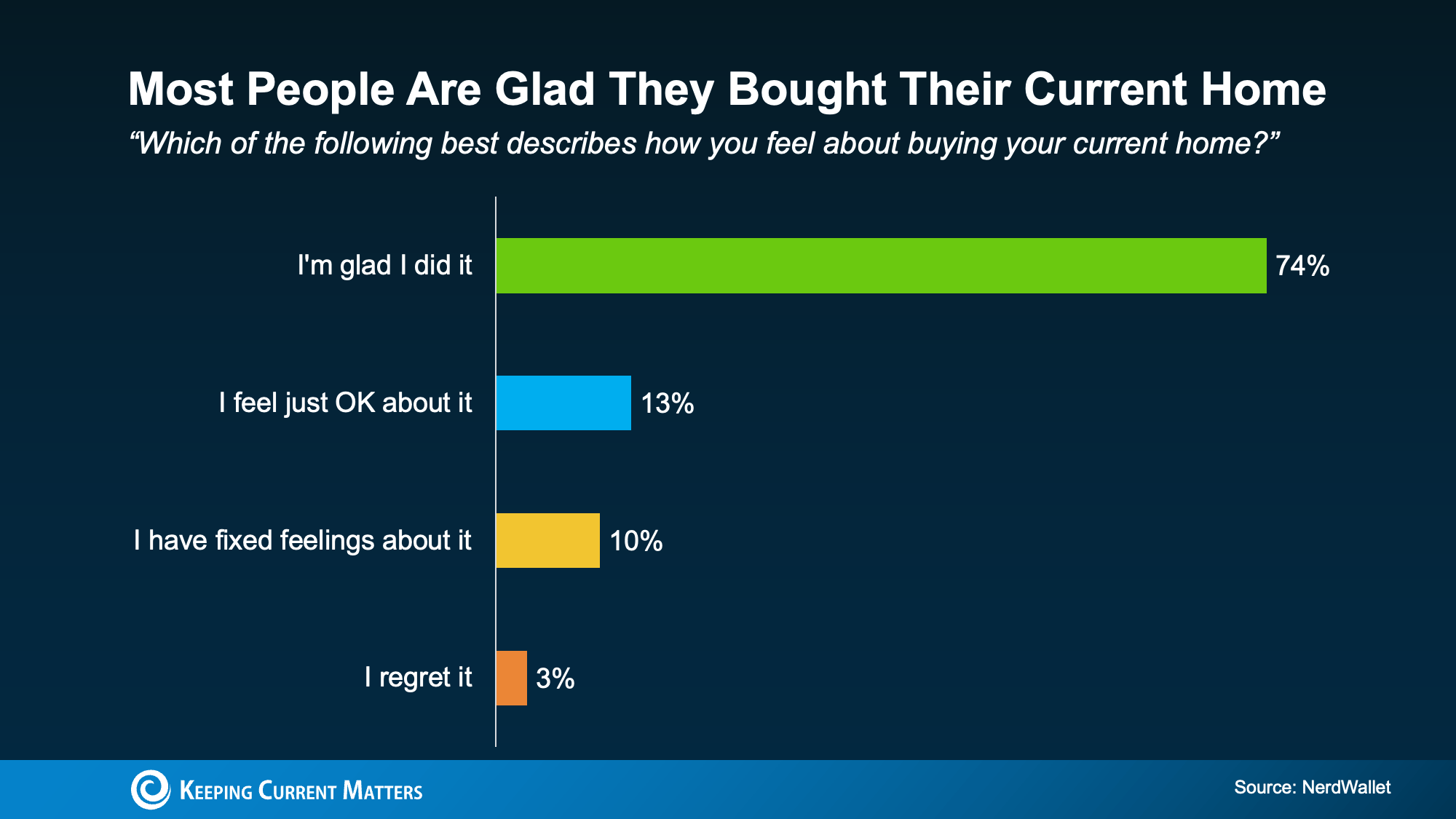
According to a recent survey from NerdWallet, the vast majority of recent buyers (74%) were glad they bought their current home. Only a very small 3% of people regret it:
And here’s a big reason why so many people feel it was worth it, even now.
Homeownership Is a Long-Term Play
When you’re deciding whether to buy, it’s easy to focus on what’s happening right now. What’s today’s mortgage rate? Are prices going up or down? Those things matter. But don’t get so caught up in buying in the perfect moment that you miss the bigger picture.
A home isn’t typically something you buy for just a year or two. It’s a longer-term play. And when you zoom out, it all starts to fall into perspective – especially if you look at home prices and equity.
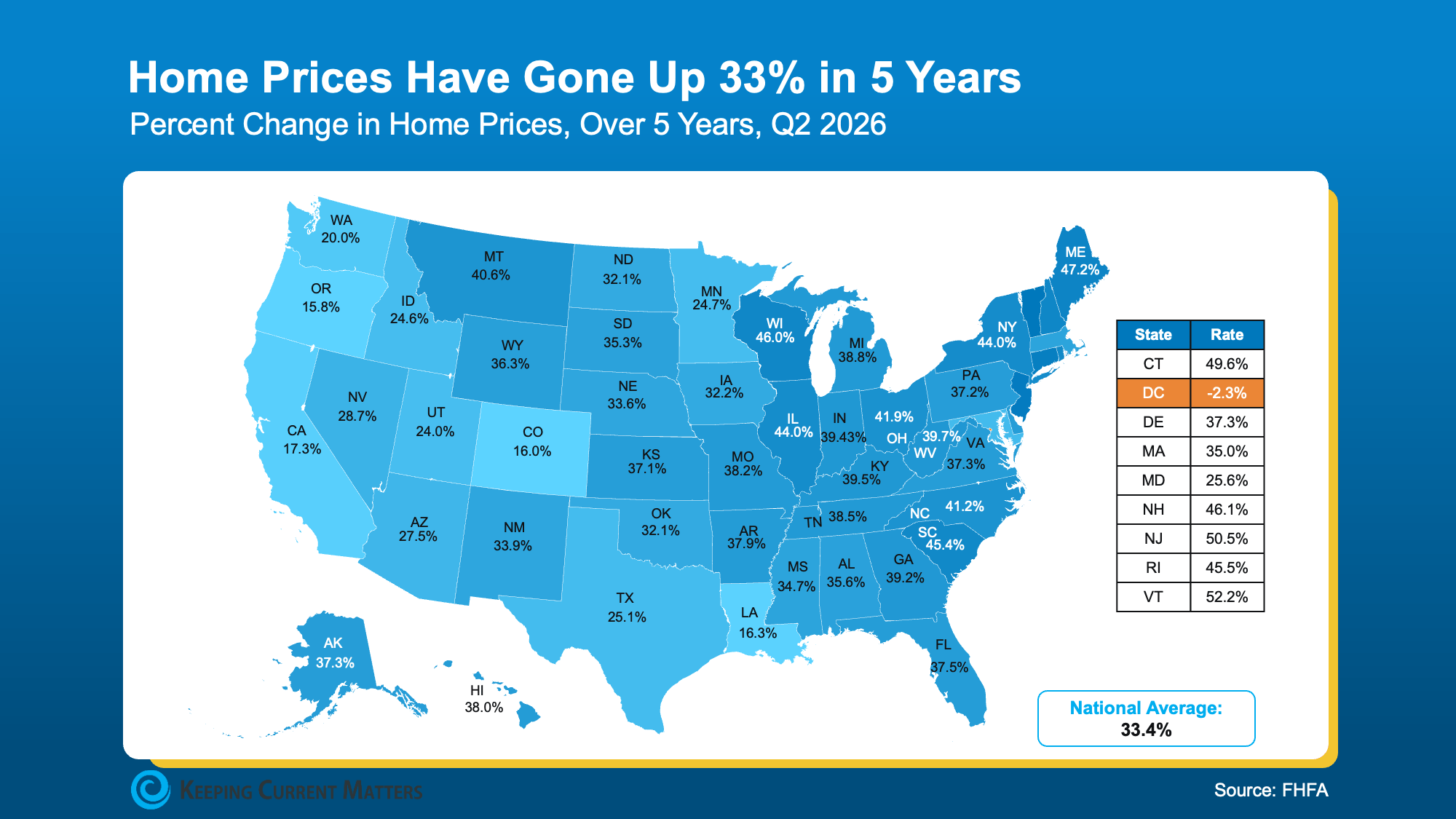
According to data from the Federal Housing Finance Agency (FHFA), home prices nationally have risen 33.4% over just the past five years (see map below):
And that appreciation has helped current homeowners build some serious wealth. Research from Bankrate shows homeowners gained an average of nearly $150,000 in wealth over the past five years as equity steadily rose across 90% of major metro areas.
That’s one of the biggest benefits of homeownership. As you pay down your mortgage and your home appreciates over time, your ownership stake – your equity – can grow.
Now, Zoom Out Even Further
The five-year numbers are impressive. But the numbers get even more dramatic when you look at decades instead of individual market cycles.
FHFA data shows home prices nationally have risen 336% since 1991. Sit with that for a second. Three hundred percent (see map below):
That doesn’t mean prices go up every single year. And it doesn’t mean buying is automatically the right decision for everyone today. You should only buy when the numbers (and the payment) work for you.
What it does show is why trying to perfectly time the market can make you miss the bigger picture.
Over time, homeowners gain a lot of equity. And that equity can eventually become a powerful financial resource. As Freddie Mac explains:
“Your home’s equity is part of your total wealth as a homeowner. If you decide to sell your home, the equity you have built over time will come back to you in the sale. . .
If it’s time to upsize or downsize, you can use that cash for the down payment on your next home.”
Basically, if you can afford to do it, buying a home now could set you up for future moves.
And just in case you’re someone who’s worried about what happens if prices do fall, after you buy, remember: you’re not buying for one year.
Prices can dip. They have before. But historically, they’ve risen far more over the long run. And the longer you own your home, the more time you have to ride out those ups and downs and keep building equity.
Bottom Line
Don’t let today’s uncertainty make you lose sight of what homeownership can do over time. Most homeowners say they’d make the same choice again. And decades of home-price growth help explain why.
If you’re wondering whether buying makes sense for you right now, connect with an agent to look at the numbers together – and what owning a home could mean for you in the years ahead.
Video game console sales in the U.S. have cratered, with both the PS5 and Xbox seeing a massive drop in YTD sales through the end of August compared with last year. Mat Piscatella, the video game industry advisor at research firm Circana, shared the numbers on his Bluesky account — PlayStation 5 sales have dropped by 25%, putting it at its lowest point since 2013, when gamers held off buying PlayStation consoles in anticipation of the arrival of the PS4, while Xbox’s retail figures have cratered by 33% YTD, putting its sales numbers at an all-time low since its launch almost 25 years ago.
From Circana’s US Retail Tracking Service:
For 2026 YTD ending August, Xbox hardware unit sales are down 33% versus a year ago in the US, while PlayStation hardware units are 25% lower.
Xbox YTD US hardware unit sales are at an all-time low, while PlayStation is at lowest point since 2013.
Piscatella said price sensitivity is becoming a real problem among gamers, especially as the chip shortage has pushed console manufacturers to raise prices. Microsoft has raised the price of the Xbox three times in the past two years, with the 512GB versions jumping by $100 and 1TB models becoming $150 more expensive. Worse, the company has killed off the 2TB model. This brought the Xbox Series S to $499.99 (512GB) and $599.99 (1TB), while the Xbox Series X now costs $749.99 for the Digital Edition, and the disc version costs $50 more at $799.99.
PlayStation fans haven’t escaped these price hikes, as Sony raised prices for that console by $100 to $150. The base Digital Edition PS5 now costs $599.99, while the version with an optical drive is priced at $649.99. If you want the PS5 Pro, you’ll have to shell out $899.99, while those who want to stream games from their console via the PlayStation Portal must now pay $249.99 — $50 higher than its $199.99 launch price. Even used consoles didn’t escape inflation, with Sonybumping the price of refurbished PS5 Slim consoles by $100, bringing them to $399.
Latest Videos FromTom’s Hardware
Despite the higher prices, the PS5 Pro remains in short supply, which is why used prices have now reached the stratosphere. Refurbished PS5 Pros now cost $1,399 at GameStop, almost $500 more than the MSRP of a new one (if you can find one in stock at that price). While this price might feel egregious, it’s about $100 less than the prices of new units we found at Best Buy and Walmart, and sealed units on online marketplaces sell for about $100 less than this.
AI chip shortage-driven price hikes, along with rising living costs, have made console purchases less of a priority for many families, driving this massive downturn in retail sales. The arrival of the much-anticipated GTA VI in November, along with the upcoming holiday season, will hopefully help consoles bounce back. Still, Piscatella says the U.S. hardware market has never been more precarious since the early 1980s.
A dedicated charging solution is a great way to declutter your desk and keep your essential gadgets charged whenever you need them. If you are looking for one, don’t miss this deal on the Ugreen Nexode 100W GaN wall charger. Currently on sale at 27% off on Amazon, the charging adapter is $39.98, down from its original price of $54.99. Thanks to its high power output, it can charge multiple devices at once, making it suitable for your smartphone, tablet, and even your laptop.
The Ugreen Nexode 100W is a Gallium Nitride (GaN) charger that replaces internal silicon components with a highly efficient semiconductor capable of handling higher voltages. At the same time, it runs cooler and shrinks the power adapter’s overall size by up to half. With a foldable plug design, this charger is also compact, making it the perfect companion for your next vacation or business trip.
It features four charging ports, including three USB Type-C ports and one USB Type-A port. One USB Type-C port can deliver up to 100W of power, provided you use a compatible 100W, 5A charging cable. According to Ugreen, this is enough to charge a MacBook Air M3 from zero to 55% in under 30 minutes. The charger works with a wide range of devices, including Apple MacBook Pro and MacBook Air notebooks, iPhones, Samsung Galaxy smartphones, iPads, and handheld consoles like the Steam Deck.
Notably, the company notes that certain Dell and Lenovo laptops may not charge at their maximum supported speeds because of charging-protocol limitations. Always check compatibility with your device before buying. The charger also includes built-in safety measures, including dynamic temperature sensors that monitor heat and an intelligent PWM chip that adjusts power output to help protect connected devices.
At its current discounted price of $39.98 on Amazon, the Ugreen Nexode 100W GaN charger is a worthwhile option for anyone looking to power multiple devices with a single wall adapter.
Gigabyte has just confirmed Intel’s plans to introduce new processors compatible with existing LGA 1700 motherboards, with an expected launch in early 2027. According to a press release, Gigabyte is rolling out a new BIOS update to extend support for the upcoming processors across its entire lineup of Intel B760 and H610 motherboards. Owners of supported boards will be able to flash the latest BIOS and upgrade to the new CPUs without replacing their motherboards.
Go deeper with TH Premium: CPU
(Image credit: Tom’s Hardware)
The most interesting bit is that the update covers both DDR4 and DDR5 variants of these motherboard families, allowing existing systems to remain compatible with the upcoming processors. The continued availability of DDR4 compatibility is particularly relevant as rising memory prices have increased the overall cost of building and upgrading a PC. Notably, the announcement does not include certain motherboard series like the Z690, Z790, and B660, which also feature the same LGA 1700 socket.
Gigabyte has not disclosed SKUs, specifications, or pricing of the upcoming processors. However, the early 2027 launch window aligns with previous reports about Intel’s rumored Raptor Lake Next lineup. According to previous coverage, Intel is preparing a third refresh of its Raptor Lake architecture based on the LGA 1700 socket, which debuted with the 13th-gen Core desktop processors and was succeeded by the 14th-gen lineup.
Latest Videos FromTom’s Hardware
Intel’s Robert Hallock, vice president and general manager of Intel’s enthusiast channel business, told Tom’s Hardware Premium in an interview back in August, “LGA 1700 is still a good socket. Lots of people are still interested in DDR4, so we’ll keep offering, and you’ll see pricing smooth out over time. It’ll come back to normal. That’s the plan.” By extending support for the LGA 1700 platform, Intel could potentially give budget-conscious PC builders another option for reusing existing memory and motherboard hardware instead of moving to a completely new platform.
In a separate report, it has been speculated that Raptor Lake Next could adopt Intel’s Core 200 branding, spanning across Core 3, Core 5, and Core 7 models. According to leaked specifications shared by tipster Jaykihn, the range could include a 20-core Core 7 model with 8 Performance cores and 12 Efficient cores rated at 65W; a 16-core Core 5 with 8 P-cores and 8 E-cores rated at 125W; a 10-core Core 5 with 6 P-cores and 4 E-cores rated at 65W and equipped with 24MB of L3 cache; and an entry-level, four-core Core 3 featuring only P-cores, also rated at 65W.
During a Thursday announcement, Vice President JD Vance said that well-known tech companies Microsoft and Adobe are now blocked out of the PERM program — one of the possible paths for the firms’ H-1B workers to eventually evolve to green card status. The move was triggered by alleged fraud and abuse. IT outsourcing firms Cognizant, Infosys, Tata Consultancy, Wipro, HCL, and Capgemini also got slapped with suspensions.
The companies involved have not yet commented.
The administration is not going to process any new or pending Permanent Labor Certification applications for the companies. In a press conference, Vance had harsh words about Microsoft in particular, stating that “There has been no company in the United States, unfortunately, that has abused this system more.” He added that “if you do the math, for every worker that Microsoft laid off, they replaced that worker with one and a half foreign indentured servants.”
Latest Videos FromTom’s Hardware
According to Vance, Microsoft fired 6,000 workers while simultaneously benefiting from 6,300 H-1B approvals and nearly 3,000 green cards. The VP said the company filed 3,682 PERM applications, 1,000 of which were for positions that seemingly overlapped with those of laid-off workers. Both Microsoft and Adobe’s PERM privileges were cut “due to multiple active federal investigations,” as stated by Labor Secretary Keith Sonderling.
A move so swift and harsh is unusual, but it comes against a backdrop of the U.S. government putting a tighter grip on the H-1B program. Last July, the Labor Department launched a nationwide investigation into fraud and human trafficking in H-1B and PERM programs. The inquest focuses on fraudulent applications, wage kickbacks, coercion, below-wage labor, recruitment abuse, and benching — when a company keeps the H-1B employee on the books but doesn’t assign them work or pay them.
In September, President Trump signed an executive order aiming to curb abuse of the H-1B program. Cognizant also had its green card filings suspended during that month. The H-1B lottery rules had already changed to reportedly favor highly skilled, highly paid workers.
According to the National Foundation for American Policy and reported estimates, Amazon had the most approved H-1Bs in fiscal year 2025 with 4,644 visas, followed by Meta at 1,555, Microsoft with 1,394, and Google at 1,050.
Get Tom’s Hardware’s best news and in-depth reviews, straight to your inbox.