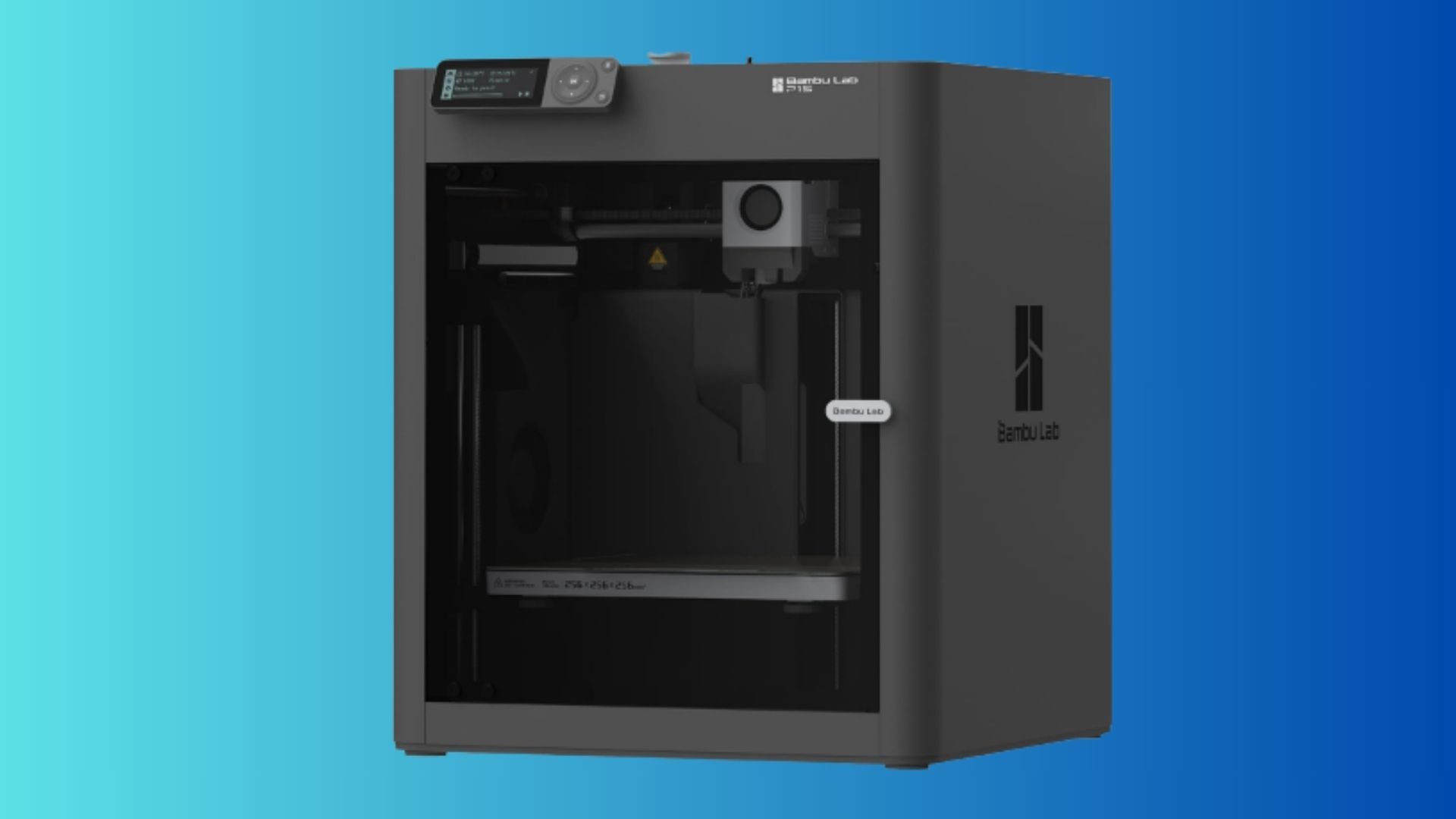
If you have been considering getting into 3D printing, now might just be a good time to take the plunge. The Editor’s Choice Award-winning Bambu Lab P1S, bundled with the AMS color printing module, is currently on sale and is available at Best Buy for just $479.99. That’s $70 off its listed price of $549.99, making this a solid deal for beginners looking to get a capable 3D printer with multicolor printing support right out of the box.
The Bambu Lab P1S is a high-speed 3D printer, while the bundled Automatic Material System (AMS) takes things a step further by enabling multi-material and multicolor printing. It comes with several useful features, including automatic bed leveling, a range of presets within the slicer software, and impressive print speeds, with acceleration reaching up to 20,000 mm/s². It also offers a generous build volume of 256 x 256 x 256 mm. According to Bambu Lab, the plug-and-play setup can be unboxed, configured, and ready to produce its first print in just 15 minutes.
The printer’s enclosed steel and glass construction helps maintain consistent internal temperatures, which is particularly important when working with warp-prone materials such as ABS, ASA, polycarbonate (PC), and polyamides (PA), including nylon. It also supports more commonly used filaments like PLA, PETG, and flexible TPU. To make printing with these materials more suitable for indoor environments, the enclosure also features a built-in air filtration system with an activated carbon filter designed to absorb fumes and reduce unpleasant odors during operation.
In our extensive testing of the Bambu Lab P1S, we came away thoroughly impressed and awarded it our Editor’s Choice recognition. Other notable features include a proprietary 0.4mm nozzle paired with a direct-drive extruder, wireless connectivity via Wi-Fi and Bluetooth, a microSD card slot for loading prints locally, and a built-in LED screen for navigating menus and adjusting settings.
The U.S. Department of Justice (DOJ) just announced indictments resulting from Operation Ghostbusters, which investigated widespread student loan fraud. According to the agency, bad actors used stolen identities to sign up for student loans and used AI to complete the application, making it appear that the fake student was attending online classes.
While the schools receive the majority of the proceeds of the fraudulent student loan, the remaining amount is funneled into the bank accounts of the fraudsters, who then use mules to move the money from U.S. bank accounts to overseas conspirators. On the other hand, unwitting victims who have skipped college and instead directly joined the workforce after high school are saddled with student debt for a degree they never even signed up for.
Multiple community colleges and universities across the United States started suspecting fraud in the Federal Student Aid (FAFSA) program in 2021. Estimates suggest the U.S. government lost over $200 million because of this activity, and the U.S. Department of Education Office of the Inspector General referred the case to the FBI Richmond Field Office. Currently, more than 40 open fraud cases involve 26 FBI field offices and 20 U.S. Attorney’s offices. The DOJ called it Operation Ghostbusters, which has already resulted in the indictment of five individuals.
Latest Videos FromTom’s Hardware
How much money are you willing to spend during the Black Friday sales?
“Today, we are announcing the first results of Operation Ghostbusters — a nationwide effort to stop a major fraud scheme targeting federal student aid, low-income Americans, and the American taxpayer,” Assistant Attorney General Colin M. McDonald of the Justice Department’s National Fraud Enforcement Division said in the statement.
“The Department is charging five defendants and announcing the seizure of more than $750,000 in cryptocurrency tied to this scheme through a network associated with Kenyan nationals. This is the first international seizure of its kind in Kenya. If you steal American identities, if you steal taxpayer dollars, if you exploit programs meant to help students build a future — we will find you. Whether you are in Nebraska, New Jersey, Virginia, or Nairobi, we will pursue you.”
While online fraud has existed since the birth of the internet, AI has let scammers become more sophisticated and target bigger payouts. One example is a scammer who used an AI-generated image of Brad Pitt to scam a 53-year-old woman out of $850,000. However, larger groups also use AI tools for their money-making schemes, such as North Korea, which has reportedly used AI to help its workers get jobs in Western companies and earn money to fund the nation’s coffers. The U.S. is taking steps to shut down student loan fraud by deploying automated fraud detection systems, but the added burden of identification and false positives is negatively affecting the country’s most vulnerable students.
In case you’re not yet subscribed to our Tom’s Hardware Premium subscription service, here’s what you’ve been missing out on this week. We detail our thoughts on Anthropic’s filings pre-IPO, Cadence’s new suite of LLMs to power its EDA tools, how Nvidia is securing its entire supply chain to serve AI data center demand, how Vera CPUs are landing in the cloud, an update to the ongoing TP-Link saga, and more. Remember, to access any of the articles listed here, you’ll need to arm yourself with a subscription.
We’ve been hard at work behind the scenes to determine exactly how locally-run AI models and workloads stress consumer-level components. While throughput and tokens per second are indeed important factors, our resident CPU expert Jake Roach has begun laying out his vision for how Agentic workloads tax CPUs, and how we’re building benchmarks in this newfangled AI world that the PC hardware space finds itself increasingly entrenched in. It’s not often that readers get the chance to look at our behind-the-scenes work, and this piece offers a look at some of the foundational exploration we’re doing around how to define what an agentic AI CPU benchmark might look like in the future.
(Image credit: Tom’s Hardware)
As the rise of Artificial Intelligence increasingly becomes attached to powerful, locally-run hardware, you might encounter terminology and nomenclature that you may otherwise not be familiar with. So, we’ve published a primer on all of the basic terminology that you need to know moving forward. Currently, you get breakdowns of how inference works, details on quantization, context, KV cache, and more. We’re striving to update this page as our exploration with local AI grows, to serve as a handy bookmark. It’s not a mere dictionary either, as we contextualize how each of these things relates to the larger overall model, how it might be served, or where you might encounter it when trying to run an AI model of your own.
Latest Videos FromTom’s Hardware
Nvidia’s Vera CPUs were a salient part of a swath of Oracle announcements this week. The chip, usually found alongside Nvidia’s NVL72 rack, is now generally available, but curiously, standalone Vera instances are also available on OCI superclusters. The CPU is specifically designed with Agentic AI workloads in mind, and it just so happens that we’ve benchmarked an Nvidia Vera server just this week to highlight the efficacy of how well Vera might perform under certain workloads.
Last week, we covered TP-Link’s proposal to allow the router manufacturer to sell its Wi-Fi 8 products in the U.S. Now, according to a new report, it’s alleged by the FCC that TP-Link’s own reports contain “false or incorrect information in its applications” related to equipment authorizations for four different models of Wi-Fi 8 routers that the company hopes to sell stateside. As the saga continues to develop, we attained a statement from TP-Link on the subject, as the situation continues to develop.
Anthropic’s large and sprawling S1 filing made headlines this week as the company prepares for an IPO. Within the document, it details many (but not all) of the numbers driving one of the world’s foremost AI labs. Once you get past the mind-bogglingly high $800 billion in GPU and TPU contracts, the company has shown that most of its compute capacity isn’t actually served to customers, and is instead dedicated to R&D for new models, features, and testing. There’s a huge amount of information to sink your teeth into here, and despite what many might believe, the company’s revenue per compute dollar spent is actually in Anthropic’s favor, shattering the myth that tokens cost more in compute than they do for a user.
As neoclouds and hyperscalers (who rent compute out to companies like Anthropic) scale up and scale out, domains become exceedingly important. With copper materials coming up to their natural limits, eyes have turned to the photonic domain to alleviate bandwidth bottlenecks. Now, PsiQuantum has entered the domain, showcasing a prototype photonic switch that loses less light than other devices on the market, and the company expects to develop and mature its solution and is likely to enter the photonic switch market.
Get Tom’s Hardware’s best news and in-depth reviews, straight to your inbox.
(Image credit: Cadence)
Cadence has revealed Maestro, a suite of tuned LLM’s, designed specifically to work in EDA flows using the company’s in-house suite of agentic tools. We’ve covered the rise of agentic EDA tools closely, and Cadence’s Maestro suite appears to be the company’s own shot across the bow in helping its customers automate elements of their own chip designs. In initial results compared with general-purpose AI models, Cadence claims up to a 30% improvement in the quality of results and that Maestro effectively uses fewer tokens for the same task, with up to 5x the token efficiency compared to off-the-shelf AI models.
But all of those new AI chips have to come from somewhere. With the ongoing, ceaseless AI buildout, firms are looking to secure their supply chains, with Nvidia one of the chief companies among them. As demand continues to soar, the very real limitation of fabs is particularly highlighted in the realm of the substrates used to create PCBs. Ajinomoto Build-up Film, or ABF, is one of the hottest commodities in the chipmaking industry as a result, and Nvidia has announced plans to secure the material from Ibiden, in addition to other critical materials used in chip packaging, testing, and more. Of course, Nvidia isn’t doing this out of the goodness of its own heart; it’s doing it in exchange for reserved production capacity.
The ramifications of AI are still being felt across the globe, but if you’ve been on social media over the past several weeks, you may have found that there’s one particular trend: Decompilation and recompilation of video games, recompiled to work natively on PCs. We detail how additional software tools like Reverse Engineer Anything and Ghidra are powering the boom.
To read any of the articles we mention above, as well as unlock Bench, you’ll need to purchase a Tom’s Hardware Premium subscription. Your support goes a long way in helping us to publish deeper, more insightful articles that might not otherwise be covered.
A technology enthusiast claims that the oldest GUI application that still runs on Windows 11 is CDPLAYER.EXE from November 1992. The app had to run on Microsoft’s newest consumer OS without modifications or emulation involved to be chosen as the ‘winner’ of their experiment. Blogger Enlyth expected something from the early NT era, as Windows 11 doesn’t support 16-bit apps, despite its strong backwards compatibility. Finding an app that is almost 34 years old that still works with a simple double-click is a remarkable result.
At the beginning of their journey to find the oldest Windows UI app that just works on Microsoft’s newest OS, Enlyth confirmed FREECELL.EXE from February 1993 would still run without issues. This game was distributed alongside the Win32s environment, designed to allow some 32-bit applications to run on the 16-bit operating systems like Windows 3.1 and 3.11. Win32s was made available in beta in October 1992, but went mainstream in July 1993.
A tip Enlyth received via a tech forum suggested that FREECELL.EXE was a candidate for the oldest GUI app remaining compatible with Windows 11. However, the blogger wasn’t satisfied with this easy win and dug through “some early NT 3.1 pre-release versions that seemed promising.” Build 347 caught the detective’s eye, specifically CDPLAYER.EXE, linked on Nov 16, 1992. That indeed seems to be the earliest GUI app that works without modification or emulation on Windows 11. But this knowledge almost defied Enlyth’s eye as their system is, like many modern systems, optical-drive-less. Luckily, adding a small DLL (cdemu.dll) allowed Enlyth to emulate a CD drive and demonstrate that the 1992-era application still functions as intended.
Latest Videos FromTom’s Hardware
I wanted to verify that CDPLAYER.EXE was still usable on the latest Windows 11 release. Unfortunately, the multi-part .ARJ archive of Windows NT 3.1 that I found on Archive.org threw up errors when I tried to pick through its contents. I have a USB-attached optical drive that plays CD audio in Windows 11, so I thought I could get CDPLAYER.EXE to run without any extra DLL.
Lastly, Enlyth wanted to push the envelope a little and see what even more ancient Windows apps might work if they got some help from the Winevdm project on 64-bit Windows. “Using otvdm does feel like cheating,” admitted the digital sleuth, and we’d agree. However, being able to run 16-bit apps in Windows 11 ratcheted back the wheels of time. The result was that Enlyth managed to enjoy “a fully playable version of REVERSI.EXE dated 15-Nov-1985.” That’s a GUI-driven game distributed as part of Windows 1.01 and is roughly 41 years old.
If you earned a million dollars a year, would you buy in New York City or would you rent? Surprisingly, for a growing number of affluent New Yorkers, the answer is to rent.
In fact, the number of wealthy NYC households that rent tripled in 2024 from 2020. A new report from RentCafe, the national rental listings site, found that New York is the U.S.’s largest millionaire market, with 40,430 households earning $1 million or more annually. Among those millionaire households, 7,296 were renters in 2024, up from 2,730 households in 2020, according to RentCafe’s analysis of Integrated Public Use Microdata Series data.
NYC far outranked second place San Francisco, with 1,863 millionaire renter households in 2024. Los Angeles was in third place (1,532), San Jose in fourth (896), and Miami in fifth (538).
Nationally, the number of renter households with incomes of $1 million or more grew during the same four-year period from 4,500 to 13,700.
Not so surprisingly, NYC is also the top market for millionaire owners. There were 33,134 millionaire homeowners in 2024, up from 14,339 in 2020. Roughly four in five millionaire households in the metro area own their homes, the report said.
Combined incomes
Even though renting in NYC is by no means cheap, wealthy would-be buyers view renting temporarily as a strategic move.
“In New York, renting is often a deliberate choice, not a stopgap. Many wealthy households prefer to keep their capital invested and stay flexible about where they live, and most of these renters reach seven figures through combined household incomes, not a single paycheck,” said Veronica Grecu, senior writer at RentCafe.com and author of the report.
Only 1,274 affluent New York renters earn $1 million a year as individuals, meaning that one in six millionaire renter households is driven by a single seven-figure earner, according to the report. Most reach that income threshold through combined earnings.
Who are these affluent renters and what do they do?
On a national basis, the report found nearly half (49 percent) of millionaire renters are Millennials and 33 percent are Gen X. Gen Z makes up just 2 percent of the total but is the fastest-growing generation, jumping from fewer than a dozen households to more than 400 in just five years, which makes more sense when you consider they were just entering the workforce a few years ago.
Most have high-paying white-collar jobs like tech and finance professionals, roles that are also flexible in that generate steady, substantial income without necessarily tying employees to one company or location.
OpenAI CEO Sam Altman has data centers full of memory, but seemingly it’s the 32GB of RAM in your desktop that’s the problem. In an interview over beers with the YouTube channel Cheeky Pint, Altman said that local inference, and, by extension, people having DRAM in computers at home, is “quite terrible.”
Go deeper with TH Premium: AI and data centers
(Image credit: Microsoft)
When discussing local inference on home computers with open-source models, Altman discussed the assumption that people will be able to run local AI on their own computers, the ones they may already own or want to build. Then he explained why that’s a bad idea (at the 29-minute mark):
“From a global allocation perspective, actually, it’s quite terrible to have everybody have a bunch of the world’s limited supply of DRAM sitting in their own computer and being used 5% of the time,” Altman said. “You want maximum utilization in the cloud if you’re trying to deal with this very supply-constrained environment. And somehow many people’s intuition is the opposite of that.”
Latest Videos FromTom’s Hardware
While OpenAI does have some open-source models, its primary business is in closed-source models that run in data centers, so he’s really defending the company’s business model.
Why Sam Altman is against a single superintelligence – YouTube
OpenAI isn’t exactly threatened by some laptops and gaming rigs just yet, but local AI could mean people one day paying less for subscriptions to models like GPT-6 Luna if they have the power to run them at home. Altman’s talk suggests that the company would prefer that more RAM go to OpenAI’s data centers rather than home computers, which also sparks enthusiast fears of not being able to own your own hardware or software, but rather rent an agent and a computer in the cloud.
Some of what Altman is saying is based on an idea that data center buildouts won’t slow down. It also assumes that RAM being used in AI data centers 24/7 is more worthwhile than RAM that is used for spreadsheets, web browsing, gaming, and maybe even local AI occasionally.
The rest of the wide-ranging interview includes talk of this week’s PHP vulnerabilities, sandboxing models in training, and OpenAI’s research in mathematics.
This weekend we celebrate all things Warhammer, and although it might be sharing the date with Halloween, fans of the grimdark franchise will be looking towards a different kind of spooky chaos, and things that materialize from the warp. Warhammer Day 2026 takes place this October 31st, and this is a good time to grab a deal or pick up a gift for yourself to adorn your desktop setup. Maybe even pick up the latest Warhammer 40K-inspired PC games to really jump into the fray.
We’ve compiled a list of some of the best Warhammer 40K furniture, collectables, and PC games, ahead of the celebrations.
Warhammer 40K Furniture
Secretlab has a range of officially licensed Warhammer 40K furniture that includes both desks and chairs. The chairs are fully decorated with the chapter livery and standards, with skins available to convert existing chairs to the same designs. The desks are just the standard Magnus Pro desks but include a 40K-themed MAGPAD that can also be bought separately if you already own the desk.
Warhammer 40K Peripherals and Collectables
If you’re looking for some collectables or ornaments to decorate your gaming setup and add a Warhammer 40K theme this Warhammer Day, then we also have some ideas that include mouse pads, keycaps, Nurgle plushies, a Death Korps rucksack, and some Space Marine figures for decoration.
Warhammer 40K Games
When you’re not painting your miniatures or indulging in some tabletop action, relax with some of the best Warhammer 40K games. Bring the grimdark future straight to your gaming PC and satiate the Omnissiah with these great titles. Combat the hive mind as a Space Marine, or jump on board the upcoming Dawn of War IV RTS and command the Space Marines, Orks, Necrons, and the Adeptus Mechanicus.
Intel’s shares plunged 30% on Friday, wiping out nearly $150 billion in market capitalization in a single day, the largest single-day loss in the company’s history. The decline followed a disappointing financial outlook, largely driven by an anticipated drop of more than 20% in sales at Intel’s client computing group (CCPG), the company’s main cash cow. The declines quickly spread across the semiconductor industry. Although losses elsewhere were nowhere near as severe as Intel’s, approximately $1 trillion in semiconductor market capitalization was wiped out on Friday, according to intraday estimates by Benzinga.
Fire sale
The PHLX Semiconductor Sector Index (SOX), which tracks the stock performance of 30 major semiconductor companies, is one of the key indicators of the industry’s financial health. On Friday, the index plunged 9.14%, or 1,052.82 points, to 10,465.38 points as of 2:31 PM ET, as Intel’s disappointing outlook triggered a massive selloff across the semiconductor industry.
Intel was by far the biggest loser, as other chip-related stocks, while Arm (-12.68%), AMD (-12.48%), Qualcomm (-12.14%), Applied Materials (-8.73%), ASML (-8.13%), Lam Research (-8%), Micron (-7.28%), and Broadcom (-7.1%) suffered considerably less. Then again, while Nvidia lost 5.66% of its market cap, this translates to around $270 billion, which is a massive amount of money. Paradoxically, Nvidia lost more market capitalization in absolute dollar terms than Intel.
Latest Videos FromTom’s Hardware
Go deeper with TH Premium: CPU
(Image credit: Tom’s Hardware)
In an unexpected turn of events, the downturn extended to server manufacturers and cloud giants too, as Dell (-12.67%), HPE (-8.10%), Supermicro (-6.96%), and Oracle (-6.88%) lost nearly 7% to 13% of their value.Reuters noted that investors increasingly question the scale of capital investments required to expand AI infrastructure as well as the sustainability of that spending.
Gloomy outlook
Intel’s client computing and physical AI group (CCPG) generated $8.1 billion in revenue during Q3 2026, down 5% year-over-year and 9% sequentially. Weaker demand and increased competition reduced client processor shipments by 14% year-over-year, which was partially offset by a 9% increase in average selling prices. CCPG accounted for nearly half of Intel’s revenue of around $16.5 billion and the company’s main source of cash. As strong demand for server processors only partially offsets declining client sales, Intel guided its Q4 revenue to be between $15 billion and $16 billion.
Intel expects the client market to deteriorate further in Q4 2026 and into 2027 as elevated memory prices and shortages of other components impact PC prices and demand. In general, Intel expects the client PC market to decline 10% in 2027 compared to 2026, which will inevitably have an effect on CCPG performance. While Intel expects its data center business to continue growing in 2027, industry-wide supply constraints will limit its ability to fully capitalize on demand.
2026 has been a mixed bag for Intel so far. On the one hand, the company achieved its highest market capitalization ever — $673.43 billion in mid-June — on growing sales of data center CPUs, strong sales of client products, and a return to profitability (if the $12.5 billion non-cash accounting charge associated with shares issued to the U.S. government is excluded). On the other hand, the company’s capitalization has dropped by nearly 50% to $338.91 billion since mid-June (with $148.68 billion in just one day), as investors began to realize that the performance of Intel’s CCPG heavily depends on memory prices, as customers and businesses tend not to like overpriced systems. Yet on the other hand, now that Intel sells fewer client processors, it can sell more expensive data center CPUs.
Get Tom’s Hardware’s best news and in-depth reviews, straight to your inbox.
What about Apple?
Surprisingly, Apple (-1.66%), which only sells client products, was nearly unaffected by the performance of Intel’s client computing group, as investors probably believe that the world’s largest supplier of consumer electronics is more immune to memory prices than Intel. Ironically, if we count the A-series SoCs used in iPhones (which tend to outperform mainstream laptop CPUs), Apple sells substantially more processors than Intel, making Apple by far the world’s largest supplier of microprocessors. Despite this, Apple’s shares were largely unaffected by the semiconductor selloff.
There are several reasons for this distinction. Firstly, Apple’s business model is fundamentally different. Intel sells processors to PC manufacturers, whereas Apple designs its own processors and sells them as part of finished products. Consequently, Apple captures revenue from the entire device rather than just the processor. Secondly, the two companies face different demand dynamics. Intel depends heavily on the PC market, while Apple’s iPhone business follows the smartphone replacement cycle. Rising memory prices could affect both, but not necessarily to the same extent and at the same time.
There is an additional irony: Apple is also a major customer of TSMC, so its processor supply chain overlaps with those of AMD, Intel, and other semiconductor companies whose shares declined sharply.
While we should not directly compare Apple and Intel, the comparison illustrates that investors were not necessarily abandoning companies that design or use semiconductors, but were rather concerned about the profitability and growth prospects of these high-tech companies. And if we take a look at the situation from this point of view, the whole thing will start looking completely different.
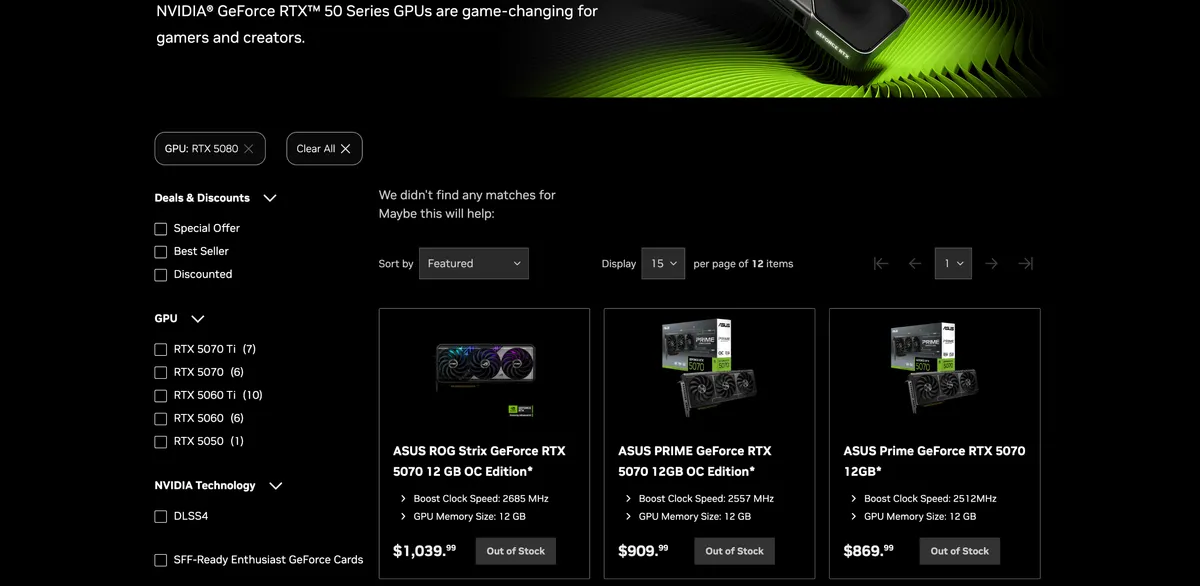
First, it was theGeForce RTX 5090, and now theGeForce RTX 5080 – two of thebest graphics cards have gone dark. After the Blackwell flagship left Nvidia’s marketplace, the GeForce RTX 5080 followed suit. Prices for the sub-flagship have exploded to more than 2.2X its original $999 MSRP, and the Blackwell-powered graphics card is slowly going out of stock at various U.S. retailers.
As with the recentdisappearance of the GeForce RTX 5090 on Nvidia’s marketplace, the listings and filters for the GeForce RTX 5080 have also disappeared. While its absence does not necessarily mean Nvidia has discontinued the graphics card, it does raise questions about its status and future availability. This move is especially fishy because other Blackwell SKUs, such as theGeForce RTX 5070 Ti andGeForce RTX 5070, remain listed on the marketplace, albeit marked as “Out of Stock.”
The continued presence of the GeForce RTX 5070 Ti and GeForce RTX 5070 suggests that Nvidia wants to keep the products visible even when they are not immediately available so that consumers can anticipate restocks. The complete removal of the GeForce RTX 5090 and GeForce RTX 5080 breaks that pattern. It fuels rumors that Nvidia has allegedly stoppedproduction of the GeForce RTX 5090 and possibly the GeForce RTX 5080 too, in favor of a rumored GeForce RTX 5080 24GB.
Latest Videos FromTom’s Hardware
(Image credit: Nvidia)
Rumors claim Nvidia allegedly stopped producing the GeForce RTX 5090 to repurpose the valuable GB202 silicon into the chipmaker’s RTX Pro Blackwell lineup, which fetches higher margins. This has a lot of credence, since many agree that Nvidia stopped being a gaming hardware vendor long ago and has transformed into an AI provider.
Rather than simply discontinuing the GeForce RTX 5090, Nvidia purportedly intends to introduce the GeForce RTX 5080 24GB as the new flagship gaming graphics card. The thing is, a 24GB variant of the GeForce RTX 5080 would solve one of the biggest consumer gripes with the graphics card: the lack of memory. While a GeForce RTX 5080 24GB would offer the same memory as the GeForce RTX 5090, it simply isn’t a direct drop-in replacement. The former has 2X fewer CUDA cores, a substantial performance gap that even a 50% memory increase can’t make up for.
How much money are you willing to spend during the Black Friday sales?
The GeForce RTX 5080 launched in January of last year with an MSRP of $999. Demand quickly outpaced supply, and with the rapid price hikes due to the memory shortage, the market price has more than doubled its original MSRP. As of this moment, the most affordable GeForce RTX 5080 in stock, the PNY GeForce RTX 5080 ARGB Epic-X RGB OC, retails for $2,199.99, which is 2.2X over the original launch price.
While some stock remains, it’s selling out fast, and the remaining units will only get more expensive as availability dwindles. At this rate, the GeForce RTX 5080 is unlikely to be available by Black Friday. If you are set on a GeForce RTX 5080, you may have little choice but to act quickly and buy at today’s elevated prices.
Get Tom’s Hardware’s best news and in-depth reviews, straight to your inbox.
If the GeForce RTX 5080 24GB is indeed legitimate, the graphics card will almost certainly debut at a substantial premium over the original GeForce RTX 5080. Although Nvidia maintains that the RTX 5090 is still alive, the reality suggests otherwise. We have contacted the company for comment regarding the GeForce RTX 5080’s status.
Ryan Serhant, CEO of SERHANT, says there isn’t just 1 housing market right now. There are really 4: cash buyers, buyers who need a mortgage, homeowners with low mortgage rates, and builders.
Today, let’s zoom in on the 1st group – cash buyers.
According to the National Association of Realtors (NAR), 27% of homes sold in September were bought with all cash. That’s more than 1 in 4 buyers. And that’s a pretty big number, especially when so many people are struggling with affordability.
So where is all that cash coming from? When you hear a number like that, it’s easy to picture wealthy investors buying up houses left and right. But that’s not necessarily the case. Some of those cash buyers are actually homeowners who’ve built up enough equity to buy their next home outright.
Here’s what you should know about who’s paying cash and what that really means for the market.
Who’s Paying Cash?
Cash buyers tend to fall into a few groups, according to NAR:
So, it’s not all those big investors social media talks about. That 1st group may include people a lot more like you. Here’s how. According to Cotality, the average homeowner with a mortgage has about $310,000 in equity.
That’s a big deal right now. Many homeowners feel stuck because they don’t want to give up the low mortgage rate they have today. But once they learn they may have enough equity to move and pay cash for their next home, today’s rates don’t matter nearly as much. Because buying in all cash means…
No monthly mortgage payment
No need to borrow at today’s mortgage rates
No loan approval process, so you may be able to close faster
And even if the equity won’t cover the whole purchase, putting more of it toward the next home means borrowing less. That can mean a smaller monthly payment, too.
But cash buyers like this are more common in some places than others. And how big of a segment of your local market this is, is going to depend on where you live.
For example, Realtor.comdata shows cash buyers made up almost 47% of sales in Mississippi and 46% in Montana earlier this year (see map below).
Where does your state fall?
According to Realtor.com, the states with the most cash buyers reflect “a mix of affordability, wealth and buyer demographics.” Think places with lower home prices, or lots of retirees and 2nd-home buyers.
So, depending on where you live, you may see a lot more (or a lot fewer) cash buyers than the national number suggests. An agent who knows your area can tell you who’s actually buying near you.
Most Buyers Are Still Using a Mortgage
And if all of this has you thinking everyone’s paying cash, they’re not. If you’re planning to buy and need a mortgage, you’re actually in the majority.
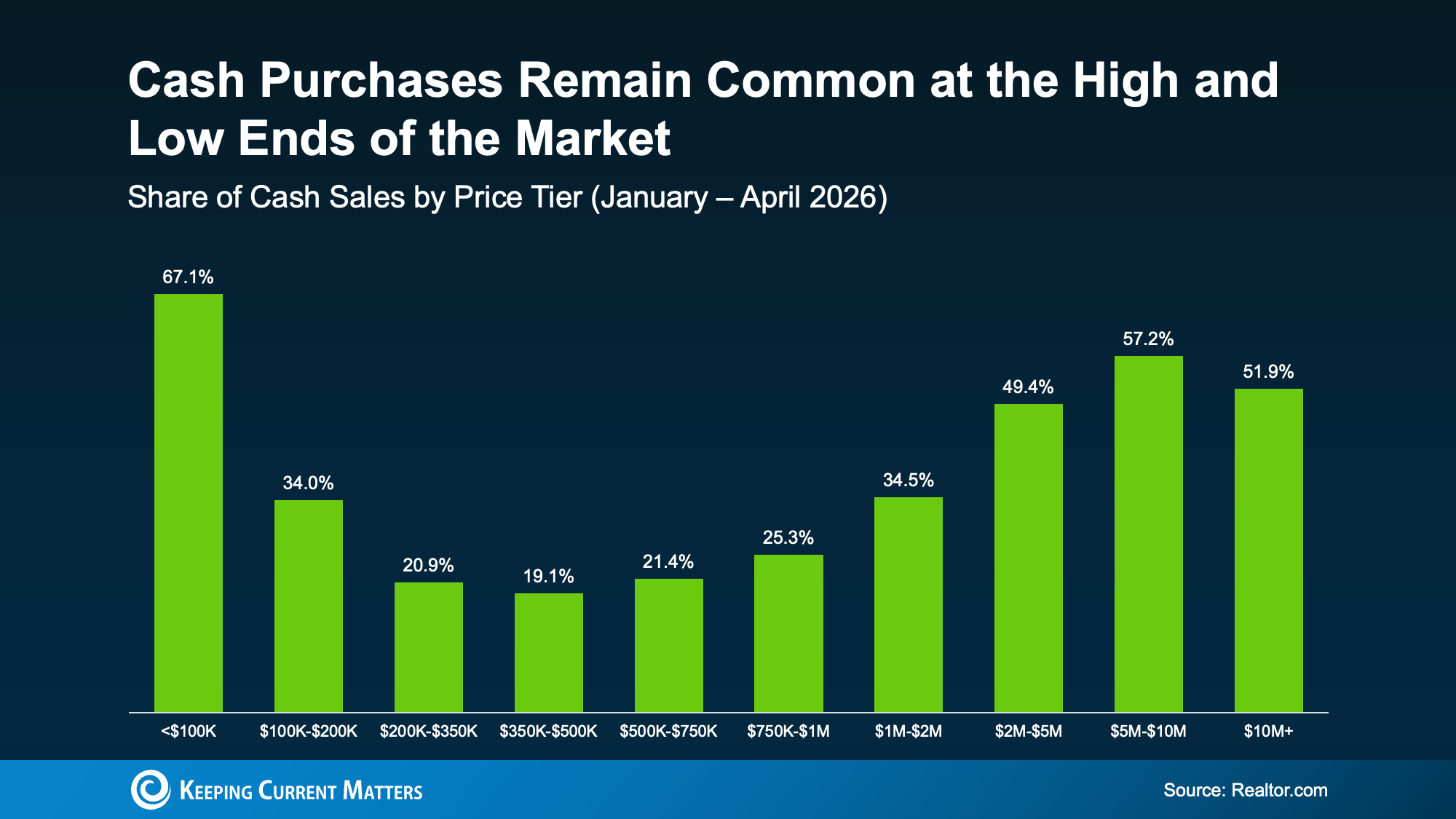
Based on NAR’s numbers, nearly 3 out of 4 home purchases still involve financing. And for homes priced between $200,000 and $750,000, only about 1 in 5 sold for cash, according to Realtor.com (see graph below):
That means most people buying in that price range are financing their purchase, too. So, there’s no need to assume you’re at a disadvantage just because you’re using a loan.
Cash Buyers and Your Move
So, what does all this mean for you? Maybe more than you think.
If you already own a house, you may have enough equity to make your next move more affordable than you realize. And if you’re buying with a mortgage, remember, you’re in good company. Most buyers are financing their purchases, too.
The takeaway? Don’t make assumptions about what’s possible based on how other people are buying homes. What really matters is your equity, your budget, and what’s happening in your local market.
Bottom Line
Cash buyers are a meaningful part of today’s market, but they aren’t the whole market.
Whether you’re hoping to put your equity to work or you’re buying with a mortgage, a local real estate agent can help you see how much equity you have, who’s buying in your area, and what that means for your next move.