A robotics startup just received a cease-and-desist letter from the state of California after it hosted a human vs. robot fight in San Francisco. REK founder and CEO Cix Liv shared the document on social media, with the California State Athletic Commission (CSAC) telling the company to stop holding, promoting, or sponsoring these unsanctioned fights and that organizing them without a license is a misdemeanor. You can see the video of the fight that prompted the order by expanding the tweet below.
World’s FIRST human vs. terminator robot fight.
Is the end near? Or do we still stand a chance? https://t.co/MTnmDOLfq6September 20, 2026
The cease-and-desist refers to the human vs. humanoid cage fight that the company sponsored on Sep. 18, 2026, where YouTuber Frankie LaPenna entered a fighting cage and faced off with three different robots. Now, it’s unclear if this was a sporting contest or a promotional stunt, but it was clearly used to give the REK robot fighting platform more publicity. After all, REK has been advertising its events as “Real pilots, real punches. Humanoid robots in brutal, full-contact combat,” and even offers private events with robots facing off in three rounds. Aside from that, a robot is already dangerous as it is, so a human facing off with one raises countless safety concerns and ethical issues. You can read the full order by expanding the tweet below.
We made it boys. California sent us a Cease and Desist for “UNSANCTIONED HUMAN VERSUS HUMANOID ROBOT CAGE FIGHT” https://t.co/cw2jjl1aNVSeptember 30, 2026
REK is proof of life imitating art, as we’ve already seen something similar in the movie Real Steel, with Hugh Jackman’s character and his son training a discarded humanoid boxing robot, allowing it to rise through the ranks and challenge the reigning champion in a classic underdog plot intertwined with a father-and-son story. While there’s no indication that Liv was inspired by the 2011 Hollywood film, the similarity of their concepts is quite uncanny. We’ve also seen another robot startup following into the footsteps of Hollywood after it decommissioned its old robots “Terminator-style” by making them jump into a vat of molten steel.
Latest Videos FromTom’s Hardware
If you’re interested in seeing these matches, REK has listed its past events on its website, where you can watch some of their replays on YouTube. The company hosts live events, although we don’t have a schedule for the remainder of the year yet; those who want to see them in the metal without waiting for a match can sponsor a private event, which starts at a cool $10,000. But if you’re interested in piloting one of these fighting robots, you can download the company’s official Real Robot Simulator, which is available on Steam and Meta Quest. Those who reach the Pro level and qualify could even get to pilot the real thing in a live event.
Regardless of whether the LaPenna vs. robot fight was a legitimate combat sports event or a promotional showcase, it just made sense for CSAC to step in. After all, the state agency regulates combat sports where at least one party is a human to ensure fairness and enforce safety, especially with lives involved. But with the way the cease-and-desist was worded, it looks as though CSAC would not have intervened if the September 18 fight had just been between robots.
The Cease and Desist Order
“PLEASE TAKE NOTICE that you and each of you are hereby ordered to cease and desist from: (1) holding, promoting, or advertising any boxing or mixed martial arts contest match, or exhibition, involving any human in the State of California without the prior approval of the California State Athletic Commission, or (2) engaging in the promotion of, or participation in, a boxing or martial arts contest, match, or exhibition involving any human without a license pursuant to Business and Professions Code section 18640,” CSAC said in its letter. “PLEASE TAKE FURTHER NOTICE that Business and Professions Code section 18870 and 18878 make it a misdemeanor for a person or promoter who is required to be license by the State Athletic Commission to directly or indirectly hold, aid or abet, or attempt to hold, aid, or abet the holding of, any contest, match, or exhibition without having first obtained a license or permit therefor from the State Athletic Commission or to otherwise violate any provision of the State Athletic Commission Act.”
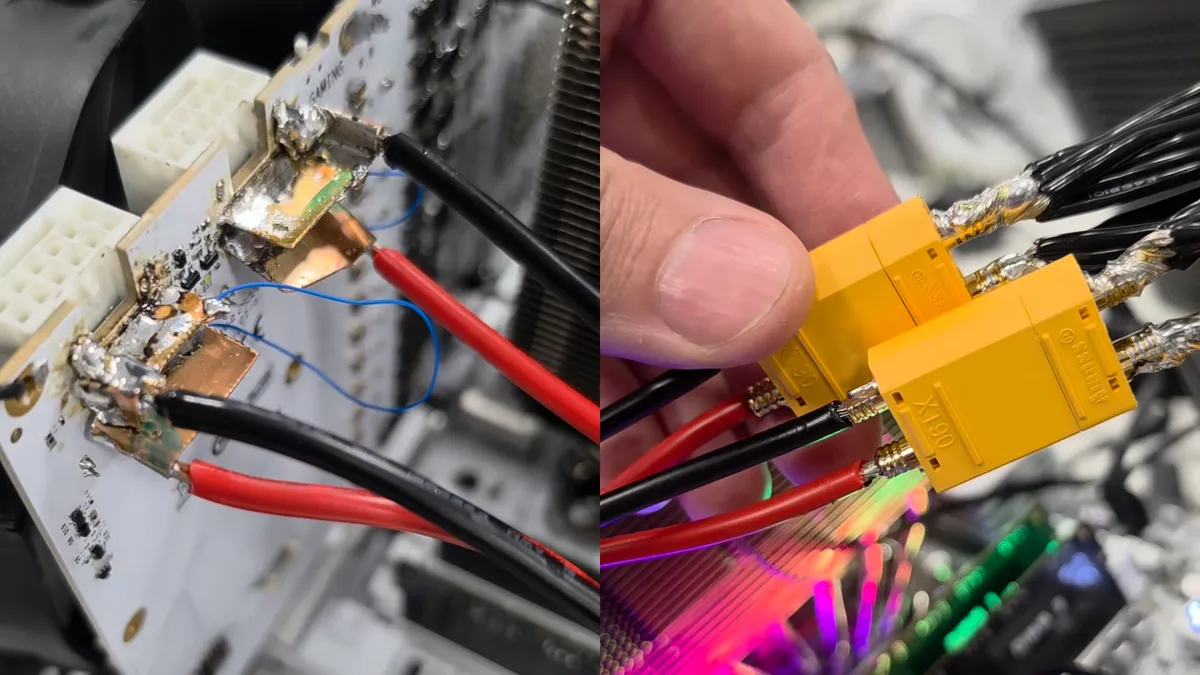
Reddit user u/DallasGrave shared a fix for his RTX 5090, one of the best graphics cards, whose 12VHPWR connector was overheating, along with an image of a module screwed onto the back of his GPU. This module is apparently a custom-made power distributor that splits the current load across more wires to lower connector temperatures. Apparently, u/DallasGrave is connected to GRAVEPC.com, which offers mainly custom cooling solutions for small form-factor PCs.
In response to a commenter asking whether this mod will be covered under PNY’s warranty, he said, “We’re a PNY partner. You’ll be able to buy a PNY-specific card with a similar modification directly from us with a full warranty.” This mod isn’t currently on his website, however. PNY hasn’t been great at honoring warranties for the 12VHPWR issue with third-party cables, as covered in this recent story about a third-party cable melting in use, so take the claim of full warranty coverage with a grain of salt.
The 16-pin connector issue plagues many Nvidia graphics cards because they draw high current through what is essentially a 12-pin connector. The four smaller pins are sensors, and the remaining 12 are split between six +12V and ground connections. The connector typically uses high-current-rated 16AWG cables, and in theory, they should handle up to 600W.
Latest Videos FromTom’s Hardware
Apparently, some cases of these melting connectors are due to poor connections where the pins don’t make enough contact, causing high resistance and heat buildup, and uneven current distribution is often a source of issues. This was rarely the case with older multi-8-pin connector setups, as the safety margins were higher. However, graphics cards now draw more current, and Nvidia thought it should run it through fewer wires.
The modder essentially fixed this issue by soldering additional connections to the power rails directly on the RTX 5090’s PCB and routing them to what can only be described as a power distributor. This distributor contains a PCB that the wires connect to and where the two female 8-pin connectors are placed. It is unknown whether the modder designed it himself and whether it contains any other power-delivery or protection components, such as capacitors and fuses.
The distributor appears to be custom-made to fit his specific graphics card, and the housing shows signs of resin printing. In the modder’s stress test, running the card at full load, pulling 550W for 48 hours, he says it “never crossed 40c even at the joint.”
(Image credit: TecLab on YouTube)
The 12VHPWR connector is a terrible design; cramming that much power into only six wires creates a very sensitive system where slight misalignment and uneven current distribution could cause connector-melting temperatures. This mod is cleaner and more attractive than the other power mods we’ve covered, like this poor Galax RTX 5090, but it is still invasive, requiring wires to be soldered directly to the card’s power rails.
Get Tom’s Hardware’s best news and in-depth reviews, straight to your inbox.
It’s the year of two thousand and twenty-six, and “Running Doom on X” is still probably the most popular software hacking hobby. From pregnancy tests to space satellites, the 1993 game has been ported to pretty much anything under the sun that has a CPU and some memory in it. Now it’s time to run the game in a database, in this case CedarDB, courtesy of the SQLDoom project by Lukas Vogel, who previously authored DoomQL.
If you’re wondering how the heck one runs a game in SQL, it’s actually much easier than you imagine, so long as you think like a database architect. The actual frontend displaying the graphics, playing sound, and taking inputs is in Python, but that part acts only like a PC’s peripherals — all the math is done inside the database.
The backend is written for the performance-focused, Postgres-compatible RDBMS CedarDB. Much like modern Doom ports, SQLDoom uses two paths: one running at the game’s original 35 Hz for handling all the logic, and a separate thread for displaying graphics, interpolating camera position between game updates.
Latest Videos FromTom’s Hardware
To start, Vogel had to convert the entities in Doom‘s WAD package file to databases. That was easier than expected, as the data therein “is highly relational already,” with Vogel presenting the example of map levels ultimately being structured in parent-child relationships that are trivial to replicate in plain tables. 1000 lines of Python was all it took.
For the main gameplay loop, Vogel was once again pleasantly surprised that the game logic was easy to convert. The resulting code was 5,900 lines of SQL, compared to the original C source code’s 9,000. A lot of the savings came from the fact that whereas one has to iterate over entities with “for” or “while” loops to update values, a simple “UPDATE… WHERE” is enough in SQL to do that in just one statement — and in parallel, no less. As an added bonus, the fact that everything is a row in a database table makes for some trivial instant modifications, like changing weapon characteristics or enemy behavior on-the-fly.
The graphical renderer is also small at 1,300 lines, but it’s trickier as it’s the one query spanning 89 tables. Vogel notes that the pipeline is ultimately very similar to that of Doom. Data for Carmack’s then-revolutionary Binary Space Partitioning (BSP) traversal, an implementation of binary trees, can be easily represented as a table.
Each left/right value can be converted to a bit, and ultimately the vertex order value can be reduced to just the one number. Thus, a simple “SELECT… ORDER BY” automagically sorts the walls front-to-back for you. Amusingly, I used the very same database technique when I wrote the defunct Tech Report‘s threaded comments system. Despite his best efforts, Vogel says the floor and ceiling renderers didn’t map very cleanly to SQL, as ultimately they’re clever flood-fill algorithms.
Get Tom’s Hardware’s best news and in-depth reviews, straight to your inbox.
When it came to multiplayer, that’s when using a database was actually much better than the original game. The reason is simple: maintaining synced states across many tables with copious amounts of interdependencies is literally what databases are designed for, so snapshots, authentication, access control, are all effectively free and implemented for you. To run a game tick, all you need is “START TRANSACTION,” run the logic, and “COMMIT,” and everything magically synchronizes.
Renovations in New York City come with unique challenges. The primary firm that you choose to work with needs to know how to deal with zoning, permitting, community boards, landmark organizations, and many more entities. If you are in a co-op or a restrictive condo, then they will also have to navigate the policies and practices of the board and management company.
Secondly, New York is full of specialists to handle each of the smaller aspects of the project —electricians, plumbers, carpenters, designers, architects, etc. If you don’t want to get stuck managing these numerous experts yourself, then you need a firm that is experienced in acting as your single point of contact that can organize all of the sub-projects on your behalf.
You also want to work with an experienced company that will be straightforward about estimated costs, will communicate with you throughout the entire process, and that has a good track record of handling projects like yours.
Review Process
We started with reviews on Google, Yelp, and the Better Business Bureau. Looking at the firm’s overall score can give a high level indicator, but it is also important to look at the time period of the reviews. Companies with only recent reviews, or only old reviews are not as informative as those with many years of reviews to demonstrate consistency. It was also helpful to look at issues that customers reported for negative reviews, to get an idea of specific types of projects or situations that the company was not as strong at handling.
The public websites for each of the companies also provided valuable information. This is where each of the firms emphasize their specialties. The best firms also provide guidance on the costs of the renovation as a rough guide to get you started. We have found that this upfront approach to pricing transparency reflects the firm’s commitment to honest and thorough communication throughout the project.
Founded in 2013, Gallery KBNY is proud to be a full-service design-build company, having a team that covers everything from permits to materials to communication to design to the actual labor needed. They specialize in high-end apartment combinations and pre-purchase renovation assessments, especially in pre-war apartments and brownstones.
Their focus on listening to their clients first and foremost, and adapting their own approach to meet individual needs, has led to a company receiving numerous awards, including two Houzz awards in 2026 and quotes in the New York Times. They also have a custom-built digital project tracker to let you see live photos and overall progress of the project.
A to Z Renovations is another full-service renovation business (hence the A to Z name), and offers multiple showrooms for their clients and potential clients, and their focus on the final product being exactly what their client wanted is reflected in their company-offered 5 year warranty on all work done by their firm. Their personal philosophy around work emphasizes the quality of their final product and communication with their clients.
Brener Construction was founded in 2013 and focuses on high quality communication with their clients, and emphasizes portfolios that cover design, painting, construction, electrical, and anything else your home project might need. They share access to the entirety of their reviews directly from their website, and stress that the client comes first. They are another company that is proud of long-term relationships and repeat customers.
Mammoth Projects is a design-build firm, founded in 2012, specializing in full-service residential renovations across New York City. They focus on end-to-end project management, taking care of everything from architectural design and permitting to complete general contracting and subcontractor management. Their portfolio highlights expertise in complex apartment combinations, complete brownstone transformations, and high-end townhouses, with notable work including a stunning renovation at Jane Street in the West Village.
Home Evolutions, founded in 2015, emphasizes transparency and open communication, along with a team with broad experience in the often-complex process of home renovation. Their lack of Yelp or BBB reviews is more a reflection of the ultra-high-end net-worth that makes up the core of their clientele. Their process involves a multi-step estimate. However they stress that the rough estimate that comes from their initial consultation leads into them providing a step-by-step total breakdown of materials, labor, and anything else that might come up, so you can decide if you want to move forward with them.
They often partner with YossiG’s design studio for projects, catering to luxury, fully managed renovations. Home Evolutions also has their own digital project tracker for their clients.
The Manhattan median sales price for co-ops and condos remained at $1.25 million in the third quarter, the same record level as the second quarter.
Deals rose for the seventh time in eight quarters, increasing by 8 percent compared to the third quarter of 2025, according to The Real Deal market report by Jonathan Miller.
Listings fell year over year for the fourth time, a drop of 10.7 percent, with the largest declines seen in the luxury and new development markets, the report said. Luxury listings were down 14.1 percent compared to a year ago.
A sharp drop in townhouse listings restrained sales in that segment, Miller’s report said. The average sales price dropped to the lowest level in more than a year, dropping 18.6 percent to $6,331,987.
Lower inventory, high prices
Manhattan prices remained close to spring levels and above last year, according a third quarter market report from Christie’s International Real Estate. This appears to indicate there’s enough demand to overcome seasonal fluctuations “without giving buyers much additional leverage,” wrote Kevelyn Guzman, regional vice president of Christie’s International Real Estate.
“While this is still a selective market, the path to a deal has become clearer for listings that are priced and positioned correctly,” Guzman said.
Rising mortgage rates and other challenges
In her firm’s Manhattan market report, Bess Freedman, CEO of Brown Harris Stevens, noted that the third quarter market was more active than a year ago, but faces a number of challenges.
“Mortgage rates have risen sharply since March and are back over 7 percent,” Freedman said. Low inventory plus concerns about the war in Iran, inflation, and the upcoming elections “led to a sharp reduction in signed contracts in September, which could mean a softer fourth quarter for closings,” she said.
Pied-à-terre tax ‘uncertainty’
Compass also released a Manhattan sales market report, which said that the strongest gains came in the $3 million to $5 million range, where deals increased more than 30 percent for condos and co-ops. Condo sales from $5 million to $10 million also rose by double digits.
The new pied-à-terre tax is “fueling a shift toward condos,” said Nicole Hay, an agent at Compass.
“Co-op boards are extremely wary of the financial and administrative complications this tax could introduce, making them even more restrictive against non-primary residents. Buyers are smart, and they recognize that buying a co-op right now could severely limit their future buyer pool and negatively impact their resale value,” Hay said.
In her firm’s Manhattan market report, Pamela Liebman, president and CEO at The Corcoran Group, said “the tax is already adding another layer of uncertainty for buyers, particularly at the upper end of the market, and at a time when New York City should be focused on encouraging investment, not creating new reasons for people to pause.”
Liebman also commented on a lack of options for buyers. “With available listings and new development inventory both near multi-year lows, buyers are competing for a shrinking pool of homes. Until we see new inventory come to market, limited supply will continue to support pricing and intensify competition for the city’s most desirable properties,” she said.
Limited options for new condos
The new development pipeline appears to be slowing to a trickle. SERHANT’s new development report for Manhattan noted that only 569 sponsor units were listed at the end of the quarter, a 27.7 percent decline year over year. Fewer than 3,000 total units remain unsold.
There were 257 new development contracts signed in in the third quarter, a 36.5 percent decline from this time last year (contract activity is an early indicator of where sales are headed). Midtown East had the most market share with 30.4 percent of contract activity.
Owning a PC gaming handheld is quite handy, but sometimes involves playing uncalled-for matches of Tetris with the internal storage, especially as games get larger. Storage expansion often comes by way of microSD cards, which can be added without opening the console, but can be slower than NVMe SSDs. BiWin’s CL 100 Mini NVMe SSD tackles both those problems, arriving in a 15 x 17 mm form factor with custom casing. It’s effectively the size of a microSD card.
The diminutive unit was spotted earlier in the year, but hadn’t been given a name or selling price until recently. The unit is currently bespoke to BiWin’s OneXPlayer consoles (OneXFly Apex/Air, OneXPlayer 3, X1 Air, X2 Mini, and Super V/X) as well as the GPD Win5. These systems have hardware slots specifically for this size drive that you could insert like an SD card. For comparison, the M.2 2230 drive inside the Steam Deck and other portables is, unsurprisingly, 22 x 30 mm — much larger, and it requires opening the machine, plus one of those annoying little M.2 screws.
Despite the physical format being manufacturer-specific, the CL 100 Mini appears to be a standard NVMe 1.4 drive with a PCIe 4.0 interface. The installation instructions are simple. The Silicon Motion SM2268XT2 controller is a standard NVMe affair, and it’s also used in standard M.2 2280 Crucial and Kingston drives, among others.
Latest Videos FromTom’s Hardware
(Image credit: BiWin / Amazon)
Despite being connected to only one slab of Samsung V8 TLC NAND, it can still reach 3700 MB/s on sequential reads and 3400 MB/s for writes, both excellent figures as far as the needs of gamers are concerned. If you want to use the BiWin CL100 Mini as an external drive, the company offers a mini-SSD reader with a USB-C port, though speeds are limited to around 3000 MB/s in either direction.
You can get the drive from the BiWin store on Amazon, in 512 GB for 139.99€ and 1 TB for 259.99€. There’s also a 2 TB unit advertised, though that one is only available from third-party sellers for an arguably disproportionate 699.99€. The smaller units are roughly in line with equivalent M.2-2230 units from reputable manufacturers. Meanwhile, the reader unit is priced at 79.99€.
A rumored SKU table for Intel’s upcoming Nova Lake desktop CPUs has surfaced, showcasing seven models that will (presumably) make up Intel’s initial NVL-S lineup. The list includes three models with the “BFC” tag, which seems to be Intel’s branding for bLLC, or big last level cache. It’s been heavily rumored to show up with Nova Lake, countering AMD’s assault on the best CPUs for gaming with its X3D chips.
Go deeper with TH Premium: CPU
(Image credit: Tom’s Hardware)
As previously rumored, the table tops out at the flagship Core Ultra 9 4970K BFC, which the spec list suggests is a 28-core chip with 8 P-cores, 16 E-cores, and 4 LPE-cores. It also lists a 125W TDP and an integrated GPU with 32 Execution Units (EUs). This 32-EU iGPU is apparently a staple across the range, short of the Core Ultra 5 4650KF, which lacks integrated graphics.
Intel retired the use of “EUs” in favor of its Xe cores several years ago. Rumors suggest Intel isn’t releasing a large, 12-Xe core model of Nova Lake. The 32-EU count here likely comes out to 4 Xe cores (each core has eight matrix and vector ALUs).
Latest Videos FromTom’s Hardware
The table does not include the heavily rumored 52-core Nova Lake model. However, as the Nova Lake launch approaches, it has become clear that the 52-core model, as well as other potential models with a dual-tile configuration, will arrive after the main range of chips. Presumably, these models will target the HEDT crowd with their high core counts.
Swipe to scroll horizontally
Rumor Intel Nova Lake desktop specifications*
SKU
Cores (P + E + LPE)
TDP
iGPU
Core Ultra 9 4970K BFC
24 (8 + 16 + 4)
125W
32 EUs
Core Ultra 9 4950K
24 (8 + 16 + 4)
125W
32 EUs
Core Ultra 9 4900 BFC
22 (6 + 12 + 4)
65W
32 EUs
Core Ultra 7 4870K BFC
24 (8 + 12 + 4)
125W
32 EUs
Core Ultra 7 4850K
24 (8 + 12 + 4)
125W
32 EUs
Core Ultra 5 4650KF
22 (6 + 12 + 4)
125W
N / A
Core Ultra 5 4650K
22 (6 + 12 + 4)
125W
32 EUs
*Names and specifications rumored, unconfirmed by Intel
There are several interesting details when looking at the range broadly. Most notably is the four-number model identifier, which Intel didn’t use with Arrow Lake chips like the Core Ultra 7 270K Plus. This larger identifier has been previously rumored, and it makes sense if the lineup above is indeed real. There’s quite a bit of specificity in this stack, and something like the “Core Ultra 9 497K” doesn’t signal what a “Core Ultra 9 4970K” does.
Regardless of naming, the SKU table shows three models with BFC, two of which fall under the Core Ultra 9 umbrella. There isn’t a Core Ultra 5 BFC option. The most interesting model is the Core Ultra 9 4900 BFC, which matches the 22-core count of the Core Ultra 5 models, though with the addition of BFC and a lower 65W TDP. Given this chip doesn’t have a K suffix, it looks like a specialized, low-power gaming chip, perhaps for small form factor desktops.
Get Tom’s Hardware’s best news and in-depth reviews, straight to your inbox.
In addition, the Core Ultra 5 model is the only one with an F suffix, noting that it lacks integrated graphics. As we saw with the Arrow Lake refresh, Intel released a Core Ultra 5 250KF Plus, though it never gave the 270K Plus the KF treatment.
According to the table, Intel could use “BFC” to note chips with a larger L3 cache, something that’s been heavily rumored for Nova Lake as AMD’s X3D chips dominate gaming in our CPU benchmark hierarchy. This is the first time we’ve heard it referred to as BFC; however, with previous rumors referring to the additional cache as bLLC.
As for what BFC stands for, there are a few possible candidates, and we’ll leave it to your imagination as to what words that start with “F” could fit between “Big” and “Cache.”
Although Intel’s Nova Lake chips have been the topic of the rumor mill for well over a year, the launch is approaching. At the beginning of the year, Intel’s CEO confirmed Nova Lake would arrive before the end of the year. Assuming that’s still true, we’d expect to learn more any day now.
Hopefully we’ll have more details soon. In the meantime, make sure to check out our recent interview with Intel’s Robert Hallock, where the executive goes into some of the expectations around Nova Lake, on Tom’s Hardware Premium.