When apartment-hunting in New York City, you may come across a listing for a condop, particularly if you are searching for sponsor co-ops. A condop is probably the most misunderstood type of NYC apartment; brokers often describe them as co-ops with condo rules, but the reality is more complicated.
Here’s a more specific description: Condops are mixed-use co-op buildings with commercial or non-residential space on the ground floor. As a result, multiple boards separately govern the building’s residential and commercial parts.
During the wave of co-op conversions in the 1980s, owners and developers faced a tax rule that capped earnings from non-residential or commercial spaces at 20 percent of their income. If earnings exceeded 20 percent, shareholders couldn’t claim certain homeowner tax deductions.
To fix that, owners and developers divided their buildings. They designated the commercial space as one condo unit, while the entire residential section became another and was divided into co-operative shares. And so the condop was born.
[Editor’s note: A previous version of this article was published in May 2025. We are presenting it again with updated information for October 2026.]
Basically, condops allowed the creation of co-ops while letting the sponsor own or rent the building’s commercial spaces with all the freedoms of condo-style ownership. Their unique structure makes them complex, typically consisting of three boards.
First is a condominium board, made up of representatives from both the residential co-op units and the commercial space. This board handles issues related to the building’s general common elements, such as exterior repairs or major plumbing upgrades.
The second is a commercial board, which governs issues for the commercial units.
The third board, elected by co-op members, handles shareholder issues for residents’ shared spaces, including common hallways or laundry rooms.
| What to know about buying or selling a condop in NYC | |
|---|---|
| Multiple boards add complexity |
|
| Buyers should do their due diligence |
|
| Financing and selling concerns |
|
Condops often have substantial and very profitable commercial spaces. As a result, disagreements often arise between the two distinct entities involved in condop governance, e.g., the residents and the commercial-space owners, said Dean Roberts, a real estate attorney at Norris McLaughlin. Further, when sponsors create condops, the commercial units—usually retained by the sponsor—often have favorable terms regarding the payment of building expenses or other rights that shift the financial burden to the residential units.
For example, representatives of the ground-floor commercial space might resist paying for elevators they never use.
Then there’s the issue of board representation. In one of Roberts’ condop cases, the building was evenly split between a school dormitory and a private residential space.
“On the board, the school had three votes, while the residents had two. That means you’re pretty much at the mercy of the school,” he said.
Roberts advised any prospective condop buyer to find out how well the boards function and whether they’ve been involved in any litigation, namely by asking the managing agent for intel and searching the building’s financial statements for clues.
It is also important to determine if they are allocating expenses properly. Is something a condo expense, a co-op expense, or a commercial expense? Gray areas can make it unclear which entity is responsible for different capital improvements.
Real estate attorney Adam Stone, a partner at The Stone Law Firm, advised reviewing both the co-op and condo financial statements to find out what percentage of the condo’s common charges is assigned to the co-op and whether the condo is up to date on its financial contributions.
If you’re not seeing enough homes for sale in your price range or target neighborhood—and/or you’d like to avoid a bidding war—consider expanding your search to “off-market” listings. NYC real estate brokerage The Agency, a Brick Underground partner, uses technology to mine public records and identify owners who may be ready to sell, meaning you can meet and deal with owners before their homes hit the market. Click here to learn more.
First, are you comfortable with the unique arrangement of condops and willing to live in a mixed-use building?
Sometimes, a condop can make it easier to become an owner. Abra Nicolle Nowitz, a broker at Corcoran, pointed to a retired couple who was looking for a one bedroom in NYC and fell short of the post-closing liquidity required of a co-op. She said a condop in Midtown East offered the flexibility they needed. The couple also planned to use money from their IRA for their down payment.
“It was the price point they were looking for and the financial package that would work for them,” Nowitz said
Know, too, that you’re unlikely to see many new condop buildings because co-ops generally trade for about 15 percent less than condos, so developers are reluctant to go this route. Mixed-use condo buildings are more common, though Brooklyn Point is a relatively recent development designated as a condop and built on leased rather than owned land. (Read more about the ins and outs of buying in a land-leased building.)
Most of NYC’s major broker firms and listing sites lack a filter for you to search for (or screen out) a condop. You can, however, do a keyword search for “condop” on StreetEasy, which turned up 95 apartments, 88 of which were in Manhattan. Prices ranged from $359,000 for a one-bedroom unit in Kips Bay to $7 million for a three bedroom with hree and a half baths in Lenox Hill.
Otherwise, buyers typically come across a condop listing while looking for co-ops or condos and reading the fine print.
Lenders treat condops like co-ops, said Keith Furer, a mortgage banker at GuardHill Financial. That means a bank will require a slightly bigger down payment than it would for a condo.
“Lenders will want to look at both the co-op part and condo part financials, along with all the other standard documentation that they look at when underwriting a project. Pretty much a similar type of underwriting scrutiny if just a co-op or a condo,” Furer said.
Even so, it’s important to work with a lender who understands what a condop is. Furer said most out-of-state lenders and loan officers don’t even understand what a co-op is. “I can’t imagine the majority of them have ever even heard of a condop or have any clue what it is,” he said.
If you are selling a condop, you should be prepared to answer a lot of buyer questions. Specifically, that means explaining how the boards operate.
Although brokers often say condops have more liberal policies, they can be every bit as tough on sublets and sales as any stand-alone co-op. Your due diligence matters because every building is unique.
—Earlier versions of this article contained reporting and writing by Marjorie Cohen and Emily Myers.
If you’ve seen headlines saying home sales are slowing down, you may be wondering: is this really a good time to sell?
While the latest numbers show sales picked up slightly in September, they’re still down compared to last year. But here’s the perspective the headlines can miss.
Homes are still selling every single day. Because no matter what’s happening with mortgage rates or the economy, life keeps happening too. People get new jobs. Families grow. Relationships change. People retire, downsize, or need to move closer to the people they love.
And those life changes create buyers and sellers in every market.
According to the National Association of Realtors (NAR), based on the current pace homeowners are expected to sell almost 4 million homes this year. Break that down, and that’s roughly:
11,000 homes every day.
450 homes every hour.
8 homes every minute.
So, yes, the market may be moving at a slower pace than it has at other points in time. But slower doesn’t mean it’s stopped. As Hannah Jones, Senior Economic Research Analyst at Realtor.com, says:
“Even in today’s high-price, high-rate market, homebuying activity around major life events, such as having kids, a job change, or a divorce, keeps the market in motion.”
Thousands of buyers are still making moves every day. The key is making sure your house is positioned to get their attention.
Today’s buyers have more choices, so they can afford to be more selective about things like price and condition. That makes having the right strategy from the start especially important.
Because you don’t need every buyer to be looking for a home like yours. You just need the right one – and to know how to get in front of that buyer.
Don’t let a headline about slowing home sales convince you no one is buying. Homes are still selling every minute of every day.
If you need or want to move, talk to an agent about what it’ll take to make sure yours is one of them.

When mortgage rates climb, buying a home can start to feel like trying to hit a moving target. Every jump in rates makes monthly payments bigger, and that pushes a lot of buyers to look for another way in.
More and more of them are finding it in the adjustable-rate mortgage, or ARM.
Here’s how an ARM differs from a more traditional mortgage. With a regular fixed-rate mortgage, your rate stays the same for your whole loan. But with an ARM, your rate is locked for the first few years, then it can move up or down based on market conditions.
Some people don’t like that level of uncertainty – and that’s okay. But others are drawn to this option specifically because there’s usually a lower rate to start when you opt for an ARM. And in an affordability-strapped market, that’s going to gain popularity.
Bankrate recently found that, in September, rates for ARM products were over a full percentage point lower than a regular fixed-rate loan. Depending on the ARM product, that can make a difference of $150-300 in the monthly payment on a median-priced home.
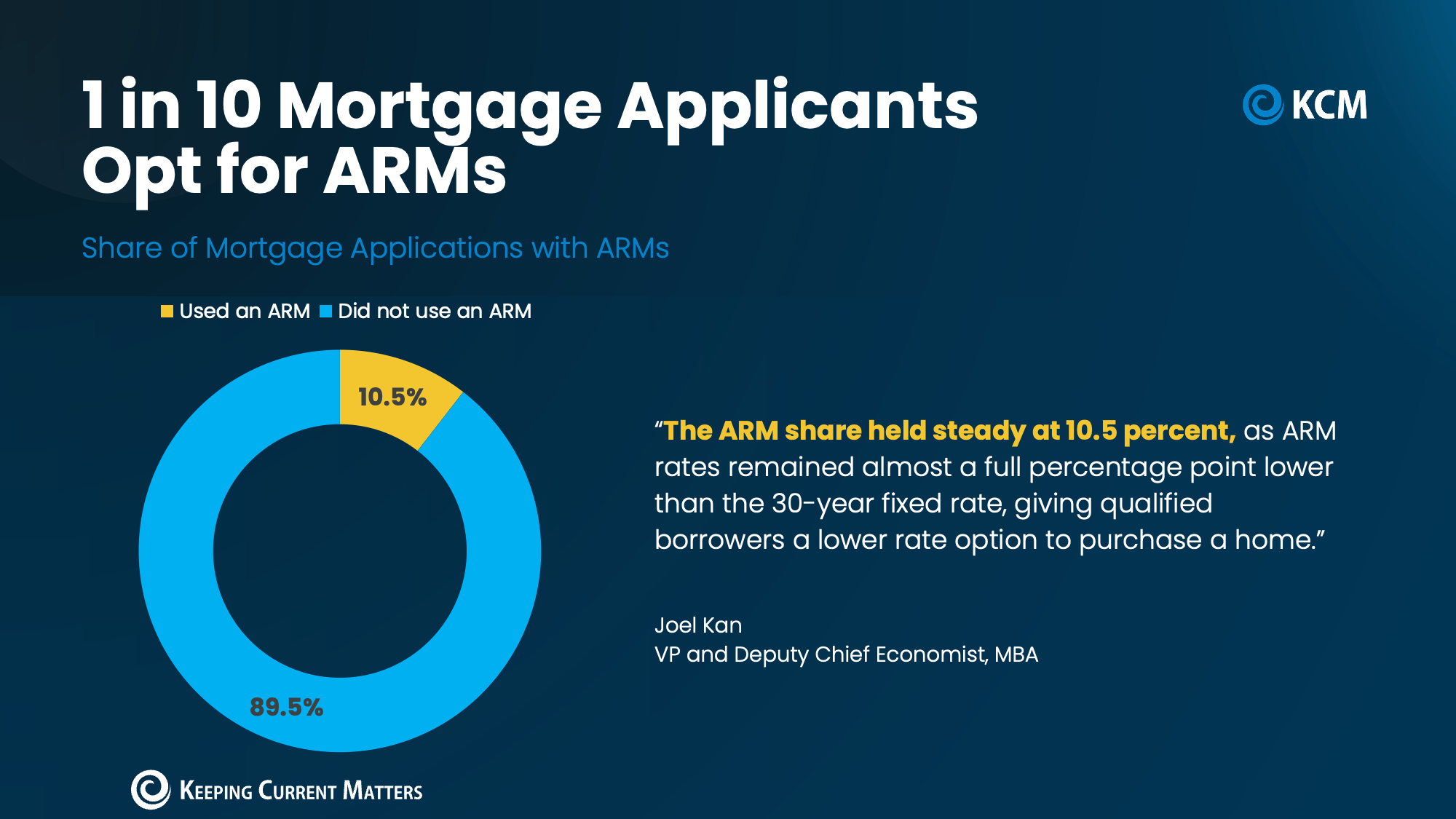
And for some buyers, that’s enough to turn “not right now” into “let’s do this.” You can see it in the numbers. Data from the Mortgage Bankers Association (MBA) shows that, in October, roughly 1 in 10 people applying for a mortgage chose an ARM (see graph below):
If you think you may want to consider this yourself, here’s what you need to know about how it works.
An ARM is like a phone or cable plan that has an introductory deal for new customers. You start out at a lower price, and then it adjusts after a specified amount of time. A popular loan is the 5/1 ARM.
The “5” means your introductory rate is locked for the first five years, and the “1” means that the rate can change every year after that. The rate change is called the “reset.” And here’s the really important part.
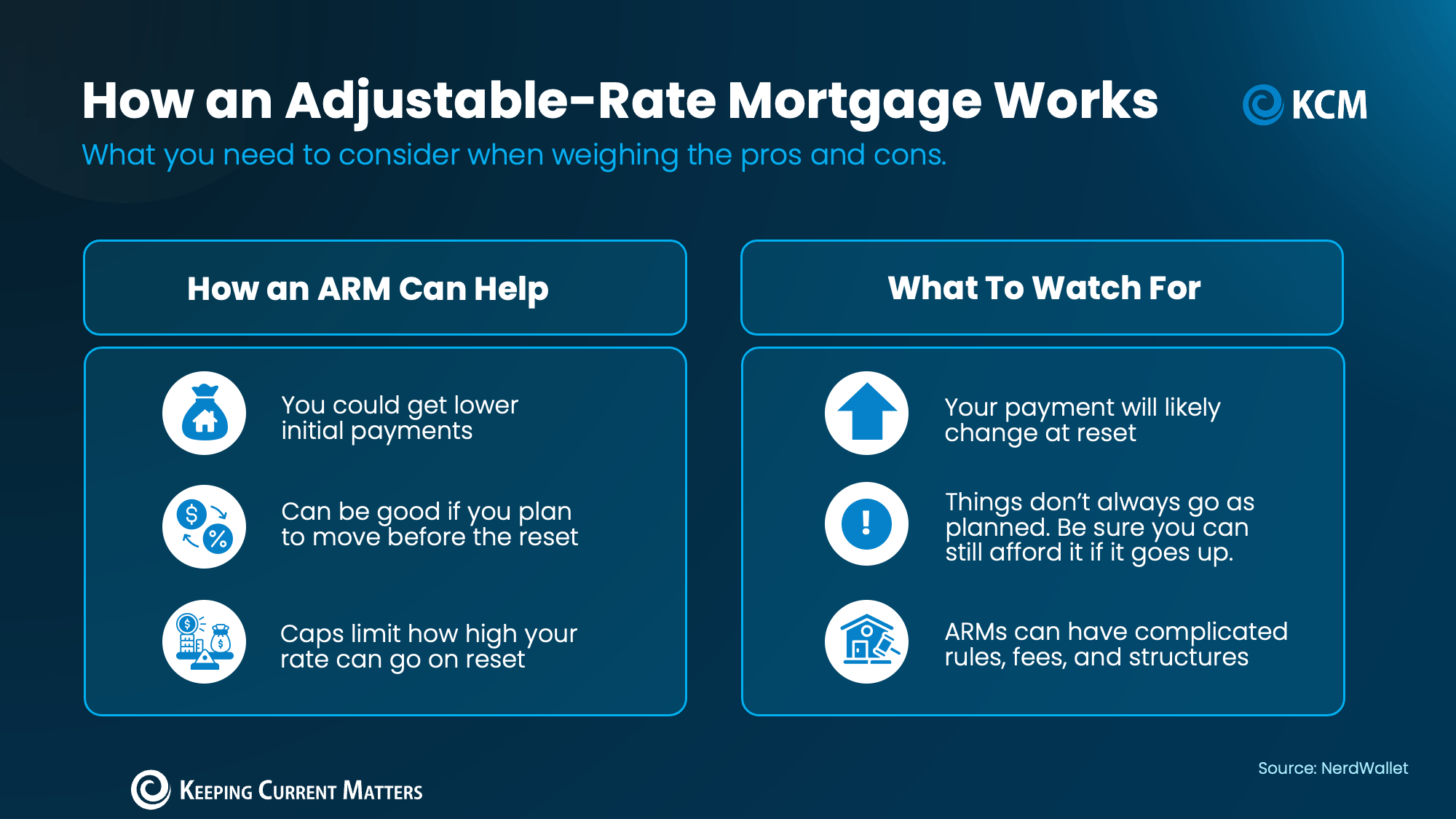
When your rate resets, your mortgage payment could go up or down. The good news is that most ARMs have caps, which are limits on how much your rate can rise each year and over the life of the loan. But either way, you have to be ready.
To see if this type of loan may be right for you, here are some things to think about and discuss with your loan officer:
Before you decide, ask your lender to work up the numbers and walk you through the different potential scenarios you could run into with an ARM. That way, you go in with your eyes open.
And, if you do go with an adjustable-rate mortgage, just know that you’ll have choices when the reset time arrives. You could:
Do nothing and keep your loan in place if the new payment still fits your budget.
Refinance into a fixed-rate loan with a payment that never changes.
Refinance into another ARM with a new lower rate locked for a specified timeframe.
Sell your home.
Talk to the loan servicer about assistance or modification.
Remember, a refinance is a brand-new loan that you’ll have to qualify for – even if it’s on a home you already own. So, keep tabs on your credit and debt levels and ask your loan officer how major financial moves like job changes and major purchases will affect your mortgage readiness. It’s important to keep your credit and finances in “mortgage shape.”
One more quick note. ARMs got a bad name after the financial crisis of 2008. Back then, there were some risky loans with small starting payments that later shot way up. Others let people borrow without proving how much money they earned.
But now, there are new laws to protect both borrowers and lenders. The biggest change is the Ability-to-Repay Rule, which says that before a lender makes a home loan, it has to check real paperwork (like pay stubs, W-2 forms, and tax returns) to make sure you can afford it. The lender also has to look at what your payment could be after the reset, not just the low starting payment.
So, you don’t have to worry that today’s ARMs are the same as the ones we saw back during the crash.
Today’s market has more options than many people realize. Finding the right one could be as simple as getting more information about tools like ARMs. A trusted lender can run the numbers with you, walk you through the what-ifs, and help you explore the possibilities.
Is an ARM a good option for you? Talk to a loan officer to find out.
Why you can trust Tom’s Hardware
Our expert reviewers spend hours testing and comparing products and services so you can choose the best for you. Find out more about how we test.
Razer has been updating its gaming mouse lineup systematically over the past two years, and it’s finally the Basilisk’s turn to get a real update. The last update we saw to the Basilisk line was the Basilisk V3 Pro 35K in October 2024, which was basically just the Basilisk V3 Pro with a new sensor.
The Basilisk isn’t Razer’s most popular gaming mouse line, but it is the more versatile, all-rounder line for people who aren’t chasing performance above all else. The Basilisk V4 Pro maintains the general design of its predecessor — a contoured, right-handed gaming mouse with bright RGB lighting and a handful of extra buttons, for the serious gamer who isn’t trying to break esports records. It features Razer’s newest Focus Pro 50K optical sensor, gen-4 optical mouse switches, and up to an 8,000 Hz polling rate, plus multiple forms of connectivity and up to 200 hours of battery life (over 2.4GHz at 1,000 Hz).
Latest Videos FromTom’s Hardware
Whether you own a house already or you’re looking to buy one, you probably care about home prices. But it’s not always easy to figure out what’s really happening right now, especially if you look at the headlines.
One says home prices are falling. The next says they’re still climbing.
So, which one’s right? It comes down to where you live.
Part of the confusion out there may be based on what’s happening to asking prices and how the media is talking about it. They’re calling attention to how asking prices are falling, but don’t give the full context or say that seasonality is at play. So here it is.
Right now, there are more homes on the market than at any other time since November 2019. And with mortgage rates rising since the spring, those homes are taking a little longer to sell. One way to help a home sell quickly in that environment is to have a lower asking price.
According to HousingWire Data, the median asking price is down from $449k in early August to $435k just 2 months later (see graph below):
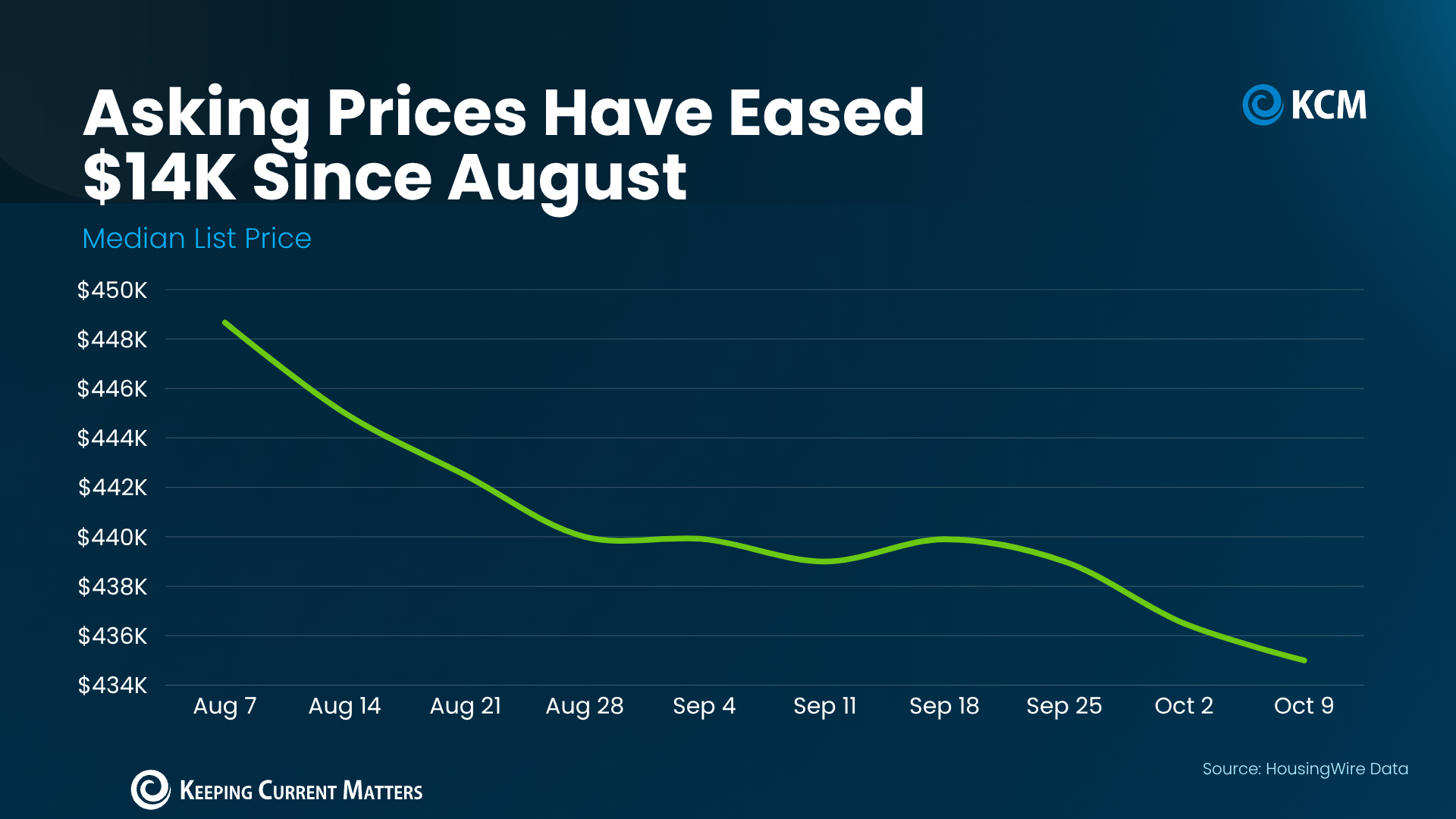
That’s a dip of about 3%, and a lot of it is normal for this time of year.
Asking prices cool off every fall once the busy summer season wraps up. With fewer buyers this time of year, sellers price a bit more competitively. Today’s rates play a role too, since sellers are pricing to match what buyers can afford right now. And that’s a good thing. Smart pricing helps homes sell.
Just keep in mind, that’s a national list price. It doesn’t show what homes near you are actually selling for. So before you react to a headline, ask a local agent what’s really happening in your area.
Realtor.com explains:
“While national headlines might suggest a buyer’s market is taking hold, the reality on the ground depends heavily on where and what you’re trying to buy. Local trends can diverge sharply from national averages, especially when you factor in price range, property type, and post-pandemic market dynamics.”
The latest numbers from S&P Cotality Case-Shiller Index show how true that is. Over the past year, sales prices in Chicago rose almost 7%. In Seattle, they dipped about 1.6%. That’s a gap of nearly 9 percentage points between two major cities (see graph below):
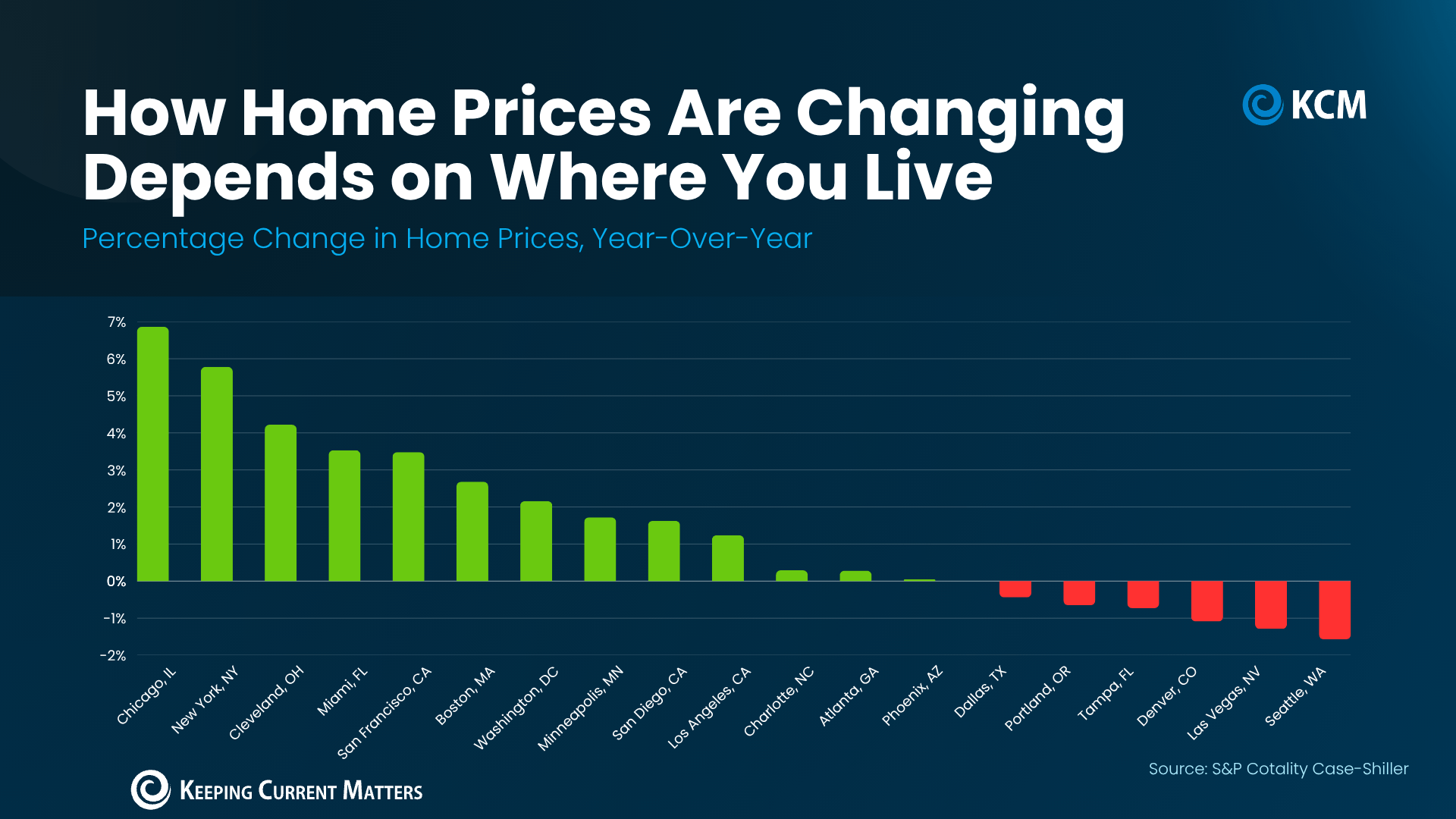
That gap changes your game plan. Selling in New York, where prices are up almost 6%? You may not need to cut your price. Buying in Denver or Las Vegas? You may have more room to negotiate.
Just in case you’re seeing those slight declines in some markets and worried it means a bigger crash is coming, here’s what you need to remember. Even in the major metros where prices are down, the declines are 2% or less. That’s a long way from a crash like 2008. And if you look back at the graph above, there are more cities in the green than in the red.
And over time, home values have a strong track record. The Federal Housing Finance Agency (FHFA) says national prices have grown year-over-year every quarter since 2012. Go back further, and a $100k home bought in 1991 would be worth about $436k today, even with the 2008 crash factored in (see graph below):
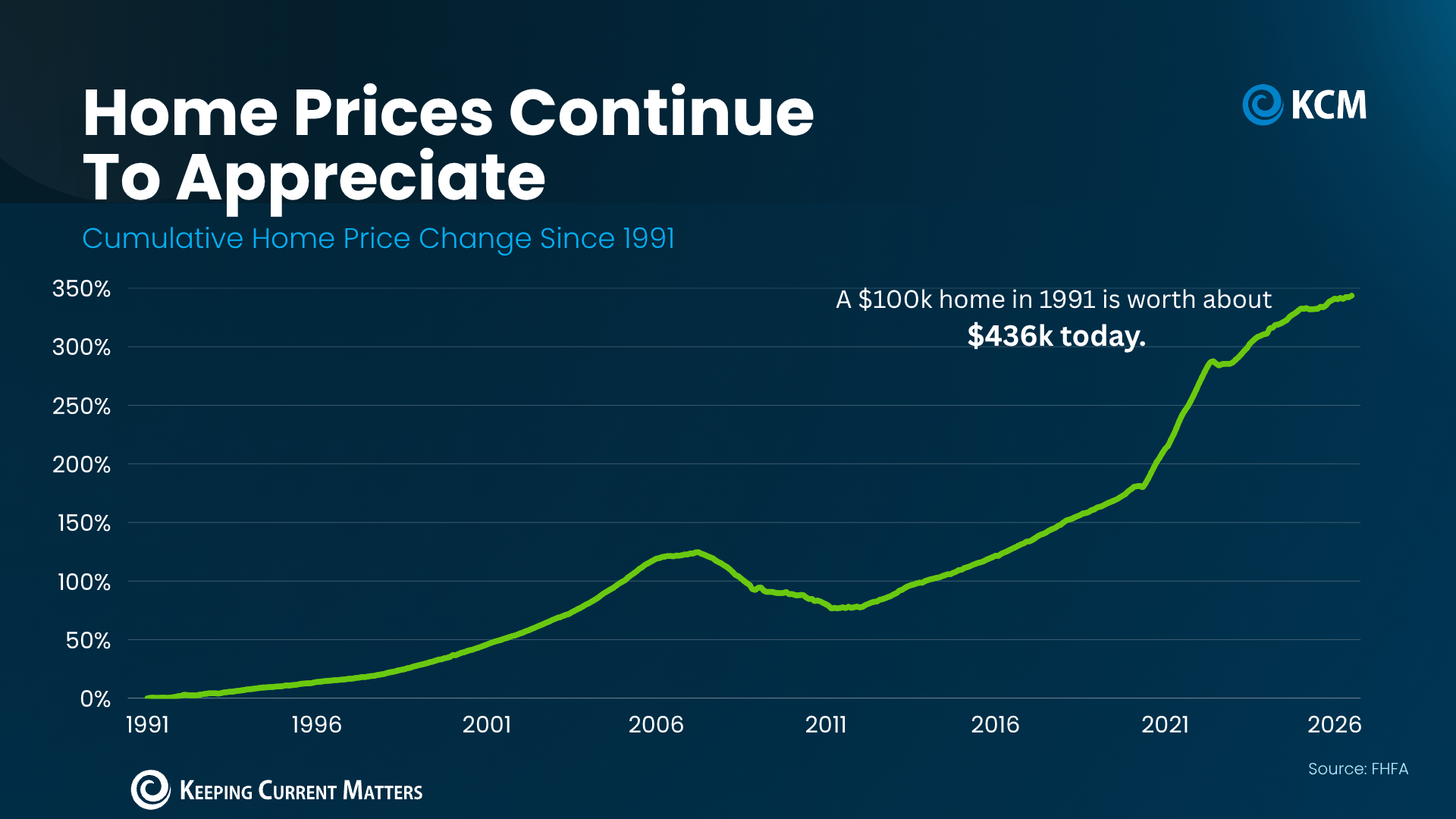
So, this short-term dip probably won’t stick around. The small declines we’re seeing now are in markets that overheated during the pandemic. As a whole, the market is headed back to normal – and normal means prices should rise over time.
National headlines can’t tell you what your home is worth or how much room you have to negotiate. Local data can. If you’re thinking about buying or selling, connect with a local real estate agent to look at how prices are moving in your area, so you can set your price or make your offer with confidence.
After six years of fighting for New York City legislation to give community land trusts and nonprofits the first shot at buying failing apartment buildings, tenant advocates finally scored a victory Thursday.
The City Council voted 38 to 9 to pass the Community Opportunity to Purchase Act, or COPA, on Thursday afternoon. The original version of COPA was first proposed in 2022. Former Mayor Eric Adams vetoed another iteration of the bill after it passed the City Council last year.
“This has gone through three mayors, it’s been introduced four times, it’s had three hearings, it’s been passed, it’s been vetoed and it had a very intense, bad-faith effort to stop it,” said City Council member Sandy Nurse, the bill’s sponsor and a Brooklyn Democrat. “I believe this thing is solid.”
Before casting her affirmative vote, Council Speaker Julie Menin, who opted not to override Adams’s veto last year, praised Nurse and her own team for their work on the bill. Menin said that lawmakers had worked with the Real Estate Board of New York, the powerful real estate trade organization, and other stakeholders to narrow the number of buildings that fall under the bill’s purview. Initially, it applied to 10,000 buildings, but now only 2,100 meet COPA’s revised criteria, she said.
COPA’s remaining detractors on the City Council mostly cited property rights in their arguments against it. Council member Frank Morano, a Staten Island Republican, called the bill unconstitutional.
“Even setting aside the constitutional questions, this is terrible housing policy. It adds uncertainty to property transactions to a city already struggling to attract investment and build housing,” he said.
Unlike Adams, Mayor Zohran Mamdani not only supported a narrowed version of the bill, but made it a focus of his Block by Block housing plan.
The law allows nonprofit groups vetted by the Department of Housing Preservation and Development to make the first offer on a distressed building that’s up for sale. That would apply to buildings with more than four units with a certain number of violations, ones included under HPD’s alternative enforcement program or buildings subject to foreclosure.
COPA gives those organizations, which could include community land trusts or private developers with a nonprofit partner, 20 days to send a letter of interest to the seller, then another 70 days to submit an initial offer. They also have the right of first refusal if the owner receives another offer.
Advocates have estimated the bill would apply to about 300 buildings a year, representing apartments for thousands of residents. With the legislation, these struggling buildings are more likely to be targets for speculation or displace poorer residents, the coalition supporting the bill argued.
“This has the potential to be really game changing for tens of thousands of New Yorkers who will be able to use this right,” said Elena Rodriguez, staff attorney at New Economy Project.
“It’s a bill that has real teeth. There’s a right of first refusal in this policy, there’s a private right of action in this policy, there’s HPD enforcement in this policy,” Rodriguez said.
COPA has undergone a few tweaks since its hearing before the council’s housing committee in September. Buildings with 100 or more units that had affordability protections expiring in the next two years were originally included in Nurse’s bill. In the latest version, they no longer are.
In Nurse’s original bill introduced earlier this year, HPD had the discretion through rule-making to expand the types of distressed buildings that are eligible for COPA. That language was struck from the bill, so that the agency will instead make any recommendations for expansion in their yearly reports.
Another change added a statute of limitations for when community land trusts or other vetted organizations can sue for COPA violations. Now qualified entities have two years from the date that the deed is publicly registered to bring a lawsuit—if a sale took place as a result of a violation.
Ann Korchak, president of the Small Property Owners of New York, called COPA a “devious policy” being held up as a “magic solution” in a statement Wednesday.
“When a privately owned property is faced with economic distress, the owner should not be forced to give right of first refusal to city-sanctioned nonprofit housing providers,” Korchak said, arguing it would scare away other buyers with the means to immediately purchase a failing property.
“It also gives an unfair advantage to the city and nonprofits, which would be free to make purchase offers without the burdensome restrictions faced by conventional buyers,” Korchak said.
There’s a year until COPA goes into effect, during which HPD will go through a rule making process.
Rodriguez said New Economy Project will educate the public on COPA during that period. “There will be a full court press informational campaign,” she said.
In the long term, renters whose struggling buildings get sold could end up living in affordable apartments or even owning them through co-op conversions.
“It represents a moment in New York where the tenant movement is winning against real estate,” Rodriguez said of COPA’s passage. “We’re letting speculators know, letting private equity know, letting house flippers know that we want to take our buildings back and put them into community hands.”