Don’t Let the Fear of a Buyer Backing Out Scare You Away from Selling


There’s nothing quite like the excitement of getting an offer on your house. You’re one step closer to moving on to what’s next. But what happens if that buyer backs out or ghosts you before closing?

If you’ve been seeing headlines about more home sales falling through lately, that possibility may be keeping you up at night. And it’s true. According to Redfin and Cotality, canceled contracts have been on the rise.

But here’s what those headlines don’t always tell you…

Most sales still go through. Only 10-15% hit this snag. And even so, there are things you can do to help keep your sale from becoming one of them.

The key is knowing what tends to scare buyers away and getting ahead of those issues before they have a chance to derail your move.

What’s Behind the Rise in Canceled Contracts?

Today’s buyers are being more cautious. Mortgage rates are stretching budgets, and with more homes to choose from, buyers have more freedom to walk away if something doesn’t feel right. As Redfin explains:

“That gives house hunters more options and makes them more likely to walk away if an inspection uncovers problems, an appraisal comes in low or the seller doesn’t agree to concessions.”

That’s why an accepted offer isn’t always a guaranteed sale. But it doesn’t mean you should be afraid to put your house on the market, either.

It just means getting ahead of potential problems matters more than ever.

3 Things That Can Scare Off a Buyer (and How To Get Ahead of Them)

A Redfin survey asked real estate agents why some buyers are backing out. And their answers give you a short of cheatsheet into what could go sideways and how you can get ahead of those headaches (see graph below):
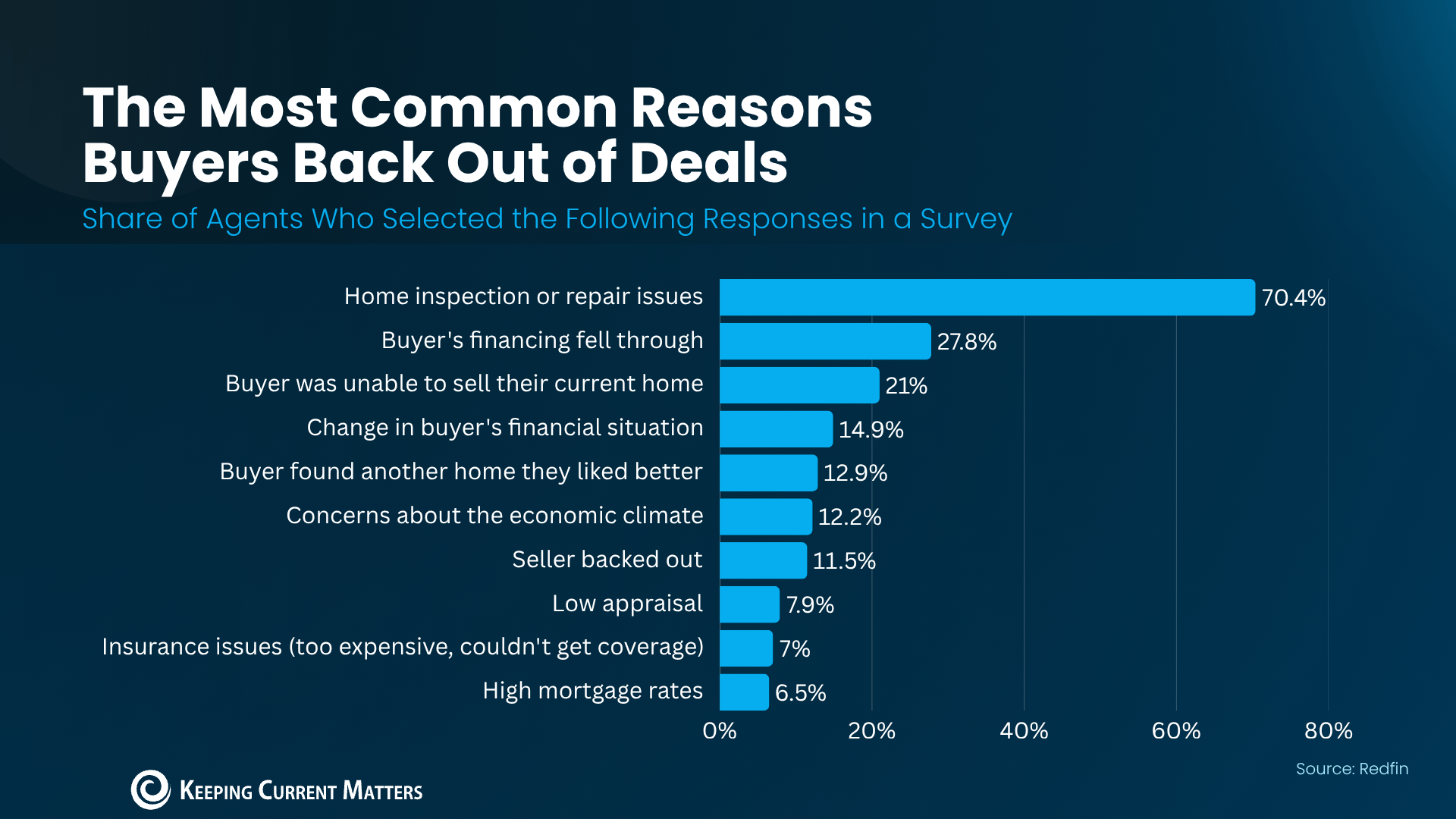
a graph of a survey

1. Inspection or repair issues (70.4%)

This is the big one. And the good news? It’s also one of the areas where you can be the most proactive.

One simple way to head this off is by getting a pre-listing inspection before your house goes on the market. That way, if something needs attention, you can decide whether to fix it upfront (before you sell), adjust your price, or disclose it and come in already prepared for what’s likely to pop up in negotiations. It’s a lot better to find the skeletons in the closet before a buyer does.

2. Buyer financing falls through (27.8%)

Even buyers who are pre-approved can run into financing issues before closing. And with mortgage rates putting extra pressure on affordability, some buyers are finding it harder to make the numbers work.

While you can’t control whether a buyer’s loan goes through, you can work with your agent to look closely at their financing before accepting an offer. And if affordability is the concern, your agent can help you explore whether incentives like closing cost credits or a mortgage-rate buydown could make a difference.

3. The buyer can’t sell their current home (21%)

Sometimes, your buyer needs to sell their house before they can buy yours. And if their sale falls through, yours could be affected too.

That’s why it’s important to understand any home-sale contingencies before accepting an offer. Your agent can help you look at where the buyer is in their own selling process and what protections you may want in place.

The goal isn’t to eliminate every possible risk. It’s to avoid being caught off guard by the ones you can plan for.

Don’t Let the What-Ifs Keep You Up at Night 

Just remember when you read headlines about canceled deals, they don’t give you the full picture. Most home sales still make it to closing.

And if a sale does fall through, that doesn’t automatically mean your house won’t sell. Sometimes a buyer’s circumstances change. Sometimes an issue comes up that can be addressed before the next offer.

What matters is having an agent who knows how to spot potential problems early, help you navigate negotiations, and keep your sale moving forward.

Because while you can’t control every twist and turn, you can control how prepared you are.

Bottom Line

There’s no need to let the fear of a buyer backing out hold you back. While no sale comes with guarantees, a little preparation upfront can go a long way toward making the whole process smoother.

If you’re ready to make a move, talk to a local agent about whether a pre-listing inspection makes sense for you.




Source link

This is your chance to secure an entire entry-level ABS gaming PC for only $849 — amazing Walmart deal sets you up with an RTX 5060 graphics card and shaves $350 off the list price


This budget-focused desktop gaming PC is on sale for a steal at Walmart. Right now, you can save a tidy $350 when you purchase the ABS Cyclone Aqua gaming PC for just $849. A superb deal when you consider the current pricing for PC hardware in general. The original list price of the Cyclone Aqua was $1,199.99, so you’re saving just shy of 30% and getting a current-generation graphics card to bring all the latest games to life on your screen.

● Grab this deal at Walmart


Source link

Grab a Nintendo Switch 2 with a free game for as low as $459 in this limited-time deal — coupon code knocks $60 off sale price for new Woot! customers, $40 for existing ones


Woot! has a brilliant deal right now on Nintendo’s latest handheld gaming console. You can pick up the family-friendly Nintendo Switch 2, along with a free digital game code, for as low as $459 right now if you’re a new Woot customer with the SAVETOBER coupon code. If you’re not, you can still grab it for $479.

● Check out this deal at Woot


Source link

You bought a NYC townhouse. How are you going to manage it?


Townhouse living comes with many perks, including more space, greater privacy, and no upstairs neighbors. But it also comes with a less glamorous reality: You’re solely responsible for every repair and maintenance issue that arises.

That reality leaves many first-time townhouse owners feeling overwhelmed when the dishwasher backs up, the furnace fails, or the roof leaks—and there’s no super to call. 

“I represent a lot of buyers who have never owned a townhouse before and definitely don’t understand what is involved in terms of maintenance,” said Tali Berzak, a broker at Compass. “Besides the one-off repairs, you’re responsible for snow removal on the sidewalk—you’re liable if someone slips and falls in front of your house—and you must be familiar with garbage and recycling collection schedules.” 

The good news is that you don’t have to figure it all out on your own. Lean on your broker and neighbors for recommendations and resources, and read on for tips to help you navigate the responsibilities of townhouse ownership.


[Editor’s note: An earlier version of this post was previously published in December 2025. We are presenting it with updated information for October 2026.]


Don’t wait until you move 

The best time to understand your townhouse’s maintenance needs is before you own it. A little preparation upfront can help you avoid unpleasant surprises down the road.

Josh Blackman, principal of Brooklyn management company Brownstone Property Group, emphasized getting organized before you even close. Specifically, he suggested hiring a property inspector and then “taking heed of the recommendations.” You might even conduct additional inspections for termites and the chimney.

Some mechanicals—such as the boiler or hot water tank—may be decades old and out of warranty. “Being informed before you purchase helps you anticipate and prepare emotionally and financially when things go wrong,” Blackman said. 

In addition, the New York property condition disclosure statement is now mandatory for most sellers of existing one- to four-family properties. Townhouse sellers need to answer 56 questions, including the year the property was built, last service dates for mechanical systems, and the age of the roof. This will give you more insight into the state of your property.

Tap your broker for information

Mine your broker for recommendations on who to call when you have a maintenance issue.

“Your knowledgeable agent can be a great resource before you buy and when something goes wrong,” Blackman said. He added that the seller may also be willing to share a list of trusted electricians, plumbers, and other service providers.

Berzak said she always provides a list of recommended vendors and a checklist of common maintenance issues at the closing so clients have a clear roadmap. First on the list: buying trash and recycling bins, and finding someone to break down boxes and take the bins to the curb if you aren’t living there yourself. (Be aware that owners are now required to use NYC official trash bins, available online or at Home Depot.)

“Among other things, you always need a plumber-slash-heating pro to bleed the radiators or check on the boiler before winter; central air systems should also be checked once or twice a year,” she noted. 

Blackman added that a plumber should check whether there is a backflow prevention valve on the sewer line and consider installing a sump pump in the basement. “Check the roof, check the plumbing, check for leaks on radiator valves,” he said. 

Make a note of subcontractor details

If you’re planning renovations, ask your contractor for a list of subcontractors they use, notably plumbers and electricians. When there’s a leak under the kitchen sink or a power outage, you’ll benefit from working with someone already familiar with your place.

Brooklyn resident Dana Luria, who bought a townhouse in Park Slope six months before the pandemic, took this approach during her own renovation.

“Being able to contact the subs directly has been particularly helpful, especially with the plumber who comes by every few months,” she said. 

It’s also worth keeping a record of the work itself. Save permits, inspection reports, warranties, equipment manuals, and receipts for major repairs in one accessible place. If your renovation involves opening walls, photograph the plumbing, wiring, and other infrastructure before it’s covered up. And when the project wraps, ask your contractor to point out the main water shutoff, electrical panel, and other critical systems so you know where to find them in an emergency.

Share information with your neighbors

No one knows the ins and outs of your block quite like the people who live there. Tapping into that collective knowledge can make finding reliable help much easier.

Luria, who pooled information with other property owners, compiled a Google Doc with details on local maintenance teams and shared it with fellow owners on her block. “It’s a list of all the service providers that people like, and I know many of our friends use it regularly,” she said. 

Local community groups—whether via listservs or social media—are other potential resources for hyper-local trusted providers. 

Berzak said you can often find enterprising neighbors who offer small-job services to multiple owners like you. Ask around. “Many brownstone owners rent out an apartment and can find a tenant willing to take on certain tasks for a rental discount,” she added.

Use subscription maintenance services

If maintenance issues intimidate you, consider hiring a company to handle them. Several businesses offer maintenance services that you can pay for monthly.

According to owner Barnabas Uba Shakur, Foot Soldiers offers exterior maintenance, trash sorting and recycling, and backyard clearing; they will also handle plantings or add mulch to tree pits.

Because townhouse owners are responsible for snow and ice removal, you should prepare in advance. 

“If you call for snow removal services when the snow is in the forecast or on the ground, you are going to pay. Plan in the warm season to find a company for your snow removal needs,” Uba Shakur said, noting his team consistently documents the work with photos and is fully insured. 

The team at Brownstone Property Group provides property management, renovation, and maintenance, as well as compliance services to ensure your property is safe and in compliance with all local laws. For example, parapets now require annual inspections, which the company provides. “Just because you live in a building doesn’t mean you want to do everything yourself,” Blackman said

Like Uba Shakur, he reported that townhouse owners’ needs have increased over recent years. “We have clients who retain our team’s services so that they have someone to call and manage the problems that will eventually arise so that they can focus on their family and work,” Blackman said. 

Berzak recommended VPM NYC, a full-service property management company with over 20 years of experience. Otherwise, she said she relies on Thumbtack to find painters, cleaners, and other pros.

Learn some basic maintenance 

Sometimes you will absolutely need to call on certified and fully insured professionals. However, it’s not a bad idea to master basic maintenance skills yourself—for example, how to relight the pilot light on your water heater, Blackman said. 

“It’s a worthwhile learning curve,” Berzak said. “You can watch the service providers for the first couple of years and then take on these kinds of tasks going forward.” Better yet, record them on video so you can build a custom reference library. She did just that to learn how to change the water filtration system in her own brownstone.

—Earlier versions of this article contained reporting and writing by Emily Myers.


Source link

US Marines join NATO mission in the Baltic Sea to protect undersea cables from sabotage as Russia continues to lurk — ‘around four dozen’ recon and intel specialists deployed to deter seabed threats


A team of around four dozen U.S. Marines is joining a NATO-led operation in the Baltic Sea to help protect undersea internet cables and gas pipelines in the area. In a press release, the U.S. Marine Corps shared its plans to deploy a “specialized team” to support NATO’s Enhanced Vigilance Activity Baltic Sentry operation. The move comes amid a backdrop of growing undersea cable interest, movements of Russia’s shadow fleet, and fears of sabotage.

The U.S. Marines are being sent from Marine Corps Base Camp Lejeune in North Carolina to provide “advanced expeditionary surveillance and tactical reconnaissance capabilities” to the region in support of Finnish and other NATO allies. Marines from 2nd Reconnaissance Battalion, 2nd Marine Division, and the II Marine Expeditionary Force Information Group are joining the mission.


Source link

What to know about NYC’s new Fast Track districts for affordable housing


If you live in one of a dozen community districts in New York City that have been slow to build housing, you could see some housing projects speeding through the approval process starting next year. 

Earlier this month, the Mamdani administration made public a list of 12 neighborhoods that have been the slowest in the city to add housing, a list some are calling the affordable housing “naughty list” or “dirty dozen.”

As a result, starting on January 1st, new affordable housing proposed in those neighborhoods will skip the step of getting approval from their local City Council representative.  

“New York’s housing crisis is not going to be solved by asking the same neighborhoods to do all the building,” Mayor Zohran Mamdani said in a statement. “Every New Yorker deserves a home they can afford, and every neighborhood must be part of delivering it. The Affordable Housing Fast Track gives us a new tool to cut through red tape and make sure our housing growth is shared more fairly across all five boroughs.”

Voters approved this change through a charter amendment that passed last November. 

Where is affordable housing being ‘fast tracked’? 

The city planning commission picked these 12 community districts in Manhattan, Brooklyn, Queens, and Staten Island by dividing the number of new affordable units in the district by the total number of housing units. For this cycle, they looked at the five-year period between 2021 and 2026. According to the city, these districts created only 1 percent of the city’s new affordable housing over the past five years, or just 724 new homes. 

Here are the districts:

  • In Brooklyn: Community District 10 (Bay Ridge, Dyker Heights), 12 (Borough Park, Kensington) and 18 (Canarsie, Flatlands)
  • Manhattan: Community District 7 (Upper West Side) and 8 (Upper East Side, Roosevelt Island)
  • Queens: Community District 4 (Corona, Elmhurst), 5 (Ridgewood, Maspeth, and Middle Village), 10 (South Ozone Park, Howard Beach), 11 (Auburndale, Bayside, and Douglaston), and 13 (Queens Village, Bellerose, and Rosedale)
  • Staten Island: Community District 2 (Mid-Island) and 3 (South Shore)

How fast is ‘fast’?

The Fast Track process aims to shorten the Uniform Land Use Review Process for qualifying projects, which can take seven months. Instead, projects in these districts will go through a 

streamlined 90-day public review process. Projects still need to go through the community board and borough president and get the approval of the City Planning Commission. 

What’s changing in these districts and why?

This status shortens the procedure that affordable housing developers go through to get permission for a zoning change. It doesn’t alter landmark or environmental requirements.

Communities can still have a say in land use decisions during a 60-day period when the borough president and community board concurrently review them. Then, instead of heading to their council member, the projects go right to the City Planning Commission for approval.  

Some parts of the city have seen virtually no new affordable housing built because of the opposition of those areas’ elected officials, said Howard Slatkin, executive director of Citizens Housing and Planning Council, a non-profit housing research organization. 

That dynamic is amplified by “member deference,” an unofficial City Council policy in which other members follow the lead of the City Council in zoning or development votes. If a council member votes no on a project, their fellow members also vote no. 

“It has kind of this nasty side effect of enabling these people who don’t want to see any housing built say ‘no,’” Slatkin said.

As a result, developers looking to build housing don’t waste time and money proposing projects in an area if the council member there is likely to oppose zoning changes. 

“People don’t even bother bringing the application if they don’t think it’s going to be successful,” Slatkin said. 

What housing qualifies?

To qualify as affordable housing subject to the Fast Track, a housing project generally must set aside 20-30 percent of the residential floor space permanently affordable, according to the city planning website.

Affordability in this case doesn’t mean cheap apartments. “It’s a particular kind of regulated affordability that restricts the rent that can be charged and the incomes of the tenants,” Slatkin said. 

This is a broad definition because of how housing is built in the city. 

“We have caps and zoning incentives around new housing that require affordability, so virtually any rental housing that’s going to be built in the city of New York is going to have an affordable housing requirement with it,” said Rachel Fee, executive director of New York Housing Conference. 

Will this actually work?

Some advocates say yes, it will ensure more housing gets built in these areas. But they caution that it takes more than one policy fix to solve NYC’s housing problems. 

“It will definitely help create more housing,” Slatkin said. But residents of these areas won’t see the results immediately. “Be patient. It takes some time.”

The Fast Track list may function as much as a stick for legislators than as a carrot for developers. 

“I don’t think the benefit of this change is so much that they’re on a fast track,” Fee said. “It’s to motivate those communities not to be on the fast track, not to be on the bottom 12.”

It’s not difficult for these communities to improve their ranking, Fee said. Approving one or two more affordable housing projects can be enough to change a district’s position on the list. 

“So many people are stuck in the housing situation they’re in, their family might grow and they have no options to change it,” Fee said. “For some communities to try to preserve what they have frozen in time feels really unfair in a changing and dynamic city.” 

“We need more housing,” she said. “Thats the only way we’re going to bring rents down.”

A call for community-centered planning

A coalition of community groups called the Thriving Communities Coalition penned an open letter to the mayor urging the city to create a comprehensive plan—with community input—to guide housing development with an eye towards investments in neighborhood infrastructure and services like transit. 

The coalition’s letter addressed the mayor’s Block by Block housing plan but also named the Fast Track program. 

“The coalition supports bringing more affordable housing to neighborhoods that have historically produced too little, but argues that faster approvals must be accompanied by meaningful opportunities for residents to shape development priorities,” the coalition said in a statement.

Slatkin said the need for planning that the coalition raises is a different conversation entirely, unrelated to the Fast Track. “This is very specifically about the manner in which land use actions are going to get reviewed—a procedural thing. It doesn’t say how much should go where,” he said.

Where do I learn more?

To learn more, you can attend a virtual public information session on December 3rd hosted by the Department of City Planning.


Source link

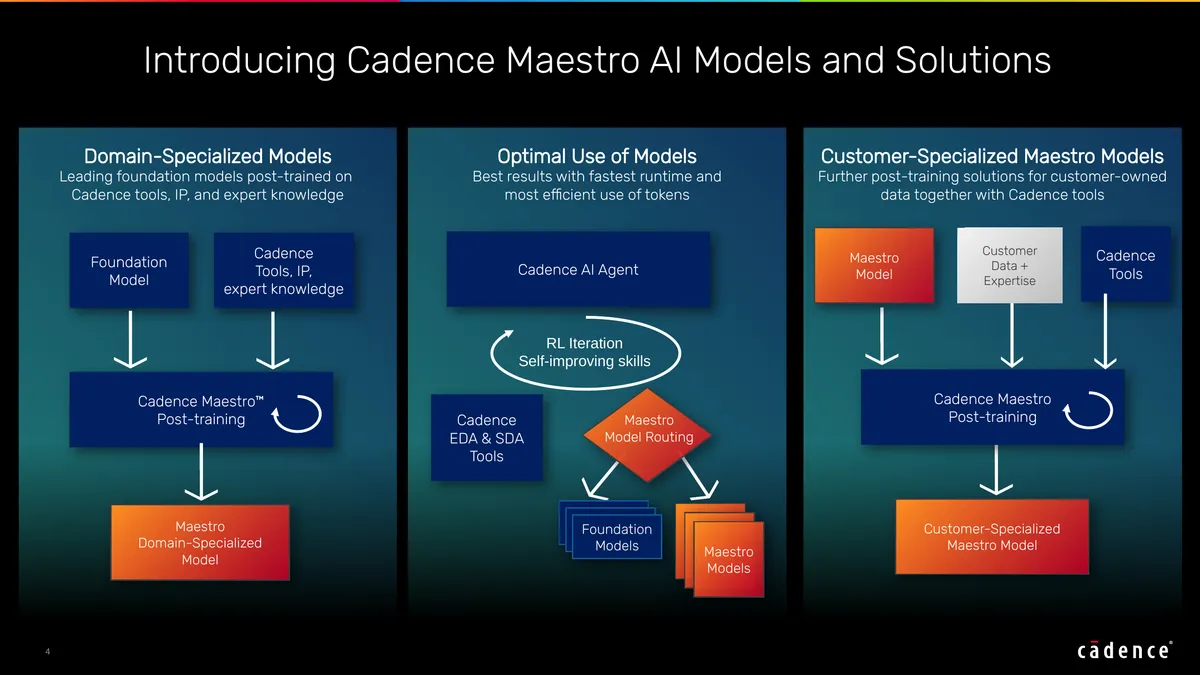
Cadence reveals Maestro, fine-tuned AI models built to run specialized chip design agents, with early access coming for ‘select customers’ in Q4 2026 — claims up to 30% higher quality results and up to 5x token efficiency over a general-purpose AI model


Cadence, one of the largest electronic design automation (EDA) companies, has unveiled Maestro, its new portfolio of domain-specialized AI models tailored for its chip design agents, in a press release sent just ahead of earnings. In initial results compared with general-purpose AI models, Cadence claims up to a 30% improvement in the quality of results and that Maestro effectively uses fewer tokens for the same task, with up to 5x the token efficiency. The first models “are available to select early access customers” in Q4 2026, and customers may run them on Cadence’s cloud, public clouds, or customer-controlled on-premises environments and post-train them on their own “proprietary data, designs, and workflows.” To learn more about Maestro, we spoke with two Cadence executives: Rob Knoth, senior group director of strategy and new ventures, and Paul Cunningham, senior vice president and general manager.

This approach is distinct from Synopsys’ own specialized model, GPT-Synopsys, which will run on OpenAI-hosted infrastructure, without using customer data to train the model. The models of both EDA giants, announced less than a month apart, now split on where a customer’s design data goes. Where they might not differ is why: Paul Cunningham, senior vice president and general manager at Cadence, told Tom’s Hardware Premium that agent costs have “really started to explode,” adding, “And I think the world realized so.” That makes it a natural step, he said, to move more of the agents’ iterating “into the weights of the models themselves.”

Latest Videos FromTom’s Hardware


Source link

Big Tech is cashing in on AI while the rest of corporate America sees no financial returns — report outlines how rising token costs threaten to squeeze corporate profit margins


AI spending is generating revenue for technology providers, but most other S&P 500 companies have yet to show comparable gains in productivity or profit margins, a report by Apollo’s Daily Spark analysis has shown.

Go deeper with TH Premium: AI and data centers

Microsoft data center in Mount Pleasant, Wisconsin

(Image credit: Microsoft)


Source link