
To Sell or Rent? How To Choose the Best Path for Your House.


Selling your house is a big step, and you want it to go smoothly. And with houses taking a little longer to sell these days, renting it out might start to sound like a nice backup plan.

But the reality is, while renting can work well for some people, it’s also a big commitment. So before you decide, it helps to see the whole picture first.

Why Some Sellers Are Deciding To Rent Instead

Lately, some sellers are choosing to hang on to their houses and rent them out instead. According to Parcl, around 9% of homes for rent right now were previously up for sale. 

Here’s why. 

Some homeowners put their houses on the market expecting a faster process than they got or a certain price buyers didn’t respond to. And when things didn’t go exactly as planned, they decided to rent instead. As Kara Ng, Senior Economist at Zillow, explains:

“Bargaining power is tilting toward buyers and homes are taking longer to sell, making renting out a property one way to buy time rather than compete aggressively on price.”

But here’s the important distinction. Just because some sellers are choosing to rent doesn’t mean selling isn’t working. In many cases, the difference comes down to how well a house is priced, prepared, and marketed for today’s buyers. 

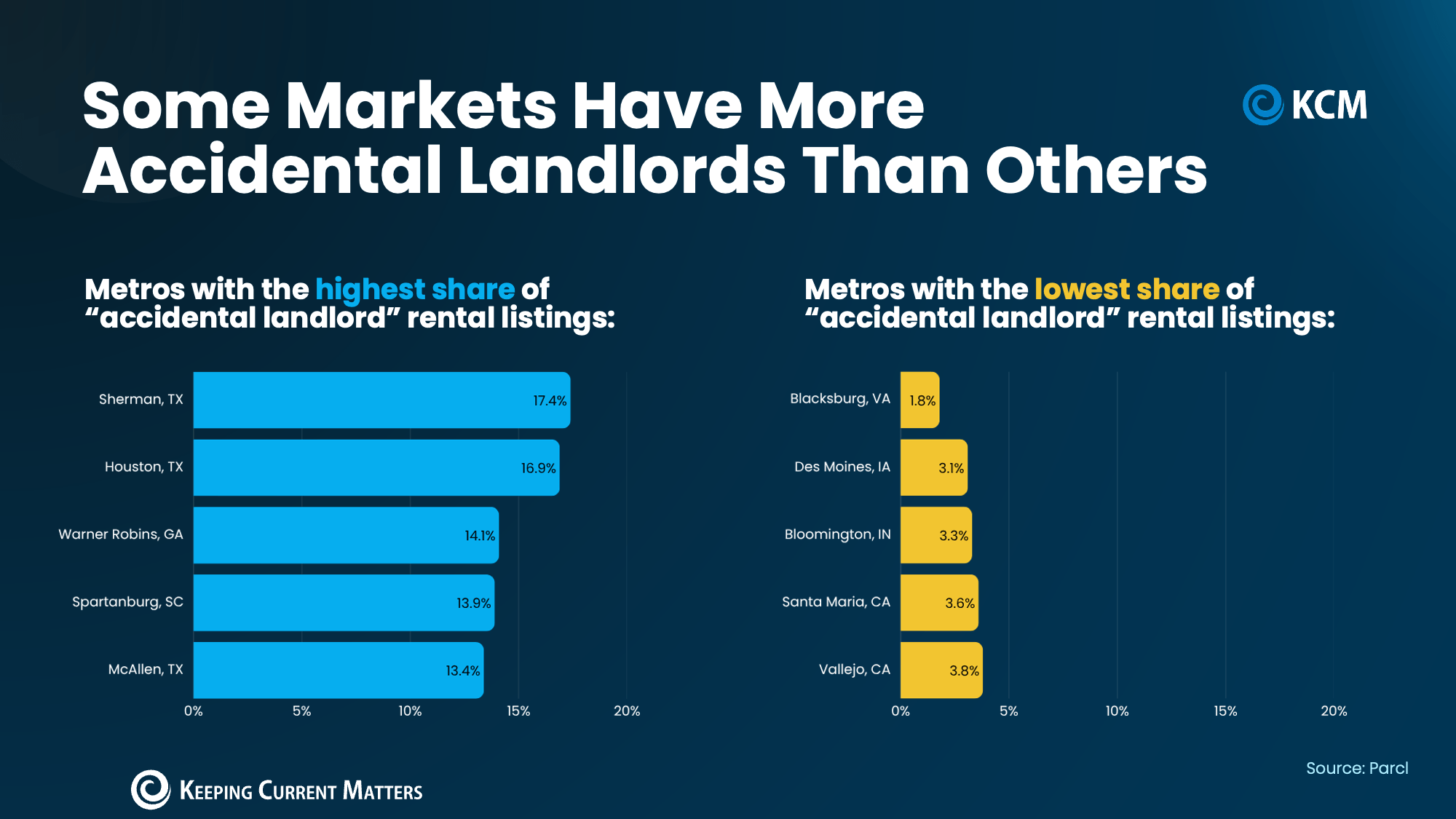
Parcl data shows where these “accidental landlords” – owners who planned to sell but decided to rent instead – are most common (see graph below):
a blue and yellow graph with white text

They make up around 17% of homes for rent in places like Sherman and Houston, TX, but less than 4% in markets like Des Moines, IA and Bloomington, IN. 

That’s a pretty big difference. And it shows why you have to know what’s happening in your neighborhood. Your market, your asking price, and your strategy all play a role in how your sale goes.

A local agent can show you how houses like yours are selling, what strategies work best, and help you weigh your options – not to push you to sell, but so you at least have the full picture based on today’s market. And part of making an informed decision is understanding what renting your house would actually take.

What Being a Landlord Actually Looks Like

While renting might sound like easy passive income on paper, in practice, it’s a hands-on job with rules to follow. As Invest West Management puts it:

“Even if you never intended to become a landlord, the law still sees you as one — and you must meet all legal obligations that come with that role. This often includes registering the tenancy, providing tenants with certain disclosures, and ensuring the property meets safety standards.”

You’d also be the one chasing missed rent payments, fixing damage between tenants, and covering unexpected repairs. Not to mention fielding weekend calls about leaky dishwashers or broken AC units. 

There are expenses beyond regular maintenance and repairs, too. According to Bankrate, these are a few of the biggest: 

  • Insurance premiums (landlord insurance typically costs about 25% more than a standard homeowners policy)

  • Management fees (if you hire a property manager, they usually charge around 10% of the rent) 

  • Gaps between tenants, when you pay the mortgage without rental income

How To Give Your House a Strong Start

If you want to be a landlord and you’re prepared for the responsibility, renting may be a great fit. But if you’d really rather sell, don’t let today’s market convince you that you can’t. 

A great agent can make it happen. The key is having an open conversation up front with your agent about pricing and how to market your house. Nailing those details from day 1 helps your house make a great first impression, so renting doesn’t have to be your fallback.

Bottom Line

Renting can be a good fit for the right person with the right house, but it isn’t the only option. A smart sales strategy can help your house stand out to buyers from day one.

So, if you’re on the fence, a local real estate agent can help you compare what selling and renting would each look like for you.



Source link

A fire safety checklist for your NYC apartment building


It shouldn’t take hearing about a devastating fire to prompt you to check safety measures in your own New York City apartment building, but that’s often what spurs people to act.

With so many tragic outcomes when there’s a serious fire—death, injury, displacement, and loss of personal possessions—it is important to take some preventative steps. Even small fires can have major consequences, because residents can be barred from returning home for extended periods and sometimes be victims of theft in their damaged properties.

So how can you make sure your apartment building is taking fire prevention seriously? The first step is knowing some of the main causes of residential fires—and making sure your landlord is following safety procedures. 


[Editor’s note: A previous version of the article ran in October 2025. We are presenting it again in case you missed it.]


Read on for a checklist for fire safety measures in a New York City apartment building.

Does your smoke detector work? 

Your landlord is required to provide at least one smoke detector in your apartment but you must maintain it. You should periodically check to make sure the batteries are not dead. Some alarms have a blinking light or sound if the batteries are dead so don’t ignore those warnings. And don’t be the person who disconnects your sensitive detector because it’s triggered by your cooking. 

You can also request to have a smoke alarm installed in your apartment for free through a partnership between FDNY and the Red Cross. You will need to fill out a request form.

Regarding fire extinguishers: NYC fire code doesn’t require them except for where fuel-burning equipment is installed, like a hot water heater. Why? FDNY advice to leave the building during a fire, not try to extinguish it yourself. 

What is the safety plan? 

NYC fire code requires your landlord to issue a copy of a fire and emergency preparedness guide each year. A copy should also be posted in your apartment (usually on a door) and in common areas. It details what you should do in the event of a fire, like call 911 and evacuate.

Your building might also include specific fire safety measures and protocols in your lease or house rules. Another tip: If there are children under six living in your apartment, landlords of multi-family buildings are required to provide either stove knob covers or permanent safety knobs. You might also want these if you have hyperactive cats who might accidentally turn on your gas stove (we’re speaking from experience). Owners must also provide either device if the tenant requests them—even if you don’t have a child under the age of six.

Are there self-closing doors? 

Self-closing doors are required in all residential buildings with three or more apartments. If the doors function correctly, they work as a barrier and cut off oxygen to stop the spread of the fire. If they aren’t maintained, they can be deadly. That was the case in a 2022 Bronx high-rise fire where safety doors failed to close and 17 people died.

How can you tell if your door closes the right way? If you push the door open, it should swing back and close on its own. You should hear a click and a latch.

Is your fire escape safe to use? 

Your fire escape isn’t a place for you to dry clothes or use for storage. It’s actually your exit if there’s a fire and you can’t make it through the building—so it’s important to keep it clear.

Fire escapes are covered by Local Law 11, which requires your landlord to have them inspected every five years if you live in a building six stories or higher. If your fire escape seems unsafe for any reason, you should contact your landlord immediately.

Where is the closest exit? 

If you live in a new building, there are no fire escapes as result of a 1968 building code change. Instead your building is required to have exit stairwells with alarms and sprinklers. So make sure you and everyone who lives in your apartment knows the easiest and quickest way to get out of the building.

Remember: You should not use an elevator during a fire. Flames can damage a building’s electrical system and short-circuit the elevator, trapping you inside. Toxic smoke can fill an elevator shaft quickly. Need we say more? Take the stairs—they are quicker and safer.


Source link

AMD Ryzen 5 5500F review: Vermeer rides again for budget gaming PCs


Why you can trust Tom’s Hardware


Our expert reviewers spend hours testing and comparing products and services so you can choose the best for you. Find out more about how we test.

We often criticise companies for misleading marketing, which typically falls in the direction of deceitful overpromising. With the Ryzen 5 5500F, we have the opposite problem. Its name and branding undersell what AMD is offering here. It’s a marked improvement over the base Ryzen 5 5500, giving AMD better standing among the best budget CPUs.

The 5500F is a Zen 3 CPU from the Vermeer family of chips, packing six cores, 12 threads, and a boost clock of 4.4 GHz. It’s modest by the standards of the best CPUs for gaming, but it also comes in at a suggested retail price of just $100. Those prices have drifted up toward $120, though hopefully they’ll settle down around list price before long.

Source link

Intel installs production tools at Fab 62 in Arizona, provides updates on Ohio chip fab — confirms High-NA EUV for High Volume Manufacturing in 2028


Intel on Wednesday announced that it had started installing production tools at its Fab 62 in Arizona, and the fab is on track for mass production by late 2028. The company also reported progress on its Ohio One manufacturing complex and confirmed that it has integrated High-NA EUV lithography into high-volume manufacturing (HVM). Meanwhile, Intel continues to invest in its leading-edge process technology R&D, advanced packaging, and photomask production capabilities in the U.S., which puts the company ahead of the competition.

“There is an important difference between technologies made in America and technologies that are truly American-made,” wrote Naga Chandrasekaran, executive vice president and chief technology and operations officer, Intel Foundry. “The difference lies in the research and development process that transforms ideas into manufacturable technologies.”

Fab 62 to begin operations in 2028

Latest Videos FromTom’s Hardware


Source link

Want a More Affordable Home? Don’t Overlook Condos.


When you picture buying your first home, chances are you’re imagining a traditional single-family house with its own yard, maybe a garage, and little extra room to grow. But with affordability still tight, getting everything on that list right away may come with a higher price tag than you’re comfortable with right now.

So, if you’re running the numbers and buying a house like that feels like a stretch, there may be another way in. A condo.

Because in a lot of markets, condos come with a significantly lower price tag. And that could make them a smart way to get your foot in the door.

Condos Can Cost Less Than You Think

According to a recent study by Zillow: 

“Condos are the most commonly affordable home type in virtually every metro. At the starter level, the savings can be pretty significant. Nationally, starter condos average $197,468 — that’s about 6% less than the typical starter home.”

And depending on where you live, the difference can be much bigger. 

Zillow identified metro areas where typical starter condos are priced significantly below the estimated home price a median-income household could afford. Here are the top 10 according to that research (see chart below).

In Houston, the gap is at its widest. There, a typical starter condo was valued at about $85,600 – 72% below the price considered affordable based on the area’s median household income.

a blue and white chart with white text 

Of course, every market is different. But the bigger point is this: if you’ve only been searching for traditional single-family houses, you may be overlooking some of the more affordable options on the market.

And even if your city didn’t make this list, that’s okay. The trend holds true in many places across the country. Here’s why.

A Condo Could Give You a Different Way In

Part of the reason condos can cost less is pretty straightforward. They’re typically smaller. And less square footage can mean a lower purchase price.

So, if you can make do with a bit less space or you’re coming from a smaller apartment now, this can be a great way in. Plus, on the upside, you won’t have to buy a ton of furniture to fill out a bigger house. You can get a potentially lower price up front and spend less once you move in because you’ll need less new stuff to fill that empty space.

And more buyers are making that trade off on space to offset the current affordability challenges. Ali Wolf, Chief Economist for New Home Source, explains:

“In addition to favoring smaller floor plans, more consumers are showing a willingness to live in an attached home. This shift is not driven by a preference for shared walls, but by a pursuit of value.”

That’s really the heart of it. Looking at condos isn’t necessarily about wanting less. It’s about finding another way to make your move happen with the budget you have.

Don’t Rule Out an Option That Could Work

If you’ve been struggling to find a house you like at a price you can comfortably afford, talk to your agent about adding condos to your search.

You may find something in a neighborhood you thought was outside your budget. You could get access to amenities you wouldn’t otherwise have. And you may be able to become a homeowner sooner rather than waiting for the numbers on a single-family house to work.

While there are trade-offs like shared walls, less outdoor space, and an HOA fee to factor into your monthly budget, maybe that’s worth it if you finally get your own set of keys.

Plus, a lot of the times, a condo community comes with great amenities like pools, gyms, and the condo association handles at least some of the maintenance. Which is closer to what you’re used to from your apartment – it could make the transition to homeowner not just more affordable, but that much easier too.

Bottom Line

The first home you buy doesn’t have to be a single-family house. If affordability has been holding you back, talk to a local agent about expanding your search and see whether a condo could fit the price point you’re looking for.


Source link

The 1865 John J. and Emma G. O’Brien House at 208 East 78th St: Colorful lives in a narrow home


Have you ever passed by an interesting residential building in New York City and wanted to know more about its history? In this series, Brick Underground teams up with Tom Miller, creator of Daytonian in Manhattan, a blog about Manhattan buildings and other historic architecture. Each week, we run an excerpt from the Daytonian’s archives with a link to the full article.

Howard A. Martin purchased 200 feet of property in 1861 along East 78th Street, which at the time existed only on paper. His deed included a $128 assessment (about $4,830 in 2026) to open the street. Martin divided the parcel into 15 building plots, each 13-feet, four-inches-wide. His builders, Warren and Ransom Beman (possibly brothers) and John Buckley, were most likely responsible for the charming design of the challengingly narrow homes.   

Martin’s project stalled when, that same year, the Civil War broke out. Thousands of laborers marched off to fight and construction in New York City ground nearly to a halt. Finally, in 1865 (the year the conflict ended) construction of the 15 identical houses was completed. Each rose three stories above high basements. Two bays wide, their red brick facades were trimmed in brownstone. Each of the openings was fully arched. Bracketed Italianate-style cornices graced the rooflines.

Possibly strapped for money because of the delay, Martin had sold the unfinished project to investor William H. Brower. It appears, because of the regular turnover in occupants, he rented 208 East 78th St.

Interestingly, despite its narrow proportions, two families initially occupied the house. William Rosenberg and Jacob Weinman were partners in three dry goods stores. The families remained until 1869, when an auction of their household goods was held.

The Morris Jacobson family occupied the house in the 1890s. Jacobson was a real estate operator and ran his business from the house. It appears that Moses Hirsch Sr. purchased No. 208 at the turn of the century as a wedding present for his son, Moses Jr. and his bride, the former Hannah Rothschild. They would suffer heartache four years later. On February 3rd, 1905, Ira Arnold Hirsch died at the age of three months.

The following year, Moses Hirsch sold 208 East 78th St. to John J. and Emma G. O’Brien. The couple had one son, Thomas K.

Born in 1862, John J. O’Brien was a fascinating figure. In 1884 he earned the title of “amateur wrestling champion of the United States,” according to The New York Times. He never totally abandoned the sport. He was a judge at wrestling events, including the 1920 Olympic Games in Belgium.  

O’Brien sat on the last New York Board of Alderman prior to the consolidation of the boroughs in 1898. That year he was appointed an official of the Department of Sanitation. He was also the head of the John J. O’Brien Printing Co.

In 1964, the four 1865 houses to the west were demolished. Those at the far east of the row were razed before 1900, replaced with a tenement building. There were now just five houses, including 208 East 78th St., that survive.

At some point the homeowners of the row agreed to paint the brownstone trim white, giving the charming residences a unified appearance. For more on the property and the interesting people that lived here, check out the full article.


Source link

Norwegian undersea cable builder pitches 2,800-mile transatlantic data link between Canada and Europe to bypass the US — Canadian majority partner sought to help fund and build new $620 million fiber connection to reduce reliance on American routes


A Norwegian company building fiber networks and data centers across Europe is looking for a majority partner to help fund and build a transatlantic undersea cable that would connect Canada with Europe directly, bypassing the United States. The project follows worsening relations between Washington and Ottawa, with the Canadian government looking to reduce direct reliance on its immediate neighbor, Bloomberg reports.

Project Leif Erikson, if it goes ahead, would stretch more than 2,800 miles, starting at the southern tip of Norway and ending up at Happy Valley-Goose Bay in Canada’s eastern province of Newfoundland and Labrador. From there, it would continue underground over Canadian territory, passing through Quebec before reaching Montreal.


Source link

Which repairs are co-op and condo owners responsible for? What do buildings take care of?


When you own a New York City apartment, some things inevitably need fixing. But it can be difficult to know what are you responsible for and what your building is on the hook for. For example, you may need help figuring out whose job it is to replace the windows. Or what the board’s role is if there’s water damage from a neighboring apartment.

Answers to these questions depend on whether you own in a co-op or a condo building. When you buy a condo, you own the property and get a deed. A co-op building, on the other hand, is structured as a corporation with a board of directors, so instead of receiving a deed you are a shareholder.

As a co-op owner you sign a proprietary lease, an agreement that has similarities to a lease in a rental building. 

In addition, for NYC renters, there’s a set of rules called the warranty of habitability that details the services a landlord must provide in order to keep the building and apartment safe and livable at all times. These rules also protect co-op owners. In a condo building, there’s no warranty of habitability between the board and unit owners.

Here are some of the most contentious maintenance issues and guidance on who typically is responsible for them.


[Editor’s note: A previous version of this post was published in September 2021. We are presenting it again with updated information for August 2025.]


Window replacements

In a co-op, a shareholder’s responsibilities are spelled out in the proprietary lease. Marc J. Luxemburg, an attorney at Gallet Dreyer & Berkey who specializes in co-op and condo law, said a good guide is to use what he called “the rule of thumb nail.” If you put your thumb nail against the wall and wiggle it into the plasterboard, you can get it a fraction of an inch into the wall. That’s about as far as the shareholder’s responsibility goes. 

“Anything you can touch with your finger or finger nail is a shareholder’s responsibility,” he said. 

So the structure of the window and the maintenance of the exterior is typically the responsibility of the board but the shareholder will have responsibility for maintaining the interior. 

“Nine times out of 10, windows are the responsibility of the co-op,” said attorney Andrew Freedland, a partner and co-chair in the condo and co-op practice at Herrick, Feinstein. He said that in most cases, if the window frames are in disrepair, a co-op board has a responsibility to maintain them. However, the majority of co-ops were converted in the 1970s and 1980s, and in some cases the proprietary lease has been updated. If your lease has been amended, responsibility may have been transferred to the shareholders.

It’s important to remember that the warranty of habitability doesn’t provide for all situations involving a window. A co-op board has a responsibility to make sure apartments are fit for human habitation but isn’t responsible if damage is caused by a tenant or shareholder. For example, if a resident throws a bottle and it breaks the window, the co-op building wouldn’t be responsible. And if the window is scratched or discolored in some way, the damage would not fall under the warranty of habitability.

Pro Tip:

Window and Door Pro specializes in the complexities that come with NYC—co-op approvals, landmark restrictions, pre-war constructions. Get a quote here. 

Water damage

If there’s a plumbing issue that’s unrelated to a fixture within the apartment, in most cases the responsibility for repairs will fall on the co-op board. Again, you’ll want to take a look at your proprietary lease to make sure. If the problem is inside the building walls, it’s typically a co-op’s responsibility under the lease. If it occurs outside of the walls, such as an issue with the faucet, toilet fixture, or sink, usually it’s the shareholder’s responsibility. 

That’s why it’s important to have homeowner’s insurance. Freedland said a standard ’80s-style lease does not typically have a requirement that shareholders get insurance but it’s one of the most frequently requested proprietary lease amendments. 

But what if you’re the neighbor in the scenario above and the shareholder who’s responsible is being slow to make repairs? Perhaps you’re worried there’s mold growing in the walls. In some cases it makes sense for a board to assume responsibility for basic repairs to save time. The board may fix the problem and pass on liability later. One reason: The board also has a responsibility under the warranty of habitability to assist affected neighbors. 

Again the situation is different for condos: In a condo you have to fix it yourself and sue a culpable neighbor or board later. However, to be successful, you’d need to prove negligence on their part.

Paint and wallpaper

Landlords—and by extension co-op boards—are required to paint or cover apartment walls with wallpaper. Your apartment walls should not be exposed sheetrock. Very often the proprietary lease will, however, say shareholders are responsible for painting.

Perhaps the remedial mold work from your neighbor’s water damage requires a hole to be made in your wall. A co-op board has a responsibility to make sure the wall is properly repaired and painted. Are they required to rehang your expensive wallpaper? No. You’ll likely get a coat of primer.

As a shareholder in a co-op, it’s possible you could call 311 and get a violation against a board if the paint or wall covering in your apartment is bad shape but that is an aggressive move that can backfire.

“The legal codes don’t supersede the proprietary lease,” Luxemburg said, so what might happen is the co-op board will, if forced by a judge, paint your apartment to meet the code but then charge the shareholder for the work. You might even have to pay the legal costs. 

These are not issues that are relevant to condo owners. However, if you rent out your condo and become a landlord, you’ll have obligations to your tenants under the warranty of habitability. 

Electric wires, steam risers, and your front door

If you’re using the “rule of thumb nail” to determine who is responsible for what, Luxemburg pointed out there are a couple of exceptions.

The first: Electrical wires in your walls. You might not be able to physically touch the wiring but it is typically a shareholder’s responsibility. This means if you change any of the electrical systems in your apartment, you take responsibility for the quality of the work.

Another exception in a prewar co-op building are the steam risers. These are pipes that are very often exposed and run from floor to ceiling to release steam from the boiler. The maintenance and repair of these risers is a co-op board’s responsibility. 

The front door of your co-op unit is another exception. “It belongs to the board,” Luxemburg said, although the painting and decoration falls on the shareholder. The door must be fitted with a standard lock but if the shareholder adds a second, for additional security, that is not the board’s responsibility.

—Earlier versions of this article contained reporting and writing by Emily Myers.


Source link