When mortgage rates climb, buying a home can start to feel like trying to hit a moving target. Every jump in rates makes monthly payments bigger, and that pushes a lot of buyers to look for another way in.
More and more of them are finding it in the adjustable-rate mortgage, or ARM.
The ARM Option
Here’s how an ARM differs from a more traditional mortgage. With a regular fixed-rate mortgage, your rate stays the same for your whole loan. But with an ARM, your rate is locked for the first few years, then it can move up or down based on market conditions.
Some people don’t like that level of uncertainty – and that’s okay. But others are drawn to this option specifically because there’s usually a lower rate to start when you opt for an ARM. And in an affordability-strapped market, that’s going to gain popularity.
Bankrate recently found that, in September, rates for ARM products were over a full percentage point lower than a regular fixed-rate loan. Depending on the ARM product, that can make a difference of $150-300 in the monthly payment on a median-priced home.
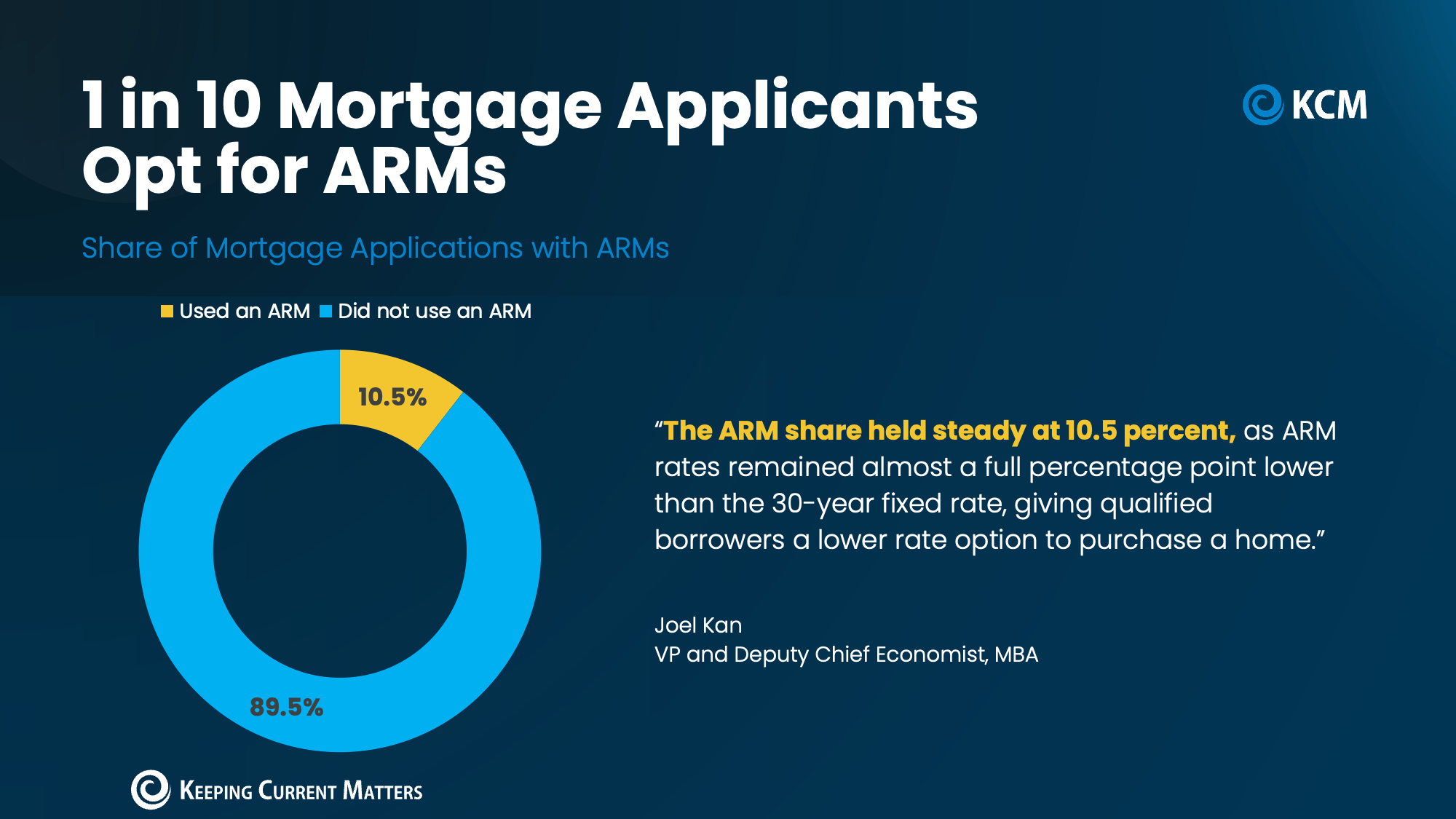
And for some buyers, that’s enough to turn “not right now” into “let’s do this.” You can see it in the numbers. Data from the Mortgage Bankers Association (MBA) shows that, in October, roughly 1 in 10 people applying for a mortgage chose an ARM (see graph below):
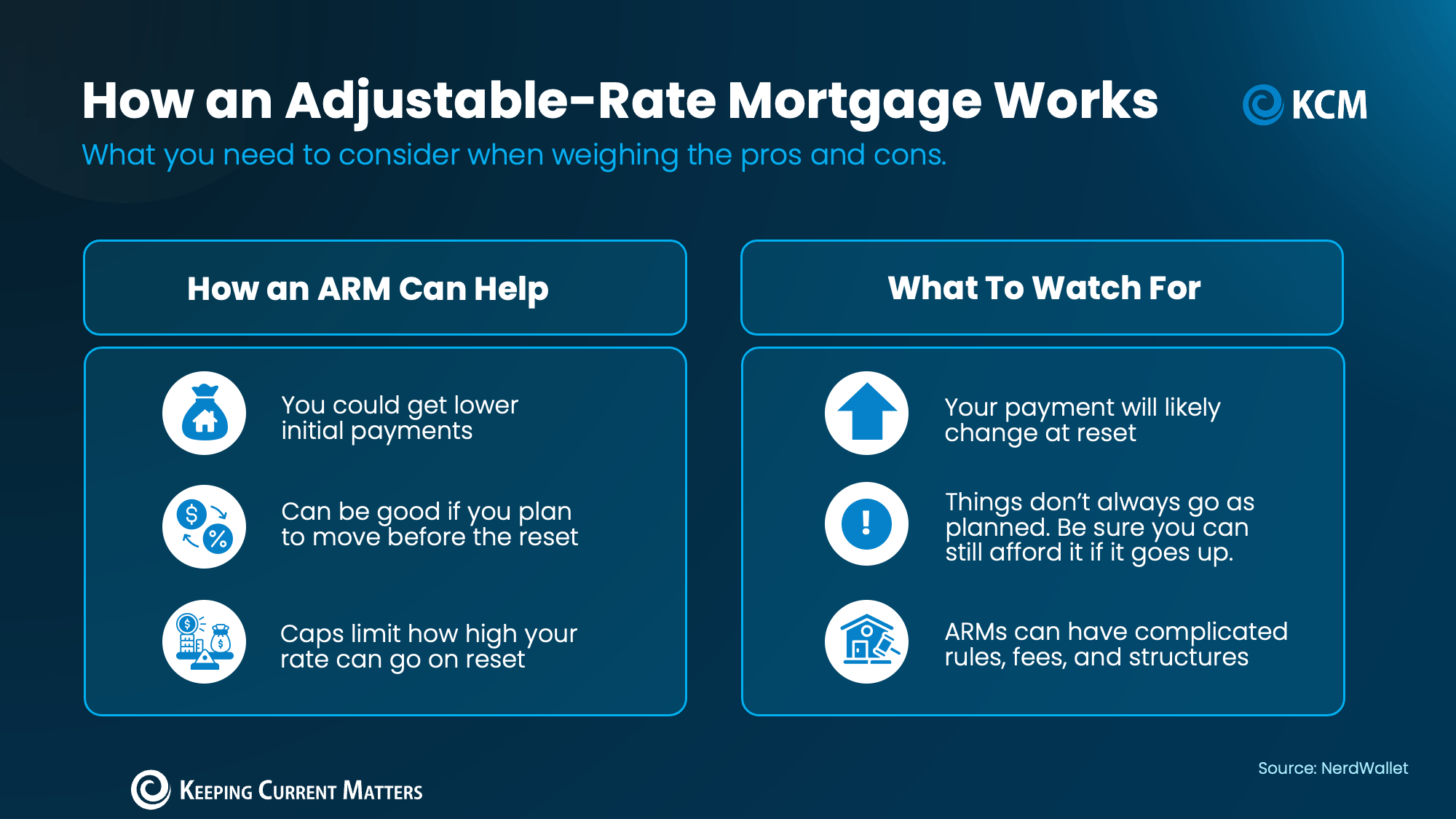
If you think you may want to consider this yourself, here’s what you need to know about how it works.
The 5/1 ARM
An ARM is like a phone or cable plan that has an introductory deal for new customers. You start out at a lower price, and then it adjusts after a specified amount of time. A popular loan is the 5/1 ARM.
The “5” means your introductory rate is locked for the first five years, and the “1” means that the rate can change every year after that. The rate change is called the “reset.” And here’s the really important part.
When your rate resets, your mortgage payment could go up or down. The good news is that most ARMs have caps, which are limits on how much your rate can rise each year and over the life of the loan. But either way, you have to be ready.
The Upsides and Potential Downsides
To see if this type of loan may be right for you, here are some things to think about and discuss with your loan officer:
Before you decide, ask your lender to work up the numbers and walk you through the different potential scenarios you could run into with an ARM. That way, you go in with your eyes open.
Be Ready for the Reset
And, if you do go with an adjustable-rate mortgage, just know that you’ll have choices when the reset time arrives. You could:
Do nothing and keep your loan in place if the new payment still fits your budget.
Refinance into a fixed-rate loan with a payment that never changes.
Refinance into another ARM with a new lower rate locked for a specified timeframe.
Sell your home.
Talk to the loan servicer about assistance or modification.
Remember, a refinance is a brand-new loan that you’ll have to qualify for – even if it’s on a home you already own. So, keep tabs on your credit and debt levels and ask your loan officer how major financial moves like job changes and major purchases will affect your mortgage readiness. It’s important to keep your credit and finances in “mortgage shape.”
Today’s ARMs Aren’t Like 2008
One more quick note. ARMs got a bad name after the financial crisis of 2008. Back then, there were some risky loans with small starting payments that later shot way up. Others let people borrow without proving how much money they earned.
But now, there are new laws to protect both borrowers and lenders. The biggest change is the Ability-to-Repay Rule, which says that before a lender makes a home loan, it has to check real paperwork (like pay stubs, W-2 forms, and tax returns) to make sure you can afford it. The lender also has to look at what your payment could be after the reset, not just the low starting payment.
So, you don’t have to worry that today’s ARMs are the same as the ones we saw back during the crash.
Bottom Line
Today’s market has more options than many people realize. Finding the right one could be as simple as getting more information about tools like ARMs. A trusted lender can run the numbers with you, walk you through the what-ifs, and help you explore the possibilities.
Is an ARM a good option for you? Talk to a loan officer to find out.
Our expert reviewers spend hours testing and comparing products and services so you can choose the best for you. Find out more about how we test.
Razer has been updating its gaming mouse lineup systematically over the past two years, and it’s finally the Basilisk’s turn to get a real update. The last update we saw to the Basilisk line was the Basilisk V3 Pro 35K in October 2024, which was basically just the Basilisk V3 Pro with a new sensor.
The Basilisk isn’t Razer’s most popular gaming mouse line, but it is the more versatile, all-rounder line for people who aren’t chasing performance above all else. The Basilisk V4 Pro maintains the general design of its predecessor — a contoured, right-handed gaming mouse with bright RGB lighting and a handful of extra buttons, for the serious gamer who isn’t trying to break esports records. It features Razer’s newest Focus Pro 50K optical sensor, gen-4 optical mouse switches, and up to an 8,000 Hz polling rate, plus multiple forms of connectivity and up to 200 hours of battery life (over 2.4GHz at 1,000 Hz).
It is admittedly pricey, like all of Razer’s flagship mice, at $169.99 for both colorways (black and white), and it launched with Razer’s Mouse Dock V2 Pro — which is sold separately for $69.99.
Latest Videos FromTom’s Hardware
Design and Comfort of the Basilisk V4 Pro
Following in the footsteps of its other recent next-gen mouse launches, Razer has kept the design of the Basilisk V4 Pro largely the same. The Basilisk V4 Pro has basically the same size and shape as its predecessor — it has a right-handed ergonomic shape with a contoured thumb rest and a hump that sits slightly back and to the left. It has large primary mouse buttons with shallow finger grooves, and a slight contour on its outer edge that makes it relatively easy to pick up and move.
(Image credit: Tom’s Hardware)
It’s not exactly the same as the V3 Pro, however. The V4 Pro has two new buttons, for a total of 12 programmable buttons on the mouse: the left and right primary buttons, three thumb buttons (instead of the usual two) and a trigger button in the thumb groove, a clickable tilt wheel (three “buttons” — center click and left/right click), two buttons above the tilt wheel, and an extra button on the left side of the left mouse button. The third thumb button and the extra button on the left mouse button are the new ones; the third thumb button sits in front of the first two and is set to open up Razer’s AI prompt by default, while the extra button on the left mouse button is set to switch through profiles by default.
Image 1 of 3
(Image credit: Tom’s Hardware)
(Image credit: Tom’s Hardware)
(Image credit: Tom’s Hardware)
I’m… actually not a big fan of the new buttons. Or, well, I don’t really think they’re necessary — the Basilisk already had plenty of buttons for a mouse that’s not all about having buttons, and I don’t really see myself incorporating these new buttons into my workflow in the near future. The extra button on the left mouse button is a little too far forward — this is a very long mouse (it measures 5.02 inches / 127.5mm long), and the extra button is right at the front edge. I have medium-sized hands and relatively long fingers, and the button felt too far for me to press comfortably. It’s not a big deal if you plan to leave it set as a profile switch button (which are often located on the bottom of mice), but it’s not really viable as a real extra button.
(Image credit: Tom’s Hardware)
Worse, however, is the location of the third thumb button — the AI prompt button — which is located in line with the other two thumb buttons. I generally have no issue with three rows of thumb buttons, as my daily driver is the Razer Naga V3 Pro, but this new AI button is the same size as the other thumb buttons and it pushes everything back a little. This puts the first thumb button (MB4) back too far to press comfortably (and that’s a mouse button I use often). And while you can swap the buttons around, the AI prompt button is slightly too far forward. Basically, there are now three buttons where there should be only two, and they all feel slightly off.
Get Tom’s Hardware’s best news and in-depth reviews, straight to your inbox.
The tilt wheel has three different modes you can switch through with the button right above it: two tactile modes (24 and 48 steps), and free-spin mode. I generally love free-spin mode, but the tilt wheel on the Basilisk V4 Pro is a little too sensitive and will backscroll if you even think about moving your finger near it. The precision-tactile scroll hits a great balance and feels great, however, so this didn’t bother me too much.
Image 1 of 2
(Image credit: Tom’s Hardware)
(Image credit: Tom’s Hardware)
The Basilisk V4 Pro comes in both black and white colorways; ours came in white, which has shiny black accents so it’s a little more Stormtrooper than iPod. It has a smooth matte white body with dimpled rubber texturing for grip on both sides. While it’s nice to have built-in side grips, I suspect they will wear down like the grips on the V3 Pro — and then you’ll have to find or make your own grip tape, as the mouse comes with none. The mouse is roughly the same size as its predecessor, but it weighs less: the black version weighs 3.53 ounces (100g), which is almost half an ounce lighter than the V3 Pro 35K (3.95oz / 112g). It’s not an ultralightweight mouse (or anywhere close), but the weight difference is noticeable and the mouse is definitely easier to pick up.
Image 1 of 2
(Image credit: Tom’s Hardware)
(Image credit: Tom’s Hardware)
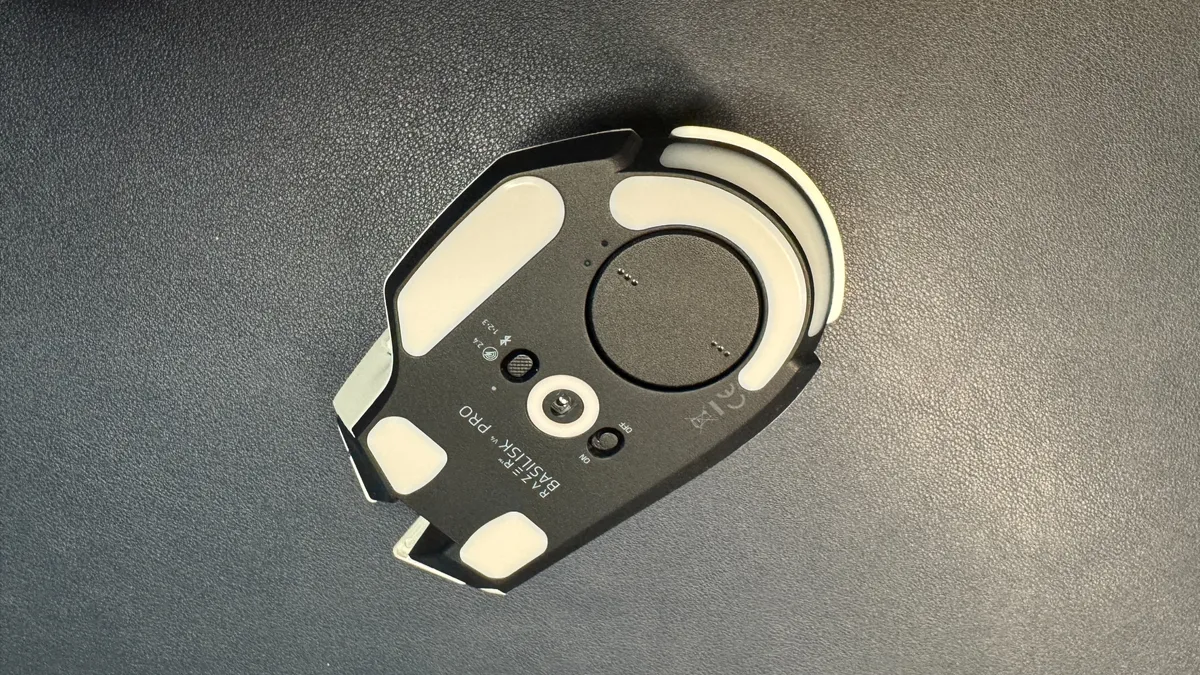
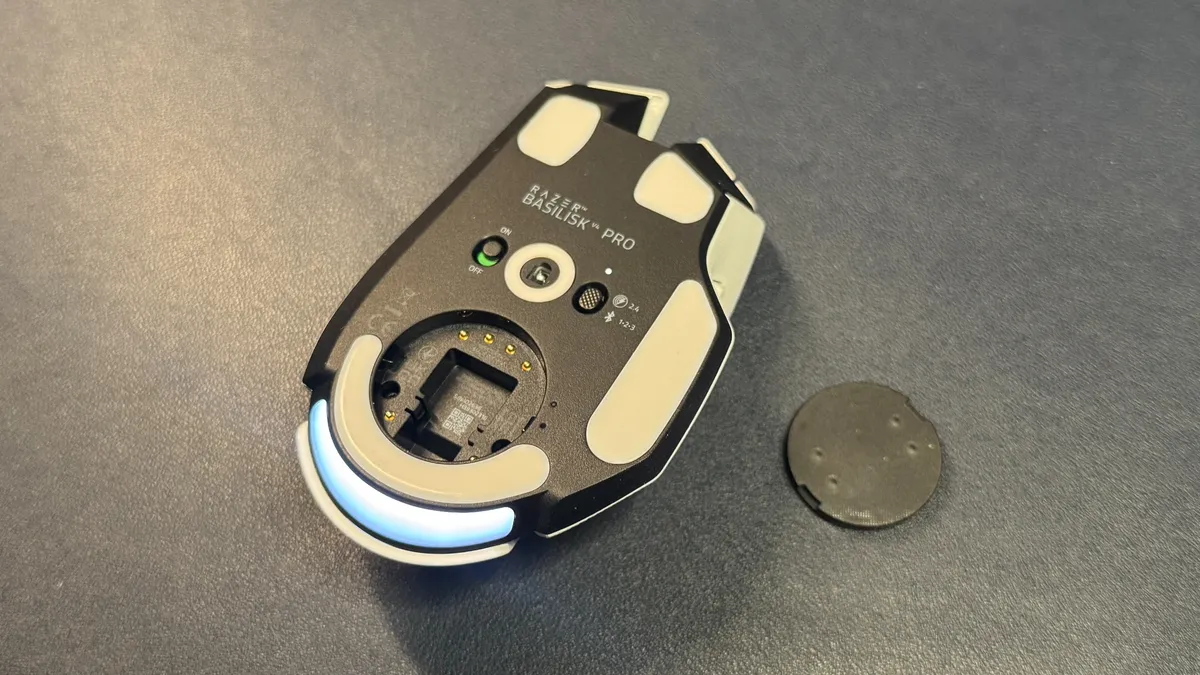
On the bottom of the mouse, you’ll find pure PTFE feet — two near the front, a strip at the back, and a strip under the thumbrest, as well as a strip around the sensor, a power switch, and a connection switch button that is not programmable.
(Image credit: Tom’s Hardware)
In the box, the Basilisk V4 Pro comes with a USB-A dongle, a USB-A to USB-C converter, and a 6-foot (2m) braided USB-C to USB-A cable. While the cable is braided, it is not one of Razer’s flexible HyperFlex cables — it’s meant for charging the mouse and plugging the dongle into your PC, not for using the mouse in its wired form.
Specs
Swipe to scroll horizontally
Sensor Model
Focus Pro 50K Gen-3 optical sensor
Max Sensitivity
50,000 DPI
Max Speed (IPS)
930 IPS
Max Acceleration
90 G
Polling Rates
8,000 / 4,000 /
Programmable Buttons
12
LED Zones
7
Cable
USB-C to USB-A
Connectivity
2.4GHz wireless, Bluetooth, wired (USB-C)
Measurements (L x W x H)
5.02 x 2.98 x 1.68 inches / 127.5 x 75.8 x 42.5 mm
Weight (excluding cable)
100g
MSRP / Price at Time of Review
$169.99
Release Date
Oct. 2026
Performance of the Basilisk V4 Pro
The Basilisk V4 Pro sports Razer’s latest optical sensor, which is the Focus Pro 50K Gen-3 optical sensor. It has a maximum resolution of 50,000 DPI and a maximum speed of 930 IPS, and it can handle up to 90 G’s of force. This is the third Razer mouse to feature this sensor (others are the Viper V4 Pro and the Naga V3 Pro), and it’s a solid sensor that works with Razer’s dynamic sensitivity (the sensitivity can be set up to change based on how quickly you move your hand) and rotation tool in Synapse. It tracks well across just about every surface, including glass that’s at least 4mm thick.
The Basilisk V4 Pro isn’t an ultra-lightweight mouse, but its shape and grippiness mean it’s pretty easy to pick up and move quickly if you’re playing an FPS. The trigger button is right under your thumb, however, so you may accidentally trigger (haha) it if you have a tendency to pick up your mouse a lot. The Basilisk’s shape isn’t quite as natural-feeling as that of the DeathAdder V4 Pro, but it’s a comfortable mouse for a variety of games — from multi-button-needing MMOs to competitive shooters (though, perhaps not for peak competition). While I still take issue with the placement of the new buttons, it is nice to have a few extra buttons without jumping straight to 19.
The Basilisk V4 Pro sports Razer’s Gen-4 optical mouse switches, which are rated for over 100 million clicks. The switches have a nice, crisp sound that’s not too loud (not as loud as Logitech’s, anyway), though it’s not a mouse for those trying to minimize mouse clickiness. The primary buttons have a solid, tactile feel, and I had no issues with misclicks or double-clicks while I was testing. While the tilt wheel’s free-spin mode was too sensitive for me to get to work properly, I love the precision tactile mode — it blends speed and tactility perfectly.
Features and Software of the Basilisk V4 Pro
The Basilisk V4 Pro is programmable with Razer Synapse 4 (not Razer’s web-based version of Synapse). You can use Synapse to remap the mouse’s 12 programmable buttons (14 programmable controls, if you include scroll up/down; the connection switch button on the bottom of the mouse is not programmable). Synapse has a variety of remap options, as well as a built-in macro recorder / editor. Synapse is also where you’ll be able to customize the mouse further by tweaking things like the scroll wheel, DPI stages, and surface calibration. There’s also a sensitivity matcher that will match the Basilisk V4 Pro’s sensitivity to match that of your old mouse.
You can also use Razer’s Chroma Studio to customize the mouse’s lighting and sync it with games and/or your other Razer peripherals. The Basilisk V4 Pro has seven RGB lighting zones: a five-zone underglow strip along the bottom curve of the mouse, as well as one in the scroll wheel and one in the logo on the palm rest. The lighting is bright and the underglow’s five zones blend nicely — the underglow strip is tilted outward so it’s pretty visible when the mouse is just sitting on your desk.
Wireless Experience and Battery Life of the Basilisk V4 Pro
The Basilisk V4 Pro has three forms of connectivity: 2.4GHz wireless, Bluetooth, and wired (via USB-C), though it doesn’t really come with a mouse-ready USB-C cable. Razer rates it at 200 hours of battery life over a 2.4GHz wireless connection with a 1,000 Hz polling rate, which is excellent. This number does drop to 54 hours at an 8,000 Hz polling rate, which is… still pretty good, to be honest.
(Image credit: Tom’s Hardware)
The Basilisk V4 Pro launched alongside Razer’s Mouse Dock V2 Pro, which is a wireless charging dock with built-in RGB lighting and an integrated 8,000 Hz wireless receiver. The Mouse Dock V2 Pro is sold separately for $70, and comes with a wireless charging puck that slots into the bottom of the mouse. It sits on your desk (it’s small — 3.28 x 2.2 x 1.71 inches / 83.5 x 56 x 43.5mm) and serves as a magnetic dock and wireless receiver for your mouse. It has eight RGB lighting zones around the base, and it lights up to indicate battery level (flashes red when the battery is low). It’s made for the Basilisk V4 Pro and V4 HyperSpeed, but it will also work with the Basilisk V3 Pro 35K, the Basilisk V3 Pro, the Cobra Pro, the Cobra HyperSpeed, the Naga V3 Pro, and the Naga V2 Pro (up to 8,000 Hz polling rate for all except the Naga V2 Pro).
The Basilisk V4 Pro is also compatible with Razer’s HyperFlux V2 charging mouse pad, but you’ll need to connect to your PC via the mouse’s dongle for 8,000 Hz polling.
Bottom Line
The Razer Basilisk V4 Pro is an expected update to the Basilisk V3 Pro / 35K. The bump in battery life, from 150 hours in the Basilisk V3 Pro 35K to 200 hours in the Basilisk V4 Pro, is very nice (and 54 hours with an 8,000 Hz polling rate isn’t bad, either). While I didn’t like the new buttons, I’m sure some people will (although I find it difficult to believe that every mouse and keyboard needs a dedicated AI prompt button), and the reduced weight feels good even if, at 100g, it’s still nowhere near the ultra-lightweight category. The Basilisk V4 Pro is a great gaming mouse for gamers who want something a little more exciting and versatile than a DeathAdder V4 Pro, but not as button-heavy (or as heavy) as a Naga V3 Pro.
Whether you own a house already or you’re looking to buy one, you probably care about home prices. But it’s not always easy to figure out what’s really happening right now, especially if you look at the headlines.
One says home prices are falling. The next says they’re still climbing.
So, which one’s right? It comes down to where you live.
What’s Really Going on with Asking Prices
Part of the confusion out there may be based on what’s happening to asking prices and how the media is talking about it. They’re calling attention to how asking prices are falling, but don’t give the full context or say that seasonality is at play. So here it is.
Right now, there are more homes on the market than at any other time since November 2019. And with mortgage rates rising since the spring, those homes are taking a little longer to sell. One way to help a home sell quickly in that environment is to have a lower asking price.
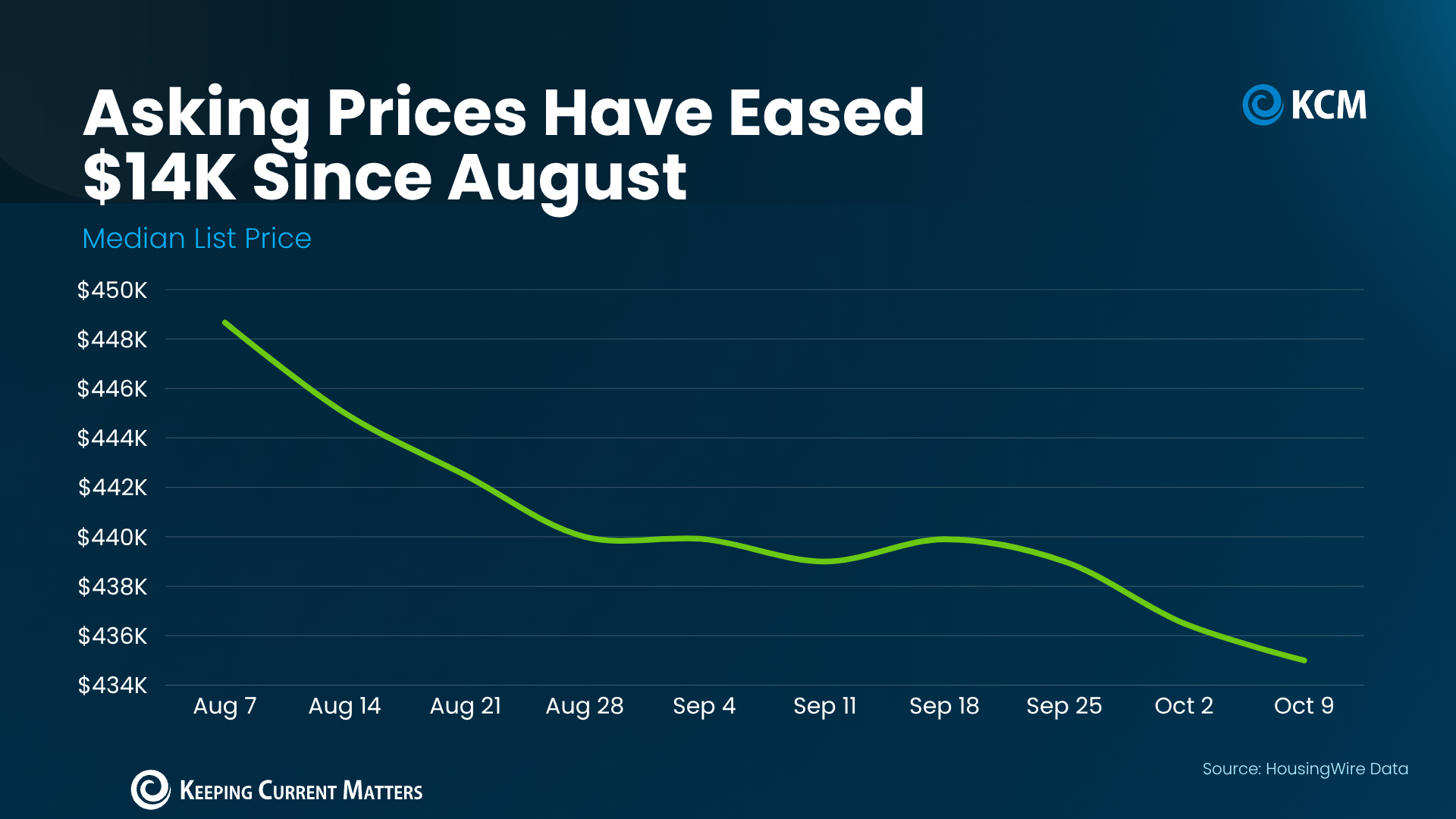
According to HousingWire Data, the median asking price is down from $449k in early August to $435k just 2 months later (see graph below):
That’s a dip of about 3%, and a lot of it is normal for this time of year.
Asking prices cool off every fall once the busy summer season wraps up. With fewer buyers this time of year, sellers price a bit more competitively. Today’s rates play a role too, since sellers are pricing to match what buyers can afford right now. And that’s a good thing. Smart pricing helps homes sell.
Just keep in mind, that’s a national list price. It doesn’t show what homes near you are actually selling for. So before you react to a headline, ask a local agent what’s really happening in your area.
Where You Live Changes Everything
Realtor.com explains:
“While national headlines might suggest a buyer’s market is taking hold, the reality on the ground depends heavily on where and what you’re trying to buy. Local trends can diverge sharply from national averages, especially when you factor in price range, property type, and post-pandemic market dynamics.”
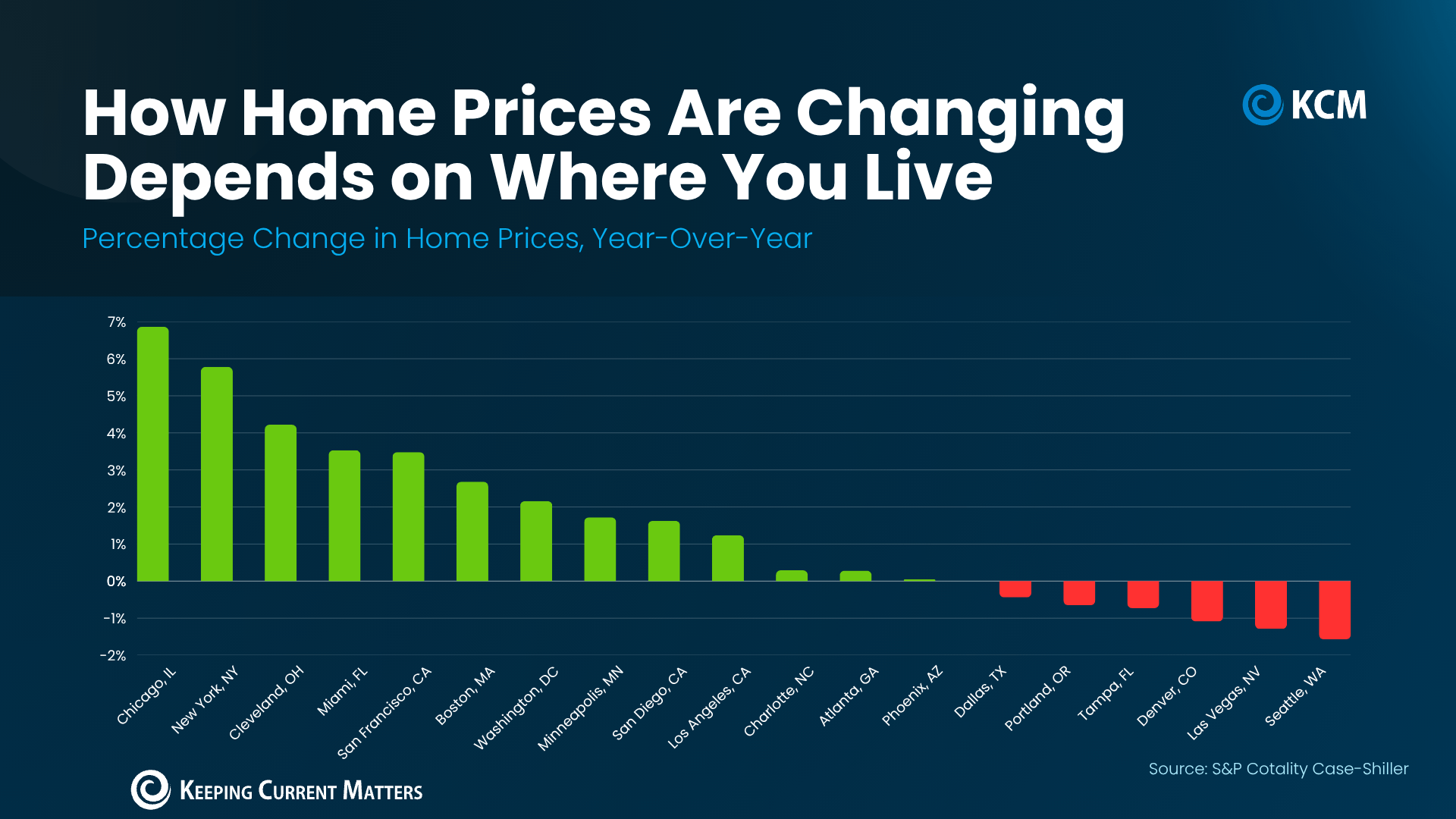
The latest numbers from S&P Cotality Case-Shiller Index show how true that is. Over the past year, sales prices in Chicago rose almost 7%. In Seattle, they dipped about 1.6%. That’s a gap of nearly 9 percentage points between two major cities (see graph below):
That gap changes your game plan. Selling in New York, where prices are up almost 6%? You may not need to cut your price. Buying in Denver or Las Vegas? You may have more room to negotiate.
Why You Don’t Need To Worry About a Crash
Just in case you’re seeing those slight declines in some markets and worried it means a bigger crash is coming, here’s what you need to remember. Even in the major metros where prices are down, the declines are 2% or less. That’s a long way from a crash like 2008. And if you look back at the graph above, there are more cities in the green than in the red.
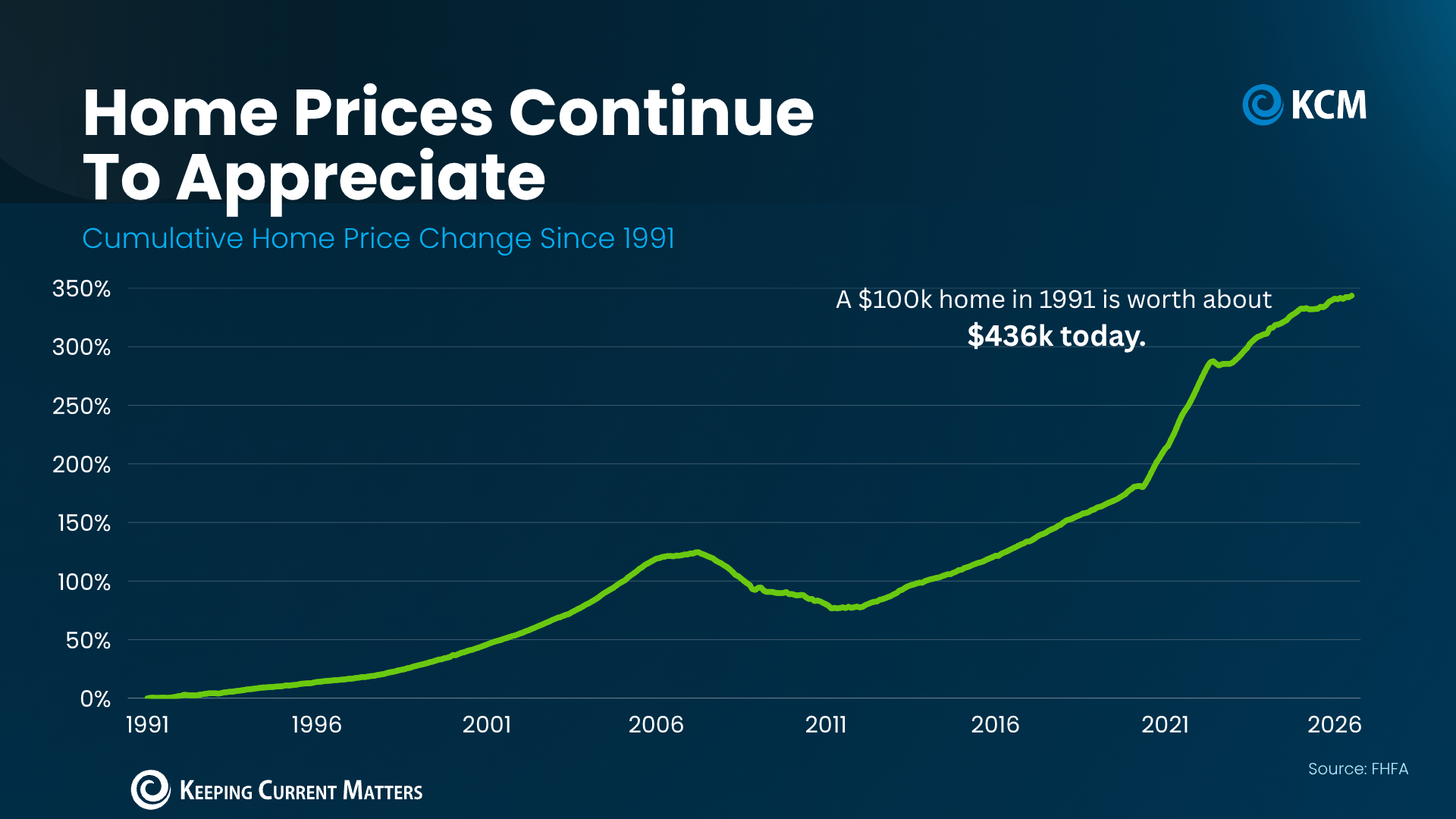
And over time, home values have a strong track record. The Federal Housing Finance Agency (FHFA) says national prices have grown year-over-year every quarter since 2012. Go back further, and a $100k home bought in 1991 would be worth about $436k today, even with the 2008 crash factored in (see graph below):
So, this short-term dip probably won’t stick around. The small declines we’re seeing now are in markets that overheated during the pandemic. As a whole, the market is headed back to normal – and normal means prices should rise over time.
Bottom Line
National headlines can’t tell you what your home is worth or how much room you have to negotiate. Local data can. If you’re thinking about buying or selling, connect with a local real estate agent to look at how prices are moving in your area, so you can set your price or make your offer with confidence.
After six years of fighting for New York City legislation to give community land trusts and nonprofits the first shot at buying failing apartment buildings, tenant advocates finally scored a victory Thursday.
The City Council voted 38 to 9 to pass the Community Opportunity to Purchase Act, or COPA, on Thursday afternoon. The original version of COPA was first proposed in 2022. Former Mayor Eric Adams vetoed another iteration of the bill after it passed the City Council last year.
“This has gone through three mayors, it’s been introduced four times, it’s had three hearings, it’s been passed, it’s been vetoed and it had a very intense, bad-faith effort to stop it,” said City Council member Sandy Nurse, the bill’s sponsor and a Brooklyn Democrat. “I believe this thing is solid.”
Before casting her affirmative vote, Council Speaker Julie Menin, who opted not to override Adams’s veto last year, praised Nurse and her own team for their work on the bill. Menin said that lawmakers had worked with the Real Estate Board of New York, the powerful real estate trade organization, and other stakeholders to narrow the number of buildings that fall under the bill’s purview. Initially, it applied to 10,000 buildings, but now only 2,100 meet COPA’s revised criteria, she said.
COPA’s remaining detractors on the City Council mostly cited property rights in their arguments against it. Council member Frank Morano, a Staten Island Republican, called the bill unconstitutional.
“Even setting aside the constitutional questions, this is terrible housing policy. It adds uncertainty to property transactions to a city already struggling to attract investment and build housing,” he said.
Unlike Adams, Mayor Zohran Mamdani not only supported a narrowed version of the bill, but made it a focus of his Block by Block housing plan.
What does COPA do?
The law allows nonprofit groups vetted by the Department of Housing Preservation and Development to make the first offer on a distressed building that’s up for sale. That would apply to buildings with more than four units with a certain number of violations, ones included under HPD’s alternative enforcement program or buildings subject to foreclosure.
COPA gives those organizations, which could include community land trusts or private developers with a nonprofit partner, 20 days to send a letter of interest to the seller, then another 70 days to submit an initial offer. They also have the right of first refusal if the owner receives another offer.
Advocates have estimated the bill would apply to about 300 buildings a year, representing apartments for thousands of residents. With the legislation, these struggling buildings are more likely to be targets for speculation or displace poorer residents, the coalition supporting the bill argued.
“This has the potential to be really game changing for tens of thousands of New Yorkers who will be able to use this right,” said Elena Rodriguez, staff attorney at New Economy Project.
“It’s a bill that has real teeth. There’s a right of first refusal in this policy, there’s a private right of action in this policy, there’s HPD enforcement in this policy,” Rodriguez said.
What’s new in the latest version of COPA?
COPA has undergone a few tweaks since its hearing before the council’s housing committee in September. Buildings with 100 or more units that had affordability protections expiring in the next two years were originally included in Nurse’s bill. In the latest version, they no longer are.
In Nurse’s original bill introduced earlier this year, HPD had the discretion through rule-making to expand the types of distressed buildings that are eligible for COPA. That language was struck from the bill, so that the agency will instead make any recommendations for expansion in their yearly reports.
Another change added a statute of limitations for when community land trusts or other vetted organizations can sue for COPA violations. Now qualified entities have two years from the date that the deed is publicly registered to bring a lawsuit—if a sale took place as a result of a violation.
Real estate industry reaction
Ann Korchak, president of the Small Property Owners of New York, called COPA a “devious policy” being held up as a “magic solution” in a statement Wednesday.
“When a privately owned property is faced with economic distress, the owner should not be forced to give right of first refusal to city-sanctioned nonprofit housing providers,” Korchak said, arguing it would scare away other buyers with the means to immediately purchase a failing property.
“It also gives an unfair advantage to the city and nonprofits, which would be free to make purchase offers without the burdensome restrictions faced by conventional buyers,” Korchak said.
What’s next?
There’s a year until COPA goes into effect, during which HPD will go through a rule making process.
Rodriguez said New Economy Project will educate the public on COPA during that period. “There will be a full court press informational campaign,” she said.
In the long term, renters whose struggling buildings get sold could end up living in affordable apartments or even owning them through co-op conversions.
“It represents a moment in New York where the tenant movement is winning against real estate,” Rodriguez said of COPA’s passage. “We’re letting speculators know, letting private equity know, letting house flippers know that we want to take our buildings back and put them into community hands.”
Selling your house is a big step, and you want it to go smoothly. And with houses taking a little longer to sell these days, renting it out might start to sound like a nice backup plan.
But the reality is, while renting can work well for some people, it’s also a big commitment. So before you decide, it helps to see the whole picture first.
Why Some Sellers Are Deciding To Rent Instead
Lately, some sellers are choosing to hang on to their houses and rent them out instead. According to Parcl, around 9% of homes for rent right now were previously up for sale.
Here’s why.
Some homeowners put their houses on the market expecting a faster process than they got or a certain price buyers didn’t respond to. And when things didn’t go exactly as planned, they decided to rent instead.As Kara Ng, Senior Economist at Zillow, explains:
“Bargaining power is tilting toward buyers and homes are taking longer to sell, making renting out a property one way to buy time rather than compete aggressively on price.”
But here’s the important distinction. Just because some sellers are choosing to rent doesn’t mean selling isn’t working. In many cases, the difference comes down to how well a house is priced, prepared, and marketed for today’s buyers.
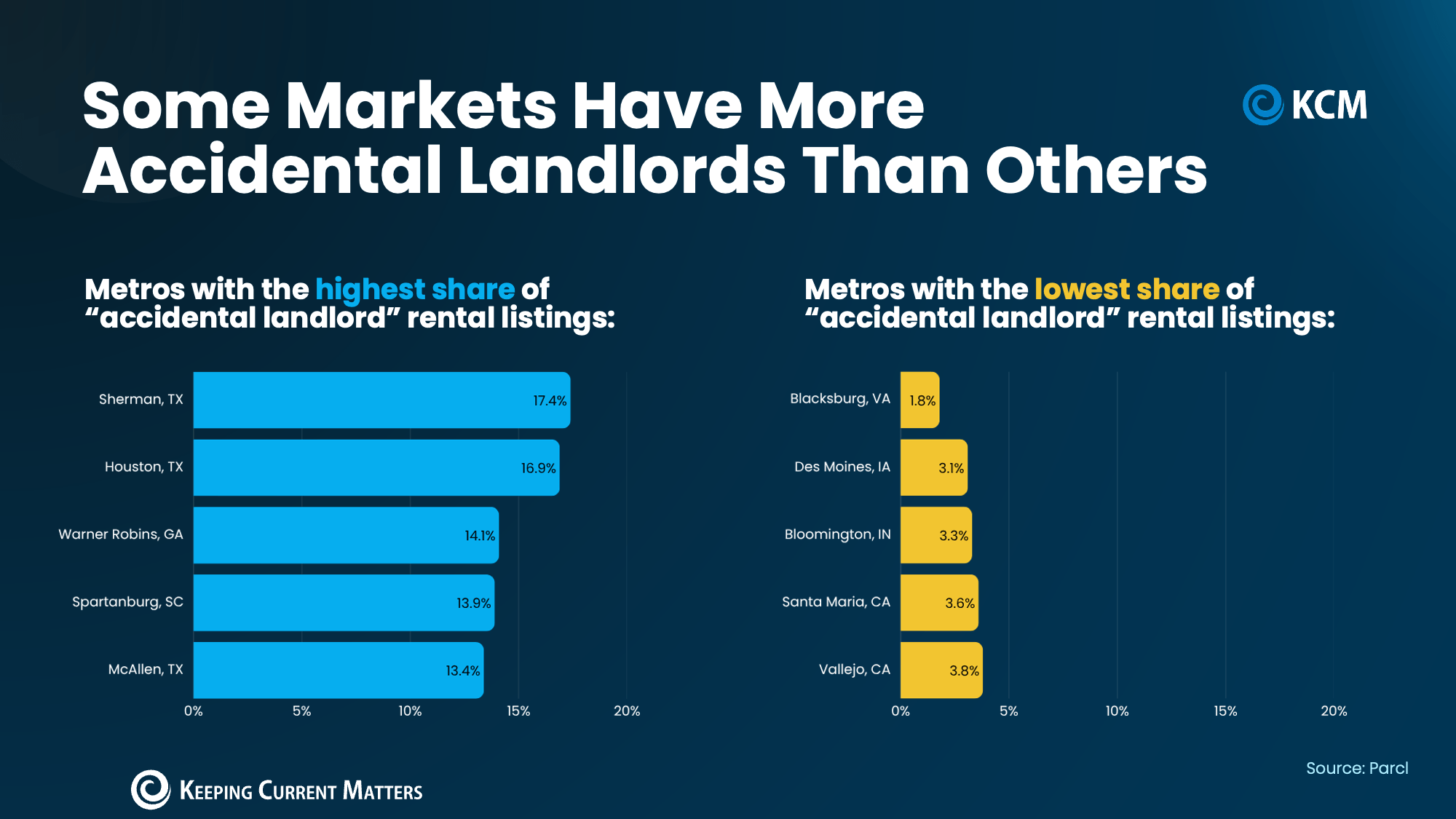
Parcl data shows where these “accidental landlords” – owners who planned to sell but decided to rent instead – are most common (see graph below):
They make up around 17% of homes for rent in places like Sherman and Houston, TX, but less than 4% in markets like Des Moines, IA and Bloomington, IN.
That’s a pretty big difference. And it shows why you have to know what’s happening in your neighborhood. Your market, your asking price, and your strategy all play a role in how your sale goes.
A local agent can show you how houses like yours are selling, what strategies work best, and help you weigh your options – not to push you to sell, but so you at least have the full picture based on today’s market. And part of making an informed decision is understanding what renting your house would actually take.
What Being a Landlord Actually Looks Like
While renting might sound like easy passive income on paper, in practice, it’s a hands-on job with rules to follow. As Invest West Management puts it:
“Even if you never intended to become a landlord, the law still sees you as one — and you must meet all legal obligations that come with that role. This often includes registering the tenancy, providing tenants with certain disclosures, and ensuring the property meets safety standards.”
You’d also be the one chasing missed rent payments, fixing damage between tenants, and covering unexpected repairs. Not to mention fielding weekend calls about leaky dishwashers or broken AC units.
There are expenses beyond regular maintenance and repairs, too. According to Bankrate, these are a few of the biggest:
Insurance premiums (landlord insurance typically costs about 25% more than a standard homeowners policy)
Management fees (if you hire a property manager, they usually charge around 10% of the rent)
Gaps between tenants, when you pay the mortgage without rental income
How To Give Your House a Strong Start
If you want to be a landlord and you’re prepared for the responsibility, renting may be a great fit. But if you’d really rather sell, don’t let today’s market convince you that you can’t.
A great agent can make it happen. The key is having an open conversation up front with your agent about pricing and how to market your house. Nailing those details from day 1 helps your house make a great first impression, so renting doesn’t have to be your fallback.
Bottom Line
Renting can be a good fit for the right person with the right house, but it isn’t the only option. A smart sales strategy can help your house stand out to buyers from day one.
So, if you’re on the fence, a local real estate agent can help you compare what selling and renting would each look like for you.
It shouldn’t take hearing about a devastating fire to prompt you to check safety measures in your own New York City apartment building, but that’s often what spurs people to act.
With so many tragic outcomes when there’s a serious fire—death, injury, displacement, and loss of personal possessions—it is important to take some preventative steps. Even small fires can have major consequences, because residents can be barred fromreturning home for extended periods and sometimes be victims of theft in their damaged properties.
So how can you make sure your apartment building is taking fire prevention seriously? The first step is knowing some of the main causes of residential fires—and making sure your landlord is following safety procedures.
[Editor’s note: A previous version of the article ran in October 2025. We are presenting it again in case you missed it.]
Read on for a checklist for fire safety measures in a New York City apartment building.
Does your smoke detector work?
Your landlord is required to provide at least one smoke detector in your apartment but you must maintain it. You should periodically check to make sure the batteries are not dead. Some alarms have a blinking light or sound if the batteries are dead so don’t ignore those warnings. And don’t be the person who disconnects your sensitive detector because it’s triggered by your cooking.
You can also request to have a smoke alarm installed in your apartment for free through a partnership between FDNY and the Red Cross. You will need to fill out a request form.
Regarding fire extinguishers: NYC fire code doesn’t require them except for where fuel-burning equipment is installed, like a hot water heater. Why? FDNY advice to leave the building during a fire, not try to extinguish it yourself.
What is the safety plan?
NYC fire code requires your landlord to issue a copy of a fire and emergency preparedness guide each year. A copy should also be posted in your apartment (usually on a door) and in common areas. It details what you should do in the event of a fire, like call 911 and evacuate.
Your building might also include specific fire safety measures and protocols in your lease or house rules. Another tip: If there are children under six living in your apartment, landlords of multi-family buildings are required to provide either stove knob covers or permanent safety knobs. You might also want these if you have hyperactive cats who might accidentally turn on your gas stove (we’re speaking from experience). Owners must also provide either device if the tenant requests them—even if you don’t have a child under the age of six.
Are there self-closing doors?
Self-closing doors are required in all residential buildings with three or more apartments. If the doors function correctly, they work as a barrier and cut off oxygen to stop the spread of the fire. If they aren’t maintained, they can be deadly. That was the case in a 2022 Bronx high-rise fire where safety doors failed to close and 17 people died.
How can you tell if your door closes the right way? If you push the door open, it should swing back and close on its own. You should hear a click and a latch.
Is your fire escape safe to use?
Your fire escape isn’t a place for you to dry clothes or use for storage. It’s actually your exit if there’s a fire and you can’t make it through the building—so it’s important to keep it clear.
Fire escapes are covered by Local Law 11, which requires your landlord to have them inspected every five years if you live in a building six stories or higher. If your fire escape seems unsafe for any reason, you should contact your landlord immediately.
Where is the closest exit?
If you live in a new building, there are no fire escapes as result of a 1968 building code change. Instead your building is required to have exit stairwells with alarms and sprinklers. So make sure you and everyone who lives in your apartment knows the easiest and quickest way to get out of the building.
Remember: You should not use an elevator during a fire. Flames can damage a building’s electrical system and short-circuit the elevator, trapping you inside. Toxic smoke can fill an elevator shaft quickly. Need we say more? Take the stairs—they are quicker and safer.
Our expert reviewers spend hours testing and comparing products and services so you can choose the best for you. Find out more about how we test.
We often criticise companies for misleading marketing, which typically falls in the direction of deceitful overpromising. With the Ryzen 5 5500F, we have the opposite problem. Its name and branding undersell what AMD is offering here. It’s a marked improvement over the base Ryzen 5 5500, giving AMD better standing among the best budget CPUs.
The 5500F is a Zen 3 CPU from the Vermeer family of chips, packing six cores, 12 threads, and a boost clock of 4.4 GHz. It’s modest by the standards of the best CPUs for gaming, but it also comes in at a suggested retail price of just $100. Those prices have drifted up toward $120, though hopefully they’ll settle down around list price before long.
Along with a 200 MHz jump in boost clock speeds over the 5500, the 5500F critically comes with access to PCIe 4.0. The original 5500 came from the Cezanne family of APUs, which all use monolithic dies and are limited to PCIe 3.0. Although the 5500F lives in the Vermeer family alongside the main Zen 3 stack, it’s still limited to the 16 MB of L3 cache that characterizes Cezanne (Vermeer chips have access to 32 MB of L3 otherwise).
Latest Videos FromTom’s Hardware
The chip squarely targets Intel’s Core i3-14100F, a quad-core CPU available for around $100 that offers 11% better gaming performance at 1080p on average compared to the base 5500. The new 5500F tightens that gap to just 2.9%, and it manages to outclass Intel in multithreaded performance while offering a 10% average jump over the base 5500.
AMD Ryzen 5 5500F specifications and pricing
AMD gave the Ryzen 5 5500F a bad name. The “F” suffix across both AMD and Intel is typically used to note chips that lack integrated graphics. And indeed, the Ryzen 5 5500F does lack integrated graphics. But so does the Ryzen 5 5500. In reality, the Ryzen 5 5500F isn’t a re-released CPU with the iGPU sliced off, as F-series processors usually are, but rather an updated Ryzen 5 5500 that comes with better specs and, in turn, better performance.
If there’s any chip that falls in the bucket of a re-released CPU with the iGPU cut off, it’s the original Ryzen 5 5500, not this new F-suffix variant. The Ryzen 5 5500 comes from the Cezanne family of Zen 3 CPUs. These chips use the Zen 3 microarchitecture, but they have only 16MB of L3 cache and are limited to PCIe 3.0. Out of the full Cezanne family, the Ryzen 5 5500 is the only chip that isn’t either an APU like the Ryzen 5 5600G, or a laptop chip.
The newer Ryzen 5 5500F is from the Vermeer family, the same as other Zen 3-based desktop CPUs like the Ryzen 5 5600X. That brings with it an update to PCIe 4.0, which is a huge boon for GPU and storage performance, as well as a bump from a maximum boost of 4.2 GHz on the 5500 to 4.4 GHz on the 5500F.
Get Tom’s Hardware’s best news and in-depth reviews, straight to your inbox.
Although the Ryzen 5 5500F falls in the Vermeer family, it still carries some Cezanne DNA. It’s the only Vermeer chip to have 16 MB of shared L3; all other Vermeer chips have 32 MB of L3, at least, with X3D options scaling higher. Both families retain the same L1/L2 setup, naturally, as they share the Zen 3 microarchitecture.
Otherwise, the Ryzen 5 5500F retains the 65W TDP, and 88W platform maximum, and it comes bundled with AMD’s Wraith Stealth cooler. The Wraith Stealth cooler is plenty to keep the Ryzen 5 5500F cool under load, saving you some money on an aftermarket CPU cooler.
Intel on Wednesday announced that it had started installing production tools at its Fab 62 in Arizona, and the fab is on track for mass production by late 2028. The company also reported progress on its Ohio One manufacturing complex and confirmed that it has integrated High-NA EUV lithography into high-volume manufacturing (HVM). Meanwhile, Intel continues to invest in its leading-edge process technology R&D, advanced packaging, and photomask production capabilities in the U.S., which puts the company ahead of the competition.
“There is an important difference between technologies made in America and technologies that are truly American-made,” wrote Naga Chandrasekaran, executive vice president and chief technology and operations officer, Intel Foundry. “The difference lies in the research and development process that transforms ideas into manufacturable technologies.”
Fab 62 to begin operations in 2028
Intel completed construction of its Fab 62 shell some time ago; now it is time for the company to begin installing production tools, which is what it is doing now. Intel expects the new facility to become operational before the end of 2028, although it has not disclosed when it intends to begin high-volume production or which nodes it will produce.
(Image credit: Intel)
Intel has not officially assigned Intel 14A to Fab 62, although the facility has been discussed as a potential manufacturing site for the node. Meanwhile, there is an important distinction between Intel’s original plans for Fab 62 and its current commitments. When Intel announced Fab 52 and Fab 62 in Arizona, it said the two facilities would manufacture its most advanced process technologies, including Intel 20A (2nm-class) and 18A (1.8nm-class). Intel subsequently designated Fab 52 for Intel 18A manufacturing. Yet, Fab 62 remains unassigned.
Latest Videos FromTom’s Hardware
Given Intel’s manufacturing process roadmap disclosed earlier this year, Fab 62 will be able to make chips on 18A, 18A-P, and 14A nodes. Intel currently manufactures Intel 18A chips at the neighboring Fab 52, whereas Fab 62 could potentially accommodate either additional Intel 18A capacity or the company’s next-generation Intel 14A process technology. However, Intel has yet to confirm its plans for the facility.
The facility will become Intel’s Fab 62, the sixth high-volume semiconductor manufacturing fab at its Ocotillo campus, which has served as one of the company’s primary production sites for decades.
Intel has also not revealed Fab 62’s planned wafer processing capacity, or the amount of capital expenditures required to complete the facility. Nevertheless, the installation of production equipment indicates that the project has progressed beyond construction of the building itself. The new fab will expand Intel’s manufacturing footprint in Arizona, where the company already produces leading-edge processors and operates advanced packaging, assembly, and testing facilities.
Intel confirms High-NA EUV insertion into mass production
Another noteworthy disclosure concerns Intel’s deployment of High-NA EUV lithography. Intel was the first chipmaker to install a commercial High-NA EUV scanner at its D1X fab near Hillsboro, Oregon, and subsequently integrated the tool into high-volume manufacturing to produce its Panther Lake and other chips.
Get Tom’s Hardware’s best news and in-depth reviews, straight to your inbox.
The Gordon Moore Park at Ronler Acres in Oregon is where Intel develops its most advanced logic process technologies and initiates volume production of the latest processors. Usage of High-NA EUV to produce select tiles for Panther Lake CPUs at D1X is a natural fit for the development fab, as it helps Intel to better understand how these lithography systems work. Meanwhile, it seems (though Intel has not explicitly confirmed) that, for now, High-NA EUV scanners are used to produce the same circuits as Low-NA EUV machines, so the use of next-generation lithography systems does not necessarily provide significant advantages over existing litho scanners.
Ohio One reaches another construction milestone
Intel has also made progress with its ‘Ohio One’ manufacturing complex in New Albany, Ohio. Construction workers recently installed the first major structural truss at the site’s first semiconductor fab, which represents a milestone in the development of the company’s manufacturing operations in the state. The project is clearly an important part of Intel’s long-term strategy to expand domestic production of chips using leading-edge process technologies for years to come.
(Image credit: Intel)
Unfortunately, Intel did not provide an updated construction schedule for Ohio One or disclose when the first fab is expected to begin operations. Intel also did not reveal which process technology the facility will eventually use or the estimated manufacturing capacity it will provide. Therefore, while construction continues, which is good news, the announcement does not clarify exactly when Ohio One will contribute to Intel’s output.
Other investments across the U.S.
In addition to leading-edge manufacturing capacity in the U.S., Intel continues to invest in advanced packaging technologies. Oregon serves as the company’s main research and development center for advanced logic and 3D interconnect technologies, while Arizona hosts advanced packaging R&D, assembly, and testing operations. Intel uses its site in New Mexico to produce its complex multi-chiplet processors relying on advanced packaging methods — starting with modest EMIB and all the way to next-generation EMIB-T and Foveros technologies.
(Image credit: Intel)
Also, Intel recently broke ground on a new photomask manufacturing facility in Santa Clara, California. The new facility will be an important part of Intel’s supply chain in the U.S., as the company will be the only chipmaker in America to develop and produce chips using leading-edge nodes completely in the U.S. (both Samsung and TSMC currently lack leading-edge process R&D in America; they do not run their own photomask shops in the U.S., and Samsung has abandoned its plan to build an advanced packaging facility in Texas). Of course, Intel critically depends on tools from Europe and materials from Japan, but even as its major rivals invest hundreds of billions in their U.S. production capacity, Intel remains ahead.
To highlight its American supply chain, Intel disclosed that its U.S. operations involve more than 4,500 suppliers across 49 states, as its annual domestic expenditures exceed $29 billion. The company stressed that domestic semiconductor leadership requires not only wafer fabrication capacity but also research, process development, advanced packaging, and a comprehensive supply chain.