Have you ever passed by an interesting residential building in New York City and wanted to know more about its history? In this series, Brick Underground teams up with Tom Miller, creator of Daytonian in Manhattan, a blog about Manhattan buildings and other historic architecture. Each week, we run an excerpt from the Daytonian’s archives with a link to the full article.
Around 1871 developer Nicholas McCool erected a row of identical Italianate-style homes on the north side of East 78th Street between Lexington and Fourth avenues (renamed Park Avenue in 1888). Three bays wide and three stories tall above high English basements, they were intended for affluent families.
McCool sold 121 East 78th St. to Dr. Elijah B. Middlebrook, who had just relocated to New York City from Connecticut. Shortly before the purchase, he was embroiled in a court battle in Connecticut. He assaulted attorney W. K. Seller in the courtroom and openly called him a liar. Middlebrook paid a $600 fine (a significant $16,900 in 2026) and the New York Herald reported that he “exiled himself from Bridgeport rather than endure the ignominy of imprisonment.”
The property was passed down to a series of inheritors until it was sold in 1933 to R. Keith Kane, according to an article in The New York Times that noted it “will be altered at a cost of $10,000.”
The renovations (equal to a quarter of a million today) included removing the stoop and lowering the entrance to below grade, converting the original entrance to a window, and adding a new floor. Astoundingly, the architect matched the former entrance with the existing parlor openings, copied the original architraves for the top floor windows, and reinstalled the 1871 cornice.
Born on July 3rd, 1900, attorney Richmond Keith Kane was a 1926 graduate of Harvard Law School. The year before purchasing 121 East 78th St., he joined the law firm of Cadwalader, Wickersham & Taft. He and his wife, the former Amanda Stewart Bryan, had four daughters: Shelah, Anne Tennant, Hope Stewart and Constance H. Their country home was in Wickford, Rhode Island. Amanda was highly involved in civic and social affairs.
The family moved to Washington D.C. in 1940 after Kane became special assistant to the U.S. Attorney General “in the enforcement of new foreign-registration laws.” When relations between the French Vichy Government and America became strained the following year, the consul left East 78th Street and No. 121 was leased to Frederick S. Bailey and his family.
R. Keith Kane was appointed assistant to the Secretary of the Navy in 1943 and in 1945 was an advisor to the United States delegation to the United Nations Conference on International Organization.
Former securities executive Aftab Islam, and his wife, Theresa Havell, lived here as early as 1999 with their six children and a live-in nanny. The couple was married in 1979. Theresa was described by The New York Post as “a Wall Street wizard.” She was the founder “of the highly successful Havell Capital Management.” Islam, on the other hand, called himself a “house husband” and had not worked since 1990.
By 1999, things were not going smoothly for the couple. According to The New York Post, they slept in separate bedrooms. Before going to bed on April 21st, Theresa told Aftab that she wanted a divorce. According to The New York Times, “she awoke just before 5 a.m. as Mr. Islam began beating her with a barbell he used to work out in their home.”
Theresa was hospitalized with a fractured skull. Islam was taken away by the police and later sentenced to eight years in prison.
New owners renovated in 2002. It was most likely during this remodeling that architectural elements of the ground floor, faithful reproductions of the 1871 versions, and a charming bay window were installed.
For more on the property and the families that lived here, check out the full article.
The short answer: It’s usually the super’s job, not yours. The reality, however, is not so clear-cut and depends on the circumstances.
If you own your apartment, the problem (and the fix) falls squarely on you. But one advantage of renting is that your landlord is typically required to address such issues.
[Editor’s Note: Realty Bites tackles your NYC rental questions. Have a query for our experts? Drop us an email. We respect all requests for anonymity. An earlier version of this post was published in November 2025. We are presenting it with updated information for July 2026.]
New York’s implied warranty of habitability requires landlords to keep your unit—and the plumbing in it—safe and functional, regardless of what your lease says. Under the 2019 Housing Stability & Tenant Protection Act, this warranty was expanded to explicitly include a duty to repair, and it covers public areas of the building too. Any lease clause that tries to waive this right is void as a matter of public policy.
The exception: If you caused the clog yourself—through negligence or by putting things down the drain that don’t belong there—the landlord isn’t on the hook for that damage, and could even pass the repair cost to you.
Arik Lifshitz, CEO of DSA Property Group, summed it up this way: Routine upkeep that doesn’t require a “snake” or other specialized tool is, in most cases, the tenant’s job. That means both clearing minor debris yourself (using a plunger, an enzyme cleaner, or pulling out visible hair) and taking preventive steps, like installing a drain cap or mesh cover (they’re very cheap) to catch hair and debris before it goes down the drain.
“But ultimately, if a snake is needed to clean out a clog, it’s the landlord’s responsibility,” Lifshitz said. That’s because an untrained novice risks damaging the pipes by using the tool incorrectly. Additionally, it is unreasonable to expect a tenant to fix what may be—or quickly become—a building-side plumbing issue.
“There are always exceptions to every rule, and I can imagine egregious situations on both sides that would cause one or the other party to be liable,” he said.
For example, if the drain becomes clogged due to tenant negligence or malicious intent—and there’s proof of that—a landlord could conceivably charge the tenant. A consistent pattern of clogs would also be a red flag, especially if your landlord has already explained that whatever you are doing is not allowed.
So while most landlords are understanding and know backups happen, if they pull your kid’s bath toys or other items that don’t belong out of the pipes more than once, don’t be surprised if they ask for a reimbursement—or, in extreme cases, refuse to renew your lease or even move to evict.
| Who is responsible for fixing a clogged drain? | |
|---|---|
| Landlords/supers must |
|
| Tenants must |
|
| Consequences |
|
Furthermore, you can get into trouble if you repeatedly flush items down the toilet that are not meant to be flushed, such as paper towels, “flushable” wipes, or hygiene products.
The same goes for pouring non-dissolvable items, such as grease or food fat, down the kitchen drain (or into the toilet).
Lest you wonder what could happen, improperly disposed of cooking grease was to blame for the infamous Queens “fatberg” of 2017, which resulted in major sewer backups.
That incident wasn’t a one-off—fatbergs are part of an ongoing, expensive problem for the city’s sewer system—and the city’s Department of Environmental Protection still runs public education about it.
On that note, the DEP advises that the correct way to dispose of cooking grease is to let it cool, put it in a sealed container (such as a yogurt container or take-out soup container), label it “Cooking Oil—Not for Recycling,” and toss it with regular trash, or freeze it in a resealable bag first. The DEP also advises using paper towels to wipe away any residual grease or oil from your dishes, pots, and pans before washing them. And never flush it in a toilet.
Most leases don’t contain any language regarding this situation. However, some agreements include provisions like: “Tenant shall keep drains clear and be responsible for clogs caused by tenant’s actions.”
The habitability standard has real teeth. Regardless of rent regulation status, all NYC tenants—not just those in rent-stabilized units—can seek repairs and rent abatements for violations of the warranty of habitability. However, if a defect is due to the tenant’s negligence, the landlord may not be responsible for the cost, even though the landlord must still keep the premises in good repair.
Otherwise, take these steps to protect yourself:
1. Try an easy fix: plunge it, or us an enzyme-based cleaner. Skip Draino-type chemical cleaners, which can damage older NYC pipes.
2. Document it before you report it: photos or a short video of the backup helps if this becomes a dispute later.
3. Notify your landlord in writing: send an email or text so there’s a timestamped record. Landlords get a “reasonable time” after proper written notice to make repairs—decided on a case-by-case basis, but typically expected to wrap up within 30 days.
Landlords will often send a plumber and then bill the tenant. If this happens, request a plumber’s report showing the cause before making any payment.
Should the landlord refuse to fix it, and the clog is not your fault, tenants are advised to call 311 for “sinks, bathtubs, showers, toilets, or other plumbing fixtures that are broken or defective.”
If a landlord ignores the problem, tenants can file a complaint with NYC’s Housing Preservation and Development (HPD) or take the matter to Housing Court, which can order repairs. For prolonged issues, courts can also award a rent abatement—a partial rent credit—proportional to the extent the condition affected livability.
Keep a two-dollar drain cover in every shower and sink. It’s the single cheapest way to avoid clogs—and keep you on the “not my fault” side of any dispute.
—Earlier versions of this article contained reporting and writing by Nikki M. Mascali.
This summer’s extreme heat has been almost unbearable for New Yorkers. Between the heat dome overtaking the city leading up to July 4th weekend to the mid-month heat wave that only subsided when smoke from Canadian wildfires blew through the city, having access to an air conditioner has been a lifeline for New York tenants. And for those who don’t have AC, cooling centers opened across all five boroughs to keep New Yorkers safe.
You’ve likely already made peace with the fact that your electricity bill is going to skyrocket this summer, even if you are planning your energy use strategically. “That doesn’t mean that you should pay this surcharge just to get your landlord off your case,” said Altagracia Pierre-Outerbridge, attorney and founder of Outerbridge Law representing residential tenants, condo owners and landlords.
“For most tenants in market-rate apartments, where you are paying your own electric bills, double-check the terms of your lease,” Pierre-Outerbridge said. “As long as there are no restrictions on having an AC unit outlined in the lease, a surcharge like the one you describe is illegal.”
Pierre-Outerbridge advises tenants to refer their landlord back to the lease to contest the charge. “Don’t pay the surcharge. If there’s nothing in the lease describing an additional fee for AC, insist that the charge is not permissible,” Pierre-Outerbridge said. “We know that rental leases are written to protect the landlord, so all costs should be explicitly stated. But the lease is your source of truth too; landlords can’t suddenly insist that tenants start paying a new fee that’s not mentioned in writing.”
However, if you install an AC unit, but your lease prohibits them, you may end up having to negotiate a fee with your landlord in exchange for permission to install it. “Landlords like to forbid tenants from having AC units because they can use it as leverage,” Pierre-Outerbridge said. “It’s unthinkable that anyone would be comfortable in this summer’s heat without air conditioning, and your landlord knows that. Sometimes, a landlord will agree to let it slide if you pay them a fee,” Pierre-Outerbridge said.
Her advice? “Don’t make any under-the-table deals with your landlord without a lawyer,” Pierre-Outerbridge said. If you’re feeling pressured to negotiate with your lawyer, a lawyer can help you identify other options, ones that keep you protected.
One instance where a surcharge like this may be legal is if the landlord pays the electricity bill on behalf of the tenant. “If electricity is included in the rent, AC use will drive up that cost significantly in the summer,” Pierre-Outerbridge said. “In that case, landlords can implement a surcharge, but the price is set by the Division of Housing and Community Renewal and reviewed on a yearly basis.”
For units installed between October 1st, 2025 and September 30th, 2026, landlords that pay for tenant electricity can charge $36.12 per month. And up until 2022, NYC permitted a $5 surcharge on air conditioning units in rent-stabilized, but that is no longer the case.
“That surcharge has been overturned,” Pierre-Outerbridge said. “I advise my clients to make sure that this clause is not still lingering in their lease. Landlords can be sloppy, and I wouldn’t be surprised if they left this surcharge in ongoing leases after the laws changed. And if this charge still appears in your lease, a lawyer can help you get the terms of your lease changed in accordance with the current laws.”
But for all tenants, rent-stabilized or not, your landlord can’t evict you for not paying air conditioning surcharges. “If you think for a second that a landlord is charging you without cause, don’t pay,” Pierre-Outerbridge said. “Stall payment and force your landlord to explain the charge. If the landlord is insistent, or the terms of the lease are unclear, a lawyer can help ensure your rights and augment the pressure on your landlord.”
Altagracia Pierre-Outerbridge, Esq. is the owner of Outerbridge Law P.C, focusing primarily on tenant representation. The firm represents all sides in landlord-tenant litigation and transactional matters such as month-to-month holdovers, nuisance cases, licensee cases, harassment claims, repair cases, tenant buyouts, succession claims, DHCR overcharges and rent reductions and more. Pierre-Outerbridge has 15 years of experience litigating in Supreme, DHCR, and Housing Court. To submit a question for this column, click here. To contact Outerbridge Law P.C. directly, call 212-364-5612 or 877-OUTERBRIDGE, or schedule a meeting today.
You usually can’t get everything you want on your wish list when you buy New York City real estate, even when you’re buying a luxury property. But as a result of NYC’s longer and hotter summers and the increasing availability of apartments cooled by quieter, electric central AC, buyers are unwilling to compromise on comfort.
Central air—the term applies to a few types of systems—is now considered a must-have in the NYC luxury market. A growing awareness of the importance of indoor air quality and a desire to control temperature settings at the touch of button are also fueling this demand.
Many buyers will not consider listings without central air, brokers told Brick.
“Don’t try to sell a place above $5 million without it,” said Lisa K. Lippman, a broker at Brown Harris Stevens. Buyers hunting in the $2 million-$3 million-plus range also lean toward some form of central air, like wall-mounted mini-split systems.
Lippman said that central air substantially boosts a property’s value, making it worthwhile for anyone selling a property that lacks central air to explore whether installation is feasible. Sellers don’t need to do the actual installation but should confirm it is permitted with the board or management company and get a few estimates from AC installation companies, she said.
Case in point: She is selling a 2,400-square-foot apartment on Central Park West for $3.5 million and the cost to install central AC would run $150,000 to $200,000.
In the recent past, buyers who wanted all the “bells and whistles”—like an in-unit washer/dryer, garbage disposal, and central air—had to look at new development, where the per-square-foot cost is higher and the square footage is lower. Older co-ops offered more space and lower monthlies, but you had to do your laundry in the basement because they had few amenities. When prewars added central AC, it was often a noisy, gas-fired, building-wide system.
But co-op buildings have been adjusting in order to compete with condos. They are allowing owners to install their own ducted electric heat pumps, which are quieter, more environmentally friendly, and have mechanicals that take up less space. (And don’t be fooled by the name—these provide heating and cooling.) Plus heat pumps can be part of a building’s Local Law 97 electrification strategy.
Instead of requiring valuable roof or rear yard space—the outside component for modern systems can be hung on the side of a building.
“In my career of 29 years, there has been more progress on central air than anything else,” Lippman said. “When I first went into real estate, people accepted that even nice places had window units. In the last five years, it’s been ‘central air or bust,’” she said.
Vickey Barron, a broker at Compass, said at a certain price point, NYC buyers expect amenities, especially if they’re coming from another state where $1.5 million gets you a house with multiple bedrooms.
If co-op buildings “can figure out how to allow people in-unit washer/dryers and not have them schlep to the basement, they can figure out how to let them control the temperature year around,” Barron said.
Plus, global warming is leading to more extreme temperatures, including longer, hotter NYC summers, making central air a matter of more than just comfort. “Maybe in the future we’ll need AC in February,” Barron mused.
Some installations are tricky, like when an owner lives in a historic building where the façade cannot be altered. In that case, it’s hard to find space to house the external component for a heat pump.
Barron previously represented a seller at 51 Fifth Ave. in Manhattan, a 1929 co-op building. The seller was allowed to put in central AC, “the only one in the building,” Barron said. “A huge win,” she added.
Central air likely adds about 5 percent to the value of the property, said Jonathan Miller, president and CEO of appraisal firm Miller Samuel. It also makes a property more marketable, translating into a faster sale, he said.
“It really enhances the quality of life relative to a window unit,” Miller said. The noise, seasonal installation and removal, plus the loss of light make window units much less desirable, he added.
Less expensive mini split units are a compromise—sometimes it’s not possible to install a ducted system—but still preferred over unattractive window units, Miller said.
Barron is a big fan of using mini splits for very large properties. “This way you only cool off the rooms you are using,” she said. She also finds the units quieter and easier to keep clean than a ducted system.
With central air becoming more ubiquitous, if you’re a buyer, you also need to be aware of where condenser units for neighboring units are positioned outdoors relative to your future bedroom. For example, are they hung on the wall close to your window or on a roof level with your unit?
It can be easy to overlook if you’re apartment hunting in the cooler months. Barron pointed out they’re silent in February. “But come July you will hear them,” she said.
Has central air become the number one amenity in NYC? Only temporarily, Miller said.
“When you have this conversation in the middle of July in a heat wave with Canadian wildfire smoke drifting over the area, yes, it is the number one amenity. But in other parts of the year, private outdoor space is still the number one amenity,” he said.
It comes down to convenience and wellness, said Kayla Lee, a broker at SERHANT. In addition to square footage and views, “buyers want an effortless lifestyle.” That means using their phone to control the temperature instantly—especially if they enjoy this amenity at their current property.
Sellers are adding central air when they renovate to respond to this demand.
“If you don’t have it, you’re not competitive with the market,” Lee said. For some buyers, “a window unit or PTAC unit will kill a deal.”
Lee represents Paragon, a new condo development in Long Island City where prices start at $655,000 for a studio. When buyers tour listings there, they ask her to turn on the central air to see how loud it is. (It’s very quiet, she said.)
Buyers are very savvy about this amenity, Lee added: “They know the lingo and jargon and ask informed questions about maintenance—for example, what type of filter the system uses, how often it should be changed, when the HVAC system was last serviced, whether the equipment is still under warranty, and what routine upkeep is recommended to keep it running efficiently.”
There’s more of a focus on wellness for today’s buyer and “indoor air quality is a part of that,” she said.
Tali Berzak, a broker at Compass, is seeing a trend toward multi-zone ducted heat pump systems that allow individual rooms to have separate temperature controls.
“We’re moving toward individual comfort” instead of larger, zoned areas, she said.
Berzak represents townhouse sellers in Central Brooklyn. “Everyone is renovating and putting in ducted AC,” she said. Some owners will put in ducted AC in the owner’s unit and mini splits in the rentals.
However, she has a Bed-Stuy townhouse listing that lacks central AC. The owner can’t put it in because there’s a tenant in place and it would be too disruptive.
As a result, “we’re looking at a $100,000 price point” difference with comparable listings, Berzak said.
If you’ve thought about buying a home in the past few years, you may have run into two frustrations: asking prices that kept climbing and too few homes to choose from.
In many places, both sticking points are letting up this summer, with lower asking prices and more homes for sale. Let’s look at the trends, and what they mean for your search.
According to Realtor.com, the national median asking price was $430,000 in June, nearly $11,000 under what it was the year before (see graph below):
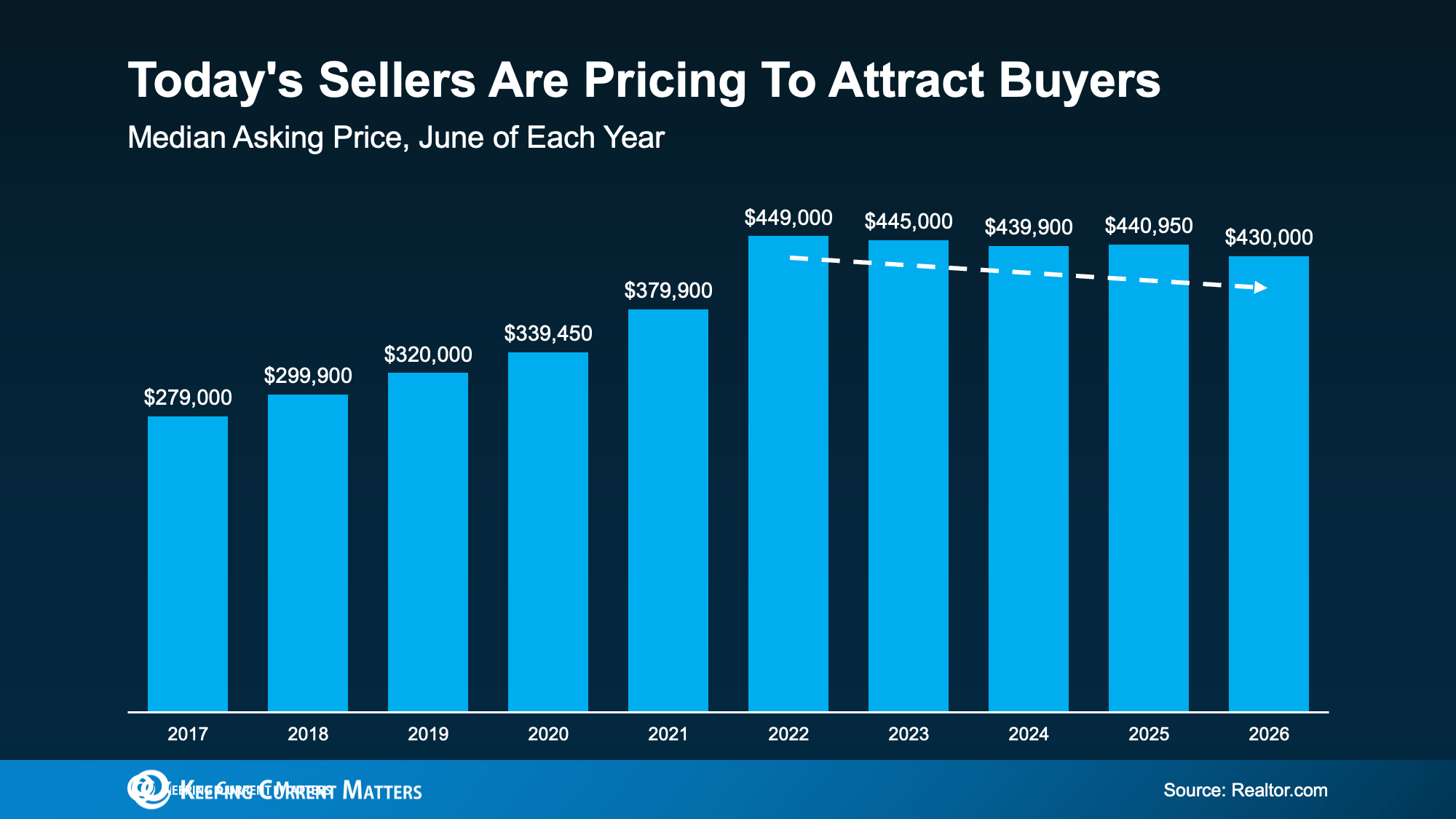
That’s the eighth month in a row that the typical asking price has dipped below where they were the previous year, according to the same Realtor.com report.
And while falling prices can sound worrying, this isn’t a sign of an impending crash. We’re talking about asking prices, not sold prices. This is a sign that today’s sellers are meeting the market where it is and pricing to draw buyers. And that’s actually something normal we’d expect from the market. As Danielle Hale, Chief Economist at Realtor.com, puts it:
“Sellers are reading market conditions and are pricing accordingly from the start rather than listing high and cutting later, and buyers are taking note and making bids. This is a welcome sign that we are in a functioning market.”
Asking prices were never going to climb forever – now they’re just settling closer to what buyers can actually pay. That signals a healthier market, and sellers re-adjusting their expectations.
If you’ve spent the past few years watching homes disappear before you could even schedule a tour, this is for you.
Supply is starting to catch up. According to Realtor.com, the number of homes listed for sale in June was the highest June number we’ve seen in three years (see graph below):
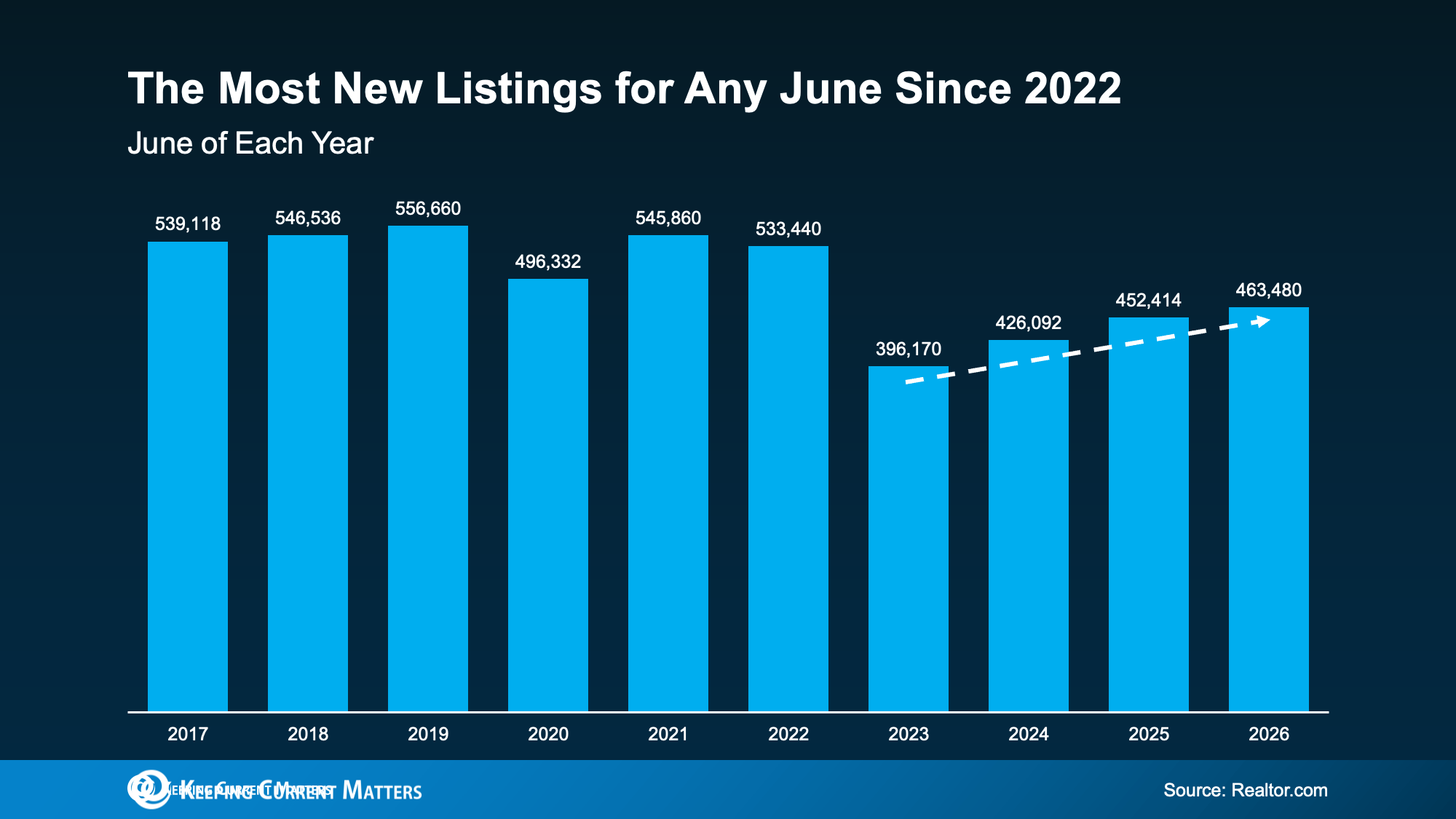
This means more options for you and less competition for each one.
Now, supply is not back to normal everywhere. As you can see, we’re still down from where we were back in 2017-2019. But in many places, it’s better than it’s been in a while. Here’s how that helps you.
You don’t have to rush an offer just to stay in the running, and you have better odds of finding and landing the right home, not just the one that’s available. Plus, you’ll have more room to negotiate, so you’re searching from a stronger position than buyers had even a year ago.
For first-time buyers looking for lower-priced homes, these trends line up especially well. Mischa Fisher, Chief Economist at Zillow, explains:
“The lowest price tiers are exhibiting some softness in terms of price, they also had the most listing-activity growth, the first time since 2022 that’s been the case.”
So, if you’re searching for your first place or your next house, there’s a little more to choose from and a little more give on price.
If a tight budget or a thin selection has kept you from buying a home, now might be the time to restart your search.
Connect with a local real estate agent to see what’s available where you’re looking.

The Brick Report is fast becoming a valuable tool for buyers, renters, and agents to gain insights about a listing—plus owners and tenants who are curious about their own address.
It’s been six months since Brick Underground launched the Brick Report and in that time over 2,000 readers have created their own comprehensive residential building reports. Some are “power” users and have run dozens of reports.
When the Brick Report launched in January, it was intended for New Yorkers on the cusp of making a major real estate decision such as buying or renting. However, it’s also proving popular with tenants considering renewing a lease and looking for information on building projects. Co-op shareholders have run reports to see whether their building has any violations, according to feedback from users.
Some upgrades have gone into effect, such as a reorganization that makes the information consumers most want to see easier to find and more improvements are coming, said Justin DeMaris, advisor and minority owner of Brick Underground.
“We’ll be translating some violation records for users. A lot of this information from the city is in a form of shorthand so the Brick Report will help make it more understandable for consumers.”
Another addition will be easier-to-understand flood risk designations. “Right now, you’re shown a map and told whether your area is high risk. In the future, we’ll include more explanatory information on why this matters in terms of insurance and maintenance issues,” DeMaris said.
Aaron Kass, a broker at Compass in Manhattan, said he appreciated the ability to pull together a wide range of information about a property for free. “Traditionally it would cost a pretty penny to get all this info on a property,” he said.
He ran a Brick Report to make sure a deal he was involved with wasn’t going to be held up by violations or any other surprises.
“As a broker, I have to comb through ACRIS and DOB records to make sure there’s nothing that will derail our deal. The Brick Report covered both HPD and DOB violations without me having to search both systems individually,” he said.
Rachel Fiegler, co-founder and CEO of the Pinpointe Group, a boutique NYC real estate firm, had a similar experience.
“I found it helpful as it aggregates the data I’m looking for in one place rather than having to look at multiple databases. One of the main things I was looking for was violations in the building, which was clearly noted in the report. I’d definitely use it again and recommend it to agents in my firm,” she said.
Running a Brick Report can help you determine whether a listing you are considering has been issued violations for pests, plumbing, or heating problems. You’ll also be able to confirm when the building was constructed and access information about recent construction permit requests as well as energy ratings and usage.
The report also provides neighborhood information, such as demographics, crime reports, overviews of restaurants and grocery stores, nearby schools and government institutions.
Brick Report draws data from NYC’s Open Data portal and combines data sets from Housing and Preservation & Development, Department of Buildings, Department of Finance, 311, New York City Police Department, as well as Federal Emergency Management Agency, U.S. Census Bureau, and Open Street Maps.
Brick Underground securely stores your email address so we can send you the report you requested. We may also contact you in the future if we find errors in the data that was used to generate your report.
Brick Underground may use this information to email you about relevant offers from Brick Underground or our sponsors in the future. Brick Underground does not publish this information, nor share this information with any of our sponsorship partners.
Brick Underground is not currently charging for Brick Report. You can try out the report for free to learn about where you live now or about places where you are considering moving. For questions, feedback, or sponsorship opportunities, reach out to [email protected].
Brick Underground reaches two million unique readers a year who are making a critical decision about renting, buying, selling, or renovating in New York City, one of the priciest and most complex real estate markets in the world. The site, which was founded by former New York Times real estate writer Teri Karush Rogers, has published more than 10,000 original articles in its 15-year history.
Today’s home prices have a lot of buyers – especially first-time buyers – wondering if there’s even anything out there that’s in their budget. But owning a home may be more within reach than you think. Sometimes, it just means considering a different type of home.
Condos and townhomes can be a great way to buy without stretching every last dollar. And right now, two things make them worth a serious look.
Maybe you feel like there’s just nothing out there for you, and you’ve exhausted all your options. But have you considered condos or townhomes? A lot of buyers start by looking for a single-family, detached home without even realizing what that search omits from their pool of choices.
According to HousingWire Data, there were 233,030 condos and townhomes for sale this June. That’s more than any June in at least the past decade, and more than double the number available back in 2022 (see graph below):
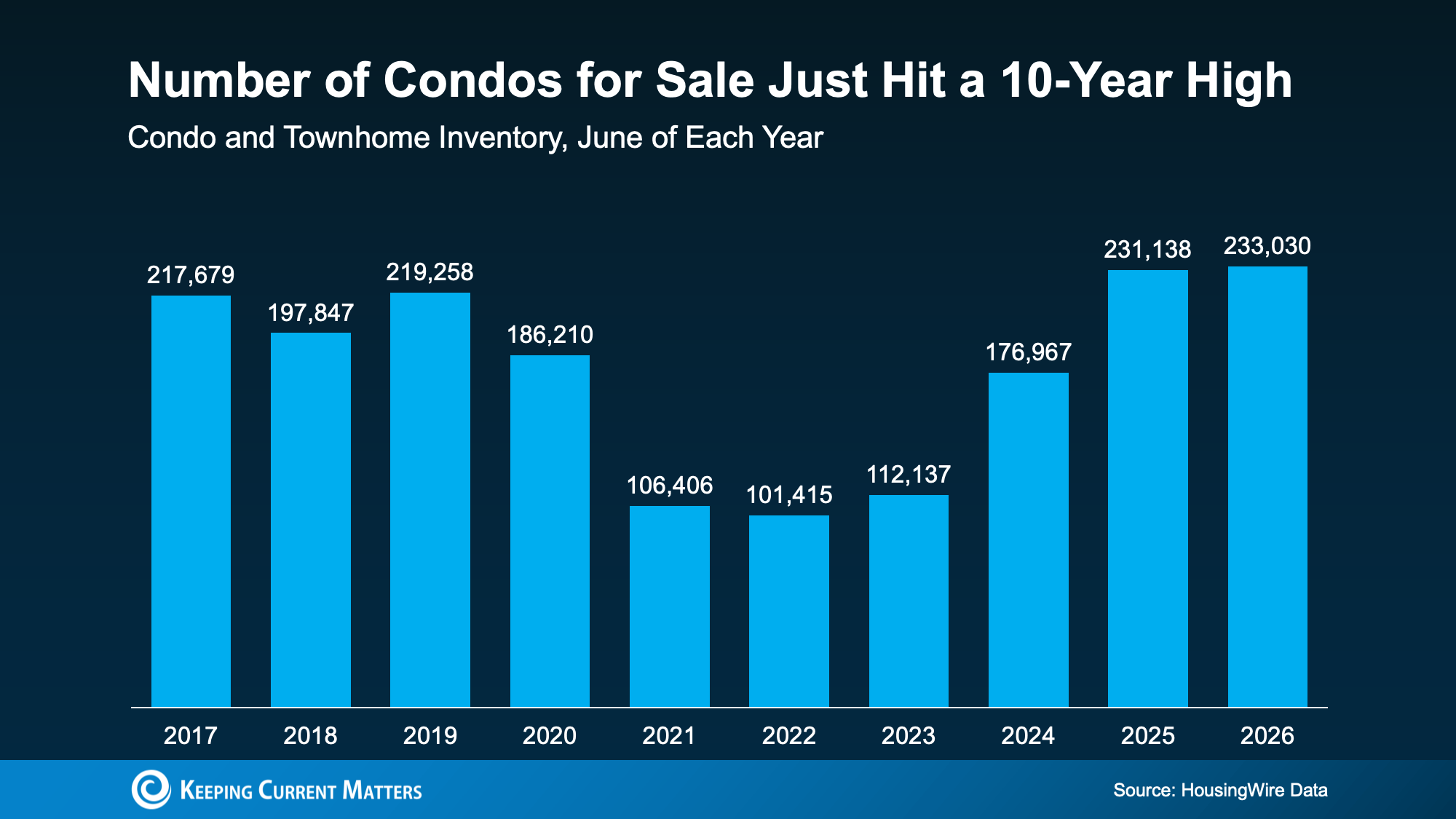
That means there are more options out there in this segment of the market – and that’s especially good news for first-time buyers. These types of homes can be a great way to break into the market for less.
Just remember, that’s the national number. What’s available will depend on where you’re looking. But generally speaking, more options means less competition, more time to decide, and more room to negotiate.
Price is the other big draw. According to the National Association of Realtors (NAR), the median condo price was $380,000 in June. In contrast, the median single-family home price was $446,400 (see graph below):
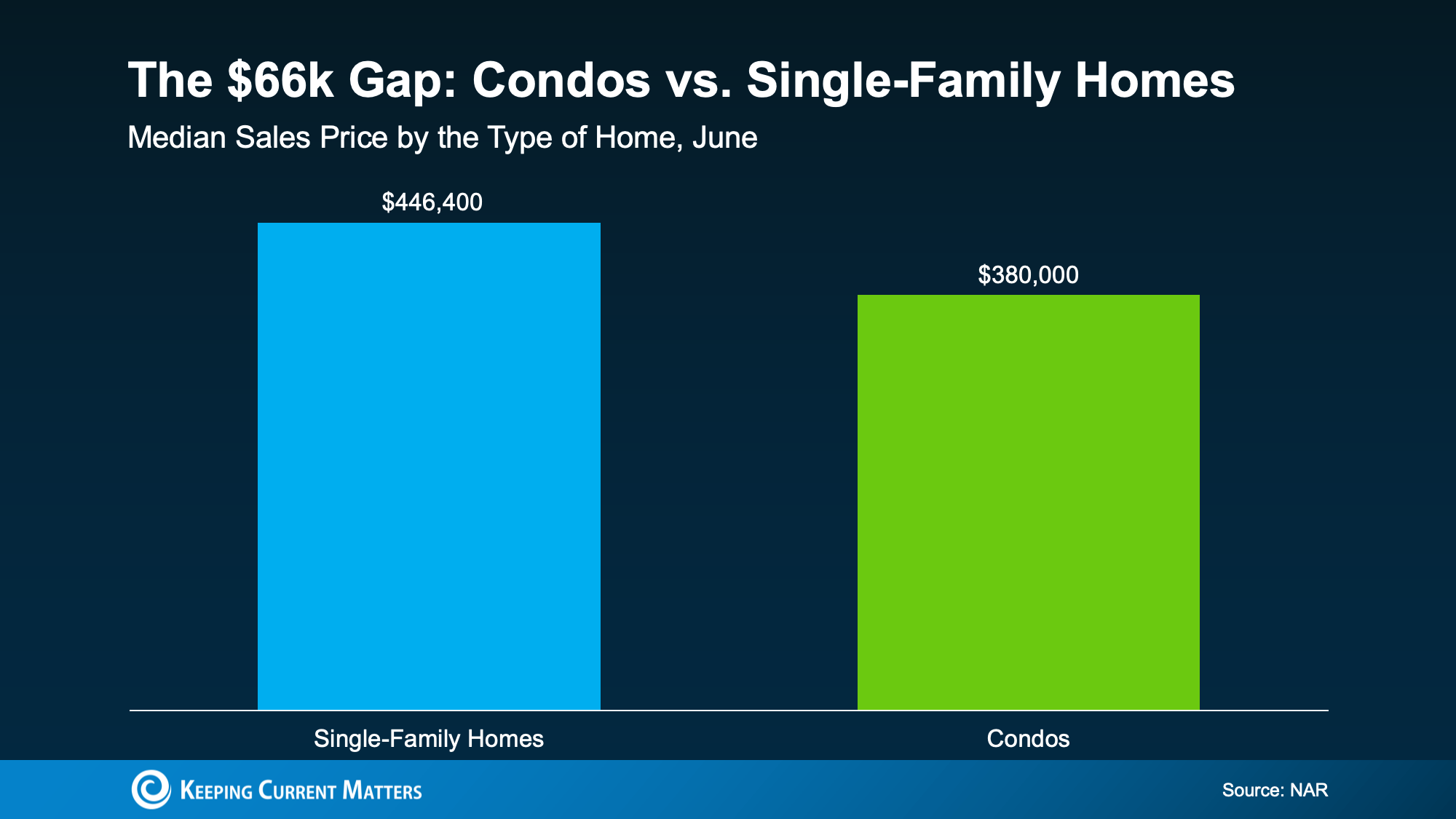
That’s a difference of more than $66,000.
A big reason why? Condos are usually smaller than single-family homes. And smaller homes can come with smaller price tags.
And if you don’t need all that extra space, that lower entry price could be exactly what gets you through the door.
Condo or Townhome? How They’re Different.
For buyers who feel priced out of the market, a condo or townhome could be a way in. But there are some things to know. Before you start checking out homes, it’s good to understand how these two compare to each other – and to a single-family home.
With a single-family detached home, you own the house and the land it sits on, and you don’t share any walls with neighbors. That means the most space and privacy. But it also usually comes with a higher tag, and all the maintenance is on you.
With a townhome, you own the building and the lot it sits on. They’re usually multi-level, so you get more space, and you share two walls at most. You’ll also have more say over how your home looks and how repairs get done, but more of that upkeep falls on you.
With a condo, you own just the inside of your unit and may have access to community features like a pool or gym. The building and shared space belong to everyone who lives there, which means you have less maintenance responsibilities. But you’ll also likely have more neighbors around you, less control over building decisions, and higher HOA fees since the HOA handles the exterior and common areas.
A condo or townhome could be your path to owning a home without blowing your budget. Connect with a local real estate agent to see what’s for sale in your area and figure out which type of home fits your lifestyle, and your bottom line.