A team of around four dozen U.S. Marines is joining a NATO-led operation in the Baltic Sea to help protect undersea internet cables and gas pipelines in the area. In a press release, the U.S. Marine Corps shared its plans to deploy a “specialized team” to support NATO’s Enhanced Vigilance Activity Baltic Sentry operation. The move comes amid a backdrop of growing undersea cable interest, movements of Russia’s shadow fleet, and fears of sabotage.
The U.S. Marines are being sent from Marine Corps Base Camp Lejeune in North Carolina to provide “advanced expeditionary surveillance and tactical reconnaissance capabilities” to the region in support of Finnish and other NATO allies. Marines from 2nd Reconnaissance Battalion, 2nd Marine Division, and the II Marine Expeditionary Force Information Group are joining the mission.
Capt. Johan Tillander, Chief of Operations for the Finnish Navy, explained that the “experience, skills, and systems of the U.S. Marine Corps are perfectly suited” for the operation, including “monitoring of the Baltic Sea.”
Latest Videos FromTom’s Hardware
While the press release stresses that the Marines are serving in a “supportive, enabling capacity,” with European nations taking the lead, the Marines are there to provide “highly specialized, agile force multipliers.”
Maj. Gen. Daniel Shipley, Commander of U.S. Marine Corps Forces, Europe and Africa, shared that its participation shows its ability to “rapidly project specialized capabilities where they are most effective,” and as a result, “ensuring we can operate seamlessly as a cohesive, lethal team to deter hybrid threats” in the area.
The U.S. deployment means that the operation will be able to “leverage… unique capabilities of Reconnaissance Marines, including small Unmanned Aerial Systems and littoral sensors, to feed vital data directly” to NATO.
Get Tom’s Hardware’s best news and in-depth reviews, straight to your inbox.
Russia isn’t mentioned in the U.S. press release, but the authoritarian nation is one of Europe’s biggest threats in the region, and has had worsening relations with European nations for several years, particularly since it went to war with Ukraine in 2022. Over 500 incidents of Russian fishing boats loitering near undersea cables in Europe have been seen in the last four and a half years, showing a persistence in mapping and identifying, if not directly interfering, with global data links in the area.
If you live in one of a dozen community districts in New York City that have been slow to build housing, you could see some housing projects speeding through the approval process starting next year.
Earlier this month, the Mamdani administration made public a list of 12 neighborhoods that have been the slowest in the city to add housing, a list some are calling the affordable housing “naughty list” or “dirty dozen.”
As a result, starting on January 1st, new affordable housing proposed in those neighborhoods will skip the step of getting approval from their local City Council representative.
“New York’s housing crisis is not going to be solved by asking the same neighborhoods to do all the building,” Mayor Zohran Mamdani said in a statement. “Every New Yorker deserves a home they can afford, and every neighborhood must be part of delivering it. The Affordable Housing Fast Track gives us a new tool to cut through red tape and make sure our housing growth is shared more fairly across all five boroughs.”
Voters approved this change through a charter amendment that passed last November.
Where is affordable housing being ‘fast tracked’?
The city planning commission picked these 12 community districts in Manhattan, Brooklyn, Queens, and Staten Island by dividing the number of new affordable units in the district by the total number of housing units. For this cycle, they looked at the five-year period between 2021 and 2026. According to the city, these districts created only 1 percent of the city’s new affordable housing over the past five years, or just 724 new homes.
Here are the districts:
In Brooklyn: Community District 10 (Bay Ridge, Dyker Heights), 12 (Borough Park, Kensington) and 18 (Canarsie, Flatlands)
Manhattan: Community District 7 (Upper West Side) and 8 (Upper East Side, Roosevelt Island)
Queens: Community District 4 (Corona, Elmhurst), 5 (Ridgewood, Maspeth, and Middle Village), 10 (South Ozone Park, Howard Beach), 11 (Auburndale, Bayside, and Douglaston), and 13 (Queens Village, Bellerose, and Rosedale)
Staten Island: Community District 2 (Mid-Island) and 3 (South Shore)
How fast is ‘fast’?
The Fast Track process aims to shorten the Uniform Land Use Review Process for qualifying projects, which can take seven months. Instead, projects in these districts will go through a
streamlined 90-day public review process. Projects still need to go through the community board and borough president and get the approval of the City Planning Commission.
What’s changing in these districts and why?
This status shortens the procedure that affordable housing developers go through to get permission for a zoning change. It doesn’t alter landmark or environmental requirements.
Communities can still have a say in land use decisions during a 60-day period when the borough president and community board concurrently review them. Then, instead of heading to their council member, the projects go right to the City Planning Commission for approval.
Some parts of the city have seen virtually no new affordable housing built because of the opposition of those areas’ elected officials, said Howard Slatkin, executive director of Citizens Housing and Planning Council, a non-profit housing research organization.
That dynamic is amplified by “member deference,” an unofficial City Council policy in which other members follow the lead of the City Council in zoning or development votes. If a council member votes no on a project, their fellow members also vote no.
“It has kind of this nasty side effect of enabling these people who don’t want to see any housing built say ‘no,’” Slatkin said.
As a result, developers looking to build housing don’t waste time and money proposing projects in an area if the council member there is likely to oppose zoning changes.
“People don’t even bother bringing the application if they don’t think it’s going to be successful,” Slatkin said.
What housing qualifies?
To qualify as affordable housing subject to the Fast Track, a housing project generally must set aside 20-30 percent of the residential floor space permanently affordable, according to the city planning website.
Affordability in this case doesn’t mean cheap apartments. “It’s a particular kind of regulated affordability that restricts the rent that can be charged and the incomes of the tenants,” Slatkin said.
This is a broad definition because of how housing is built in the city.
“We have caps and zoning incentives around new housing that require affordability, so virtually any rental housing that’s going to be built in the city of New York is going to have an affordable housing requirement with it,” said Rachel Fee, executive director of New York Housing Conference.
Will this actually work?
Some advocates say yes, it will ensure more housing gets built in these areas. But they caution that it takes more than one policy fix to solve NYC’s housing problems.
“It will definitely help create more housing,” Slatkin said. But residents of these areas won’t see the results immediately. “Be patient. It takes some time.”
The Fast Track list may function as much as a stick for legislators than as a carrot for developers.
“I don’t think the benefit of this change is so much that they’re on a fast track,” Fee said. “It’s to motivate those communities not to be on the fast track, not to be on the bottom 12.”
It’s not difficult for these communities to improve their ranking, Fee said. Approving one or two more affordable housing projects can be enough to change a district’s position on the list.
“So many people are stuck in the housing situation they’re in, their family might grow and they have no options to change it,” Fee said. “For some communities to try to preserve what they have frozen in time feels really unfair in a changing and dynamic city.”
“We need more housing,” she said. “Thats the only way we’re going to bring rents down.”
A call for community-centered planning
A coalition of community groups called the Thriving Communities Coalition penned an open letter to the mayor urging the city to create a comprehensive plan—with community input—to guide housing development with an eye towards investments in neighborhood infrastructure and services like transit.
The coalition’s letter addressed the mayor’s Block by Block housing plan but also named the Fast Track program.
“The coalition supports bringing more affordable housing to neighborhoods that have historically produced too little, but argues that faster approvals must be accompanied by meaningful opportunities for residents to shape development priorities,” the coalition said in a statement.
Slatkin said the need for planning that the coalition raises is a different conversation entirely, unrelated to the Fast Track. “This is very specifically about the manner in which land use actions are going to get reviewed—a procedural thing. It doesn’t say how much should go where,” he said.
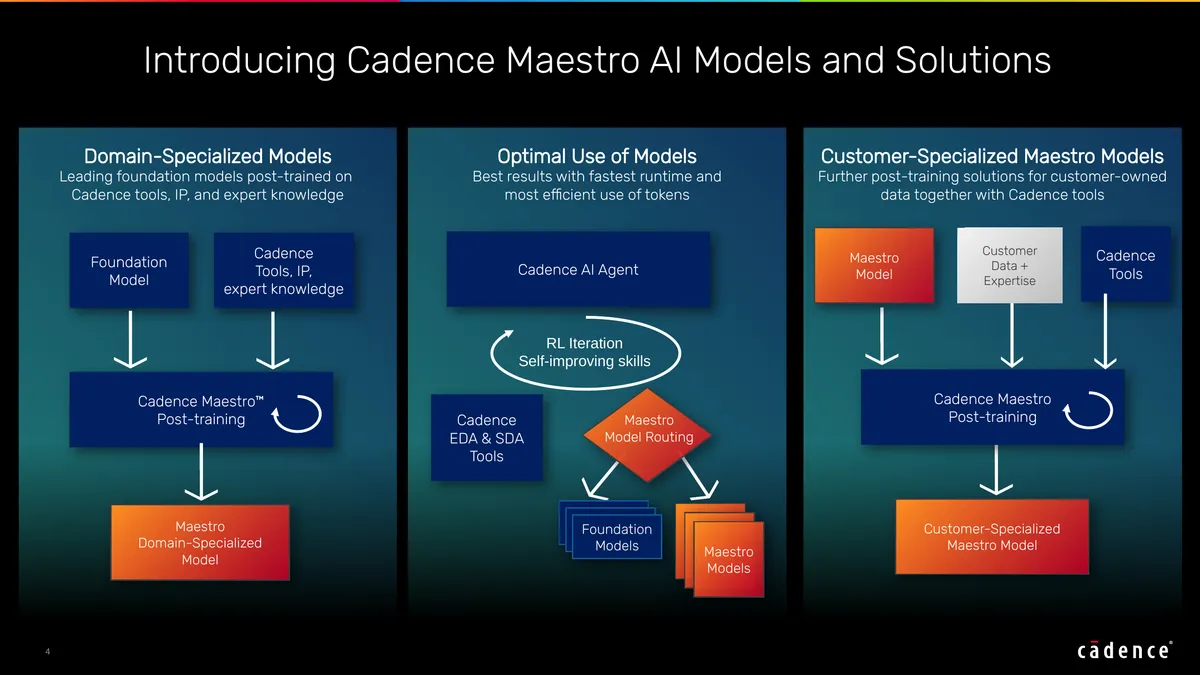
Cadence, one of the largest electronic design automation (EDA) companies, has unveiled Maestro, its new portfolio of domain-specialized AI models tailored for its chip design agents, in a press release sent just ahead of earnings. In initial results compared with general-purpose AI models, Cadence claims up to a 30% improvement in the quality of results and that Maestro effectively uses fewer tokens for the same task, with up to 5x the token efficiency. The first models “are available to select early access customers” in Q4 2026, and customers may run them on Cadence’s cloud, public clouds, or customer-controlled on-premises environments and post-train them on their own “proprietary data, designs, and workflows.” To learn more about Maestro, we spoke with two Cadence executives: Rob Knoth, senior group director of strategy and new ventures, and Paul Cunningham, senior vice president and general manager.
This approach is distinct from Synopsys’ own specialized model, GPT-Synopsys, which will run on OpenAI-hosted infrastructure, without using customer data to train the model. The models of both EDA giants, announced less than a month apart, now split on where a customer’s design data goes. Where they might not differ is why: Paul Cunningham, senior vice president and general manager at Cadence, told Tom’s Hardware Premium that agent costs have “really started to explode,” adding, “And I think the world realized so.” That makes it a natural step, he said, to move more of the agents’ iterating “into the weights of the models themselves.”
(Image credit: Cadence)
Maestro takes this step through Cadence’s AI Super Agents, which “interpret design intent, decompose tasks” and “orchestrate the Maestro portfolio with other leading frontier and open-weight models,” evaluating trade-offs to guide decisions with domain expertise. It also uses reinforcement learning (RL), where Cadence’s “deterministic solvers evaluate outputs against engineering objectives, constraints and ground truth,” and, importantly, the results feed back into the models for improvement.
Latest Videos FromTom’s Hardware
The models include Nvidia’s Nemotron, and customers can run the customer-data training step themselves with Cadence’s fine-tuning harness, potentially “on their own GPUs, on their own network,” Cunningham said. He added that Nemotron, specifically, was “giving really solid results and actually improving very, very fast.”
One constant that keeps popping up with agentic EDA is the need to nail down what the numbers actually measure. In chip design, quality of results usually refers to the design’s power, performance, and area, though Cadence didn’t specify what its 30% figure measures. Both it and the 5x token efficiency figure are measured against “a general-purpose foundation model,” which Cadence told us is the open-source model Maestro started from before its training. The company wouldn’t name the foundational AI model that Maestro is derived from beyond mentioning that it is “one of the leading open source models that’s very competitive with commercial frontier models.”
Cadence credits the token savings to balancing its EDA and system design automation (SDA) “tool calls with LLM invocations.” As an analogy, Cunningham said, “You don’t need to drive to Safeway in the jet engine,” and you want to use “the right model at the right time for the right task.”
Runtime does matter, too: as Rob Knoth, senior group director of strategy and new ventures at Cadence, told Tom’s Hardware Premium in September that a tool call could take anywhere from hours to days to return a value, while the AI industry’s training loops are “used to minutes.” Efficiency could also lower costs, since Maestro use counts toward Cadence’s agent pricing, a subscription with a consumption allowance and charges for use beyond it, Cunningham said. He didn’t say whether the token savings cut a customer’s bill.
Being flexible for the customer is a key element of any solution, and for Cadence’s competitor Synopsys, this lies in Autopilot, which Synopsys says allows customers to “choose among commercial, open-source, and fine-tuned language models” across “Synopsys-managed and customer-managed deployments,” with cloud or on-premises infrastructure. For agent security, such as sandboxing, Cadence says it’s working with Nvidia on an integration with Nvidia’s OpenShell Reference Architecture, which Nvidia launched last week, naming both Cadence and Synopsys. These options can help protect customer intellectual property.
Swipe to scroll horizontally
Cadence Maestro vs. GPT-Synopsys
Header Cell – Column 0
Cadence Maestro
GPT-Synopsys
Announced
Oct. 26, 2026
Sept. 30, 2026
What it is
A portfolio of domain-specialized AI models for Cadence’s AI Super Agents
A specialized model that operates Synopsys’ tools directly
Model partner
Nvidia (Nemotron, OpenShell)
OpenAI
Models
Post-trained LLMs, trained decision models and agent skills, blended with frontier and open-weight models, including Nemotron
OpenAI frontier models
Where it runs
Cadence’s cloud, public clouds or customer-controlled on-premises environments
OpenAI-hosted infrastructure
Customer data
Customers can post-train it on their own data, designs and workflows, with Cadence’s fine-tuning tools
Customer data isn’t used to train the model
Claimed results
Up to 30% higher quality of results and up to 5x token efficiency vs. a general-purpose foundation model, the unnamed open-source model Maestro started from (initial results; measure not stated)
None disclosed
Availability
First models to select early-access customers in Q4 2026
No date; early technology engagements underway
Customers named
Socionext, Silicon Labs (Nvidia as partner)
None
Pricing
Subscription with a usage allowance, then charged by use
Not disclosed; Synopsys and OpenAI share revenue under their deal
Cadence has had a busy 12 months with customers and agents alike. During Cadence’s July earnings call, CEO Anirudh Devgan said ChipStack, its design and verification agent, “has more than 20 customer engagements,” and ViraStack, its custom and analog agent, “more than 25 customer engagements.” Socionext said just last week that it was applying InnoStack. Silicon Labs has also credited ChipStack with accelerating debugging, and both companies say they are watching Maestro next.
Cadence’s agentic consolidation began with its acquisition of ChipStack back in November 2025. In June 2026, the company claimed that its agent had reached Level 5 autonomy, which we explored in detail. In September, Knoth teased Maestro’s ingredients to Tom’s Hardware Premium a month early, two days before the GPT-Synopsys announcement: “reinforcement learning loops, domain-specific post-training of open-weight models, model routing.” Maestro is now sitting under all four super agents, targeting a similar year-end window to Synopsys’ Autopilot; the table below has the full timeline.
Done; co-founder Kartik Hegde now leads Cadence’s core AI research group
February 2026
ChipStack AI Super Agent
Up to 10x productivity for coding designs and testbenches, test plans, regressions and debug
In early access since launch
April 2026
ViraStack (custom and analog), InnoStack (digital implementation) and AgentStack (head agent)
—
Socionext is deploying InnoStack in production; others not stated
June 2026
ChipStack at Level 5, with Nvidia’s Nemotron and OpenShell
Over 40x faster RTL validation cycles in Nvidia’s deployment
Level 5 and AgentStack due to early-access customers in the second half of 2026
July 2026
AuraStack (PCB and advanced packaging)
Up to 2x faster time to market and 15x higher productivity
Available on Cadence’s Millennium M2000 supercomputer; Nokia is deploying it (Oct. 21)
September 2026
ChipStack RTL Generation Agent
An average of 24% less area and 18% less power than pure foundation-model code, in early evaluations
Due to select early-access customers in Q4 2026; early collaboration with Honda R&D
Oct. 26, 2026
Maestro AI Model Portfolio
Up to 30% higher quality of results and up to 5x token efficiency vs. a general-purpose foundation model, in initial results
First models available to select early-access customers in Q4 2026; about a dozen engagements
This rapid pace of progress means that a clear distinction has to be made between early access and general availability. Both Cadence and Synopsys can point to customer engagements, and, at least in the latter’s case for the AgentEngineer portfolio and Autopilot platform, general availability remains a goal by year’s end; Cadence hasn’t given a general availability date for Maestro. For GPT-Synopsys, though, only “early technology engagements are underway,” according to its partners. The platforms and agents remain works in progress.
For Maestro, Cunningham hopes for “more case studies, more quantifiable benefits” through Q4. The real story, as he aptly put it, is that “we’re going to bring agents and agentic AI natively into our vertical, not that our vertical is going to get embedded into general-purpose agents.” Only customer results on real workflows will test Cadence’s 30% number, but going by what both companies have shown so far, their own early figures are extremely promising and exciting for the EDA industry.
AI spending is generating revenue for technology providers, but most other S&P 500 companies have yet to show comparable gains in productivity or profit margins, a report byApollo’s Daily Spark analysis has shown.
Go deeper with TH Premium: AI and data centers
(Image credit: Microsoft)
Artificial intelligence has helped fuel a boom in technology spending, but the financial benefits remain difficult to spot across much of corporate America. Apollo Global Management chief economist Torsten Slok said on October 24 that revenue per worker and profit margins were rising for the Magnificent Seven technology stocks while remaining flat across the other 493 companies in the S&P 500.
Notably, Slok’s analysis found no clear evidence that AI is boosting productivity growth, despite heavy investment in the technology. Revenue per worker and profit margins have risen among the Magnificent Seven but remain flat across the other 493 companies in the S&P 500, according to the report. “Despite massive investments and widespread hype around artificial intelligence, the technology has delivered zero financial payoff to corporate America outside of tech,” Slok wrote.
Latest Videos FromTom’s Hardware
Running AI models at scale can quickly drive up costs since many providers charge by token usage, so bills climb as employees make more requests or AI agents process data and handle increasingly complex tasks. Slok said mainstream companies were beginning to view token spending as a cost center rather than a source of growth. Venture capital-backed businesses are spending more on tokens, he noted, while established companies have less incentive to pay for the newest models if cheaper alternatives can do the job.
That creates a problem for AI providers hoping to turn growing adoption into a lasting revenue stream. Selling more computing power and model access can boost suppliers’ sales, but customers need to see corresponding gains in productivity, revenue or operating costs to keep spending at the same pace. Moreover, if AI expenses rise without a measurable improvement in business performance, the additional spending could weigh on margins.
“AI does not understand accountability, trust, culture, unwritten rules, ethical trade-offs or fairness, all of which shape reputational risk and ultimately drive revenue growth and profit margins.” Slok added. “The bottom line is that the AI story will be decided in the S&P 493, not the Mag 7, and so far, there is no evidence that revenue growth or margins are improving outside the tech sector.”
Slok’s analysis also points to a broader limitation: AI adoption remains concentrated among a relatively small group of companies. Unless usage spreads across more industries and produces measurable results, the technology’s effect on the wider economy could remain limited.
Get Tom’s Hardware’s best news and in-depth reviews, straight to your inbox.
The same tension is emerging in India’s financial technology sector. APwC India survey reported by Business Standard on September 11 found that 84% of surveyed fintech respondents had yet to see measurable financial results from their AI investments.
That has not stopped companies from pressing ahead. The survey also found that 48% of respondents identified proprietary intelligence as a leading strategic priority. Meanwhile, 30% expected customer experience to drive AI agent adoption over the next three to five years, followed by cost reduction and productivity gains at 22%.
Trust is another hurdle for businesses looking to deploy AI agents in financial services. As per the survey, 41% of respondents identified customer trust and adoption as the biggest barriers to scaling agentic payments, while 33% pointed to fraud, security and risk management as major concerns.
AI agents could expand the technology’s role in business by handling multistep tasks rather than simply responding to prompts, although their ability to access tools, process information and act across company systems also brings additional usage costs and security concerns.
Nvidia has been developing tools to address some of those risks, previously,introducing its Open Agent Safety Platform, a hardware-and-software security stack designed to help businesses control AI agents and restrict potentially harmful actions.Rising token consumption has also prompted companies including Microsoft, Meta and Amazon to rein in AI usage as employees adopt the tools and agentic workloads drive up bills. The trend highlights a growing challenge for businesses: encouraging wider AI adoption without allowing operating costs to spiral.
OpenAI CEO Sam Altman has also acknowledged the problem,describing AI token costs as a “huge issue” for customers seeking better value from their spending. The infrastructure behind the AI boom carries its own price tag with Amazon, Google, Meta and Microsoft having committed enormous sums to data centers, chips and the power needed to run AI workloads.
When apartment-hunting in New York City, you may come across a listing for a condop, particularly if you are searching for sponsor co-ops. A condop is probably the most misunderstood type of NYC apartment; brokers often describe them as co-ops with condo rules, but the reality is more complicated.
Here’s a more specific description: Condops are mixed-use co-op buildings with commercial or non-residential space on the ground floor. As a result, multiple boards separately govern the building’s residential and commercial parts.
Why NYC has condops
During the wave of co-op conversions in the 1980s, owners and developers faced a tax rule that capped earnings from non-residential or commercial spaces at 20 percent of their income. If earnings exceeded 20 percent, shareholders couldn’t claim certain homeowner tax deductions.
To fix that, owners and developers divided their buildings. They designated the commercial space as one condo unit, while the entire residential section became another and was divided into co-operative shares. And so the condop was born.
[Editor’s note: A previous version of this article was published in May 2025. We are presenting it again with updated information for October 2026.]
Basically, condops allowed the creation of co-ops while letting the sponsor own or rent the building’s commercial spaces with all the freedoms of condo-style ownership. Their unique structure makes them complex, typically consisting of three boards.
First is a condominium board, made up of representatives from both the residential co-op units and the commercial space. This board handles issues related to the building’s general common elements, such as exterior repairs or major plumbing upgrades.
The second is a commercial board, which governs issues for the commercial units.
The third board, elected by co-op members, handles shareholder issues for residents’ shared spaces, including common hallways or laundry rooms.
What to know about buying or selling a condop in NYC
Multiple boards add complexity
The condo board handles issues related to the building’s common elements, like exterior repairs.
The commercial board governs issues for the commercial units.
The co-op board deals with shareholder issues specific to the residential spaces, such as common hallways.
Buyers should do their due diligence
Different boards may disagree on things like making capital repairs to the commercial space.
So it’s important to ask the managing agent how well the boards function.
Carefully review the financial statements, too.
Financing and selling concerns
Lenders usually treat condops like co-ops, requiring a bigger down payment than for a condo.
Your best bet is to work with a local bank that understands the condop structure.
Sellers should expect to answer lots of questions from prospective buyers about how the boards work.
What you need to know before buying a condop
Condops often have substantial and very profitable commercial spaces. As a result, disagreements often arise between the two distinct entities involved in condop governance, e.g., the residents and the commercial-space owners, said Dean Roberts, a real estate attorney at Norris McLaughlin. Further, when sponsors create condops, the commercial units—usually retained by the sponsor—often have favorable terms regarding the payment of building expenses or other rights that shift the financial burden to the residential units.
For example, representatives of the ground-floor commercial space might resist paying for elevators they never use.
Then there’s the issue of board representation. In one of Roberts’ condop cases, the building was evenly split between a school dormitory and a private residential space.
“On the board, the school had three votes, while the residents had two. That means you’re pretty much at the mercy of the school,” he said.
Roberts advised any prospective condop buyer to find out how well the boards function and whether they’ve been involved in any litigation, namely by asking the managing agent for intel and searching the building’s financial statements for clues.
It is also important to determine if they are allocating expenses properly. Is something a condo expense, a co-op expense, or a commercial expense? Gray areas can make it unclear which entity is responsible for different capital improvements.
Real estate attorney Adam Stone, a partner at The Stone Law Firm, advised reviewing both the co-op and condo financial statements to find out what percentage of the condo’s common charges is assigned to the co-op and whether the condo is up to date on its financial contributions.
Pro Tip:
If you’re not seeing enough homes for sale in your price range or target neighborhood—and/or you’d like to avoid a bidding war—consider expanding your search to “off-market” listings. NYC real estate brokerage The Agency, a Brick Underground partner, uses technology to mine public records and identify owners who may be ready to sell, meaning you can meet and deal with owners before their homes hit the market. Click here to learn more.
Are you the right buyer for a condop?
First, are you comfortable with the unique arrangement of condops and willing to live in a mixed-use building?
Sometimes, a condop can make it easier to become an owner. Abra Nicolle Nowitz, a broker at Corcoran, pointed to a retired couple who was looking for a one bedroom in NYC and fell short of the post-closing liquidity required of a co-op. She said a condop in Midtown East offered the flexibility they needed. The couple also planned to use money from their IRA for their down payment.
“It was the price point they were looking for and the financial package that would work for them,” Nowitz said
Know, too, that you’re unlikely to see many new condop buildings because co-ops generally trade for about 15 percent less than condos, so developers are reluctant to go this route. Mixed-use condo buildings are more common, though Brooklyn Point is a relatively recent development designated as a condop and built on leased rather than owned land. (Read more about the ins and outs of buying in a land-leased building.)
How to find a condop
Most of NYC’s major broker firms and listing sites lack a filter for you to search for (or screen out) a condop. You can, however, do a keyword search for “condop” on StreetEasy, which turned up 95 apartments, 88 of which were in Manhattan. Prices ranged from $359,000 for a one-bedroom unit in Kips Bay to $7 million for a three bedroom with hree and a half baths in Lenox Hill.
Otherwise, buyers typically come across a condop listing while looking for co-ops or condos and reading the fine print.
How to finance or sell a condop
Lenders treat condops like co-ops, said Keith Furer, a mortgage banker at GuardHill Financial. That means a bank will require a slightly bigger down payment than it would for a condo.
“Lenders will want to look at both the co-op part and condo part financials, along with all the other standard documentation that they look at when underwriting a project. Pretty much a similar type of underwriting scrutiny if just a co-op or a condo,” Furer said.
Even so, it’s important to work with a lender who understands what a condop is. Furer said most out-of-state lenders and loan officers don’t even understand what a co-op is. “I can’t imagine the majority of them have ever even heard of a condop or have any clue what it is,” he said.
If you are selling a condop, you should be prepared to answer a lot of buyer questions. Specifically, that means explaining how the boards operate.
Although brokers often say condops have more liberal policies, they can be every bit as tough on sublets and sales as any stand-alone co-op. Your due diligence matters because every building is unique.
—Earlier versions of this article contained reporting and writing by Marjorie Cohen and Emily Myers.
If you’ve seen headlines saying home sales are slowing down, you may be wondering: is this really a good time to sell?
While the latest numbers show sales picked up slightly in September, they’re still down compared to last year. But here’s the perspective the headlines can miss.
Homes are still selling every single day. Because no matter what’s happening with mortgage rates or the economy, life keeps happening too. People get new jobs. Families grow. Relationships change. People retire, downsize, or need to move closer to the people they love.
And those life changes create buyers and sellers in every market.
Just Look at the Math
According to the National Association of Realtors (NAR), based on the current pace homeowners are expected to sell almost 4 million homes this year. Break that down, and that’s roughly:
11,000 homes every day.
450 homes every hour.
8 homes every minute.
So, yes, the market may be moving at a slower pace than it has at other points in time. But slower doesn’t mean it’s stopped. As Hannah Jones, Senior Economic Research Analyst at Realtor.com,says:
“Even in today’s high-price, high-rate market, homebuying activity around major life events, such as having kids, a job change, or a divorce, keeps the market in motion.”
Thousands of buyers are still making moves every day. The key is making sure your house is positioned to get their attention.
What That Means for Your Sale
Today’s buyers have more choices, so they can afford to be more selective about things like price and condition. That makes having the right strategy from the start especially important.
Because you don’t need every buyer to be looking for a home like yours. You just need the right one – and to know how to get in front of that buyer.
Bottom Line
Don’t let a headline about slowing home sales convince you no one is buying. Homes are still selling every minute of every day.
If you need or want to move, talk to an agent about what it’ll take to make sure yours is one of them.