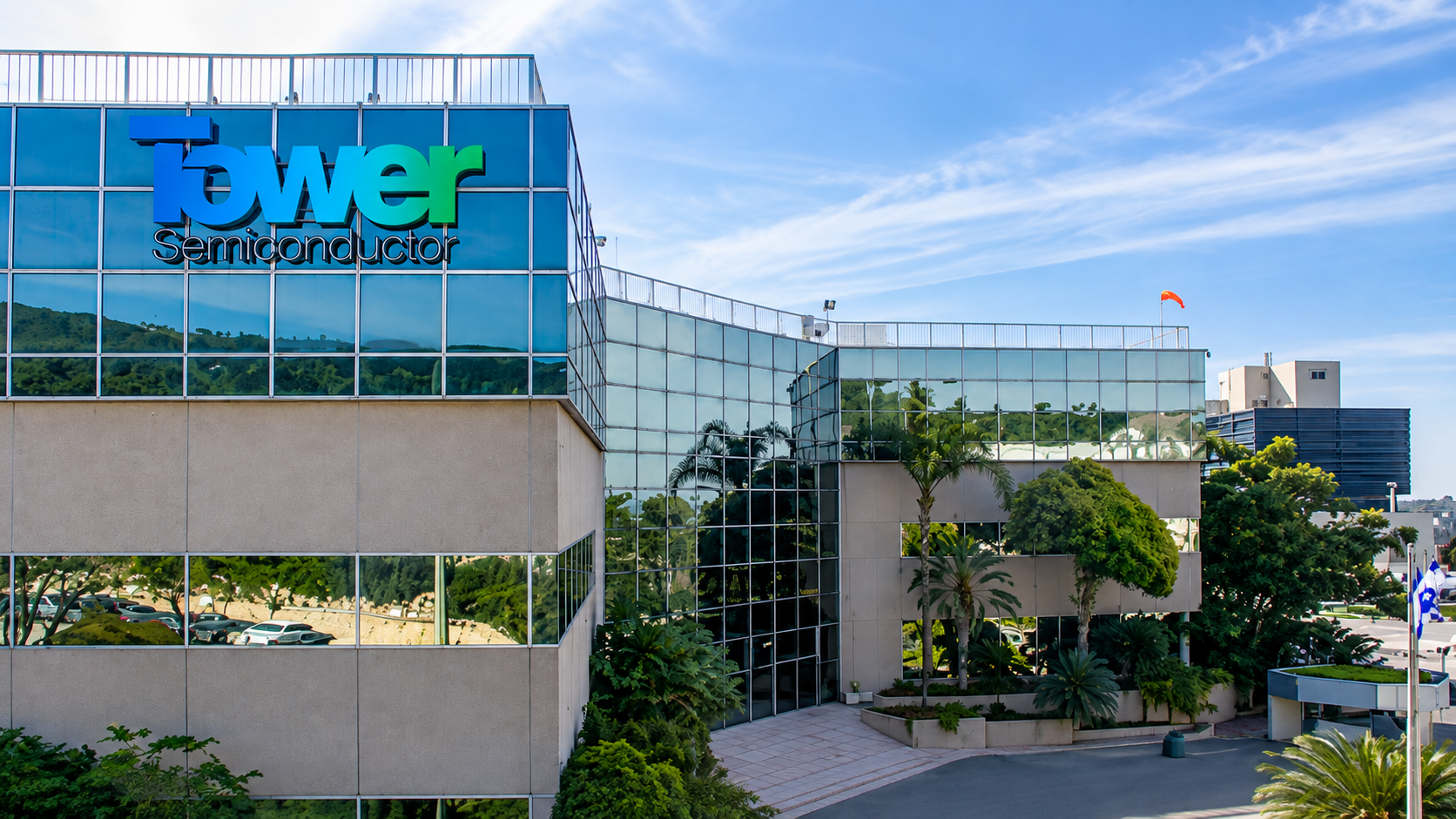
Tower Semiconductor and the government of Japan plan to co-invest a total of $4 billion in the company’s Japanese operations to turn regional fabs into a massive manufacturing base for optical-connectivity semiconductors, reports Nikkei. The dual-track expansion will repurpose an idled fab, maximize output of an existing 300mm facility, and eventually add another 300mm fab, thus boosting Tower’s Japanese capacity to the equivalent of 45,000 300mm wafers per month by 2029.
Track One: Convert and expand
The first stage, called Track One, involves converting Tower’s idle 200-mm Fab 6 in Arai, Niigata Prefecture, into a 300mm manufacturing facility for silicon photonics (SiPho) and advanced optical packaging (i.e., bonding electronic integrated circuits with photonic integrated circuits), as well as expanding the output of SiGe EICs (Silicon-Germanium Electronic Integrated Circuits) and SiPho PICs (Photonic Integrated Circuits) at 300-mm Fab 7 near Uozu, Toyama Prefecture.
Fab 7 is already fully qualified and is in mass production of various SiGe EICs and SiPho PICs using various process technologies, including the latest TPS65SG and several other TPS65-series 65nm-class SiGe fabrication nodes, as well as TPS45PHD 45nm-class SiPho manufacturing technology. The plan is to expand Fab 7’s output as significantly as possible to meet growing demand for optical engines by the AI industry. Such an approach enables the company to add output progressively as additional equipment is installed, rather than waiting for an entirely new fab and process flows to qualify.
Latest Videos FromTom’s Hardware
Track One is scheduled to reach full production readiness in the fourth quarter of 2027. Tower expects Track One to enable it to earn approximately $3.6 billion in revenue and $1.2 billion in net profit in FY2028.
Track Two: Build new fab
The second stage, called Track Two, commences in parallel and is considerably more ambitious. Tower intends to construct another 300mm manufacturing facility next to Fab 7 in Uozu that will increase the company’s output of SiGe EICs and SiPho PICs by several times. As a result, Tower will have two sites in Japan producing EICs and PICs and one — the converted Fab 6 — assembling optical engines using these components.
The second stage is expected to start contributing materially to Tower’s financial results in 2029.
Tower expects its Japanese production capacity to ultimately reach the equivalent of 45,000 300mm wafers per month in 2029, around 40 times higher than 2025 levels, and plans to hire approximately 200 people. The scale of the project reflects rapidly growing demand for optical connectivity in AI infrastructure. According to Nikkei, Tower controls more than 80% of the contract production market for optical communications semiconductors used in servers and serves some of the industry leaders, including Marvell, so it needs massive scale.
Tower plans to invest $3 billion of its own money in its two expansion tracks, while Japan’s Ministry of Economy, Trade and Industry (METI) will provide another $1 billion, bringing the overall project to roughly $4 billion.
Tower admits that companies like Intel, TSMC, and GlobalFoundries are currently ahead in co-packaged optics (CPO), so the Japanese investment is not merely about adding capacity, but also about setting the stage for its CPO plans. For now, Tower intends to bring CPO and preceding manufacturing technologies to its Uozu, Toyama Prefecture, site. While the company has not disclosed any details about its CPO roadmap, even its latest process technologies for EICs and PICs should be more or less good enough to bring optics closer to compute silicon.
Tower’s Japan restructuring
Tower Semiconductor’s plans for major expansion in Japan also coincide with a restructuring of the company’s local manufacturing operations. But understanding what is changing requires a short history lesson.
Tower established its Japanese manufacturing presence in 2014 by forming TowerJazz Panasonic Semiconductor Co. (TPSCo) with Panasonic, owning a 51% controlling stake while Panasonic retained 49% and contributed its fabs in Uozu, Tonami, and Arai. Following Panasonic’s exit from the semiconductor business in 2020, Panasonic’s stake passed to Nuvoton Technology Corporation Japan (NTCJ).
The most important asset is Fab 7 in Uozu, a 300mm facility that Tower has gradually transformed from a former Panasonic fab into one of its key specialty manufacturing sites that now supports 65nm-class SiGe and 45nm-class SiPho technologies.
Tower and Nuvoton are now effectively dismantling the original TPSCo structure. Under an agreement announced in March 2026 and expected to close in April 2027, Tower will take full ownership and operational control of Fab 7 and its 300mm foundry business, while Nuvoton will take full ownership of TPSCo and Fab 5 in Tonami. At the same time, Tower is resurrecting the former Arai facility, Fab 6, as a 300mm SiPho and advanced optical packaging site and plans to build another 300mm fab adjacent to Fab 7.
In short, what started as a relatively inexpensive way for Tower to obtain Japanese manufacturing capacity from Panasonic more than a decade ago is now evolving into a major Tower-owned 300mm SiPho and SiGe production hub, which is set to increase the company’s output and revenue by multiple times.