We’re officially in dire straits. There’s almost no way, if you’re reading this site, that you aren’t aware that memory prices have become entirely divorced from reality. Some are calling it the RAMpocalypse; I prefer “RAMageddon.” Whatever you want to call it, though, the reality for PC builders right now is just grim. To put this in perspective, just take a look at our RAM price tracking post:
|
Memory Kit |
Best U.S. Price |
Lowest-Ever U.S. Price |
|
DDR5-5200 16GB |
$52 |
|
|
DDR5-5600 16GB |
$199 |
|
|
DDR5-5600 32GB |
$72 |
|
|
DDR5-6000 16GB |
$197 |
|
|
DDR5-6000 32GB |
$72 |
|
|
DDR5-6000 48GB |
$144 |
|
|
DDR5-6000 64GB |
$159 |
|
|
DDR5-6000 96GB |
$189 |
|
|
DDR5-6400 128GB |
$329 |
|
|
DDR5-6600 32GB |
$158 |
That’s right: 128GB DDR5 kits are fully ten times more expensive than the lowest price we’ve ever seen. Things improve as you step down the memory capacities and speed tiers, but not as much as we’d like. You’re still looking at $392 for a memory kit that was just $72 last year.
To reinforce the point, I pulled the latest average price data from PCPartPicker, comparing where we are today (August 2026) to exactly one year ago. This data is somewhat approximate, but it should be broadly accurate.
Latest Videos FromTom’s Hardware
|
Memory Kit Speed & Size |
August 2025 Average Price |
August 2026 Average Price |
Change (YoY) |
|---|---|---|---|
|
4800 MT/s 2×16GB |
$90 |
$425 |
+$335 |
|
5200 MT/s 2×16GB |
$100 |
$480 |
+$380 |
|
5600 MT/s 2×16GB |
$116 |
$528 |
+$412 |
|
6000 MT/s 2×16GB |
$108 |
$572 |
+$463 |
|
5600 MT/s 2×32GB |
$191 |
$1118 |
+$927 |
|
6000 MT/s 2×32GB |
$222 |
$1272 |
+$1050 |
The numbers speak for themselves; in just 12 months, the cost of DDR5 memory has essentially exploded. We are looking at year-over-year increases nearing 500% for high-capacity kits. A standard 64GB (2x32GB) DDR5-5600 kit that would have cost you under $200 last summer is now demanding over $1,100. It is a 5x multiplier on a component that used to be a fairly boring and predictable line item in a PC build budget.
|
Memory Kit Speed & Size |
August 2025 Average Price |
August 2026 Average Price |
Change (YoY) |
|---|---|---|---|
|
3200 MT/s 2×8GB |
$63 |
$163 |
+$100 |
|
3600 MT/s 2×8GB |
$75 |
$165 |
+$90 |
|
3200 MT/s 2×16GB |
$105 |
$281 |
+$176 |
|
3600 MT/s 2×16GB |
$120 |
$307 |
+$187 |
|
3200 MT/s 2×32GB |
$222 |
$614 |
+$392 |
|
3600 MT/s 2×32GB |
$300 |
$789 |
+$489 |
If you plan to just wait it out on an older AM4 or LGA1700 motherboard with DDR4, you’d better hope your memory holds out too, because DDR4 isn’t safe from the fallout. With DDR5 entirely out of reach for most builders, the resulting scramble for older platforms running DDR4 memory has created a massive knock-on effect, and as a result, DDR4 kits are up anywhere from 120% to nearly 180% across the board. Nowhere near as bad as DDR5 pricing, but it still stings when a kit that was $105 last year is $281 this year.
This phenomenon is by no means exclusive to the US, either. German tech site ComputerBase have also been tracking this global trend, reporting just this week that average RAM prices in Europe have skyrocketed by 345% compared to September 2025. Their data shows the squeeze is bleeding into other components too, with hard drive and SSD prices both climbing over 125% in that same timeframe.
In fact, the situation is so severe that hyperscale buyers have reportedly already locked in almost all of the global DRAM production capacity for 2027, handing over advance deposits to guarantee their supply of precious DRAM, which is now among the highest-value commodities in the world by weight; mainstream DRAM chips are worth over half as much per kilogram as solid gold. PC and smartphone makers are simply fighting over the scraps, as low-priority markets compared to the extremely lucrative AI datacenter buildouts. And lucrative they are indeed; all four memory vendors (SK hynix, Samsung, Micron, and China’s CXMT) have increased revenues by double, triple, or even more, all in just the space of one year.

For consumer prices to drop, we would essentially need a major contraction in the AI market, which would mean a massive correction in financial markets worldwide. Absent that, the people actually making the chips don’t see an end in sight. SK Hynix CEO Kwak Noh-jung recently warned that 2027 will be the worst year for memory supply in the industry’s history, forecasting that demand will outstrip their ability to produce it well into 2030. ADATA’s Chairman, Simon Chen, was even more pessimistic, suggesting this DRAM crisis could last another 10 years and dismissing the idea of an “AI bubble” bursting anytime soon.
The era of cheap, plentiful memory is over, at least for now. If you need RAM today, you’re either going to have to bite the bullet and pay the premium, or learn to get by with less. Make sure you check out our RAM price tracking post for the best deals we found on memory, as well as some tips on how to secure solid deals yourself.

Follow Tom’s Hardware on Google News, or add us as a preferred source, to get our latest news, analysis, & reviews in your feeds.
That spare room on the main floor. The finished basement with a kitchenette and its own entrance. The bonus room you’ve been using for storage.
To you, it’s extra space. But to a growing pool of buyers, it’s the reason they’d pick your house. Here’s why. Multi-generational homebuying is on the rise.
The number of multi-generational households is climbing. That’s when 3 or more generations live under one roof. And data shows those households grew from 3.2 million to almost 4 million between 2014 and 2024, according to Realtor.com.
And each year, more people are shopping for a larger home that fits their combined needs.
While the appetite for this type of house is rising across the board, data from USAFacts shows multi-generational living is more common in some states than others. The darker the state in the map below, the more common it is in that area (see map below):

Where does your state fall? Depending on where you are, the pool of buyers looking for a house like yours could be even bigger than you’d think. But the overall bottom line is this.
There’s a real market out there for larger homes with room for multiple generations under one roof, especially since affordability is still so tight. And if you own a house like that, it’s in demand.
And that extra room carries real value with the right buyer. According to Realtor.com, in 2025 the median asking price for a multi-generational house was $709,000 – roughly 65% higher than the $429,900 median for a standard house.
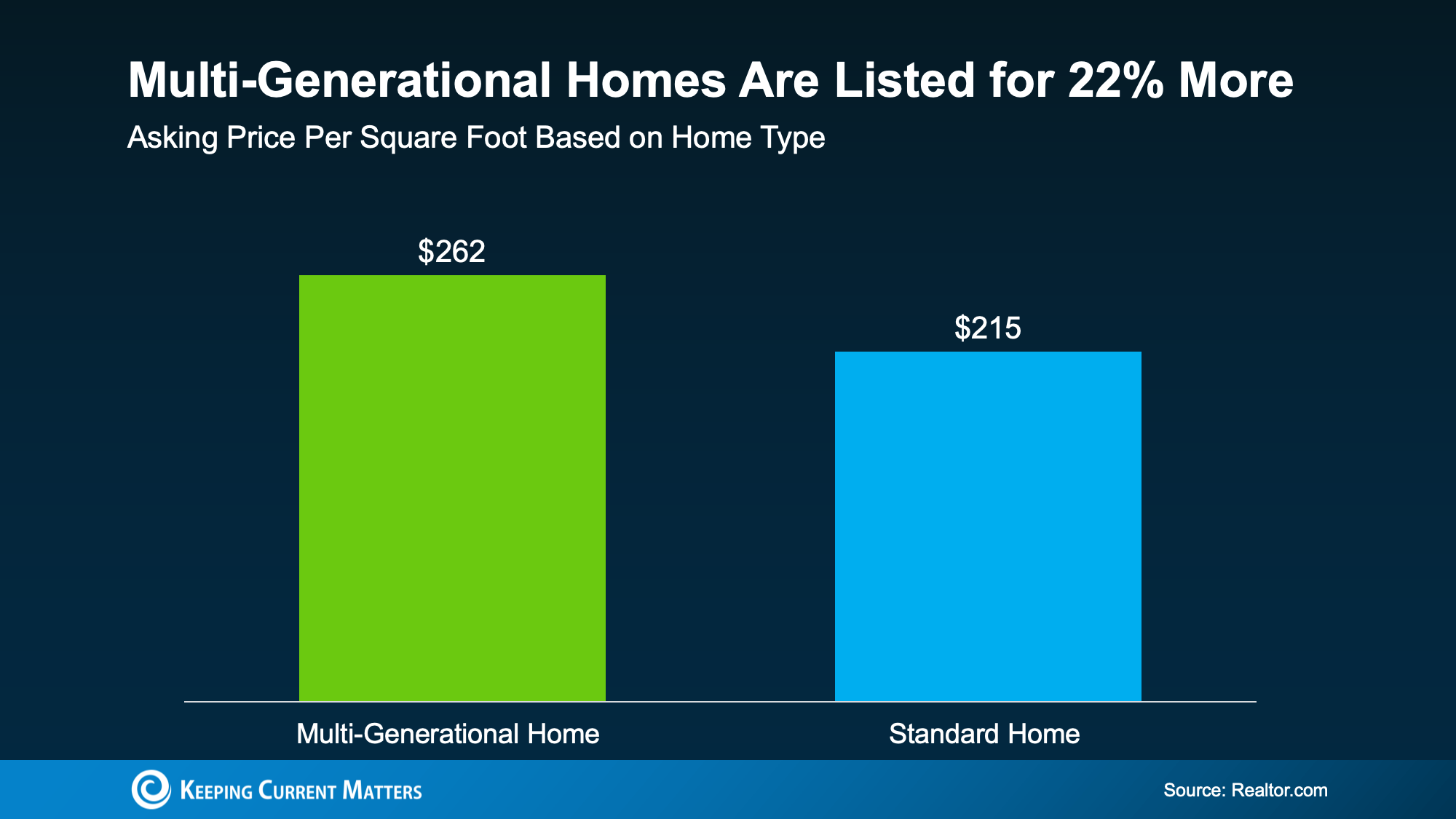
Some of that is simply size. But compare multi-generational homes to regular homes with the same amount of square footage, and they still come out on top – $262 per square foot versus $215.
That’s a 22% premium you could command for special features like in-law suites, second kitchens, and separate entries (see graph below):
When you sell, this could help you walk away with more money in your pocket, especially when your agent highlights your home’s multi-generational-friendly features in your listing.
And even with slightly higher price tags, buyers aren’t flinching. Multi-generational houses drew 13.5% more online views than standard ones, and they still sold just as fast – in about 59 days – per the same Realtor.com report.
Hannah Jones, Senior Economic Research Analyst at Realtor.com, explains:
“The strong demand and steep premiums we are seeing in inventory-constrained markets point to a real mismatch between what buyers are looking for and what is actually available. For sellers in these markets, this type of home can be a significant asset.”
Basically, when buyers want something that’s very specific, the house that checks the box tends to stand out.
Your multi-generational-friendly, or simply larger-than-average, house might meet criteria a lot of buyers can’t find in a standard one. That’s what gets attention. And offers. So, talk to a local real estate agent about what it could get you in your market right now.

Dell has created a humorous 2026 update to its iconic early-2000s “Dude, you’re getting a Dell” series of commercials. Company CEO Michael Dell shared a brief new 10-second commercial this weekend, which shows the Dell Dude (basically a Ben Curtis-alike), gleefully opening the garage door, ready for his shiny new Dell AI rack to be delivered, which is then dropped in his yard from a crane.
The revamped AI era ‘Dude, you’re getting a Dell’ commercial can be seen by expanding the tweet above.
In the commercials of old, dating back 26 years to 2020, the Ben Curtis character would insert himself into situations where folks were discussing acquiring a new PC. After highlighting all the thrilling features of one of the latest Dell PCs of the era, he could then deliver his catchphrase to the delighted on-screen shopper: “Dude, you’re getting a Dell.”
Latest Videos FromTom’s Hardware
Pentium III era ‘Dude, you’re getting a Dell’ commercial
Perhaps now PCs aren’t that important to Dell, and a lot of other once-major PC companies. Nodding knowingly at this fact, and likely cheered on by investors, Michael Dell acknowledges 2026 is instead all about AI servers.
While the original ads hyped up getting a prebuilt PC, now the communicated excitement is getting a fresh hulking dual-door AI compute cabinet packed with hardware so cool it emits frosty mist. In the video, we see what could be Dell PowerRack or PowerCool systems. These might be packed with multiple Xeon or Epyc CPUs, tens of the latest Nvidia GPUs, dozens of DIMMs, and oodles of fast storage. All potentially sucking kilowatts of power.
Of course, Dell’s post is basically a parody/joke, as few if any home users would want to buy such powerful and expensive hardware for a corner of the garage. The most obvious use for this hardware would be for local LLM and generative AI work at scale – working on very large models without cloud latency, usage fees, rate limits and so on. But very few independent researchers or hobbyists (well, none) will be getting this Dell delivery to their home.
Instead, Michael Dell’s ‘2026’ commercial break may be signaling to IT business watchers that Dell is now far more invested in, and making far more income from, its AI-industry-facing businesses – like these extremely powerful rack systems.
Follow Tom’s Hardware on Google News, or add us as a preferred source, to get our latest news, analysis, & reviews in your feeds.
As the AI boom consumes everything tangible around us, it’s even more important to keep physical media alive. Since our current tech isn’t equipped to interface with these relics, an external disc drive is a great investment to access your collection. Alronly makes a great CD/DVD player that also comes with a 2.5-inch SATA and SD Card slot, along with standard USB ports, for just $26.99 on Amazon.
This drive is absolutely packed with features for the price. It can read and write CDs at a blazing-fast 24X, or at 8X speeds for DVD. It also acts as a USB hub and a SATA-to-USB adapter. You can use the 2.5-inch SATA slot for either a hard drive or an SSD. It provides easy-to-reach access to a full-size SD card slot, microSD slot, 2x USB-A ports, and USB-C — both of those are promised to be USB 3.0 with 5 Gbps speeds.
Alrony says this USB attached device is compatible with Windows XP, 7, 8, and 10, as well as a wide gamut of Linux and MacOS computers. It’s a true plug-and-play device that doesn’t require downloading any drivers, making it very suitable for older family members that consider you tech support. Just don’t expect to use it with your iOS, Android, or ChromeOS device; they are specifically stated to be incompatible.


The include cable for data/power has both a USB-A and USB-C connector. Meanwhile, the drive also includes another USB-C port for dedicated power, which may be useful in case your chosen system’s data port is not up to scratch in power delivery terms. The device is also quite sleek, measuring just 0.9 inches thick and weighing only 0.75 pounds with an all-black aesthetic that would fit basically anywhere.
While CDs and DVDs don’t hold a candle to Blu-Ray, the best physical media standard we have today, they still hold an important place in history. Even if you don’t have any special memories stored in old discs, you can use this external drive to put new ones on there. For just $26.99, this is a great tool to have by your desktop that can still be put to good use when it’s not reading or writing to optical media.
If you’re looking for more savings, check out our Best PC Hardware deals for a range of products, or dive deeper into our specialized SSD and Storage Deals, Hard Drive Deals, Gaming Monitor Deals, Graphics Card Deals, Gaming Chair, Best Wi-Fi Routers, Best Motherboard, or CPU Deals pages.
The 3rd Brigade Combat Team (3rd BCT) of the 1st Cavalry Division took part in the semi-annual Combined Resolve exercise in Germany, where it faced off with a dedicated U.S. Army OPFOR (opposing force) unit augmented by the 412th Unmanned Systems Brigade, better known as 412 Nemesis, an elite multidomain Ukrainian unit primarily operating drones. According to the Wall Street Journal, the 3,500-strong unit, which was tasked to attack the OPFOR, had many of its tanks and other armored vehicles eliminated during the simulated engagements.
The 3rd BCT is quite a powerful unit, and has been traditionally equipped with M1 Abrams tanks, M2 and M3 Bradley Fighting Vehicles, M109 Paladin Howitzers, and more. It also had standard electronic warfare and counter-drone operators to protect its vehicles against new threats. But despite the impressive armor and firepower of its equipment and the additional protection of its own specialized anti-drone troops, the 3rd BCT still didn’t stand a chance against the small and nimble drones of 412 Nemesis. It turned out that the biggest assets of the 3rd BCT are its biggest weakness. As the heavy vehicles maneuvered around the battlefield, they threw up plumes of dust that made them easy to spot by Ukrainian recon drones. From there, the UAV operators of 412 Nemesis turned these metal predators into sitting ducks as they either dropped bombs or explosives from loitering attack drones or used first-person-view (FPV) drones to smash directly into their targets.
Since this is an exercise, there were no actual losses — instead, damaged or destroyed tanks are marked by an attack drone hovering above them. Once an observer has awarded an official “kill,” the vehicle is sent back to the rear to “respawn” and continue the war game.
Latest Videos FromTom’s Hardware
The WSJ noted that the U.S. pioneered the use of UAVs on the battlefield and often used them for reconnaissance and even long-range strikes. Even today, the U.S. Navy is developing an aerial refueling drone to release more important assets like the F/A-18 Strike Eagle from mundane (but important) duties like air-to-air refueling. However, the Ukrainians have mastered the use of short-range drone warfare as they defended their country from the 2022 Russian invasion. The war has been going on for over four years now, and Ukraine’s successful use of drones has helped them hold off the Russians from pushing further into the country. Aside from using drones tactically on the front lines, Ukraine has also started deploying them strategically, conducting strikes deep into Russian territory and targeting gasoline infrastructure in Siberia, more than 1,500 miles (2,500km) from its launch site.
The experience of most units in American and NATO armed forces have been against poorly armed (but still dangerous) insurgents, so exercises like these are crucial for them to keep their edge. Even though the 3rd BCT was “decimated” in its initial engagements against the OPFOR and the 412 Nemesis, its performance gradually improved, and its troopers have become more proficient in dispersing their units to make them harder to target, as well as cover and concealment, making it harder for reconnaissance drones to spot them from afar.
While a few argue that drone warfare has made tanks obsolete, some officers in the U.S. military argue that this is only true if the situation has devolved into a stalemate, like the current situation on the Ukrainian front lines. If a gap in the lines appears and either side wants to exploit it, mobile warfare would still require the combined effort of tanks, armored vehicles, mobile artillery, helicopter support, and infantry. However, Ukrainian commanders disagree, saying that, in their experience, drones have made maneuver warfare unfeasible, at least for now.
Nations across the world recognize the threat that drones have to their forces, too. So, even as they build their own drone units, they’re also trying to develop effective counters to them, like this microwave system from Lockheed Martin or China’s man-portable anti-drone laser. If these devices make it to the front line and prove to be effective against drone attacks, they could potentially change the equilibrium and give one side an advantage over the other.
Follow Tom’s Hardware on Google News, or add us as a preferred source, to get our latest news, analysis, & reviews in your feeds.
If you are a blogger, a niche website owner, or a small business owner trying to save time with the help of AI, you have probably asked yourself the same question: which AI model is actually best for writing content? This question keeps coming up because the market is now crowded with options, from ChatGPT to Claude to Gemini, not to mention the many “AI writer” platforms that simply run on top of these models.
After testing several of these models myself for blog writing, SEO articles, and product descriptions, I want to share an honest comparison here, not just another generic “top 10” list you have probably already read. The goal is simple: help you choose a tool that actually matches the type of content you produce, instead of chasing whatever is trending.
Many people assume all “AI writers” are the same. Type in a title, click a button, get an article. In reality, every AI model has its own writing personality. Some are strong at formal, structured tone. Others read more naturally, closer to how a human actually writes. And some are fast but tend to sound generic if not guided carefully.
This matters especially if you want your content to:
Claude is known among writers and content marketers for holding a consistent tone and voice across longer pieces. While many models tend to drift or lose focus halfway through a long article, Claude tends to stay coherent from the first paragraph to the last.
Best suited for:
Limitation: It sometimes needs more detailed prompts to hit a very rigid SEO format, such as strict H2 and H3 structures.
GPT is known as a versatile, general purpose model and performs particularly well on content that needs tight structure, such as listicles, step by step guides, and pillar pages that support a broader SEO strategy.
Best suited for:
Limitation: Output can sometimes feel formulaic or repetitive if you do not give clear style instructions.
Gemini has a distinct advantage because of its integration with the wider Google ecosystem, and it tends to be strong at producing content that requires current information or up to date facts.
Best suited for:
Limitation: For highly creative or deeply personal toned content, it can feel slightly less expressive compared to other models.
If budget is a major constraint, these models can be a reasonable starting point, especially for first drafts that will later be edited manually. They also tend to be fairly strong for multilingual content.
Honestly, there is no single answer that fits everyone, and anyone claiming otherwise is probably trying to sell you something. A more accurate approach is this: choose your model based on the type of content and your specific goal.
The best practice in 2026 is no longer “use one model for everything.” Instead, it is about combining the strengths of multiple models depending on the task, similar to how a graphic designer uses different tools for different kinds of work.
Yes, and this is an important point to understand. Google has stated that it does not penalize content simply for being AI assisted. What actually gets evaluated is the value of the content to the reader: is it helpful, is it accurate, and is it original.
This means content that is fully generated by AI without any human review or input carries real risk, not because it is “AI,” but because it often ends up shallow, repetitive, and lacking genuine experience, which happens to be one of the core pillars of E-E-A-T.
There is no single AI model that fits every type of writing. What matters most is understanding each model’s strengths, whether that is natural tone, clean SEO structure, or up to date factual accuracy, and using it wisely based on your specific content needs.
For most bloggers and website owners aiming for high quality content that aligns with Google’s E-E-A-T guidelines and stays eligible for monetization tools like AdSense, the winning formula in 2026 is still a combination of AI assistance and genuine human editorial input. AI can speed up the writing process, but your own experience, expertise, and honesty as a writer remain something that cannot be fully replaced.