
Author: admin

Why Most People Are Still Glad They Bought a Home
With everything going on, it’s understandable if you’re wondering if you’d regret buying right now.
Everyday expenses cost more. Mortgage rates are higher than you’d like. And when the economy feels uncertain, taking on a mortgage can feel like a much bigger leap. But here’s some perspective that may help…
Most people who already made that leap would do it again.
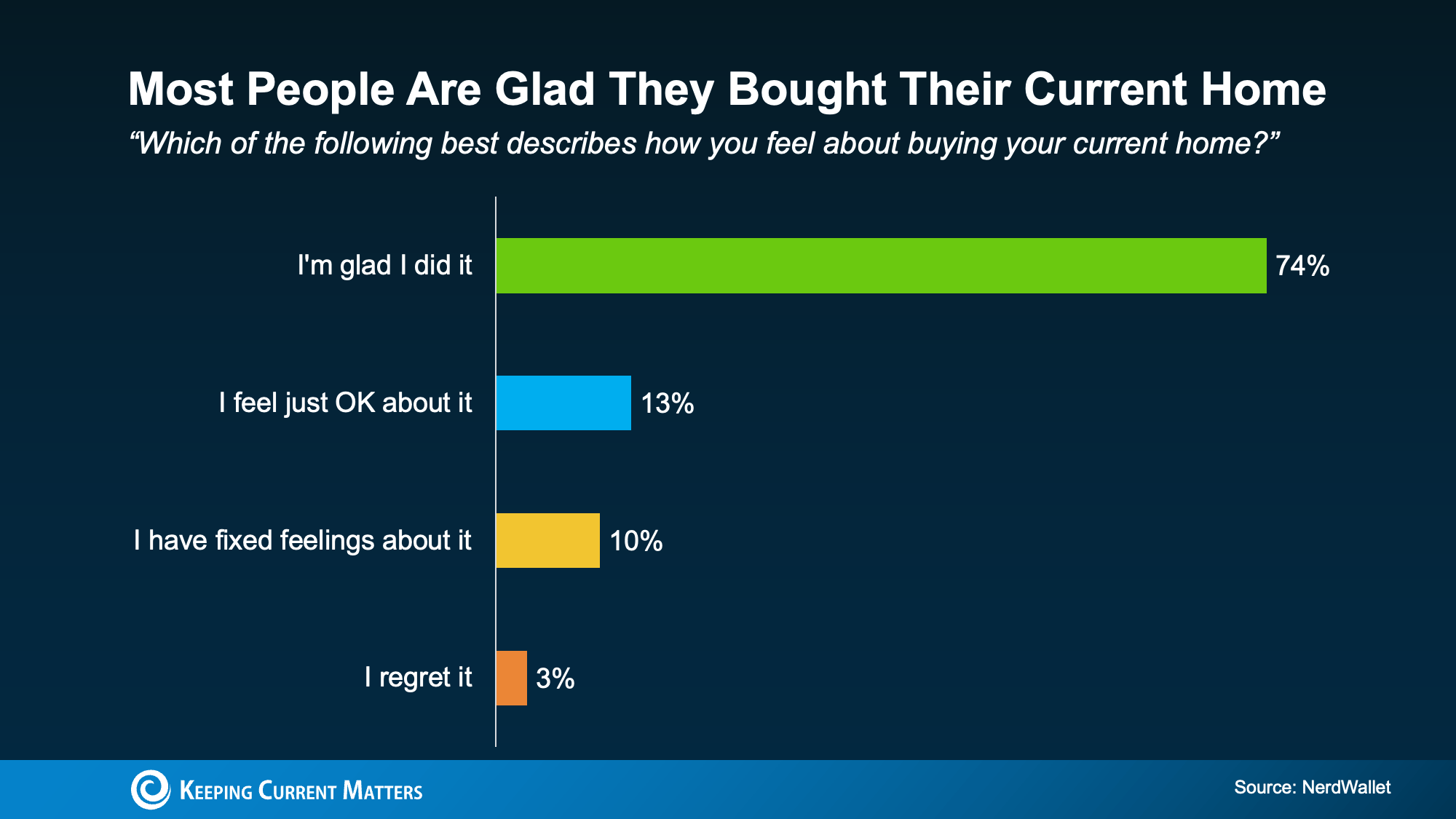
According to a recent survey from NerdWallet, the vast majority of recent buyers (74%) were glad they bought their current home. Only a very small 3% of people regret it:
And here’s a big reason why so many people feel it was worth it, even now.
Homeownership Is a Long-Term Play
When you’re deciding whether to buy, it’s easy to focus on what’s happening right now. What’s today’s mortgage rate? Are prices going up or down? Those things matter. But don’t get so caught up in buying in the perfect moment that you miss the bigger picture.
A home isn’t typically something you buy for just a year or two. It’s a longer-term play. And when you zoom out, it all starts to fall into perspective – especially if you look at home prices and equity.
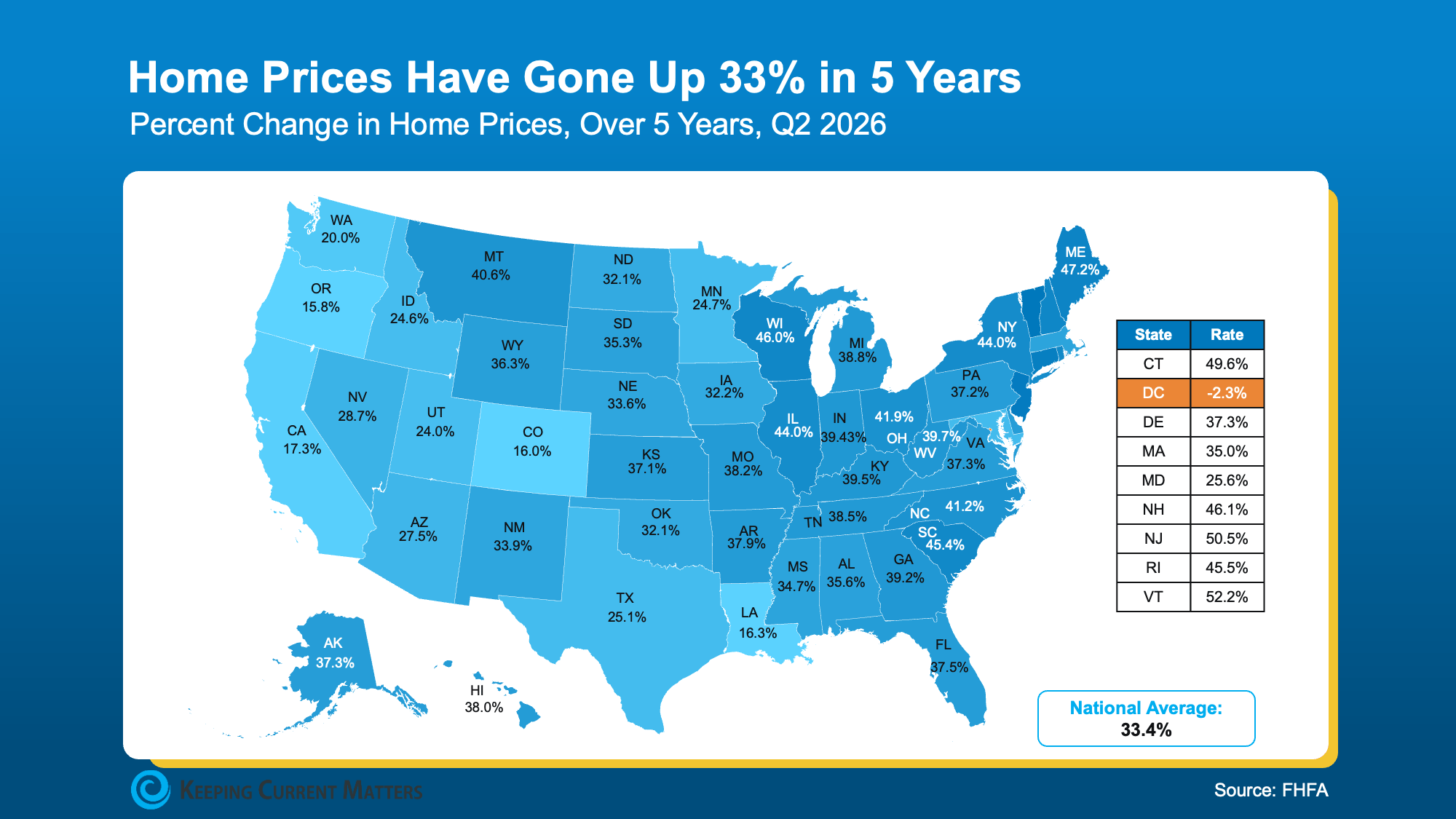
According to data from the Federal Housing Finance Agency (FHFA), home prices nationally have risen 33.4% over just the past five years (see map below):
And that appreciation has helped current homeowners build some serious wealth. Research from Bankrate shows homeowners gained an average of nearly $150,000 in wealth over the past five years as equity steadily rose across 90% of major metro areas.
That’s one of the biggest benefits of homeownership. As you pay down your mortgage and your home appreciates over time, your ownership stake – your equity – can grow.
Now, Zoom Out Even Further
The five-year numbers are impressive. But the numbers get even more dramatic when you look at decades instead of individual market cycles.
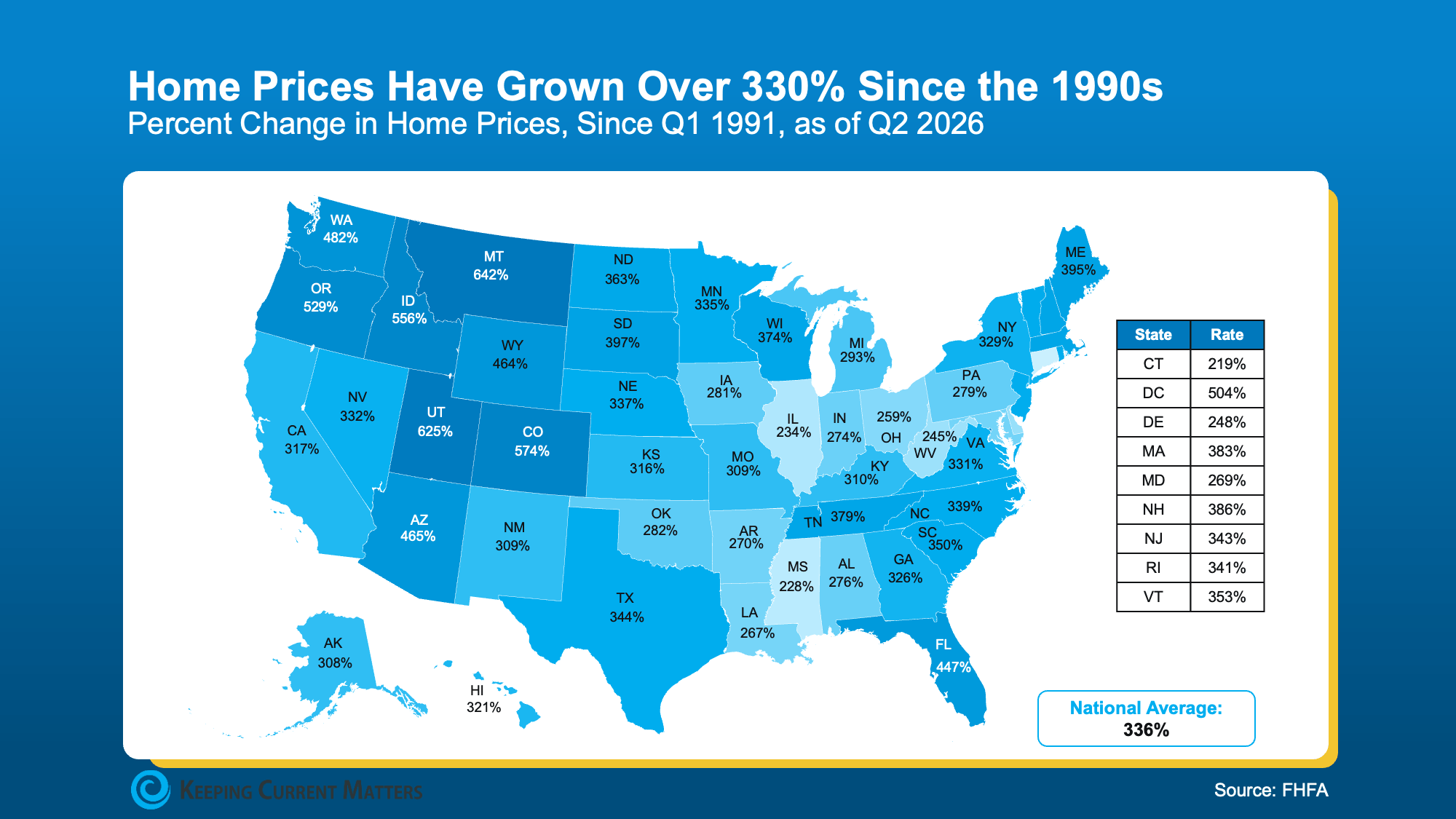
FHFA data shows home prices nationally have risen 336% since 1991. Sit with that for a second. Three hundred percent (see map below):
That doesn’t mean prices go up every single year. And it doesn’t mean buying is automatically the right decision for everyone today. You should only buy when the numbers (and the payment) work for you.
What it does show is why trying to perfectly time the market can make you miss the bigger picture.
Over time, homeowners gain a lot of equity. And that equity can eventually become a powerful financial resource. As Freddie Mac explains:
“Your home’s equity is part of your total wealth as a homeowner. If you decide to sell your home, the equity you have built over time will come back to you in the sale. . .
If it’s time to upsize or downsize, you can use that cash for the down payment on your next home.”
Basically, if you can afford to do it, buying a home now could set you up for future moves.
And just in case you’re someone who’s worried about what happens if prices do fall, after you buy, remember: you’re not buying for one year.
Prices can dip. They have before. But historically, they’ve risen far more over the long run. And the longer you own your home, the more time you have to ride out those ups and downs and keep building equity.
Bottom Line
Don’t let today’s uncertainty make you lose sight of what homeownership can do over time. Most homeowners say they’d make the same choice again. And decades of home-price growth help explain why.
If you’re wondering whether buying makes sense for you right now, connect with an agent to look at the numbers together – and what owning a home could mean for you in the years ahead.


Console market craters as Xbox sales crash 33% to the lowest since launch 25 years ago, PS5 sales drop 25% — steep price hikes push Series X to $800 and PS5 Pro to $900
Video game console sales in the U.S. have cratered, with both the PS5 and Xbox seeing a massive drop in YTD sales through the end of August compared with last year. Mat Piscatella, the video game industry advisor at research firm Circana, shared the numbers on his Bluesky account — PlayStation 5 sales have dropped by 25%, putting it at its lowest point since 2013, when gamers held off buying PlayStation consoles in anticipation of the arrival of the PS4, while Xbox’s retail figures have cratered by 33% YTD, putting its sales numbers at an all-time low since its launch almost 25 years ago.
From Circana’s US Retail Tracking Service:
For 2026 YTD ending August, Xbox hardware unit sales are down 33% versus a year ago in the US, while PlayStation hardware units are 25% lower.
Xbox YTD US hardware unit sales are at an all-time low, while PlayStation is at lowest point since 2013.— @matpiscatella.bsky.social (@matpiscatella.bsky.social.bsky.social) 2026-10-11T15:51:03.015Z
Latest Videos FromTom’s Hardware


Ugreen’s 100W 4-port GaN charger drops 27% today — get 100W of power and four ports for just $39.98

A dedicated charging solution is a great way to declutter your desk and keep your essential gadgets charged whenever you need them. If you are looking for one, don’t miss this deal on the Ugreen Nexode 100W GaN wall charger. Currently on sale at 27% off on Amazon, the charging adapter is $39.98, down from its original price of $54.99. Thanks to its high power output, it can charge multiple devices at once, making it suitable for your smartphone, tablet, and even your laptop.

Gigabyte’s latest BIOS update hints at Intel’s Raptor Lake Next launch in 2027 — new CPUs may support both DDR4 and DDR5 memory
Gigabyte has just confirmed Intel’s plans to introduce new processors compatible with existing LGA 1700 motherboards, with an expected launch in early 2027. According to a press release, Gigabyte is rolling out a new BIOS update to extend support for the upcoming processors across its entire lineup of Intel B760 and H610 motherboards. Owners of supported boards will be able to flash the latest BIOS and upgrade to the new CPUs without replacing their motherboards.
Go deeper with TH Premium: CPU

Latest Videos FromTom’s Hardware

U.S. suspends green card path for H-1B workers at Microsoft and Adobe — labor certification program blocked due to alleged fraud
During a Thursday announcement, Vice President JD Vance said that well-known tech companies Microsoft and Adobe are now blocked out of the PERM program — one of the possible paths for the firms’ H-1B workers to eventually evolve to green card status. The move was triggered by alleged fraud and abuse. IT outsourcing firms Cognizant, Infosys, Tata Consultancy, Wipro, HCL, and Capgemini also got slapped with suspensions.
The companies involved have not yet commented.
Latest Videos FromTom’s Hardware

GlobalFoundries to produce silicon interposers for TSMC’s CoWoS in the US — Five-year agreement valued at $2 billion
GlobalFoundries and TSMC have entered into a five-year manufacturing agreement valued at $2 billion under which GlobalFoundries will produce silicon interposers for TSMC’s CoWoS advanced packaging technology. The arrangement will establish a U.S.-based manufacturing source for these components, which will enable TSMC’s clients to brand their products as completely made and packaged in America. Volume production is scheduled to ramp up in the first half of 2028.
“By providing manufacturing service using GF’s trusted U.S. manufacturing footprint, we are creating a secure, scalable source of essential advanced-packaging elements that will help customers accelerate innovation and strengthen the semiconductor supply chain,” said Ed Kaste, senior vice president of CMOS Business at GlobalFoundries.
GF and TSMC team up
Latest Videos FromTom’s Hardware


Becoming a part of TSMC’s CoWoS ecosystem
Some things remain unclear

Mortgage credit availability declines slightly in September

Brooklyn median sales price reached $1.15 million on fewer deals in the third quarter
Brooklyn’s median sales price climbed in the third quarter as buyers competed for fewer listings.
The median sales price increased 5.4 percent to $1.15 million compared to the third quarter of 2025, according to Douglas Elliman’s sales market report with analytics from Marketproof.
There were fewer deals: sales fell 9 percent annually. “Recorded sales show some of the lagging effects of earlier caution,” the report said. Buyers have been spooked by continued high inflation, rising mortgage rates, and low inventory.
New listings were down 2.9 percent year over year, with inventory concentrated at the lower end of the market: 47.8 percent of listings are priced under $999,000 and another 45.1 percent are in the $1 million to $3 million range, the report said.
Stronger fourth quarter expected
Despite “elevated mortgage rates and economic uncertainty,” signed contracts expanded in the third quarter, increasing 8 percent year over year, according to Corcoran’s Brooklyn sales market report. (Contract activity is an early indicator of where sales are headed in the next quarter.)
Some pricing bands saw increases in inventory, as per Corcoran: Entry-level listings under $350,000 jumped 43 percent, and listings from $350,000 to $500,000 rose 25 percent.
With inventory expanding at more accessible price points, “buyers have greater flexibility than they’ve had in recent years. Still, pricing has remained firm, and homes are spending less time on the market,” said Michael Sorrentino, senior vice president and general sales manager for New York at The Corcoran Group. Days on market decreased by two percent annually.
Average vs. median sales price
In her firm’s Brooklyn sales market report, Bess Freedman, CEO at Brown Harris Stevens, explained why the average apartment price increased 3 percent over the past year to $1,176,072, yet the median sales price saw a decline. Stronger sales of luxury properties skewed the average price, while the median price reflects the market’s midpoint, she explained.
Brownstone Brooklyn neighborhoods Boerum Hill, Brooklyn Heights, Carroll Gardens, Cobble Hill, and DUMBO saw an 11 percent year-over-year increase in the average co-op price per room, as per Brown Harris Stevens. And the average price in Park Slope, South Slope, and Windsor Terrace ($1,476,897) was 7 percent higher than the year-ago quarter.
Looking ahead to the fourth quarter, Freedman said, “the Brooklyn apartment market faces several challenges. Mortgage rates have risen sharply since March and are back over 7 percent. Brooklyn also faces low inventory in many of its neighborhoods. These two factors, along with concerns about the war in Iran, inflation, and the upcoming elections, led to a sharp reduction in signed contracts last quarter.”
Demand for houses in Queens
Compass also released sales market reports for Brooklyn and Queens, taking note of a rise in sales of townhouses in North and Northwest Brooklyn, which saw 1.2 percent and 5 percent more closings year over year.
Overall, inventory of houses was down in Brooklyn with 17.3 percent fewer properties on the market. Median sales price for houses was $1,699,000, a 1.1 percent increase from a year ago.
Queens saw 4,446 deals in the third quarter, a 1.2 percent year-over-year increase. Houses led the growth, with closings up 8.7 percent year-over-year. Northeastern Queens, including Bay Terrace, Bayside, Auburndale, Flushing, and Glen Oaks, posted the largest increase in sales.
Buyers were most active at the top of the market, with luxury homes priced at $1.5 million and above seeing 28.4 percent more closings, the Compass report said.
“If inflation cools and mortgage rates ease, buyers who held back this summer could return” to the market, the report said.
Paying more for the same size condo
Coury Napier, director of research at SERHANT, said in his firm’s sales market reports for Brooklyn and Long Island City that “scarcity pushed prices higher across every [Brooklyn] property type.”
Contracts for Brooklyn condos were nearly flat from the spring, down just 0.9 percent and buyers are paying more at the top, the report noted, with $3 million-plus contracts commanding an 11.1 percent higher average price per square foot and the average price of $3 million-plus condo closings up 26.9 percent.
Condo closings in Long Island City rose 8.7 percent year-over-year, up 29.4 percent from the spring. The average price per square foot was up 10.8 percent and the median price up 10.4 percent even as unit sizes were nearly unchanged.

Renovate or Relocate? What To Know Before You Decide To Age in Place
You’ve spent years making your house feel like home, celebrating milestones, making each room your own, and turning neighbors into friends. As you look ahead to the next chapter of your life, it’s natural to wonder if this is still the place you want to spend it.
Whether you’re leaning toward staying in your house as you get older or moving to a 55+ community, the goal is the same: a home that fits the life you want, with more time for the people and things you love. So, here’s what to consider before you decide.
What It Can Take To Stay Put
Wanting to stay in a house you love and are familiar with makes sense. But most houses need at least some updates to make aging in place easier.
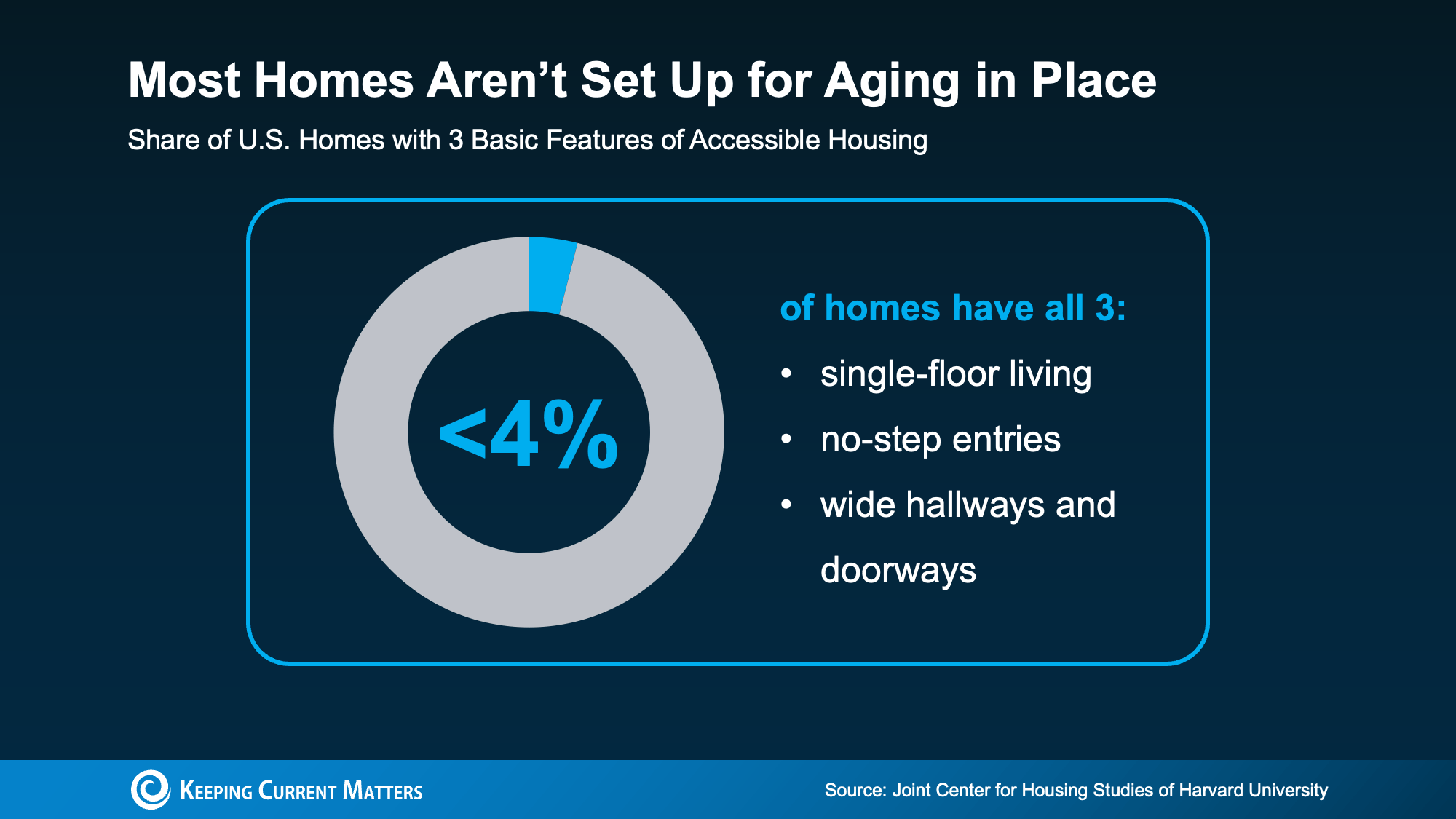
In fact, the Joint Center for Housing Studies of Harvard University (JCHS) finds that fewer than 4% of homes have the basics, like single-floor living, no-step entries, and wide hallways and doorways (see graph below):
That means for most homeowners, staying put means doing a remodel.
The National Association of Home Builders (NAHB) reports more than half of remodelers (56%) take on this kind of work. Some of the most common projects are installing grab bars, curb-less showers (walk-in showers with no ledge to step over), and wider doorways.
Now, that’s not to say you can’t go this route. You most certainly can. But if this is how you’re leaning just know you’d be living with contractor noise and dust until the work gets done. Some people don’t want to live in a construction zone. Not to mention, having to manage the contractors and schedules, etc.
Your Equity Could Pay for Your Next Move
If that sounds like something you’d rather avoid, here’s the good news. The money for your next home may already be sitting in your current one. It’s called equity, which is the difference between what your house is worth and what you still owe on it. After years of mortgage payments and rising home values, it adds up. Jess Catorc, Co-Founder of Carry, explains:
“The way home equity builds and is used changes a lot depending on your stage of life. . . . For older homeowners, decades of mortgage payments and home-value growth can turn equity into a financial cushion.“
When you sell, that cushion can go toward a home that’s ready for this stage of life. No demo required. You just get the keys and it’s all there, ready for you. That means less time on projects and more time for living. And one option you may consider if you’re entertaining a move is a 55+ plus community.
Why 55+ Communities Are Worth a Look
From the homes to the shared spaces to the activity calendar, these communities are planned around this stage of life. And that means everything you need is already rolled into one place. Rocket Mortgage lists some of the biggest perks (see visual below):
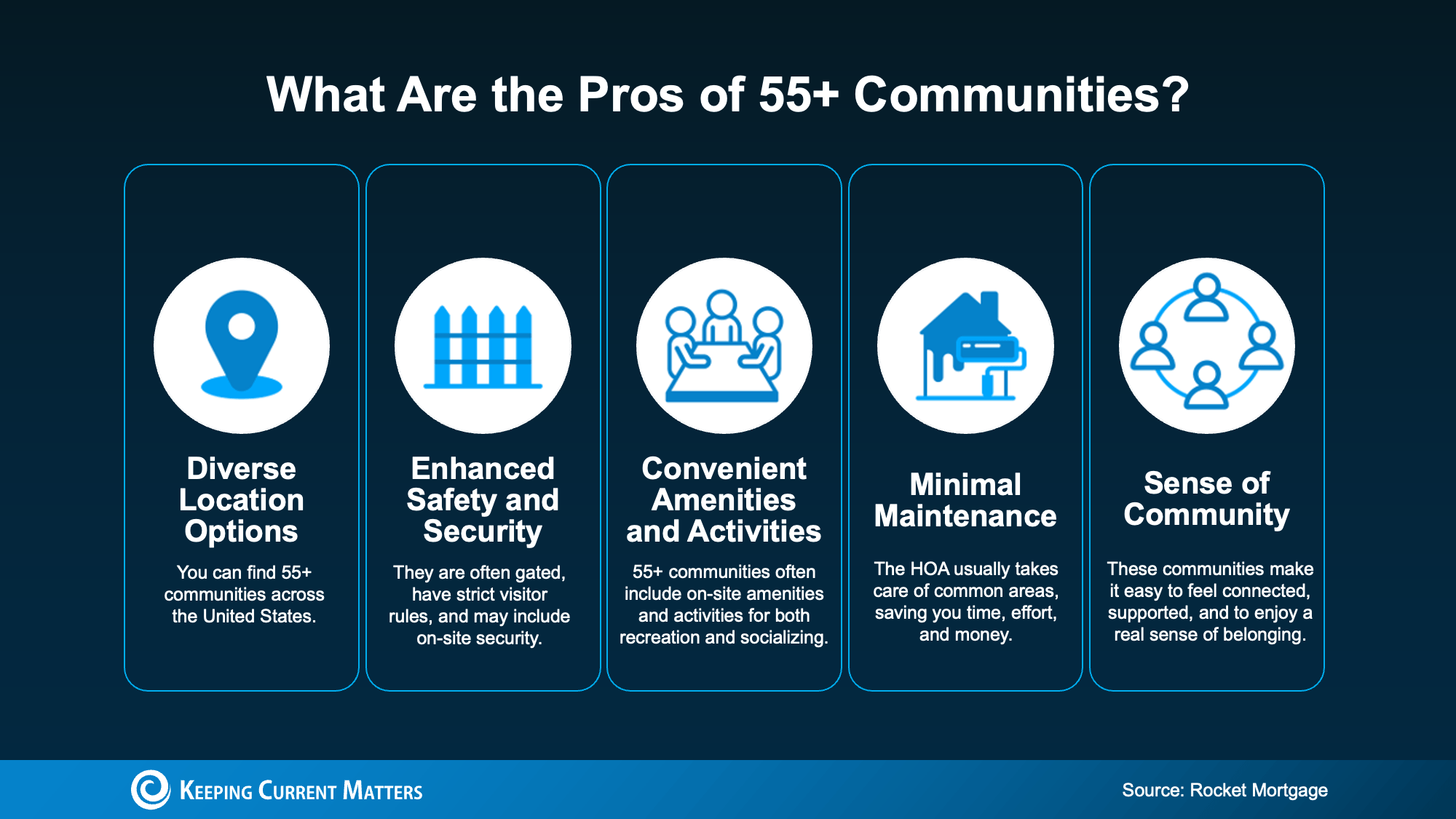
Instead of spending time and money to make your house easier to live in, you’d move into a community that’s designed with that in mind from the jump. That frees you up for the good stuff, like a morning walk with a neighbor, a game night down the street, or finally trying the hobby you’ve been putting off.
Bottom Line
Staying and moving can both be good choices. What matters most is finding the place where you’ll feel comfortable and at home for years to come.
A local real estate agent can help you weigh the two by showing you what your house could sell for and what 55+ communities in your area have to offer, so you can decide what feels right for you.