Less than two weeks after Google released a mapping of the complete brain and central nervous system of an adult male fruit fly, we’ve seen enthusiasts put the structure to work everywhere from turning a fruit fly into a day trader to teaching it parallel parking. Now, one Balatro fan says they trained the structure with an algorithm to play the game, with the win rate currently sitting at a cozy 20%.
The player shared a sped-up video of the model apparently playing the game. Based on the video, the player chose the lowest difficulty (White Stake) and the default Red Deck. We’ve already seen OpenAI’s GPT-6 ‘Astra’ model beating the game with the Black Deck on Gold Stack difficulty, which is generally considered the hardest combination in the game.
ActualAerie1011, the Reddit user who shared the video, says they trained the model using a trainer algorithm they developed to discover useful Balatro seeds. Like other roguelike games, Balatro is randomized, so algorithms like this can discover seeds that are unique and can potentially lead to very high scores (including the game’s scoring limit). In order to train the brain, both the brain apparatus (a connectome alongside the actual model) and the algorithm play a seed. Then, the results are compared, and the model on the brain is rewarded or punished based on its choices.
Latest Videos FromTom’s Hardware
Currently, the user says that the brain has a 20% success rate on a random seed, presumably at that same White Stack/Red Deck difficulty. The user says the model doesn’t know anything about the seed outside of what’s immediately visible on-screen, and that training is ongoing. “The fruit fly will return, strong and smarter,” they wrote in a comment on their original post.
It’s an impressive feat, though some commenters have cast doubt on the project. The player didn’t share many details about how they trained the model outside of what’s above, nor any repo for the project or references to other open-source projects they used. This isn’t uncharted territory for Balatro; projects like BalatroBot and BalatroLLM have been available for about a year.
We’ve reached out to ActualAerie1011 to see if they’re able to provide more details on how they trained the model, and we’ll update this story when we hear back.
Although Balatro seems straightforward enough, it’s surprisingly difficult to train a model to play the game, especially at higher difficulties. The core rules of playing and scoring poker hands aren’t difficult. However, the complex interactions between jokers (the perks that help you achieve higher scores), how they’re ordered and scored, and specific stipulations like boss abilities and temporary/permanent jokers make consistency a high bar to clear, even for human players, much less an AI model.
Get Tom’s Hardware’s best news and in-depth reviews, straight to your inbox.
Folks with Nvidia-based gaming laptops can now use a new tool called NvpwrControl to unlock additional performance from their assuredly power-limited mobile GPU, as long as they’re willing to accept the risks of cranking their GPU power limit by as much as 40 watts. The tool, spotted by VideoCardz, is available for download on GitHub, and it is labeled as ‘experimental’, so you’ll want to be very sure you’re willing to damage the reliability, if not the lifespan, of your fancy discrete GPU gaming laptop before using it.
NVIDIA GeForce RTX 50 Series Laptop GPU Power Limits
GPU Name
GPU Power (varies per laptop)
Dynamic Boost Max
Mod Max (Experimental)
GeForce RTX 5050 Laptop
35 – 100W
15W
140W
GeForce RTX 5060 Laptop
45 – 100W
15W
140W
GeForce RTX 5070 Laptop
50 – 100W
15W
140W
GeForce RTX 5070 Ti Laptop
60 – 115W
25W
180W
GeForce RTX 5080 Laptop
80 – 150W
25W
225W
GeForce RTX 5090 Laptop
95 – 150W
25W
225W
In Nvidia’s case, the GPU models (aside from the RTX 30 Series) don’t match at all between laptop and desktop, but even with the smaller size of the laptop GPUs, the chips are still sharply limited in performance by their stringent power limits. These limits top out at 150W, with an extra jolt, usually 25W, available from Dynamic Boost if the CPU isn’t heavily loaded. This is, frankly put, not enough power for even the mobile GeForce RTX 5070 Ti to stretch its legs, to say nothing of the GeForce RTX 5080 Laptop or GeForce RTX 5090 Laptop. In high-intensity gaming situations, these GPUs can score pretty similarly due to having the same power limit.
Latest Videos FromTom’s Hardware
That’s what makes this tool attractive. By cranking the power limit, you can give these power-limited GPUs a performance boost. The developer doesn’t provide any benchmarks, but I can say from experience that testing power limit adjustments on a power-limited GPU can give nearly linear performance gains, meaning that increasing the power limit from a stock 140W all the way up to 180W could potentially give a GPU performance uplift in the neighborhood of 25% or more, although it is impossible to verify this without testing.
There are quite a few caveats to this utility, though. For one thing, even the author describes it as ‘experimental ‘, and for another thing, it’s clearly AI-generated in the largest part. The developer is called “LevinAI”, after all, and there are the hallmarks of generative AI all over the GitHub repository. Still, there are a few reports on both GitHub and Reddit suggesting that users have been testing it, and the developer claims that it works on his GeForce RTX 5070 Ti laptop, posting the proof below.
The developer’s screenshot of GPU-Z, showing a board power draw of 163.9 watts on a GeForce RTX 5070 TI Laptop, well above the stock 140W cap. (Image credit: /u/Ecstatic_Hamster2208 on Reddit)
Other notable qualifiers include that it only supports Blackwell GPUs for now, and it only enables power controls when it can recognize the power policy layout and OEM baseline. If your GPU already ships with a wacky power configuration, this tool may not work for you. It’s also not verified to work on every brand of laptop nor every model of GeForce RTX 50-series GPU, so we absolutely wouldn’t try this unless you’re willing to replace your Blackwell-based laptop.
The partially AI-generated project description (likely chosen as the author’s native language appears to be Russian) explains that the developer investigated numerous layers of the software stack on top of the GPU to see where the power limit could be modified. The controls that NVIDIA exposes generally won’t let the user raise the power limit above the value set by the OEM for fear of potentially damaging the hardware, since the power delivery and cooling mechanisms were likely not designed with the higher power draw and thermal output in mind.
Get Tom’s Hardware’s best news and in-depth reviews, straight to your inbox.
The solution he found was apparently to modify a low-level NVIDIA power policy that isn’t normally exposed to end-users. He says, “One of the important findings was that the power-management chain contains internal policy values that are not exposed through the normal consumer power-limit controls. This is the path that eventually led to a working experimental implementation.” However, due to the method employed, the tool does require the user to disable Windows driver signature verification, which is yet another ‘gotcha’ of the mod.
As amusing as it is to see that the developer left his AI assistant’s instructions for constructing his GitHub repository (which he didn’t follow), it’s a reminder both of the reliability concerns around “vibe”-coded software in production as well as of the incredible potential of AI software development. Since we spotted the story on this utility, the developer has already bumped the version from 1.5.0 to 1.8.0 with a new release on GitHub, suggesting that the pace of improvements is extremely rapid.
A few users on Reddit, where the author posted the above screenshot, lambasted the developer for taking ownership of what they claim is “100% AI generated work” and also for not structuring his code repository correctly (since all of the source is packed in a ZIP file, not properly viewable on GitHub). However, the majority of other users seem enthusiastic about his work, and several have already posted proof that it seems to work, with huge gains in 3DMark and other benchmarks.
Want to buy a house this year, but not sure if the timing’s right? Seasonally, it may actually be a better time to buy than you expect.
Yes, mortgage rates have been ticking up lately – and that’s creating some real challenges with affordability. No one’s arguing that. But there are also predictable trends that happen this time every year that can put some wind back in your sails.
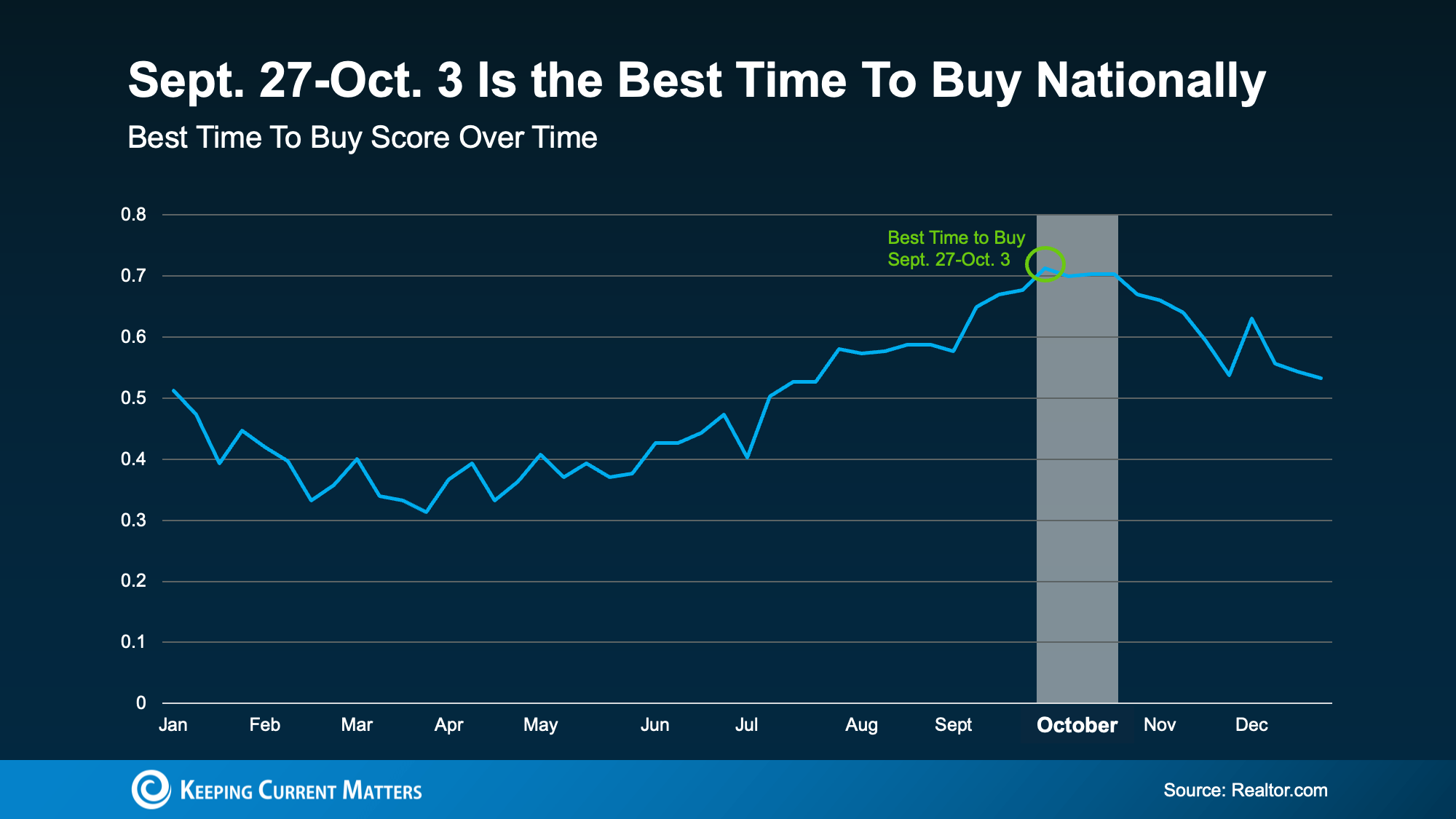
According to research coming out ofRealtor.com, nationally, the week of September 27 – October 3 will be the best time to buy this year for this very reason:
“The week of September 27–October 3 brings together the market conditions buyers value most—elevated inventory, less competition and prices that have eased from their seasonal high—giving prepared buyers a way to offset high rates with savings on price and room to negotiate with confidence.”
But that’s the national best week. Depending on where you live, your local sweet spot may come a little earlier or later (see map below):
It all depends on local trends and how inventory and buyer demand ebbs and flows seasonally where you want to live. But no matter when your market hits its peak, here are some of the perks you can expect this time of year.
More Choices, Better Prices, and Less Competition
For starters, there are more homes to choose from. In fact, data from the National Association of Realtors (NAR) shows the number of homes for sale recently reached its highest level in more than 10 years:
“NAR’s data does show a strong uptick in for-sale inventory at the end of the summer, reaching the highest level in more than 10 years.”
That means you may have a better shot at finding something you love and can afford without making as many compromises. And that’s not the only advantage.
Realtor.com says buyers during this window could see home prices about $14,000 lower than the summer peak, along with 30% less competition from other buyers.Plus, homes tend to stay on the market almost 2 weeks longer (13 days), giving you a little more breathing room to make a decision.
More choices.
Better pricing.
Less competition.
That combination could be enough to ease some of the pressure higher mortgage rates are putting on your budget.
The Window Doesn’t Close After This One Week
But you certainly don’t have to buy during that very specific window. This isn’t a one-week-only opportunity. History tells us conditions should be tipped in your favor for the entire month of October:
In fact, Realtor.com says 42 of the 50 largest metros see their best week to buy fall sometime during October.So, don’t feel like you have to rush to hit one specific date. Use the time now to get things lined up, then jump in when the timing is right for you. As Guaranteed Rate explains:
“The best time to buy a home depends on your needs. Certain seasons can give you an advantage when starting your homebuying journey.”
Bottom Line
If you want to buy a house this year, there’s still a way to make it happen, even with today’s rates. This fall gives you the chance to get some of the best seasonal perks the market has to offer.
Want help figuring out when those advantages typically show up in your market?
Have a quick conversation with a lender and a local agent about how your market works and the steps you’ll need to take to get ready.
I’m relocating for a new job and have to break my lease. The landlord listed the apartment at a higher rent ($200 more than what I pay). Does this mean I’m off the hook for paying the remainder of my lease?
Many New Yorkers don’t know how to go about breaking their lease. So when life comes along with other plans, like a new job forcing a relocation, breaking a lease can feel daunting and spark fears of being dragged to housing court.
But there’s no need to assume the worst-case scenario, said Altagracia Pierre-Outerbridge, attorney and founder of Outerbridge Law representing residential tenants, condo owners and landlords. “What most renters don’t know is that the law actually incentivizes New York landlords to work with their tenants to find someone to take over the lease.”
In New York, landlords are required to mitigate damages when a tenant breaks a lease. This means that they have to make a good faith effort to rent out the apartment at either the same rent or at the current market value, whichever one is lower.
“But if your landlord listed the apartment at a higher rent, they can’t then sue you for damages,” Pierre-Outerbridge said. “It’s a clear violation of the mitigation statute. They’d be directly benefitting from your choice to vacate, so I’d balk at any lawsuit.” Pierre-Outerbridge recommends documenting the listing as proof should a lawsuit come to pass. It could help you get a suit dismissed quickly without having to go to housing court.
How to fulfill your duty
However, that alone doesn’t absolve you of your duty to fulfill the remainder of your lease, and vacating without any communication with your landlord would be a big risk. “It’s still in your best interest to remain cooperative so you don’t have to pay more than is necessary, because you are still on the hook until a new tenant takes over,” Pierre-Outerbridge said.
One of the best ways to show cooperation is to help find another tenant to take over the lease. “Especially if you have to relocate quickly, it’s in your best interest to find someone that can move in as soon as possible so you aren’t stuck paying rent for an apartment you aren’t living in for several months,” Pierre-Outerbridge said. “Your landlord will want to approve the new tenant, so make sure they can provide clear proof of income and financial history. ”
From there, the landlord can assign the lease to the new tenant or you can request a sublease. “Make sure you understand which type of agreement you are entering into, as a sublet keeps you responsible to meet lease obligations,” Pierre-Outerbridge said.
Check your lease for other fees
Even if you are able to find someone to take over your lease, it’s worth further inquiry into other charges that you may owe. The rent laws passed in 2019 “help protect tenants as far as the remainder of the monthly rent payments are concerned. It does not however specify how other potential fees may be handled,” Pierre-Outerbridge said.
Though most leases are unlikely to include specific language that penalizes breaking the lease, Pierre-Outerbridge still suggests that tenants review their lease to see whether it outlines any additional fees, or how your security deposit may be impacted. “Since landlords are required to mitigate damages and find a tenant, they can’t exactly withhold the security deposit, but they may argue that they can use it to cover fees that they incur to re-rent the apartment, like repainting or hiring a brokerage,” Pierre-Outerbridge said.
Ultimately, your goal is to pay as little as possible to get out of your lease, so do what you can to find a new tenant that can take over monthly rent payments. “You want to get your landlord out of your hair as quickly as possible, and presenting them with a new tenant will make that easier,” Pierre-Outerbridge said.
Altagracia Pierre-Outerbridge, Esq. is the owner of Outerbridge Law P.C, focusing primarily on tenant representation. The firm represents all sides in landlord-tenant litigation and transactional matters such as month-to-month holdovers, nuisance cases, licensee cases, harassment claims, repair cases, tenant buyouts, succession claims, DHCR overcharges and rent reductions and more. Pierre-Outerbridge has 15 years of experience litigating in Supreme, DHCR, and Housing Court. To submit a question for this column, click here. To contact Outerbridge Law P.C. directly, call 212-364-5612 or 877-OUTERBRIDGE, or schedule a meeting today.
We’ve reviewed Asus’ ROG Edition 20 anniversary kit. We’ve built a PC with it. It’s about as premium as a gaming PC build can get. Right now, you can pick up the same kit for a whopping $10,849.96 on Newegg in a combo deal. To put it mildly, this is one expensive deal, but it’s actually hiding a secret gem: it’s the cheapest RTX 5090 graphics card on sale right now.
Writing up a near-$11,000 combo set as a deal might seem silly, but one of the core components here is the Asus ROG Astral GeForce RTX 5090 Edition 20 that is priced as part of this deal at $5,999. You can’t buy this Astral card on sale individually right now. In fact, you can barely buy an RTX 5090 anywhere. RTX 5090 stock has almost completely disappeared in the United States, with only sketchy third-party sellers offering it at prices approaching $10,000.
This premium GPU is now ultra premium and, for the time being, ultra rare. Does that make this $10,849.96 Newegg combo deal a good option? If money is no object, you’re perversely getting some value for your money, as long as you don’t think too hard about the RTX 5090’s original $1,999 MSRP.
Yes, the GPU is an unstoppable force for any gamer. Our GPU benchmarks make that very clear. The RTX 5090 is the best GPU you can buy, and no other consumer GPU is going to beat it. It has 21,760 CUDA cores and 22GB of GDDR7 VRAM, with a 512-bit memory bus and bandwidth speeds of up to 1,792 GB/s.
This Astral is a world-beater of its own, though. It features an upgraded design, with a second BTF power connector to pull up to 800 watts, a glass backplate, and a curved OLED screen. It has faster clocks, hitting 2,750 MHz, with a 4.7-slot design. Performance-wise, the OG Astral is beating world records, so this is a card that you can really push to its limits (if you’re not scared of charred power cables).
Image 1 of 3
(Image credit: Tom’s Hardware)
(Image credit: Tom’s Hardware)
(Image credit: Tom’s Hardware)
The $6,000 GPU aside, you’re also getting a $3,299 Asus ROG Crosshair X870E Edition 20 motherboard. Asus has a few variants of this, but the Edition 20 board here has (alongside some beautiful gold accents) supports for up to nine M.2 SSDs, with five slots on the board and more via add-in cards. There are six USB-C ports, plus two 20 Gbps front-panel connectors. Large copper VRM heatsinks work with its integrated AIO cooler, with a curved 6.7-inch AMOLE screen and a huge copper heatsink. Probably overkill, but for $3,299, you want it all.
You’re also getting a $899.99 Asus ROG Thor Titanium III 3000W Edition 20 power supply. It’s a PSU, but 3000W isn’t to be sniffed at, and it’ll certainly provide enough power for the monstruous Astral RTX 5090. It’s fully modular, with another OLED display (magnetic, this time) which you can mount either side, or extend with a cable.
(Image credit: Tom’s Hardware)
Finally, you get the Asus ROG GR20 open-frame EATX PC case, set at $649.99. This is a totally new design from Asus, supporting large EATX motherboards, and you can stand it vertically or horizontally. There’s a crossflow fan to blow cool air onto the GPU, RGB light strips, and several fast USB ports. It’s mostly aluminum, with some plastic, magnetically attached cosmetic covers around the sides.
$10,849.96 for this Asus combo kit is so much money for anyone to spend on a gaming PC build, but, unfortunately, we are where we are. As our Asus ROG Edition 20 build write-up mentions, this is a kit that few will buy and own. AI is pushing gaming PCs to new heights, and it’s a real shame that we’re now seeing current-gen flagship GPUs like the RTX 5090 becoming so rare to buy that combo offers like this are, perversely, almost good value. If you’re spending $6K or more on a GPU, though, then it might make sense. You won’t find an RTX 5090 cheaper (or, probably, at all, at least for some time) so if you want the best gaming PC build that you can find, this is the kit you’ll want. For once, we don’t imagine this will sell out soon, but Newegg might pull the deal at any point.
AI companies don’t have a great track record in areas like copyright or user privacy — unless they’re the ones on the short end of the stick, that is — but it’s generally known that the chat logs from platforms like ChatGPT are used for improving models. The mechanism as to how this happens was still a mystery until today. 404 Media just published a report about OpenAI’s process of human review for chat transcripts, explaining how the review process works, and how it involves other humans sometimes reading private information.
The rating project’s name at OpenAI is Project Lily. The publication got information on the project’s instruction guides, Slack channels, real ChatGPT conversations, and, of course, the rating system to classify conversations. The operators are called “prompt reviewers,” and their job is fairly simple: look at anonymized real-world chats, and judge the quality of ChatGPT’s responses to assess whether they actually answer the question, and that the text doesn’t overuse “AI-speak,” patronizing tones, emojis, or sycophancy, among other parameters. Anthropomorphizing and stating “personal” experiences are both off the table, meaning that while it’s OK for ChatGPT to say “I found some information,” it’s not OK for it to say “as a chef, I like to…” or “I know what that’s like.”
The work is “very rote,” according to a reviewer, but at reportedly over $50 an hour, it’s a high rate for what looks like reasonably simple work. The reviewer also said that their guidelines keep changing and are often self-contradictory, a feeling most software developers should easily identify with.
Latest Videos FromTom’s Hardware
The person doesn’t think that most users are aware their chats are being read by others, though, something that’s particularly troubling when many use ChatGPT as an impromptu friend or therapist and put deep secrets in words for the bot to read.
While the chats allegedly go through an anonymization pass and reviewers don’t see usernames, OpenAI admitted to 404 Media that the filtering may let some personal data through, especially in shorter chats. The site notes that in many conversations, the user asks ChatGPT to keep the contents secret, as well. The version of the chat handed to reviewers also reportedly includes a “user memories summary,” containing a summary of the users’ questions and interests, context, and potentially even location.
Crucially, Project Lily does not grade the chats’ actual factual accuracy other than flagging obvious mistakes, implying that there’s likely at least one more team (or several) doing separate evaluations. Likewise, this reviewing is separate from manual safety checks that ascertain if someone might be looking to hurt someone else (or, presumably, themselves).
The existence of the project also indicates that contrary to these image AI companies try to cultivate, the models don’t improve just with technological advancement and better training sets — it appears you still need more than a few competent humans in the mix.
Get Tom’s Hardware’s best news and in-depth reviews, straight to your inbox.
By now you may be wondering about the “allow us to use your chats to improve our product” (paraphrased) setting present in most consumer-facing chat bots. That setting is turned on by default in every bot we can think of, even with many paid plans. In ChatGPT’s case, it does default to off in Enterprise, Business, and Educational customers.
That toggle switch does not work retroactively, though, so any chats already in ChatGPT’s database will remain there unless the user requests deletion. Also, said deletion is also not retroactive, meaning that deleted chats may have already been hoovered and anonymized, and possibly reside in a dataset somewhere.
Although OpenAI initially had no answer to 404 Media’s inquiry on whether users were explicitly informed that their chats could be read by humans, the company eventually offered a link to one of its FAQ pages that discusses human review for the purpose of model improvement. We verified ourselves that said notice is at least two years old, and likely older. After the publication of the exposé, the firm changed its help page explaining how people can opt out of data collection, but there’s no mention of human operators in that text.
This type of data collection and review is a running theme across most providers. Google Gemini clearly states that “humans may review some saved chats” in its Privacy Hub. Anthropic’s stance is similar, with a page dedicated to this topic. Perplexity’s stance, meanwhile, is unclear, as its Privacy Notice doesn’t confirm or deny human access to chat logs.
Have you ever passed by an interesting residential building in New York City and wanted to know more about its history? In this series, Brick Underground teams up with Tom Miller, creator of Daytonian in Manhattan, a blog about Manhattan buildings and other historic architecture. Each week, we run an excerpt from the Daytonian’s archives with a link to the full article.
German-born architect Jobst Hoffmann filed plans for a “five-story brick apartment house” at 29 East 7th St. in February 1880 for developer Isaak Horchster. Hoffmann’s plans projected the cost of construction at $11,000, or about $357,000 in 2026 terms. Soon after, Hoffman was hired by Z. H. Miller to design two apartment buildings at 25 and 27 East 7th St. that would exactly match 29 East 7th Street.
Hoffman’s design was a blend of Queen Anne and neo-Grec styles. He also included a whimsical cast iron fencing and stoop railings with stylized sunflowers.
The paired ground-floor openings shared a lintel decorated with a small rosette. The centered entrance was crowned with an earred cornice inspired by ancient Greece. The four upper stories were clad in red brick and trimmed in sandstone. Hooded lintels decorated the second and fourth floor openings and between the third and fourth, Hoffmann added colorful encaustic, quilt-like tiles.
No. 29 East 7th Street was known as a double flat, which meant there were two apartments per floor. Among the initial tenants was Auguste Schelcher. He was on his way with friends to the ball of the Société Culinaire Philanthropique on the evening of April 30th, 1883, when his night of gaiety turned to horror. The New York Times reported that as they passed 404 Sixth Ave., Désiré L. Houvet, a French chef and another member of the Société Culinaire Philanthropique, exited the building and collapsed.
The “elegantly dressed” Houvet had just been stabbed in the back by Elizabeth Quinquinet. The New York Times would later explain, “Houvet, who was single, had led Mrs. Quinquinet astray and they had quarreled.” The 33-year-old Houvet died on the scene.
The Hessler family occupied an apartment here in 1896 when their 15-year-old son, Charles, became a hero of sorts. On the afternoon of July 7th, Charles was on the Bowery near Catharine Street. He saw 68-year-old John M. Sweitzer, who was inebriated and staggering along the sidewalk. Suddenly three men rushed up and robbed him of $40. The New-York Tribune explained that Sweitzer, “was unable, owing to his condition, to furnish any description of the robbers.”
Young Hessler, however, was able to describe them and pointed out one of the accomplices to police. On the weight of teen’s affidavit, the accomplice was committed to the Tombs Prison for further investigation.
By 1924, the basement level of 29 East 7th St. had been converted to two commercial spaces. Operating from one of them that year was George Withers Music Co.
There are still just two apartments per floor in 29 East 7th St. Because Z. H. Miller wisely decided to have Hoffmann recreate his design at Nos. 25 and 27, the trio has an enhanced presence.