Our expert reviewers spend hours testing and comparing products and services so you can choose the best for you. Find out more about how we test.
The good news is that Sandisk is still putting out SSDs for consumers, and these are not just cheap replacements. The Optimus GX Pro 850P is a bona fide high-end Gen 4 SSD that puts Sandisk’s name on theWD Black SN850X’s legendary design. This means DRAM, TLC flash, and good performance for any role.
Like theBlack SN850P, which is a Black SN850X made with a heatsink and for the PS5, the 850P is made for the console. Its heatsink is excellent, and it would fit right into your desktop PC, too. We wouldn’t recommend shucking it for use in a laptop, but theoretically it could work there as well. Our main concern would be the pricing, which is a bit steep – this is a nice drive, but you’ll pay a premium for it.
The Sandisk Optimus GX Pro 850P is available at the same capacities as itsWD Black SN850P forebear: 1TB, 2TB, 4TB, and 8TB. This also matches the originalWD Black SN850X and its later8TB SKU. Prices at the time of review for the Optimus GX Pro 850P are $309.99, $609.99, $1,139.99, and $2,249.99. These prices are well above the $234.99, $494.99, and $1,019.00 that the Black SN850P is currently demanding. We think the prices will come down on the Sandisk drive, but be aware of the comparable alternatives when making a purchase.
Latest Videos FromTom’s Hardware
The drive can reach up to 7,300 / 6,600 MB/s for sequential reads and writes and up to 1.2 million random read/write IOPS. This performance is at the top for a Gen 4 drive and, frankly, is capable of delivering an excellent experience even for heavier workloads. The drive’s warranty is standard at five years with 600TB of writes for every TB of capacity. The Optimus GX Pro 850P supports data-at-rest encryption through TCG Opal v2.01, but this is not explicitly listed for the SN850P, likely as this model is designed for use in the PS5.
Sandisk Optimus GX Pro 850P Software and Accessories
Sandiskfully supports its drives with downloadable software. For the Optimus GX Pro 850P this includes the Sandisk Dashboard, which is Sandisk’s version of WD’s Dashboard, and Acronis True Image for Sandisk. The former is an SSD toolbox with all of the expected features: drive health and SMART monitoring, firmware updating, performance testing, etc. Acronis True Image is OEM-licensed software used for backing up files and imaging drives.
Sandisk Optimus GX Pro 850P: A Closer Look
Image 1 of 2
(Image credit: Tom’s Hardware)
(Image credit: Tom’s Hardware)
The Optimus GX Pro 850P is designed to specifically fit into the PS5 with an effective heatsink. The bare drive underneath is single-sided at 1TB and 2TB but double-sided at 4TB and 8TB. For that reason, the rated height is larger for the latter two SKUs. In general, this should not be an issue for fit in desktop PCs. The heatsink itself is finned for extra surface area for better heat dissipation and should keep the drive cool even under harsh conditions. It does not have RGB, unlike the WD Black SN850’s heatsinked SKU.
The drive label gives some additional information, such as a rating for 3.3V / 2.8A. This is ~9W, which matches the drive’s highest reported power state. This is certainly higher than the ~5W we see for many DRAM-less drives, which have half the flash channels on top of not having DRAM to worry about, but it is not enough to be a problem with this heatsink.
Get Tom’s Hardware’s best news and in-depth reviews, straight to your inbox.
Image 1 of 3
(Image credit: Tom’s Hardware)
(Image credit: Tom’s Hardware)
(Image credit: Tom’s Hardware)
The Optimus GX Pro 850P has a relatively standard SSD layout with an SSD controller, a DRAM module, power management circuitry, and two NAND flash packages. The larger, double-sided versions of the drive will have more NAND flash packages, with two additional packages on the back. We’ve covered the controller and its iterations in the past. The DRAM, for what it’s worth, is DDR4, which is serviceable for the role volatile memory plays on an SSD: mostly as a metadata cache. The one caveat here is that our 2TB drive only has 1GB of DRAM, which is one-half the usual and likewise one-half of what we had on our 2TB WD Black SN850X sample. In practice, this should have no impact on intended workload performance and could potentially reduce cost a small amount.
The flash is potentially more interesting, as it could be the expected BiCS5, or it could have been updated. The8TB WD Black SN850X uses BiCS6, and it can make sense to cycle in newer flash later on in a product’s lifetime. The Optimus GX Pro 850P is essentially in that line. What we can say for sure is that the flash on here was manufactured more recently than the flash on the Black SN850X samples we’ve reviewed at both capacities – newer in production date, not necessarily in generation – but the performance is close enough that there would be little perceptible difference even if it were generationally different. This drive is at the edge of what you can get out of this controller technology and Sandisk could also choose to tune it specifically for this performance range, so at the end of the day one could say this is, effectively, equivalent to the WD Black SN850X with BiCS5 TLC flash.
We believe our sample is still using BiCS5 anyway – the coding’s sixth character “C” implies that – but that statement applies to any potential BiCS6 swap. In this case, moving to newer BiCS5 means a higher I/O rate, 1,200 MT/s to 1,600 MT/s. The former is plenty to saturate a PCIe 4.0 link with an eight-channel controller like the 850P’s, but putting in newer flash makes sense from a supply perspective. Higher MT/s flash can have lower latency and potentially better power efficiency when run at a lower MT/s, but we don’t believe either is a motivation here. Real-world impacts are, again, minimal, with minor exceptions that might not exist if we were comparing to a current Black SN850X.
Tech enthusiast and developer Matt Birchler has tested an Apple iPhone 18 Pro with a can of La Croix used as a cooling device to address persistent thermal throttling that he noticed during his other tests with the phone. Surprisingly, this yielded much stronger results than one would assume, given that he simply placed the can of sparkling water on top of the phone, providing a 25% improvement in sustained performance.
Birchier has been benchmarking the A20 Pro processor inside the iPhone 18 Pro, and it has so far offered excellent transcription results in its normal non-sparkling-water-cooled configuration. In one test run, the latest Apple smartphone hit a maximum speed of 447.9 words per second, before settling down to a little over 320 for the 7th to the 20th runs. The reduced performance during the latter stages of a prolonged benchmark run is normal for nearly every portable device, as they reduce performance to avoid thermally damaging their chips and other components.
It’s exactly for this reason that high-performance computers often come with the best CPU coolers, with some enthusiasts preferring the best AIO coolers or custom water-cooling loops to get the most out of their high-end processors. However, this usually isn’t possible with most mainstream phones, unless you’re running a specialized gaming handset like the liquid-cooled Redmagic 11 Pro — but it seems that Birchler found a solution for the iPhone 18 Pro. “I did some benchmarking today and saw how the newest iPhone thermal throttles, which isn’t severe, but does happen,” the developer said. “I know from experience that if you put a cold beverage on the back of your phone, it will cool down really quick, so I thought…the test is obvious.”
So, Birchler pulled out an ice-cold can of La Croix from the fridge, started a benchmarking session consisting of 20 runs, and placed the drink on the back of the phone. After the tests were completed, the results were as expected: even though its initial run had a slightly lower result of 429.5 words per second, the “liquid-cooled” iPhone 18 Pro had a higher average of 400.4. This meant that giving the iPhone a cold drink helped it sustain around 25% higher performance, but at the cost of keeping the phone facing down while running heavy loads.
The average user wouldn’t need cooling solutions like these for most mobile devices. But if you use your device for extensive loads, like gaming or shooting and editing photos and videos, you might notice slower performance and a dimmer screen after a few minutes. You could follow Birchler’s lead and strap a cold drink to the back of your phone to reduce thermal throttling, but it’s going to be inconvenient and impractical. After all, it’s quite awkward to hold your phone while a can is sticking out of its back. This is why some smartphone accessory manufacturers make devices like the Black Shark Magnetic Phone Cooler 6 Pro for gamers or the SmallRig Universal Hyper Chill Cooling Phone Cage and the Tilta Khronos Advanced Kit for filmmakers.
Other enthusiasts have also experimented with their own designs, like this monstrous SSD cooling solution strapped to the back of an iPhone 17 Pro Max. These will allow you to squeeze more performance from your phone, but at the expense of an impractical design, additional weight, and shorter battery life.
A German Army Enigma transmission from 85 years ago, known as the MVUEH message, has been cracked by GTP-Astra in two days, reports the Crypto Cella. MVUEH was sent by the German Army to the SS-Totenkopf (Death’s Head) Division on July 10, 1941, at the height of the Nazi military power in WWII. This uncracked Enigma message was shared with enthusiasts online in 2005, but its secrets had remained concealed until now.
Crypto Cellar researchers highlight that what Astra managed to do in just two days “would take a human researcher weeks or even months.” Currently, the awestruck researchers are still picking through logs to determine how Astra managed this feat and how it did it so quickly.
One of the most impressive things about Astra’s tackling of MVUEH was that it “did it entirely on its own,” says the source. It was merely asked whether it could break any of the unbroken Enigma machine messages published on the Crypto Cellar Research web page. In response, Astra picked Nr. 172, MVUEH as a promising target and thought it might be related to the plaintext of Nr. 173, SIPVX.
Latest Videos FromTom’s Hardware
With its target decided and expecting the repeated place name “ROSENOW ROSENOW” as a probable plaintext clue, Astra developed Python and C++ software for an Enigma simulator and an Enigma Bombe. Its hunch appears to have been correct. You can see a demo of the radio message being decrypted online at the MVUEHA Cryptanalysis Case Study site (screenshot below).
In brief, the encrypted 82-letter MVUEH cipher looked like this: ICRVSORMCCWQTATYEVFXDBZGGSNXWLPSYWZYTCBSWULRTBZCVGODVJUSLSOOMJQJZSXSEBZPEYMDNXJYTC
Decrypted, with spaces added as appropriate, it looks like this: BTTE UM ANGABE DES MARSQWEGES X BEFINDE MIQ IN X ROSENOW ROSENOW X SOFORT FUNKANTWORT X WASCHBBSCH
An approximate English translation is: Please specify the route of march. I am in Rosenow, Rosenow. Immediate reply by radio
Get Tom’s Hardware’s best news and in-depth reviews, straight to your inbox.
Note that there was a spelling mistake at the front of the original message, which wouldn’t help decoding efforts.
We’ve looked at Enigma machines before, as efforts to crack wartime ciphers from them, as well as from Lorenz machines, would lead to some of the first general-purpose digital computer designs.
The Enigma featured a 26-key keyboard, with 26 light-up letters on the ‘lampboard’ positioned above it. Behind the lampboard, three rotors were installed from a set of five. The signal from a keyboard press traveled through an input wheel, then the three manually turnable rotors with 26 pins each, then a reflector to return the signal, which lit up the lampboard. Making it even more tricky to crack, the rotors would advance every keypress. Thus, if you keep pressing the same letter, a different letter on the lampboard would be shown each time. Yet another layer of obfuscation was added via the plugboard at the front of the machine, where users swapped more letters around. Operators used up to 10 plugboard rerouting wires.
Before using the Enigma machine, four settings must be dialed in by the operator: rotor order, ring setting, rotor starting positions, and plugboard connection(s). These settings were distributed separately, and they changed following a calendar. Even if the enemy had an Enigma machine, they’d also need to know the settings on the day to decode the message(s).
We reported on GPT6-Astra’s deciphering skills just last week. The LLM was behind the cracking of a 108-year-old unsolved WWI German code that had been encrypted using the ADFGVX method.
The maker of XMG gaming laptops and Schenker workstations said the prices for DDR5 SO-DIMMs have increased sixfold since July 2025, and it believes RAM will be in short supply through 2027 and beyond. The company said this in the r/XMG_gg subreddit, where the company also announced a price increase of $113 (€100) and $228 (€200) for most of its gaming laptop models, plus a massive $342 (€300) hike for one professional laptop.
This dramatic DDR5 SO-DIMM price jump tracks closely with desktop RAM, which experienced a similar 500% climb in the past 12 months. But what’s also concerning is that other components have increased in cost, too. Aside from RAM and SSDs, XMG noted that PCBs, electronic components, CPUs, graphics cards, and video memory are also facing similar cost pressures, resulting in higher costs. The war in the Middle East has compounded the situation, especially as increased oil and fuel prices are making air freight costs higher, while also increasing insurance premiums for sea cargo traveling from Asia to Europe via the Red Sea and the Suez Canal.
Because of this, the company says it was forced to increase the prices of several of its models. It also reminded customers that its margins are fixed and that the resulting hikes are solely driven by higher upstream costs. A company representative also said, “If relevant input prices fall again, we will reflect this in our retail prices as well — just as we have done in the past.” This is similar to Framework’s pricing strategy, where it recently cut the memory prices for the Laptop 13 Pro after it was able to find another source for cheaper LPCAMM2
Latest Videos FromTom’s Hardware
The post also gave a bearish outlook on the memory situation, echoing Micron CEO Sanjay Mehrotra’s words that the DRAM shortages will go well into 2027. This contrasts with Asus CEO Jason Chen’s prediction that component prices will start reversing in the latter half of 2027, and that the long-term predictions of high memory costs are just chip makers wanting to retain high gross margins for as long as possible. Chen said that Chinese memory makers increasing their production would help ease the shortage and that price increases are reportedly cooling as consumers refuse to pay more. Unfortunately, we have no way of knowing which of these two perspectives is correct, and we can only wait and see what happens with memory prices over the next 12 months.
Our expert reviewers spend hours testing and comparing products and services so you can choose the best for you. Find out more about how we test.
Gamemax is a brand behind an OEM (Sohoo), founded to retail its own products. Founded in 2013, the company sells cases, coolers, monitors, peripherals, and power supplies under a positioning it calls affordable luxury, which in practice means visually loud products at prices that undercut the established names. Its power supply catalog has always been the most uneven part of the range. There are units at the bottom of the stack that exist purely to hit a price, and there are recent models such as the Lion Core series that carry genuine certification and measure respectably. Knowing which of the two a given Gamemax supply belongs to has historically required someone to open it up and put it on a load tester, because the badge on the box does not settle the question.
We examine the Gamemax RGB PRO 750G to see how it fares among the best power supplies on the market. The RGB PRO series sits in the middle of that catalog and leads with its lighting. The 750G reviewed here is the 750W model, a fully modular ATX unit built around a 140 mm ARGB fan, compliant with ATX 3.1 and PCIe 5.1, and fitted with a native 12V-2×6 connector for current graphics cards. Gamemax rates it at 40°C ambient and lists an operating range up to 50°C, with the important caveat that output is derated by twenty percent above 40°C, so anyone running it in a genuinely hot environment is buying a 600W supply.
The company claims 80 PLUS Gold efficiency, Japanese 105°C main capacitors, and 25 addressable lighting modes with motherboard sync. The Gold claim is the one worth pausing on, because no entry for this model exists in the CLEAResult 80 PLUS database, nor in the Cybenetics or PPLP databases, so the badge printed on the sticker is at present a manufacturer assertion and nothing more. At an MSRP of $105, the RGB PRO 750G is asking more than several other 750W Gold units currently sell for, which places a great deal of weight on the lighting to justify the difference.
Latest Videos FromTom’s Hardware
Specifications and Design
Swipe to scroll horizontally
Gamemax RGB PRO 750G Power specifications ( Rated @ 40 °C for 750W )
RAIL
+3.3V
+5V
+12V
+5Vsb
-12V
MAX OUTPUT
15A
15A
62A
2.5A
0.3A
Row 1 – Cell 0
80W
80W
744W
12.5W
3.6W
TOTAL
750W
Row 2 – Cell 2
Row 2 – Cell 3
Row 2 – Cell 4
Row 2 – Cell 5
AC INPUT
100 – 240 VAC, 50 – 60 Hz
Row 3 – Cell 2
Row 3 – Cell 3
Row 3 – Cell 4
Row 3 – Cell 5
MSRP
$105
Row 4 – Cell 2
Row 4 – Cell 3
Row 4 – Cell 4
Row 4 – Cell 5
In the Box
The RGB PRO 750G arrives in a black cardboard box with a render of the unit on the front, the model name and wattage set large across the top, and three badges in the top right corner: PCIe 5.1 ready, ATX 3.1 ready, and a warranty shield. Green pinstripes run vertically across the artwork, the word Gamemax is spelled out letter by letter along the bottom edge, and an RGB color wheel with the words RGB LIGHT VERSION occupies the corner. It is busy but legible, and the front of the box tells a buyer most of what they need to know.
(Image credit: Tom’s Hardware)
Protection inside is adequate rather than generous, with the supply held between two molded pieces and the cables bagged separately. The bundle is thin. There is the AC power cord, four mounting screws, two zip ties, a multilingual user manual, and a 5V three-pin ARGB cable for motherboard synchronization. The ARGB cable is the one item a competitor would not usually include, and given the feature set, it is a necessity rather than a bonus.
(Image credit: Tom’s Hardware)
All of the unit’s cables are individually sleeved in black braid. Gamemax’s marketing describes the whole set as “embossed flat cables”. Wire gauges look appropriate throughout. These sleeved cables are slightly stiffer than flat ones and take more effort to route behind a motherboard tray, which is the usual trade for looks and ruggedness.
(Image credit: Tom’s Hardware)
Swipe to scroll horizontally
Gamemax RGB PRO 750G
Connector type
Hardwired
Modular
ATX 24 Pin
–
1
EPS 4+4 Pin
–
2
PCI-E 5.1
–
1
PCI-E 8 Pin
–
3
SATA
–
8
Molex
–
3
Floppy
–
1
External Appearance
At 165 x 150 x 86 mm, the RGB PRO 750G is a slightly long power supply. The 165 mm depth is 25 mm more than the ATX design guide recommendation, which is commonly met by 750W units. While every full-size ATX case will likely take it, cable clearance behind the unit in a mid-tower with a shroud will be tighter than it should be. The chassis is all black with a slightly textured matte finish that, for some reason, is very sensitive to fingerprint marks. It is a decent paint job, evenly applied. Four exposed screws hold the fan in place.
Get Tom’s Hardware’s best news and in-depth reviews, straight to your inbox.
(Image credit: Tom’s Hardware)
The top face is dominated by a hexagonal honeycomb grille stamped directly into the panel rather than a separate wire guard, with a Gamemax lion badge at the hub of the fan. The specification sticker occupies the opposite face, printed clearly, and includes the full rail table, the safety marks, and an 80 PLUS Gold logo. The side panels carry a large 750W in outline type with RGB LIGHT VERSION beneath it and the lion logo rendered in a rainbow gradient, alongside a further honeycomb perforated section.
(Image credit: Tom’s Hardware)
The rear face holds the C14 receptacle, a recessed main rocker switch, and a small square button labelled RGB LIGHT, all set into a perforated exhaust panel that covers most of the available area. The front face is the fully modular connector bay, arranged in two rows and silkscreened above and below each socket. A three pin 5V ARGB header sits at the left edge of the bay for the sync cable.
(Image credit: Tom’s Hardware)
The lighting is the reason this model exists, and it is better executed than the price suggests. A ring of addressable LEDs sits under the perimeter of the fan opening and lights the honeycomb cells from beneath, so the effect is a glowing hexagonal halo rather than the illuminated fan blades most RGB supplies use. It is diffused, even, and free of the visible hot spots that give away cheap LED strips, and it looks considerably more expensive than it is. Gamemax claims 25 modes, cycled with the rear RGB LIGHT button.
A short press steps to the next mode, holding the button for three seconds switches the lighting off, pressing again restores the previous mode after a single white flash, and a longer hold enters a self-test that lights every LED white. The last mode is retained through a power cycle. Connecting the bundled cable to a 5V three-pin header on the motherboard hands control to the board’s own software instead. However, the lighting is on the fan face, and in any case, with a bottom-mounted shroud, the conventional fan-down orientation buries the whole effect. Seeing it requires mounting the unit fan up, which most cases allow but which compromises intake air for the supply itself.
(Image credit: Tom’s Hardware)
Internal Design
Cooling comes from a 140 mm fan is made by PowerYear, model PY-14025H12S, rated at 12V and 0.40A. We could not find a datasheet for it. Gamemax claims a fluid dynamic bearing (FDB) engine fan and has a 50,000-hour life expectancy. The “S” designation suggests a sleeve bearing, but fan OEMs are infamous for mixing SKUs, so we cannot say be certain of the engine inside it. In a unit with a 10-year warranty, we would certainly hope that Gamemax’s claims are accurate.
(Image credit: Tom’s Hardware)
The platform is a Sohoo design. Guangdong Sohoo Technology is behind Gamemax, which is a Chinese manufacturer better known for cases and entry-level supplies than for anything with grand ambitions, but they have begun looking up lately. The layout is tidy for the class. Component placement is orderly, the soldering on the underside is clean, and the heatsinks are properly sized rather than the token strips of aluminum that usually accompany a budget platform. The extra 25 mm of chassis depth is put to use, as the board is not crowded and airflow is virtually unrestricted. None of this is bad work.
Image 1 of 2
(Image credit: Tom’s Hardware)
(Image credit: Tom’s Hardware)
The transient filtering stage begins on a small vertical PCB mounted behind the AC receptacle and continues on the main board, comprising two Y capacitors, two X capacitors, two common-mode chokes, and a MOV. That is a basic but complete filter with nothing omitted. Inrush current is handled by an NTC thermistor with a relay for bypass duty. A single bridge rectifier is mounted on the main heatsink alongside the APFC components. The active PFC stage uses two Oriental Semiconductor OSG55R140F MOSFETs and stores energy in a Nichicon 390 μF, 420V capacitor rated to 105°C, from the CE GG series. That capacitor is the one Gamemax’s marketing points to when it advertises Japanese capacitors, and on the primary side, the claim is accurate. The boost coil is unshielded.
(Image credit: Tom’s Hardware)
The primary inversion stage is built from two Si-Trend SI23N50F MOSFETs in a half-bridge arrangement, also sharing the long heatsink with the APFC components and feeding the main transformer. The resonant components alongside it indicate an LLC resonant converter, the standard and sensible choice for a Gold-class unit of this size.
(Image credit: Tom’s Hardware)
On the secondary side, the 12V rail is produced by four SPTJ4R1D6LA MOSFETs in synchronous rectification, a part we could not attribute to a known vendor. The 3.3V and 5V rails are generated by DC-to-DC converters on a vertical daughterboard adjacent to the modular PCB. Secondary filtering is where the cost comes out. Every secondary capacitor in this unit is supplied by Teapo. Teapo parts are not bad, and the ones fitted here are 105°C rated, but they are the middle-budget choice, which explains why the marketing claim about Japanese “main capacitors” looks carefully worded. With 10 years of warranty behind them, the secondary capacitors are the wrong place to have economized.
(Image credit: Tom’s Hardware)
Cold Test Results (25°C Ambient)
Cold Test Results (25°C Ambient)
For the testing of PSUs, we are using high-precision electronic loads with a maximum power draw of 2700 Watts, a Rigol DS5042M 40 MHz oscilloscope, an Extech 380803 power analyzer, two high-precision UNI-T UT-325 digital thermometers, an Extech HD600 SPL meter, a self-designed hotbox, and various other bits and parts.
At 25°C ambient, the RGB PRO 750G measures considerably better than its provenance would suggest. Efficiency averaged 90.8% across the nominal load range at 230 VAC and 88.6% at 115 VAC, peaking at 92.1% near 40% load on the higher input and 90.3% at roughly the same point on the lower one. Full load returns 90.7% and 87.2%, respectively, and the curve falls away gently rather than collapsing. Those are real Gold numbers. At 115 VAC the unit returns 88.3% at 20% load, 90.0% at 50% and 87.2% at 100%, which clears the 80 PLUS Gold thresholds of 87%, 90% and 87%, though two of the three points clear them by a thin margin. The performance is there. What is not there is any independent confirmation of it, since no entry for this model appears in the CLEAResult, Cybenetics, or PPLP databases, and an 80 PLUS Gold logo on a sticker with nothing behind it is a claim, not a real certification.
Thermally, the unit is excellent, and acoustically it pays for that. The primary heatsink reached 51.0°C and the secondary 47.8°C at full load, with exhaust air leaving at 39.7°C against a 25.2°C intake, a delta of 14.5°C. Those are figures we would expect from a considerably more expensive supply, and they are achieved the obvious way. There is no semi-passive mode, and the cooling profile is a little aggressive. The fan turns on from the moment the unit is powered, and it stays close to the base through the first 300W, drifting only to 33 dB(A). Past 400W, the curve turns sharply upward, reaching 43.0 dB(A) at 525W, 45.2 dB(A) at 600W, and close to 50 dB(A) at a sustained 750W. Below 300W, this is a quiet supply, and the absence of a fanless window costs it very little, as it is practically inaudible. Above 500W, it is one of the louder 750W units we have measured, and in a quiet build it will be the component you hear.
Hot Test Results (~45°C Ambient)
Hot Test Results (~45°C Ambient)
Inside the hotbox at approximately 45°C ambient, into the range where Gamemax derates it, efficiency moves, but not dramatically so. The average fell to 89.8% at 230 VAC and 87.7% at 115 VAC, with full load figures of 89.3% and 85.9%. A single point of degradation at 230 VAC across a 20-degree ambient rise is a genuinely good result for the class of this unit. The 115 VAC curve suffers more than the 230 VAC one, falling below 86% at maximum output, which is where the manufacturer’s derating starts to look like sound engineering rather than marketing caution, as the signs of thermal stress become obvious.
Internal temperatures stayed under control. The primary heatsink reached 80.8°C and the secondary 76.3°C at full load, well within the ratings of the components fitted, and the exhaust delta is essentially unchanged from the cold run. Once again, the fan is doing the work. It starts at 37.7 dB(A) even at 37.5W, passes 45 dB(A) before 300W, reaches 50 dB(A) at half load, and finishes at 54.4 dB(A) at a sustained 750W. That is loud in the plain sense of the word, and it makes sustained heavy load in a warm case an unpleasant proposition. It is a unit that will stay cool and reliable, but acoustics are being sacrificed for it.
PSU Quality and Bottom Line
Power Supply Quality
Voltage regulation is good rather than exceptional. Across the 20% to 100% load span, the 3.3V rail moved by 1.1%, the 12V rail by 1.4%, and the 5V rail by 1.5%. The 12V line ran from 12.12V at 20% load down to 11.95V at maximum output, which is 0.4% below nominal and entirely comfortable. The 5V rail sags to 4.97V at full load and the 3.3V rail to 3.31V. Neither minor rail is generously specified in the first place, at 15A each and 80W combined, but modern systems ask almost nothing of them and the figures are of academic interest for most builders. Ripple suppression is the strongest single result in this review. The 12V rail peaked at 48 mV under full load against the 120 mV ATX design limit, leaving 60% headroom on the rail that matters. The 5V rail topped out at 28 mV and the 3.3V rail at 26 mV against their 50 mV limits, with roughly 44% and 48% headroom respectively. However, all three rails stayed almost perfectly flat across the load range rather than degrading as output climbed, which behavior is rather odd for a PC PSU, as they tend to perform better when lightly loaded.
During our thorough assessment, we evaluate the essential protection features of every power supply unit we review, including Over Current Protection (OCP), Over Voltage Protection (OVP), Over Power Protection (OPP), and Short Circuit Protection (SCP).
All protection mechanisms triggered correctly with the unit hot. OCP tripped at 136% on the 3.3V rail, or 20.4A, and at 132% on the 5V rail, or 19.8A. The 12V rail is the outlier. OCP intervened at 108%, equivalent to 67A against a 62A rating, which is a far tighter margin than we normally see and tighter than we are comfortable with on an ATX 3.1 supply. Modern graphics cards produce short excursions well above their rated draw, and a 12V protection point set 8% above the rail rating leaves very little room for them. OPP shut the unit down at approximately 110% of rated output, or 825W, which is similarly conservative. Nothing here is unsafe. The unit is simply less tolerant of transient behavior than its ATX 3.1 badge implies, and a system pairing an ATX 3.1 class graphics card with a supply already running near its rated output is the scenario we would be cautious about.
Swipe to scroll horizontally
Main Output
Load (Watts)
151.5 W
Row 0 – Cell 2
377.6 W
Row 0 – Cell 4
561.28 W
Row 0 – Cell 6
746.95 W
Row 0 – Cell 8
Load (Percent)
20.2%
Row 1 – Cell 2
50.35%
Row 1 – Cell 4
74.84%
Row 1 – Cell 6
99.59%
Row 1 – Cell 8
Row 2 – Cell 0
Amperes
Volts
Amperes
Volts
Amperes
Volts
Amperes
Volts
3.3 V
1.4
3.35
3.49
3.34
5.23
3.32
6.98
3.31
5 V
1.4
5.05
3.49
5.03
5.23
4.99
6.98
4.97
12 V
11.53
12.12
28.84
12.08
43.26
11.97
57.67
11.95
Swipe to scroll horizontally
Line
Regulation
Voltage Ripple (mV)
Row 1 – Cell 0
(20% to 100% load)
20% Load
50% Load
75% Load
100% Load
CL1 12V
CL2 3.3V + 5V
3.3V
1.1%
22
24
22
26
24
22
5V
1.5%
24
28
26
28
24
24
12V
1.4%
36
34
40
48
46
34
Bottom Line
The RGB PRO 750G is two products fighting each other. Underneath there is a Sohoo platform that is competently engineered, properly filtered, generously heatsinked for the class, and that holds its efficiency in heat better than many mainstream Gold units. The Nichicon primary capacitor is a real one, and the ripple figures, although not record-breaking, are the best part of the review. On top of it sits a lighting ring, a set of marketing claims that do not survive checking, and a price that assumes you want the first of those enough to stop asking questions about the second.
(Image credit: Tom’s Hardware)
The measurements support the 80 PLUS badge even though there is no published certification for this particular model. An average of 90.8% at 230 VAC and 88.6% at 115 VAC are honest Gold numbers, and the 115 VAC curve clears the 80 PLUS Gold thresholds at all three checkpoints, if narrowly at two of them. Regulation is comfortable on every rail, and ripple has more than half its allowance spare on the 12V line. Internal temperatures are excellent in both ambients. Nothing in the electrical results embarrasses the unit.
The compromises are concentrated in three places. The secondary capacitors are all Teapo, which is the middle-budget choice and sits awkwardly against marketing that advertises Japanese capacitors without mentioning that only one of them is. The fan is a PowerYear part whose engine we cannot confirm, and it never stops; while that buys the excellent thermals, it also produces noise, which places this among the louder 750W supplies at high load. And the 12V OCP point of 67A, only eight percent above the rail rating, is tighter than a supply carrying an ATX 3.1 badge should be, given what current graphics cards do to a 12V rail on a millisecond scale. The warranty is the part of the package doing the most work. Ten years is serious coverage, level with MSI and three years beyond Corsair, and on a unit whose secondary capacitors are the obvious economy, it is the reassurance that makes them tolerable. It is also the clearest signal that Gamemax expects this platform to last, which the thermal results support.
(Image credit: Tom’s Hardware)
The pricing is where the argument gets difficult. At $105, the RGB PRO 750G is not the cheap option, which is the position a Gamemax supply usually occupies and the one this feature sheet is built for. The MSI MAG A750GL PCIE5 and the Corsair RM750e both sell below it routinely, frequently closer to eighty dollars, and both carry certification that exists in a public database along with quieter behavior at high load. Against that pair, the Gamemax is behind on certification, behind on acoustics, level with MSI and ahead of Corsair on warranty, competitive on efficiency, ahead on ripple, and 25 mm longer in the chassis. Against the Cooler Master MWE Gold 750 V4 at $119, it saves fourteen dollars and matches the coverage, giving up the conformal coating and the better-documented parts sheet to do it. It wins outright on exactly one axis, and that axis is decorative.
(Image credit: Tom’s Hardware)
The engineering does not deserve dismissal, and anyone who assumes an RGB badge guarantees a bad power supply will be wrong about this one. It measures well, it runs cool, it is covered for a decade, and none of that is an accident. But competence is the floor in this segment rather than the selling point, and $105 asks a buyer to pay above the going rate for a unit that leads on decoration and merely keeps pace on everything else. If the ARGB halo is what you want, and your case mounts the supply fan up where you will actually see it, this is a defensible purchase that will not let you down. If it is not, the same money buys a certified, quieter, equally well-covered supply from a brand with a longer record, and that is the comparison Gamemax still has to answer.
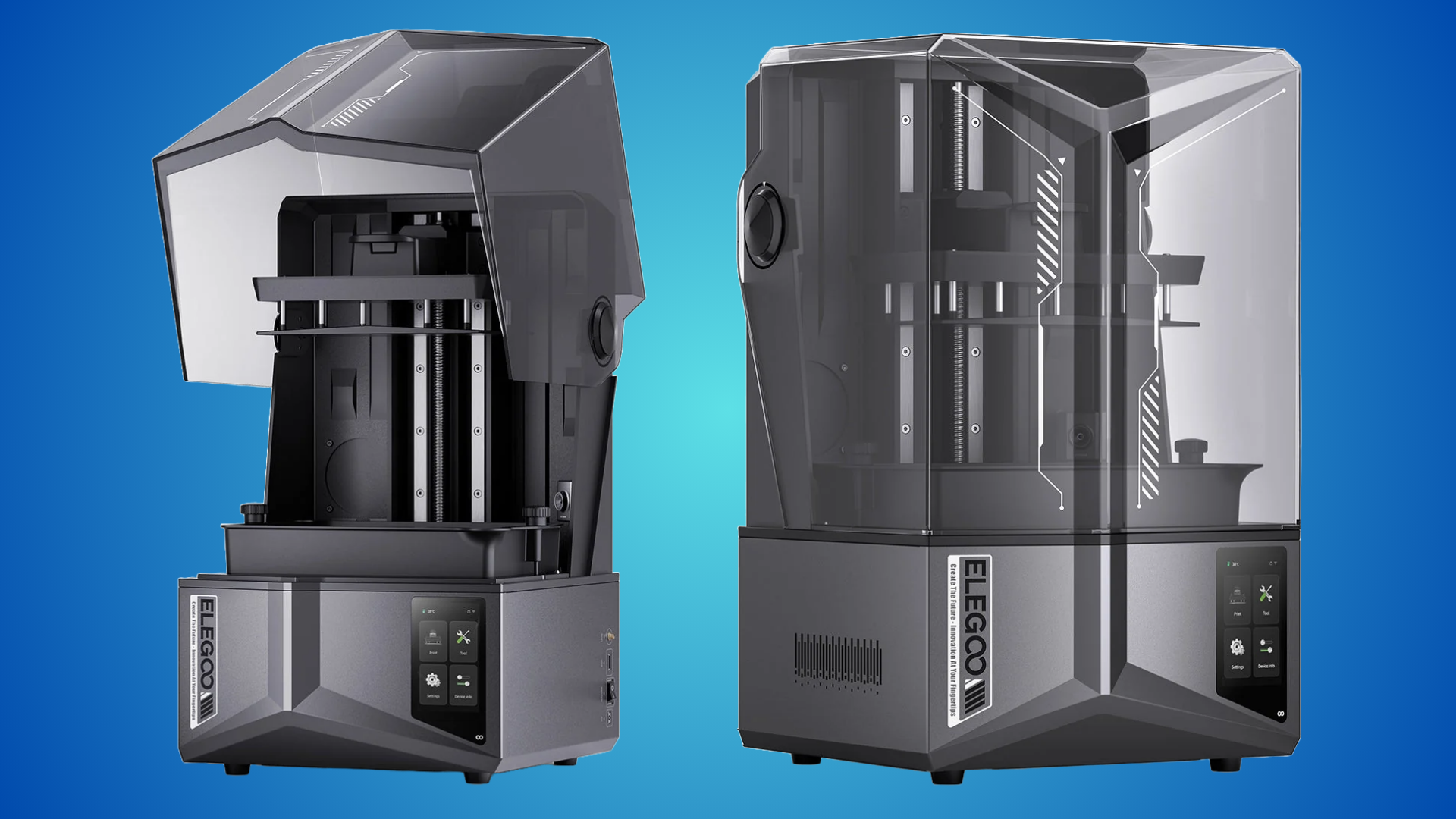
The Saturn 4 Ultra 16K is a slightly upgraded version of the model that we tested in our Saturn 4 Ultra review, which saw it score highly and gain an Editor’s Choice award based on its brilliant performance. This deal brings an already featured-packed and good-value resin 3D printer down to an even more enticing price, with the upgrades including an integrated vat heater and upgraded Wi-Fi connectivity.
With the Saturn 4 Ultra 16K, you’re getting a resin printer that includes a 4-inch capacitive touchscreen on the front, giving you full access to several of the built-in smart features to help you start printing. The build volume is 211.68 x 118.37 x 220mm, slightly smaller than the original 4 Ultra, but only just.
You also get a 10-inch, 16K LCD screen with this printer. For resin printer newcomers, this isn’t a display, but a mask that helps to block or let UV light pass through to cure each individual layer of liquid resin that prints. You’re getting a 11,520 x 5,120 resolution with this printer, giving you an accuracy of 14 microns. Compare and contrast to the humble human hair, which is around 70 microns in thickness. This improved over the original Saturn 4 Ultra’s 12K screen.
The Saturn 4 Ultra 16K’s integrated vat heater is a real improvement on this model, which means you can maintain optimal resin temperatures for reliable prints, even in a really cold environment, giving you a solid 86°F or 30°C. You’ve also got mechanical sensors that help stop the plate from crushing the screen if a print fails, as well as a tilt-release feature that moves the entire tank away to peel resin layers one by one, giving you a 150mm/hr print speed. There’s also power loss recovery to protect your print progress in an outage, as well as a built-in camera to help you monitor your print and create time-lapse videos.
The $399 sale price for the Elegoo Saturn 4 Ultra 12K is a brilliant one for the upgraded version of one of our favorite resin 3D printers. With the Elegoo Day sale set to finish on September 29, you’ve only got a few days to dive into a new hobby or expand your existing collection with this very affordable resin printer.