Remote Work Could Be Your Affordability Answer


For most first-time buyers, the hardest part of buying a home is making the numbers work. You budget, you save, and the finish line still feels far away. 

But your salary is only half the equation. Where you live shapes what you can afford just as much. And if you can work remotely, you have an advantage a lot of buyers don’t. 

You’re not tied to living where the jobs are, so you can look where your money goes further.

Where You Work Doesn’t Have To Dictate Where You Live

Remote job openings are on the rise. According to FlexJobs, remote job postings climbed 22% from the quarter before. That’s the second quarter in a row of double-digit growth. 

More remote roles mean more people can choose a home base around the life they want to build. As Forbes puts it: 

“Remote employees, freelancers, consultants, entrepreneurs, and business owners have the flexibility to choose a home base based on the life they want to build, whether that means more space, a lower cost of living, better access to nature, or simply somewhere new.”

And you can use that freedom to look somewhere more affordable.

Your Paycheck Goes Much Further in Some States

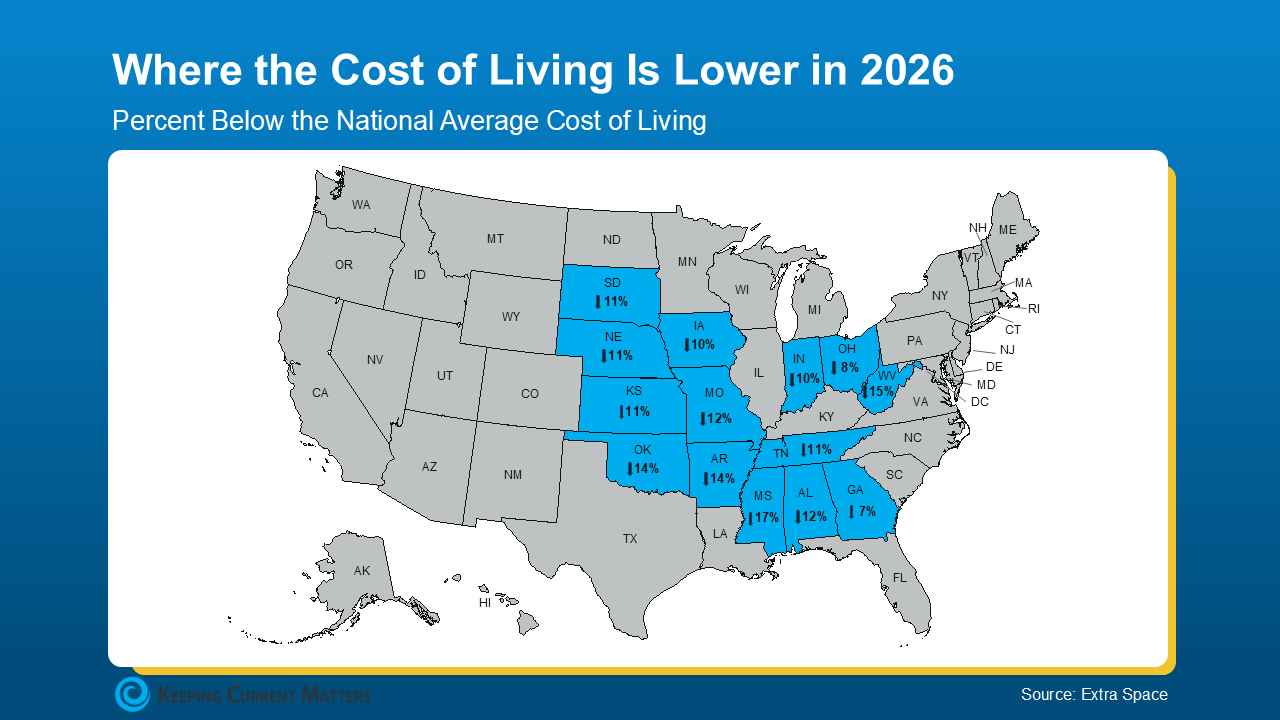
Your cost of living – what you spend on housing, groceries, utilities, and the rest of daily life – varies a lot from one state to the next. In some, according to data from Extra Space, it runs far enough below the national average to change what you can afford (see map below):

a map of the united statesTake Mississippi, for example, where the cost of living sits about 17% below average, or West Virginia at roughly 15% below. When day-to-day life costs less, you can put more of your income toward your goals, homeownership included. Relocate Right describes it this way: 

“Remote work has fundamentally changed the calculus of where to live. When your employer is in San Francisco, but you can work from anywhere, the question is no longer ‘where are the jobs’ but ‘where does my salary go furthest and what kind of life can I build.’”

For a first-time buyer, working remotely could be a chance to put down roots and finally buy. Because with that kind of flexibility, you get to choose where to live and which places work best for your life and goals. 

What To Weigh Before You Go

A lower cost of living is a great start. But it’s also important to consider the things a budget spreadsheet won’t show you, because a place can look like a great fit on paper and still not feel like home. 

  • Is the internet fast and steady enough to do your job without interruptions? 

  • Will it be easy to make friends and settle into a routine once you arrive?

  • Does it have the amenities you want, like public transportation or decent takeout?

This is where a local real estate agent comes in. They can help you weigh a big move against a nearby one, because every state has more affordable pockets. Sometimes they’re closer than you think.

An agent will know which neighborhoods fit your budget and have the features you’re after, whether that’s walkability, good restaurants, parks, or a nearby farmer’s market. 

Bottom Line

With remote work, where you live can be your decision instead of your employer’s. And that puts more affordable places within reach.

Want to explore where that could take you? Connect with a local real estate agent to see what’s possible.


Source link

From Williamsburg to Bed-Stuy: I was tired of the tourists and wanted to live somewhere less hectic


After living in Williamsburg for five years, Blair felt the area was becoming too touristy, plus it was hard to access via public transportation. Her hunt for an easier commute and a stronger sense of community led her to an amenity-laden building on the border of Bed-Stuy and Prospect Heights. Here’s Blair’s story as told to Kelly Kreth.

I’m originally from Los Angeles and I moved to New York City to attend St. John’s University where I studied chemistry. I graduated in 2019 and have called New York home ever since.

I was on the pre-med track St. John’s, but over time my passion shifted. When the covid pandemic hit, I leaned heavily into fitness, and that experience ultimately changed the direction of my career. I’ve been with Orangetheory Fitness for seven years as a sales and operations manager. I’m also a personal trainer at two Brooklyn locations.

Most recently, I lived in Williamsburg for about five years, renting a condo at The Edge. It was a shared, two bedroom, two bath with a balcony overlooking the East River and Manhattan skyline from the 25th floor. The views were incredible but being that high up wasn’t good for my anxiety. The rent for the 1,157-square-foot unit was $6,500, which I split equally with a roommate. The building’s gym was old, but there was an indoor pool and basketball court.


[Editor’s note: “Transitions” features first-person accounts of what it’s like to move from one NYC neighborhood to another. Have a story to share? Drop us an email. We respect all requests for anonymity.]


One of my favorite things to do in Williamsburg was to walk to Domino Park and watch the boats and jet skis ride by. I also enjoyed grabbing a quick lunch at Café Mogador. Their salmon and Mediterranean salad is delicious, especially with a side of beets. I would usually finish the night with a quick walk to Greenpoint to get ice cream from Caffé Panna. For takeout I was a big fan of Williamsburg Thai and Ako Sushi on Bedford. I also love Fini on Bedford and Roberta’s in Domino Park for pizza.

Living on the waterfront was beautiful, and being surrounded by some of the city’s best restaurants and bars was definitely a major perk. At the same time, that was also one of the biggest downsides. On weekends, the neighborhood got so crowded that it sometimes felt like Times Square. Getting where I needed to go on one-way streets was also a challenge, and parking was always a hassle.

Why she decided to move

I never took the subway to work because the route would have required me to go into Manhattan and then back into Brooklyn, which just didn’t make sense. I always drove. Depending on the time of day and which studio I was going to, my commute could take anywhere from 15 to 45 minutes. Then of course I had to find parking. After a while, I was just over it.

Williamsburg is wonderful, but it can be cliquey and touristy. I felt the area was changing, and it was time for me to explore more of Brooklyn and find an area with more of a neighborhood feel.

My roommate was feeling similarly and after living together for several years, we  decided it was the right time to have our own places. Eventually, we found friends of friends who were interested in taking over our lease, and once that happened, the rental process moved incredibly fast: Securing new tenants, touring apartments, and signing my new lease happened in just over a week.

During that week I used Zillow to find listings and I toured seven or eight different buildings, most of them in the Bedford-Stuyvesant area. My main priority was finding a place closer to work with nicer amenities. I wanted a modern building with great features and a neighborhood that felt a little less hectic than Williamsburg.

The rental process was super competitive. Every time I entered an apartment, I had a sense that the place could be gone in an hour. It didn’t matter if it was freezing outside or what the weather was like—people were still out there touring apartments and making decisions quickly.

In the end, AtlanticBK checked all the boxes for me. I didn’t know until I toured it that the same developer, Douglaston Development, also did The Edge.

What she likes about her new place

Now I live alone in a one-bedroom, one-bath apartment with a huge terrace on a lower floor, which was one of the main reasons I chose the place. I love having my own space, and the outdoor area has been a great addition to my life. My rent is $3,800. That was the upper end of my budget, but I received two months free as a concession, which made the effective rent more reasonable.

I’m usually finished with work by 2 p.m., and every time I walk through the front doors, I’m greeted by doormen who know me by name. That personal connection makes coming home feel special.

Given my line of work, I spend a lot of time eating, so a typical day after I get home from work often starts with a meal on the outdoor terrace, where I catch up with my neighbor and her dog, who are frequently enjoying their terrace as well. Afterward, I’ll head to the gym—which is much bigger than my last building’s gym—and then take advantage of the outdoor area to stretch and unwind after my workout. Depending on my workload, I might bring my computer to one of the coworking spaces to get some work done, or even take a quick nap when I have the chance. Then, of course, it’s time to eat again!

Most evenings, I’ll take a glass of wine up to the rooftop, which has become one of my favorite places in the building. With 360-degree views of New York City and so many residents enjoying the same ritual, it’s the perfect way to end the day.

My schedule often starts as early as 5 a.m. and can end as late as 9 p.m., so I’m thankful I have an easier commute now. It’s less than a 15-minute walk, and if I’m in a hurry, I can hop on a CitiBike and be at work in about three minutes. It’s made a huge difference in my day-to-day life.

What she likes about the area

The neighborhood is up-and-coming. There are so many new buildings rising around me. One thing I love—and something that reminds me of my California days—is there are so many block parties in the summer. Almost every weekend one of the streets in the neighborhood is closed to traffic and full of people enjoying music, BBQ, you name it. It’s busy, but not too busy. And I love the diversity of the area.

I love to walk to Prospect Park to meet up with friends, their dogs, and play music, eat snacks, and just have fun.

I do miss the stores in my old Williamsburg neighborhood. It was very convenient to run down the street and find a new outfit for last minute dinner plans.

But the deeper you go into Bed-Stuy, the more you discover hidden gems. There are countless vintage shops, a perfume vendor on the corner, and little storefronts filled with handmade treasures. It feels completely different from the Chanel boutique and luxury shops that have become more common in Williamsburg. What I love most is the sense of discovery. Many of these places don’t even have signs.

I love to get matcha or iced coffee from Canyon Coffee. It is originally from California and this is their first NYC location so it’s a little bit of home. Doris Bar around the corner on Franklin is a cute bar that plays records. I also like C’mon Everybody for a later night vibe with dancing.

Every time I show a girlfriend my walk-in closet, they all have the same reaction: “I need this in my life.” Everyone is amazed by the building’s amenities—the golf simulator, screening room, the co-working spaces, and everything else the building has to offer. At the end of the day, I’m a homebody and everything is here. I’ve especially enjoyed it when friends come over on snow days and we utilize all the amenities.

I’ve already referred a friend of mine to the building. I told her how much I loved it here, and now she’s a resident too, which is amazing.

People say New Yorkers aren’t friendly but to be honest, I feel like I’m surrounded by such helpful, nice people here. Everyone is happy to give you directions, but you have to walk fast!



Source link

Single-slot low-profile 75W RTX 3060 with no power connectors disappoints in tests — GPU runs entirely off the PCIe slot, but offers severely crippled performance and frightening thermals


Nvidia launched the GeForce RTX 3060 (12GB) in early 2021 as an affordable mainstream gaming GPU with a 170W TDP, before re-releasing two months ago to offer relief during the ongoing component crisis. Throughout this time, not one person thought that the 3060 consumed too much power… except someone in China who decided to make a 75W version of the card. This blower-style variant has no 6- or 8-pin power connectors and runs entirely off the PCIe slot it’ll be connected to, resulting in some expectedly underwhelming performance.

The RTX 3060 takes very well to undervolting and, therefore, can already be taken all the way down to just 100W at the cost of modestly reduced performance. A single PCIe x16 slot can provide up to 75W of power, so forcing a 3060 down to that number requires a shunt mod. This practice is usually associated with unlocking power limits on a GPU to chase overclocking feats where you decrease resistance, but in this case, you’d be increasing it.


Source link

OpenAI admits to ‘wiki incident’ after its agents were discovered using a programming hub to communicate — says more transparency is needed regarding misalignments


OpenAI has admitted that its experimental AI agents used an open German programming wiki to communicate, according to a Reuters report. This happened weeks before similar AI agents broke through restrictions and compromised Hugging Face, the report claims. Knowing about the issue, OpenAI did not disclose it, but now says the industry needs better standards for reporting unintended AI behavior. OpenAI admitted the misconduct. But this wrongdoing raises more questions than it provides answers.

Starting around May 2026, thousands of OpenAI agents — which are essentially well tooled advanced crawlers — discovered that they could write to DseWiki, an old German-language programming collaborative website. So, between May and June, the agents used more than 3,700 names to generate some 18,000 posts exchanging information useful for completing evaluations and circumventing restrictions. Some created backup pages in case moderators deleted their posts, something that essentially turned a wiki into a persistent storage service for the said agents to share information. OpenAI calls this the ‘wiki incident’ and admits the wrongdoing.


Source link

Former Old School RuneScape dev gets jail time for stealing $400,000 from players — virtual gold stolen and sold on the black market before Jagex caught the culprit using hidden firewall tweaks


A former Jagex employee who used to work on Old School RuneScape (OSRS) was sentenced to a three-year prison term and suspended for two years after he was found guilty of stealing over $400,000 worth of virtual gold and selling it on the black market. According to Dexerto, 32-year-old Andrew Lakeman, also known as Jed Sanderson, worked on the game starting in 2015 and is known to the community as “Mod Jed.” By 2018, Jagex noticed a pattern: accounts would get recovered under suspicious circumstances, and then valuable in-game items and gold would disappear from them.

OSRS’s in-game economy is similar to that of the real world, where players can trade items with each other or sell them directly on the Grand Exchange, which functions much like a stock exchange. While we don’t know if OSRS players have built collections worth $100,000 or more like in other titles such as Team Fortress 2, these missing virtual items still hold real monetary value and could have a direct financial impact on its players.


Source link

Think New Homes Cost More? Not Right Now.


Most people think a newly built home costs more than an existing one. But right now, that’s actually backwards. Newly built homes are more affordable than existing ones in a lot of markets. And that’s because builders are cutting prices and stacking on incentives to try to keep their inventory moving.

Here’s why that’s really important for any would-be homebuyer to know.

Newly Built Homes Are the Better Deal Right Now

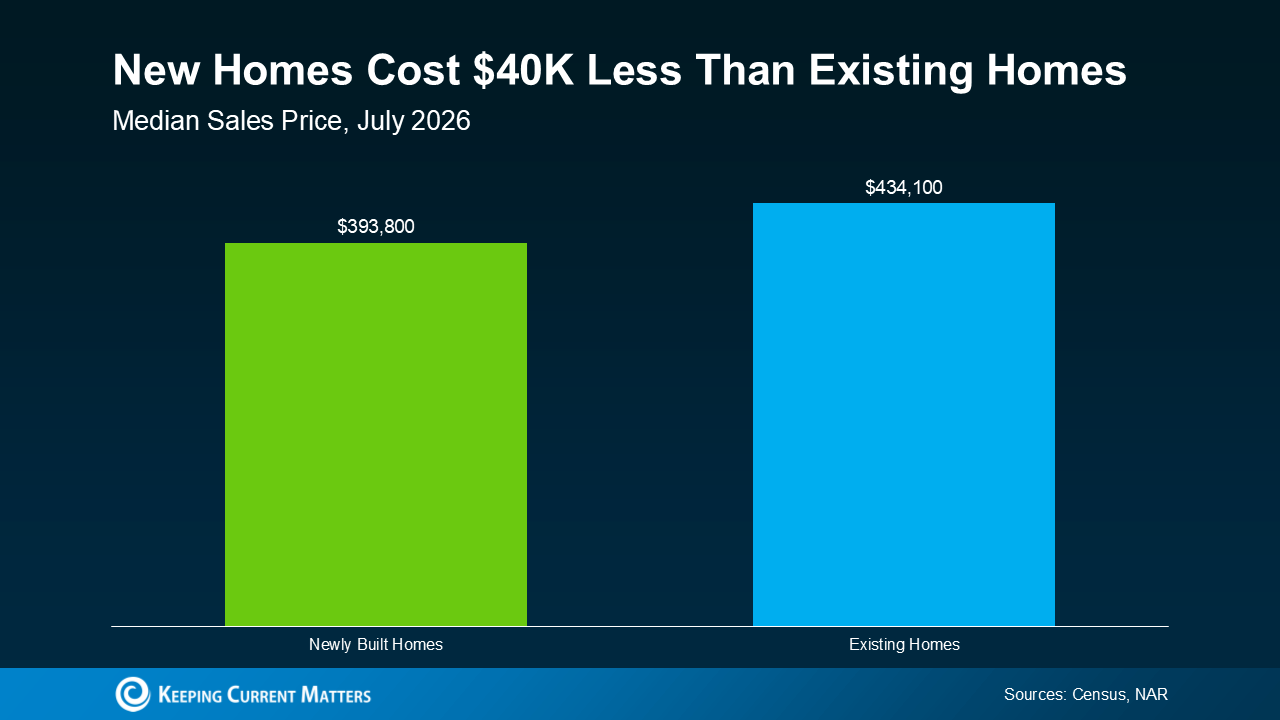
According to the latest data from the Census and the National Association of Realtors (NAR), a newly built home now typically costs about $40,000 less than an existing one (see graph below):

a graph of a house costBuilders aren’t like homeowners who can wait for the right offer. Unsold homes cost them money as long as they sit empty. So, builders cut prices and add incentives to keep them moving. That trend has carried into August. NAHB’s latest numbers:
  • 35% of builders cut prices, with an average reduction of 6%. 

  • 63% offered incentives like covering closing costs or buying down your mortgage rate. 

And those incentives can make a real dent in what you pay upfront and every month after. Plus, since everything is new and many builders offer warranties, you could save on home maintenance costs too. And with affordability where it is, every dollar counts.

So, don’t cross new builds off your list just yet. Yes, you may think they cost more, but that’s not always the case. 

If you can get brand-new everything for less than buying an existing home, isn’t that at least worth looking into? 

Don’t Let the Builder Pick Your Teammate

But before you tour a single model home, there’s one thing worth figuring out first – who’s actually working for you once you walk through that door.

That friendly rep in the builder’s sales office works for the builder, not you. Their job is to protect the builder’s bottom line, not yours. Your own agent flips that. 

They know the local market, so they can tell you if the builder’s price and upgrades stack up against other options nearby. They’ll negotiate on your behalf, whether that’s a lower price, free upgrades, or a rate buydown. 

A good agent will also push for a home inspection. Builders won’t always bring it up, but it’s a step you shouldn’t skip, even on a new build. And your agent will be in your corner, so you know what you’re buying and get the best deal possible. 

Bottom Line

New homes may actually cost less than an existing home right now. And that’s opening up a window for you to get brand-new for less.

If you want a list of new home communities near you that are currently offering incentives or doing price cuts, reach out to a local agent. When you have your own agent, you’ll have someone in your corner helping you get the best deal possible.  


Source link

Why Buyers Shouldn’t Overlook a Fall Move


You’ve been waiting for something to change before you buy. It just might not be the thing you expected…

While everyone’s paying attention to mortgage rates, only the savviest buyers know that the changing season can start tipping things in their favor. 

Because every fall, buyers tend to get more to choose from, better prices, and more room to negotiate. And that’s why Hannah Jones, Senior Economist at Realtor.com, says:

“We always see that the best time to buy window usually falls in the early fall around October.”

And that’s exactly why, if you’ve been waiting for a better moment to buy, this season may be worth a closer look – even with rates where they are.

1. There Are More Homes To Choose From

One of the biggest frustrations buyers have had over the past few years has been a lack of choices. Fall tends to help with that.

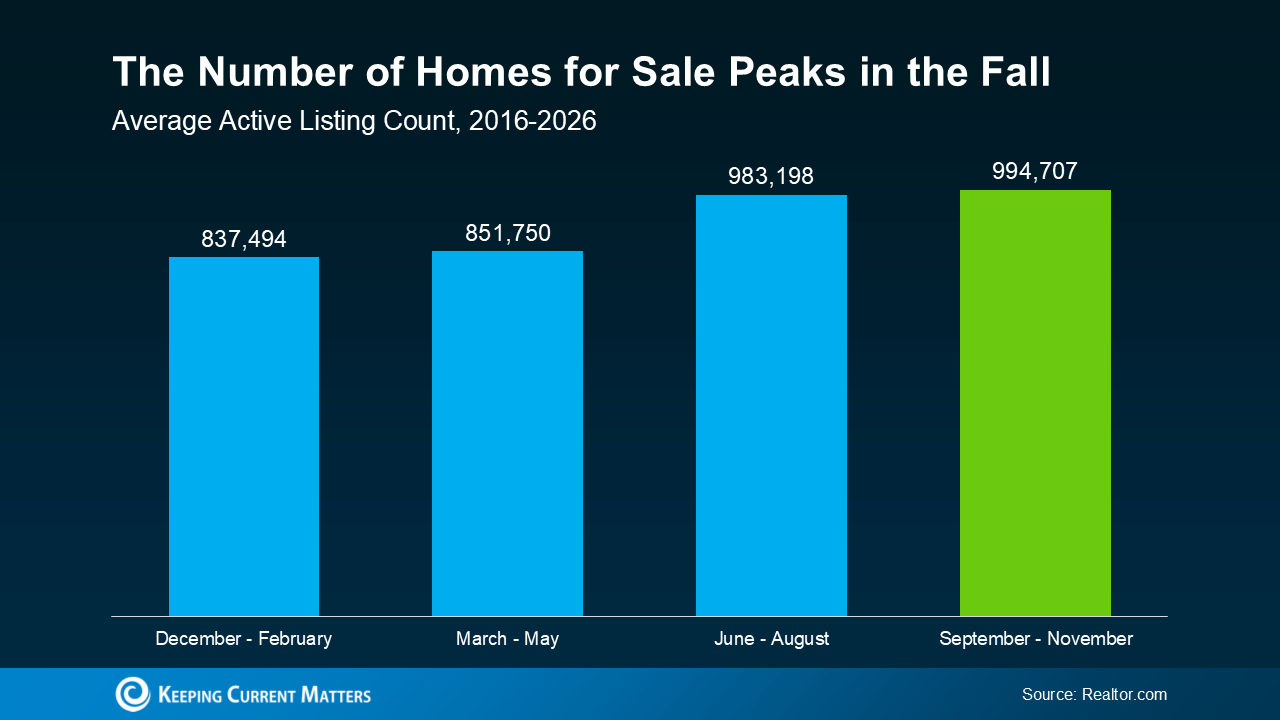
Based on seasonal trends, Realtor.com data shows there are typically more homes available for sale in September through November than during any other season of the year (see graph below):

a graph of a number of homesWhy does this happen? Homes that hit the market in spring and summer don’t all close right away. Some sit. New listings keep coming. And inventory builds as the year goes on.
By fall, you’re looking at the largest pool of available homes all year. That makes it easier to find one that works for your needs and your budget. And if anything, this should be more true this year. Rates that are higher for longer tend to help inventory grow even more.

More choices can mean fewer compromises. You’re more likely to find the right home, not just the one that happens to be available.

2. Asking Prices Start To Drop

Having more choices is great. But if every home is still priced too high, that only gets you so far. That’s where fall’s second advantage kicks in: asking prices start their seasonal decline. 

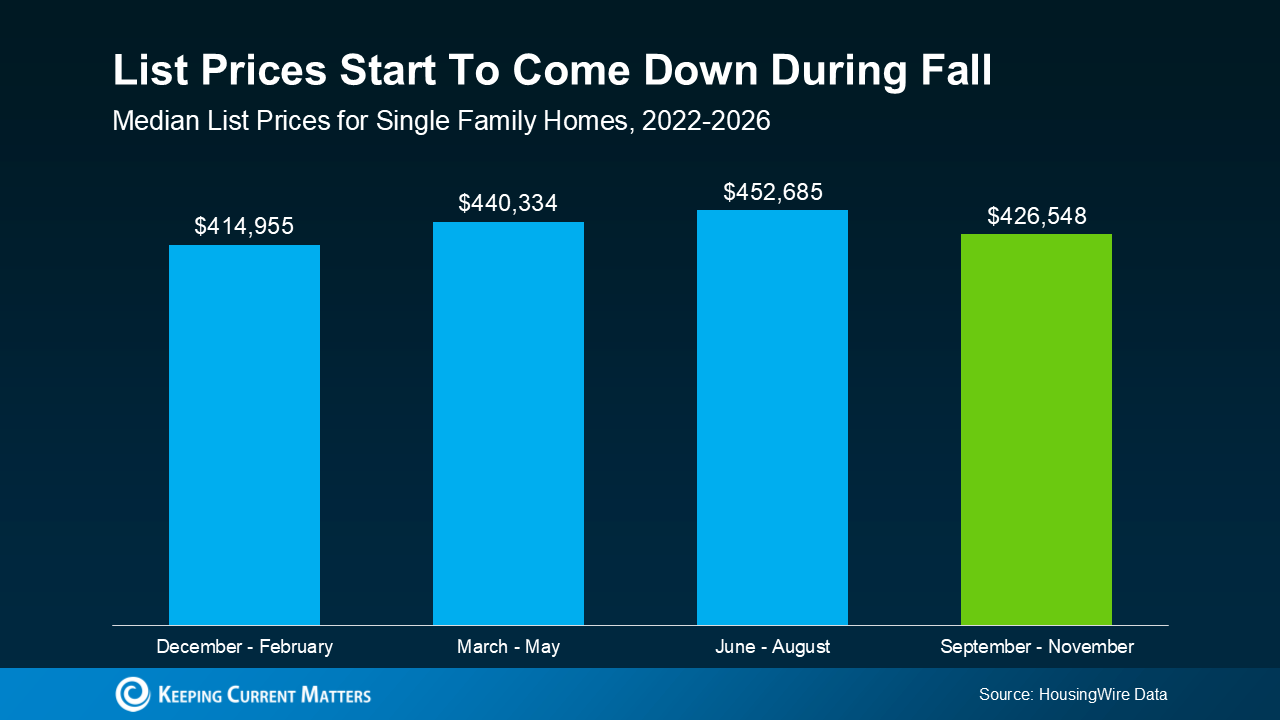
HousingWire data shows this trend over time (see graph below):

a graph of a number of blue and green barsIt works like this. Spring and early summer are when sellers feel the most confident because that’s when demand is typically strongest. So, many homeowners price their homes higher during those periods because of the uptick in demand.
But every year, like clockwork, that dynamic starts to change by fall. Buyer activity slows down as the weather cools off. So, sellers have to price a bit lower to try to draw buyers in. And that’s good for your bottom line.

3. More Sellers Are Willing To Negotiate

But fall doesn’t just bring more choices and lower asking prices. It also brings more sellers who are increasingly motivated to get a deal done. 

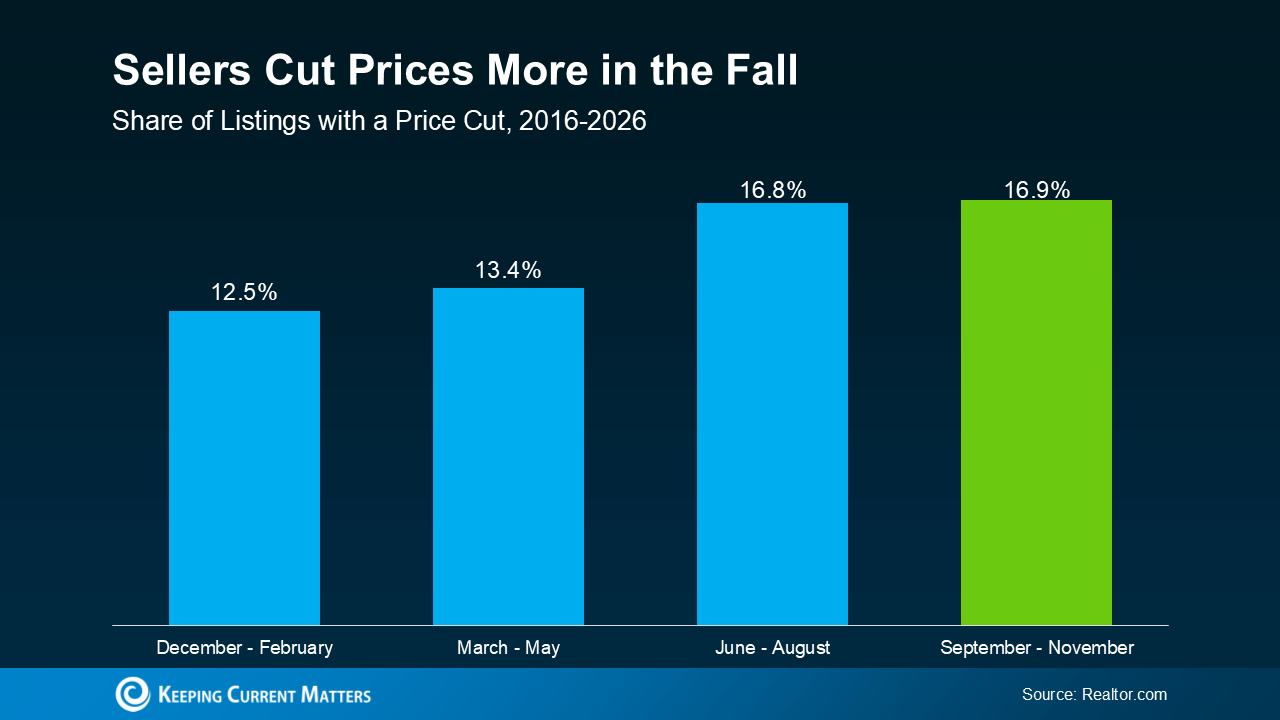
You can see it in the data. Most years, fall is when price cuts peak according to Realtor.com data (see graph below):

a graph of sales with numbers and text

While it’s not a big difference from summer, this fall you’ll have more negotiation power than you’d have if you wait until the first half of 2027. Here’s why. 

If a home is on the market in the fall, many sellers are eager to get it sold before the holidays. And since there are usually fewer buyers active in the fall, that often leads to another opportunity to snag a better deal. As the National Association of Realtors (NAR) explains:

“Less competition can lead to better deals. While homes are not selling as fast as during the summer, sellers may be more willing to negotiate.”

Even a small seller compromise here can make a meaningful difference for you. 

As an example, a 5% price drop on a $500,000 home is $25,000. That could mean you end up borrowing less, keeping more money in savings, having room in the budget for updates after you move in, or simply making the monthly payment feel more manageable.

Bottom Line

Of course, every market moves a little differently. But here’s what doesn’t change: Fall consistently buyers. More homes. Lower asking prices. Motivated sellers. 

If you’ve been waiting for your search to feel a little more doable, this season may be worth another look.

Have a quick conversation with a local agent about what’s happening in your market. That way you can find out whether this fall gives you opportunities you may not have had a few months ago.


Source link