Ask Altagracia: I’m breaking my lease, and the landlord listed the apartment for a higher rent. Does this protect me from being sued?


I’m relocating for a new job and have to break my lease. The landlord listed the apartment at a higher rent ($200 more than what I pay). Does this mean I’m off the hook for paying the remainder of my lease?

Many New Yorkers don’t know how to go about breaking their lease. So when life comes along with other plans, like a new job forcing a relocation, breaking a lease can feel daunting and spark fears of being dragged to housing court.

But there’s no need to assume the worst-case scenario, said Altagracia Pierre-Outerbridge, attorney and founder of Outerbridge Law representing residential tenants, condo owners and landlords. “What most renters don’t know is that the law actually incentivizes New York landlords to work with their tenants to find someone to take over the lease.”

In New York, landlords are required to mitigate damages when a tenant breaks a lease. This means that they have to make a good faith effort to rent out the apartment at either the same rent or at the current market value, whichever one is lower. 

“But if your landlord listed the apartment at a higher rent, they can’t then sue you for damages,” Pierre-Outerbridge said. “It’s a clear violation of the mitigation statute. They’d be directly benefitting from your choice to vacate, so I’d balk at any lawsuit.” Pierre-Outerbridge recommends documenting the listing as proof should a lawsuit come to pass. It could help you get a suit dismissed quickly without having to go to housing court. 

How to fulfill your duty

However, that alone doesn’t absolve you of your duty to fulfill the remainder of your lease, and vacating without any communication with your landlord would be a big risk. “It’s still in your best interest to remain cooperative so you don’t have to pay more than is necessary, because you are still on the hook until a new tenant takes over,” Pierre-Outerbridge said.

One of the best ways to show cooperation is to help find another tenant to take over the lease. “Especially if you have to relocate quickly, it’s in your best interest to find someone that can move in as soon as possible so you aren’t stuck paying rent for an apartment you aren’t living in for several months,” Pierre-Outerbridge said. “Your landlord will want to approve the new tenant, so make sure they can provide clear proof of income and financial history. ”

From there, the landlord can assign the lease to the new tenant or you can request a sublease. “Make sure you understand which type of agreement you are entering into, as a sublet keeps you responsible to meet lease obligations,” Pierre-Outerbridge said. 

Check your lease for other fees

Even if you are able to find someone to take over your lease, it’s worth further inquiry into other charges that you may owe. The rent laws passed in 2019 “help protect tenants as far as the remainder of the monthly rent payments are concerned. It does not however specify how other potential fees may be handled,”  Pierre-Outerbridge said. 

Though most leases are unlikely to include specific language that penalizes breaking the lease, Pierre-Outerbridge still suggests that tenants review their lease to see whether it outlines any additional fees, or how your security deposit may be impacted. “Since landlords are required to mitigate damages and find a tenant, they can’t exactly withhold the security deposit, but they may argue that they can use it to cover fees that they incur to re-rent the apartment, like repainting or hiring a brokerage,” Pierre-Outerbridge said. 

Ultimately, your goal is to pay as little as possible to get out of your lease, so do what you can to find a new tenant that can take over monthly rent payments. “You want to get your landlord out of your hair as quickly as possible, and presenting them with a new tenant will make that easier,”  Pierre-Outerbridge said. 


Altagracia Pierre-Outerbridge, Esq. is the owner of Outerbridge Law P.C, focusing primarily on tenant representation. The firm represents all sides in landlord-tenant litigation and transactional matters such as month-to-month holdovers, nuisance cases, licensee cases, harassment claims, repair cases, tenant buyouts, succession claims, DHCR overcharges and rent reductions and more. Pierre-Outerbridge has 15 years of experience litigating in Supreme, DHCR, and Housing Court. To submit a question for this column, click here. To contact Outerbridge Law P.C. directly, call 212-364-5612 or 877-OUTERBRIDGE, or schedule a meeting today.



Source link

Asus’ ludicrous 20th anniversary bundle is now the cheapest way to buy an RTX 5090 — Nvidia’s flagship GPU stock is so limited that this $10,850 bundle with a 3000W PSU, X870E board, and open-frame case is actually cheaper than some scalper listings


We’ve reviewed Asus’ ROG Edition 20 anniversary kit. We’ve built a PC with it. It’s about as premium as a gaming PC build can get. Right now, you can pick up the same kit for a whopping $10,849.96 on Newegg in a combo deal. To put it mildly, this is one expensive deal, but it’s actually hiding a secret gem: it’s the cheapest RTX 5090 graphics card on sale right now.

● Check out this deal at Newegg


Source link

ChatGPT transcripts are reportedly read by humans to improve responses, including those with personal information — ‘Project Lilly’ has seen OpenAI hire hundreds of contractors to manually review logs


AI companies don’t have a great track record in areas like copyright or user privacy — unless they’re the ones on the short end of the stick, that is — but it’s generally known that the chat logs from platforms like ChatGPT are used for improving models. The mechanism as to how this happens was still a mystery until today. 404 Media just published a report about OpenAI’s process of human review for chat transcripts, explaining how the review process works, and how it involves other humans sometimes reading private information.

The rating project’s name at OpenAI is Project Lily. The publication got information on the project’s instruction guides, Slack channels, real ChatGPT conversations, and, of course, the rating system to classify conversations. The operators are called “prompt reviewers,” and their job is fairly simple: look at anonymized real-world chats, and judge the quality of ChatGPT’s responses to assess whether they actually answer the question, and that the text doesn’t overuse “AI-speak,” patronizing tones, emojis, or sycophancy, among other parameters. Anthropomorphizing and stating “personal” experiences are both off the table, meaning that while it’s OK for ChatGPT to say “I found some information,” it’s not OK for it to say “as a chef, I like to…” or “I know what that’s like.”


Source link

Jobst Hoffman’s 1880 29 East 7th St: A double-flat building that was part of a whimsical trio


Have you ever passed by an interesting residential building in New York City and wanted to know more about its history? In this series, Brick Underground teams up with Tom Miller, creator of Daytonian in Manhattan, a blog about Manhattan buildings and other historic architecture. Each week, we run an excerpt from the Daytonian’s archives with a link to the full article.

German-born architect Jobst Hoffmann filed plans for a “five-story brick apartment house” at 29 East 7th St. in February 1880 for developer Isaak Horchster. Hoffmann’s plans projected the cost of construction at $11,000, or about $357,000 in 2026 terms. Soon after, Hoffman was hired by Z. H. Miller to design two apartment buildings at 25 and 27 East 7th St. that would exactly match 29 East 7th Street.

Hoffman’s design was a blend of Queen Anne and neo-Grec styles. He also included a whimsical cast iron fencing and stoop railings with stylized sunflowers.

The paired ground-floor openings shared a lintel decorated with a small rosette. The centered entrance was crowned with an earred cornice inspired by ancient Greece. The four upper stories were clad in red brick and trimmed in sandstone. Hooded lintels decorated the second and fourth floor openings and between the third and fourth, Hoffmann added colorful encaustic, quilt-like tiles.

No. 29 East 7th Street was known as a double flat, which meant there were two apartments per floor. Among the initial tenants was Auguste Schelcher. He was on his way with friends to the ball of the Société Culinaire Philanthropique on the evening of April 30th, 1883, when his night of gaiety turned to horror.  The New York Times reported that as they passed 404 Sixth Ave., Désiré L. Houvet, a French chef and another member of the Société Culinaire Philanthropique, exited the building and collapsed.

The “elegantly dressed” Houvet had just been stabbed in the back by Elizabeth Quinquinet.  The New York Times would later explain, “Houvet, who was single, had led Mrs. Quinquinet astray and they had quarreled.” The 33-year-old Houvet died on the scene.

The Hessler family occupied an apartment here in 1896 when their 15-year-old son, Charles, became a hero of sorts. On the afternoon of July 7th, Charles was on the Bowery near Catharine Street. He saw 68-year-old John M. Sweitzer, who was inebriated and staggering along the sidewalk. Suddenly three men rushed up and robbed him of $40. The New-York Tribune explained that Sweitzer, “was unable, owing to his condition, to furnish any description of the robbers.” 

Young Hessler, however, was able to describe them and pointed out one of the accomplices to police. On the weight of teen’s affidavit, the accomplice was committed to the Tombs Prison for further investigation.

By 1924, the basement level of 29 East 7th St. had been converted to two commercial spaces. Operating from one of them that year was George Withers Music Co.

There are still just two apartments per floor in 29 East 7th St. Because Z. H. Miller wisely decided to have Hoffmann recreate his design at Nos. 25 and 27, the trio has an enhanced presence.

For more on the property and the interesting people that lived here, check out the full article.


Source link

Anthropic says AI can boost U.S. GDP by 32%, up to $44.4 trillion in four years — economics model predicts that displaced employees ‘may have to switch to jobs like electrician and nurse’


Last week, Anthropic published its prediction of what the economic impact of AI on the U.S. economy is going to be for the next few years. The company thinks the U.S. can reach a $44.4 trillion GDP or higher by 2030, provided, of course, it conveniently adopts AI at a rapid pace. Having said that, Anthropic admits “the challenge is making sure that the gains are broadly shared.”

The interactive post has a simulator where readers can plug in their estimates on key factors and get their own future predictions, within the firm’s analysis and perspective. That’s definitely interesting to play around with, but perhaps the most relevant piece of information is the lens through which Anthropic views the world.


Source link

Community Opportunity to Purchase Act moves closer to a vote


Before the start of a hearing of the City Council’s housing committee Wednesday morning, dueling groups on opposing sides of the revived Community Opportunity to Purchase Act hoisted signs and shouted slogans.

Dozens of tenants, organizers, and housing advocates chanted “pass COPA now!” and shared stories of harrowing housing conditions. A few hundred feet away, beyond City Hall Park’s protective barricades, a group of property owners occasionally shouted “unconstitutional!” while holding their own signs. 

The Community Opportunity to Purchase Act would give nonprofit groups and community land trusts on New York City’s qualified buyer list the chance to make offers on struggling multi-family buildings when they go up for sale. 

COPA’s supporters say it will preserve affordable units in distressed buildings that might otherwise become targets for speculation, leading to the displacement of longtime residents. 

Now that the bill has had a committee hearing, it can be scheduled for a committee vote before a vote by the full council. COPA isn’t yet scheduled for a vote, but with 28 co-sponsors, it has the support to pass. 

A priority for Mamdani

After former Mayor Eric Adams vetoed a previous iteration of the bill, Mayor Zohran Mamdani included COPA in his housing plan as one of his administration’s priorities. 

“The fact is, the private market cannot create enough affordable housing to solve this crisis, especially if we’re losing the affordable housing stock we do have faster than we can build,” said Council member Sandy Nurse, who introduced the bill. “This bill is about interrupting a cycle of despair and neglect by design, because many landlords across the city use deterioration as a strategy to get their tenants out,” Nurse said. 

Members of the housing committee questioned housing officials about the bill’s details, and tenants and landlords testified about its impact. 

“We support this legislation and believe it is aligned with our larger housing preservation goals,” said Dina Levy, commissioner of the Department of Housing Preservation and Development. 

How to implement COPA

In response to questions from Nurse, Levy acknowledged that if COPA does pass, HPD will have to go through the rule-making process to determine how the qualified buyers list is set, make sure there is a notification for the buildings subject to COPA, and establish penalties for noncompliance and notify tenants. 

HPD makes about 10 to 20 “preservation deals” with groups on the qualified buyer’s list each year, Levy said. She said COPA would apply to an estimated 2,100 buildings—if those buildings were sold today. 

Will Spisak, a senior policy strategist at New Economy Project, said COPA would have applied to about 300 buildings sold last year.

Opposition to COPA

Zach Steinberg, executive vice president for external relations and advocacy at the Real Estate Board of New York, praised legislators for amending this version of the bill so that it applies fewer properties, while also limiting HPD’s ability to extend deadlines and shortening the transaction timeline. Still, REBNY, the leading trade association for the NYC real estate industry, wants to see other changes to the bill. 

“COPA remains a significant intervention into private property transactions, and additional revisions are needed to provide certainty for owners, lenders, and affordable housing investors,” Steinberg said. “We urge the council to establish reasonable limits on lawsuits and penalties, clarify the timelines governing the right of first refusal process, and place firm limits on administrative extensions.”

Christopher Athineos, a landlord testifying on behalf of Small Property Owners of New York, took an even stronger stance, saying his organization opposes any version of COPA. He said smaller landlords suffer from compounding problems as lower rents cause deferred repairs and code violations, which then lead to higher legal costs and difficulty refinancing.

“We’re operating in an environment where policies increase the cost of owning and maintaining regulated housing, which can potentially increase the number of buildings that meet the distress criteria to trigger COPA,” Athineos said. “Don’t regulate responsible small property owners into distress and then use that distress as the justification for taking their buildings out of the private market.”

SPONY board member Ilan Rabinovitch expressed the group’s support for a different bill that would allow owners to register their properties with HPD electronically, rather than sending the agency hard copies of documents.

An ‘infuriating lack of concern’

Tenants told the committee about a litany of poor conditions in their buildings and shared stories of learning that their homes had been sold to a new buyer without their knowledge. 

Stephanie Thomas, a Bronx resident, said her building at 3435 Giles Pl. had no heat in the winter, an inoperable elevator, frequent leaks, and water damage and roaches and mice.

“What’s most infuriating is the lack of concern by the owner and his sons in response to these allegations,” Thomas said. 

Changes to housing lottery process

HPD also informed the housing committee about coming changes to the housing lottery process. In the short term, HPD will be making these changes:

  • Shortening the lottery period from 60 days to 21 days
  • Streamlining the income requirements for renters. For example, if you have proof that you receive a SNAP benefit, that will be sufficient to prove you’re income eligible 
  • Clarifying the process for first-time occupancy inspections. 

The housing committee meeting also weighed changes to the housing lottery application process. Levy proposed cutting in half the waiting period for Housing Connect to approve lottery applicants, reducing the number of days from 210 to 100. 

HPD is also working with the NYC Office of Technology and Innovation to make sure the technical system can keep up with these changes. In the longer term, HPD will take a look at the processing of paper applications, appeals and allowing marketing agents to take applications as they receive them, Levy said.


Source link

Selling This Fall? You Haven’t Missed Your Window


Summer’s winding down, and if you’ve been thinking about selling, you might be wondering if you missed your chance. Better to wait until next year or even next spring, right?

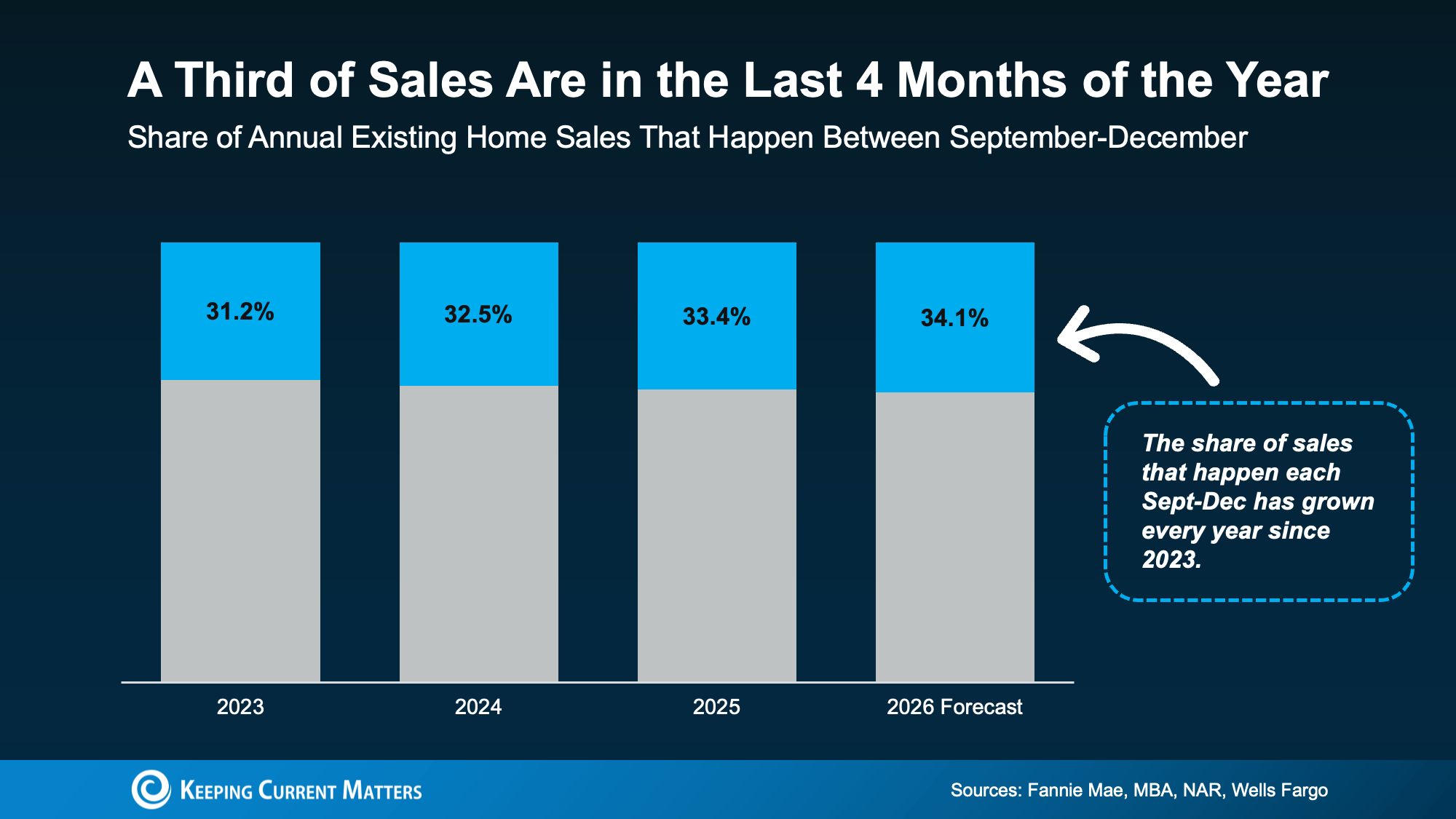
Not so fast. About one in three of all home sales happen in the last four months of the year.

Fall Is Busier than You Think

Data from the National Association of Realtors (NAR) shows around a third of existing home sales happen in the final four months of the year. And that share has grown every year since 2023 (see graph below):

a graph of sales

Here’s What That Means for You

According to forecasts from Fannie Mae, the Mortgage Bankers Association (MBA), NAR, and Wells Fargo, there will be about 4.16 million existing home sales this year. Based on how many sales have happened so far, that means roughly 1.4 million sales are expected between now and December.

That’s about 11,800 houses selling every single day this fall.

So, the market isn’t frozen and you don’t need to put your plans on ice either. Yes, higher rates are keeping some buyers on the sidelines. But hold out for next spring, and you’ll sit out months when other serious buyers are ready to move before the new year.

How do you get in front of those buyers who are still out there looking right now? Getting your house sold this season comes down to how well it’s priced and presented,  and that’s where a local agent shines.

A good agent knows what buyers in your area want right now, prices your house to match this fall’s market, and positions it to stand out to the serious buyers shopping before year-end. From the first photo to the final offer, they handle the details that turn your house on the market into one of the 11,800 selling every day.

Bottom Line

Listing this fall doesn’t mean your house will sit on the market until spring. Buyers are out there right now, ready to make a move before the new year – and your window is still open.

To make yours one of the homes that sells this season, connect with a local real estate agent.


Source link