The world of travel is continually evolving, influenced by economic shifts, safety considerations, and emerging trends. Here’s an overview of the current state of global travel: Economic Challenges Facing U.S. Airlines U.S. airlines, once optimistic about sustained profitability, are now confronting economic headwinds. Factors such as recent tariffs and reduced government spending have led to … Continue reading Exploring the Evolving Landscape of Global Travel
Source link
Category: General

Samsung Odyssey G80HS 6K gaming monitor review: Upping the stakes in pixel density
Why you can trust Tom’s Hardware
Our expert reviewers spend hours testing and comparing products and services so you can choose the best for you. Find out more about how we test.
Since the advent of fixed-pixel flat panel displays, the quest for greater pixel density has not subsided. In times past, a high-res display was 1280×1024 with a 4:3 aspect ratio. Now the gold standard is 4K, 3840×2160. So, where do we go from here?
Traditionally, resolution increases in whole multiples like 1920×1080 to 3840×2160. And there are a few 8K 7680×4320 screens out there. But in the realm of the best gaming monitors, you can have any resolution you want, so why not 6K?
Samsung’s Odyssey G80HS is a 32-inch IPS panel with 6144×3456 pixels at 165 Hz and 3072×1728 pixels at 330 Hz along with Adaptive-Sync, HDR10, and wide gamut color. Pixel density is an impressive 224 or 112 ppi. Let’s take a look.
Latest Videos FromTom’s Hardware
Samsung Odyssey G80HS Specs
Swipe to scroll horizontally
|
Panel Type / Backlight |
IPS / W-LED, edge array |
|
Screen Size / Aspect Ratio |
32 inches / 16:9 |
|
Max Resolution and Refresh Rate |
6144×3456 @ 165 Hz |
| Row 3 – Cell 0 |
3072×1728 @ 330 Hz |
| Row 4 – Cell 0 |
FreeSync and G-Sync Compatible |
|
Native Color Depth and Gamut |
10-bit / DCI-P3 |
|
Response Time (GTG) |
1ms |
|
Brightness (mfr) |
450 nits |
|
Contrast (mfr) |
1,000:1 |
|
Speakers |
None |
|
Video Inputs |
1x DisplayPort 2.1 |
| Row 11 – Cell 0 |
2x HDMI 2.1 |
|
Audio |
3.5mm headphone output |
|
USB 3.2 |
1x up, 2x down |
|
Power Consumption |
52.5w, brightness @ 200 nits |
|
Panel Dimensions WxHxD w/base |
28.1 x 18.5-23.5 x 10.4 inches (714 x 470-597 x 264mm) |
|
Panel Thickness |
2.3 inches (58mm) |
|
Bezel Width |
Top/sides: 0.3 inch (8mm) |
| Row 18 – Cell 0 |
Bottom: 0.8 inch (20mm) |
|
Weight |
16.3 pounds (7.4kg) |
|
Warranty |
3 years |
I’ll start with the caveat: the G80HS requires the latest port specification, DisplayPort 2.1 or HDMI 2.1, to run in 6K at 165 Hz. You’ll also need an HDMI cable rated for 48 Gbps, or a DisplayPort cable rated for 80Gbps. You’ll also need a GeForce RTX 5090 to even dream of running over 120fps in 6K. That’s where the dual mode function comes in. Though 3072×1728 is unusual, it is a realistic task for an RTX 5090 or an RTX 4090 to move things along at 240 fps or more. That 330 Hz refresh rate is handy to have.
The panel uses Fast IPS technology with a claimed 1ms response time. It includes Adaptive-Sync and overdrive, but you can’t have both at the same time. I’ll talk more about that later. The good part is that input lag is extremely low, so gamers will get a responsive experience. And running at the higher refresh rate eliminates nearly all motion blur.
The panel doesn’t employ Quantum Dots but manages to cover just over 90% of DCI-P3 with solid out-of-box accuracy. With a few tweaks, I saw reference-level color, gamma and grayscale tracking. The G80HS also has an equally accurate sRGB mode for graphics pros, photographers, and users who want the correct BT.709 color space for SDR content. HDR10 signals are supported as well with expanded contrast and peak white levels around 480 nits.
The G80HS is clearly a gaming monitor with extras like LED lighting, aiming points and game-specific picture modes. You get all the latest video ports too with DisplayPort 2.1 and two HDMI 2.1 inputs. There are USBs for peripherals and a 3.5mm headphone jack. The only thing missing are internal speakers.
Bleeding-edge resolution doesn’t come cheap, but the G80HS isn’t super pricey either at $1,599 to start. Let’s see how it performs.
Assembly and Accessories
The G80HS arrives packed in crumbly foam with a base, upright, and panel that assembles easily, no tools needed. A medium-sized power brick with right-angled cords provides the alternating current, and you get very thick HDMI and DisplayPort cables which are rated for 48 and 80 Gbps respectively.
Product 360
The G80HS has a minimalist aesthetic with only a tiny Samsung logo on the front bezel. The rest of the frame is flush and thin. Coupled with a very slim side profile, one might think they’re looking at an OLED. Internal bits are packed into a central bulge which has generous ventilation. The stand’s fulcrum is ringed by an LED that can play a variety of effects and colors.
The stand is substantial with firm movements and generous adjustments. You get a five-inch height range plus 2/25 degrees tilt and 30 degrees swivel. There’s a 90-degree portrait mode as well. The base has a medium footprint and brings plenty of stability. I noted that the fulcrum had a little wobble when adjusting tilt and rotation.
The screen has an effective anti-glare coating with a matte finish. It is grain-free and provides excellent clarity for the extreme 224ppi pixel density. You’ll need a magnifying glass to see any dot structure from any distance. Sharp and smooth is almost an understatement.
The I/O panel includes a DisplayPort 2.1 and two HDMI 2.1 ports. All of them can manage 6K resolution at 165 Hz if your video card has DisplayPort 2.1 or HDMI 2.1 outputs. USB 3.2 ports are also included, one upstream and two downstream.
OSD Features
The G80HS has a super-efficient OSD that’s controlled by a joystick. A quick menu pops up on the first press, then you click up and select to see the full menu.

(Image credit: Tom’s Hardware)


Samsung’s gaming monitors all have this cool control-panel-looking menu with signal info at the top in little portholes and a tree-style menu. The G80HS has four sub-menus starting with game options. You can toggle Adaptive-Sync, which is good because if you want overdrive, it must be turned off. This is an unusual choice because at 165fps, you’re going to want both things. The choice is less motion blur or no frame tears. And that will depend on game type. I’ll talk more about that below.
The Dual Mode option switches between 6K at 165 Hz and 3K at 330 Hz. Given my experience, users will be using the 3K mode more often for twitchy shooters and the 6K mode for less frenetic titles. For aiming help, you get two different reticles. And the lighting, called Infinity Core, can play different colors and effects through the LED ring in the back. CoreSync lets you sync the light show with what’s happening on the screen.
The Picture menu starts with 10 picture modes, with Graphic being the default and best choice for all-around gameplay and productivity. It leaves calibration controls accessible and has an Auto color space option which selects sRGB for SDR and DCI-P3 for HDR. This is something I wish more wide-gamut monitors had. For adjustments, you get gamma presets and a very precise set of RGB sliders.
To enhance contrast, there are three different options: Local Dimming, Contrast Enhancer, and Dynamic Brightness. Local Dimming is a bit misleading because the G80HS is not a full-array panel. And tests showed me that it doesn’t do zone-edge dimming either. The best of the three for expanding dynamic range is Dynamic Brightness. That will deliver almost 15,000:1 contrast versus the panel’s native ratio of around 1,700:1. In HDR mode, you can opt for dynamic tone mapping, which improves the image in most cases. I noted that in testing, the Static mode produced reference-level accuracy. You can read more about that on page five.
Samsung Odyssey G80HS Calibration Settings
The G80HS is close to standard out of the box and will display its full native color gamut, 90% of DCI-P3, for both SDR and HDR content. The Picture menu has a single-point RGB control which is very precise. I used it to tighten up grayscale tracking. Gamma is nearly perfect on the zero setting. If you want sRGB for SDR content, change the Color Space option to Auto. Then the monitor will switch back and forth automatically. My recommended settings are below. I noted that I could adjust the RGB sliders independently for HDR mode, and as it turned out, the same settings worked. This is something very few HDR monitors allow.
Swipe to scroll horizontally
|
Picture Mode |
Graphic |
|
Brightness 200 nits |
17 |
|
Brightness 120 nits |
Row 2 – Cell 1 |
|
Brightness 100 nits |
4 |
|
Brightness 80 nits |
2 (min. 71 nits) |
|
Contrast |
50 |
|
Gamma |
0 |
|
Color Temp User |
Red 2, Green 3, Blue -3 |
Gaming and Hands-on
Gaming on the G80HS was a unique experience. On the positive side, it’s the first dual-refresh monitor that I can call truly useful because its resolution only reduces to 3072×1728, which equates to 112 ppi, a tad more than a 27-inch QHD screen. And my GeForce RTX 4090 ran it at around 250 fps, which eliminated any need for Adaptive-Sync or overdrive.
This was fortunate because, as I discovered, playing in HDR mode grays out both options. In essence, you get no video processing with dual mode engaged, but don’t be dismayed. Motion resolution was superb, and the G80HS was super responsive to control inputs. You’ll see why when you read the input lag test results on the next page.
Playing in 6K was not as fun with my setup. An RTX 4090 is fine for 4K where I can get speeds over 200fps. But at full resolution, I could barely crack 100 fps. And with Adaptive-Sync and overdrive out of the picture, motion was just too blurry. There was no hit to input lag; control response was instantaneous. But it was hard to aim precisely at distant targets because unless I stopped moving, enemies were too difficult to make out.
Gameplay experiences aside, the G80HS is gorgeous to look at. With 224 ppi, the picture is uncannily smooth. I could not see the pixels even with my nose next to the screen. Though 4K looks very film-like and realistic, 6K is even more so. It amps up my anticipation and desire for 8K, which will inevitably be a thing within my lifetime.
Working on documents and graphics is such a pleasure when detail and clarity are this high. Though I usually crow more about contrast… Oh wait, the G80HS has a good deal of that. True that it’s IPS, but it delivers around 1,700:1 natively and almost 15,000:1 with Dynamic Brightness engaged. Though it isn’t quite in OLED territory, it is visibly superior to the average LCD panel, and that includes Mini LED monitors with their full-array backlights. The G80HS’s HDR is particularly excellent with balanced color, perfect luminance tracking, and peak highlights around 480 nits.
Takeaway: Though the G80HS’s resolution is somewhat of an “in-between” proposition, there’s no denying its appeal. 224ppi is serious pixel density, and it manifests itself as a super smooth and lifelike picture. Coupled with excellent contrast and pro-level color accuracy, it delivers a truly useful dual-refresh feature where you can play at 330fps at 3K resolution, which equates to 112ppi. So, if you can’t drive it at 6K/165 Hz yet, you can still enjoy it until the next generation of premium video cards comes to market.
MORE: Best Gaming Monitors
MORE: How We Test PC Monitors
MORE: How to Buy a PC Monitor

Who Has the Upper Hand in Today’s Housing Market?
Ask around and almost every homebuyer out there wants to know if there’s a way to get a better deal. And just about every seller wants to know if they’ll still get top dollar.
The interesting thing is… both can be right at the exact same time. It just depends on where you live.
That’s because today’s housing market isn’t moving in one direction anymore. Some markets clearly favor buyers. Others still favor sellers. But most are sitting somewhere in the middle.
And knowing which market you’re actually in can completely change the strategy you use to buy or sell (and what expectations you should have). Let’s break it down.
One Number Tells You Who’s Got Leverage
So how do you know which market you’re in? There’s one number that tells the story faster than anything else: the months’ supply of homes for sale. It’s the clearest signal of who’s got leverage – and what strategy you’ll need. Think of it like this.
Imagine no additional homes were listed starting today. Months’ supply tells us how long it would take to sell everything that’s currently on the market based on today’s demand.
Generally speaking, if months’ supply is:
-
Fewer than 4 months: Sellers usually have the advantage.
-
4 to 6 months: Buyers and sellers are on more equal footing.
-
More than 6 months: Buyers can usually negotiate for a better deal.
Right now, the National Association of Realtors (NAR) data says that number is 4.6 and that puts the overall market back in balanced territory (see graph below):
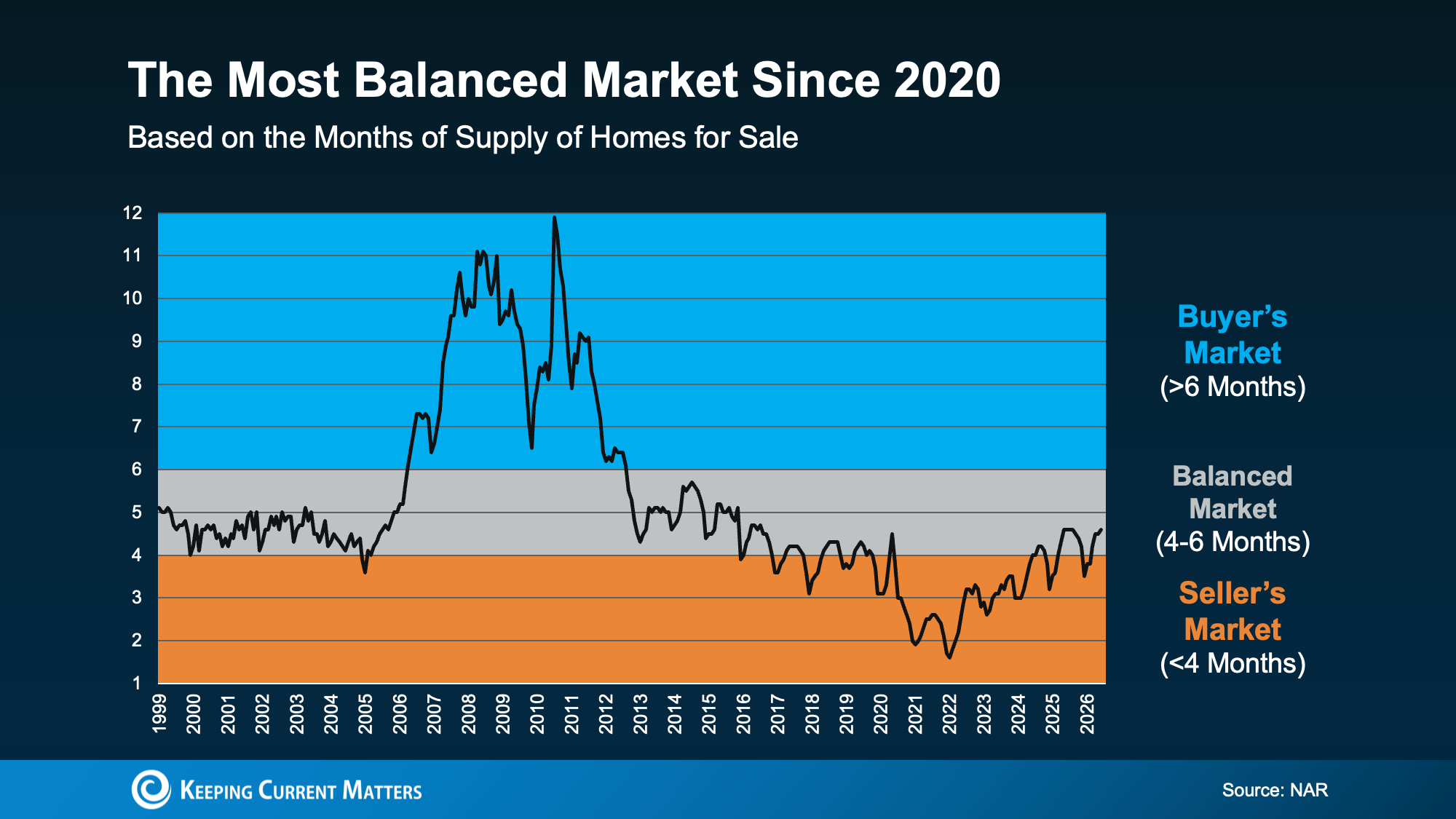
That means, as a whole, the market has finally moved back into a much more balanced range after years of being tilted in sellers’ favor. While that may look like the scales have tipped only slightly, it’s enough to make a real difference in what strategy you’ll need for your move – at least in most places.
The Tale of Two Markets: Why ‘Balanced’ Doesn’t Mean the Same Thing Everywhere
Redfin data helps shed some light on how this shakes out across the country. It breaks down which cities are leaning in either direction (see graph below).
-
Some markets give buyers more leverage. Those are in blue.
-
Some still favor sellers. That’s the orange.
-
Others fall somewhere in between. Those are gray.
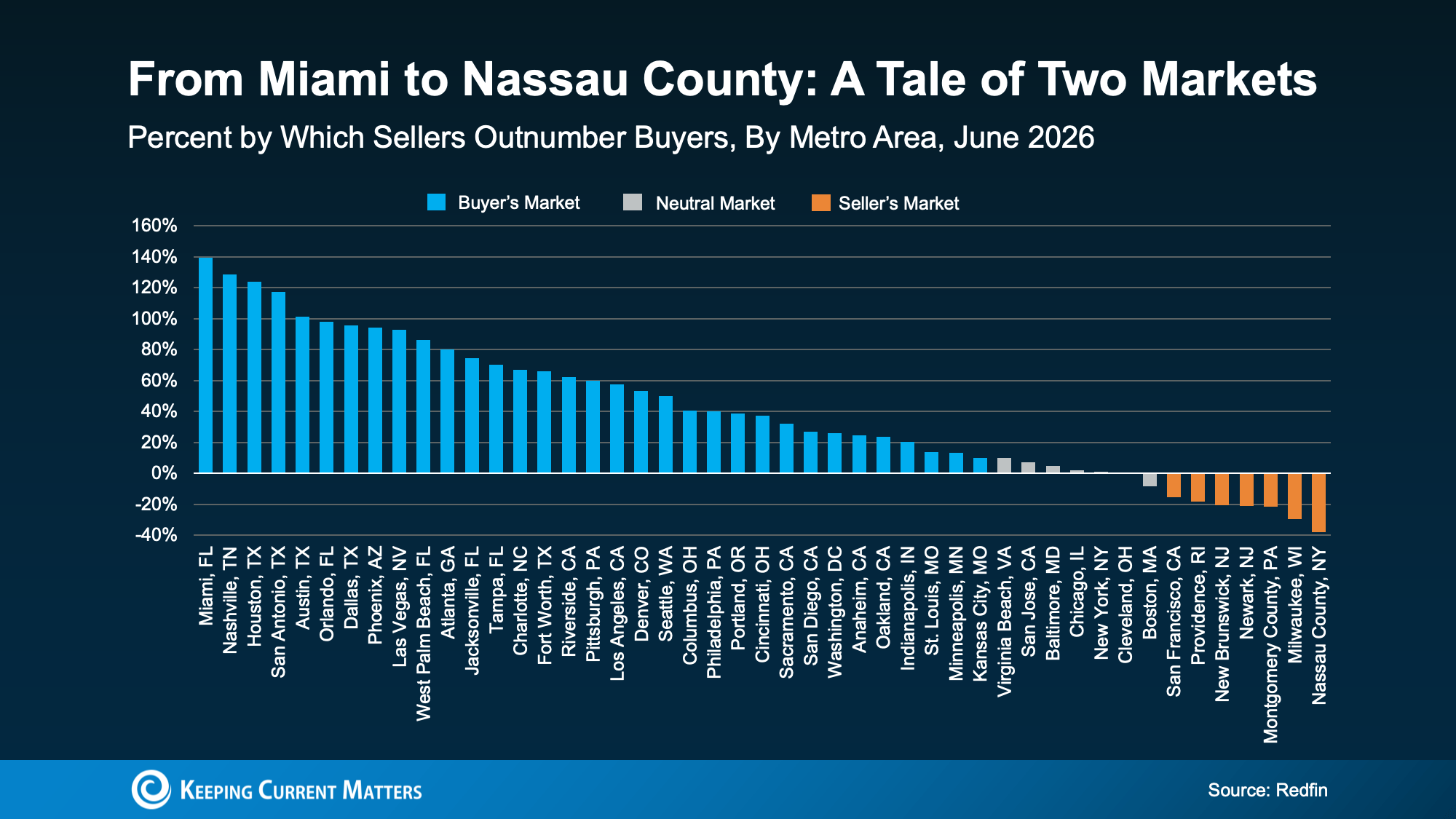 Notice anything? A lot more places are seeing more buyer-friendly conditions right now. In fact, this is the most buyer-friendly market we’ve seen in nearly 6 years.
But don’t take that as buyers have the upper hand everywhere.
There are still cities where sellers still have the power. And if you’re in one of them, your approach to selling or buying looks completely different than it would in a buyer-leaning market.
The Biggest Mistake You Can Make Right Now
That’s why the biggest mistake isn’t thinking it’s finally a buyer’s market. And it isn’t thinking it’s still a seller’s market either. It’s making any assumption without talking to an expert agent first.
Today’s market is incredibly local. In one market, a buyer may be getting thousands of dollars in concessions from a seller. And a homeowner may have to consider dropping their price.
But in another, a buyer may be stressed about coming in with their best offer, or they may lose out on the home to another buyer. And a seller may still be seeing strong demand and prices inching higher.
Same overall housing market.
Very different experiences.
The truth is what’s happening in your back yard affects everything from pricing your house to making an offer to negotiating repairs or concessions. And that’s why an agent’s local knowledge matters more now than ever before.
Your plan has to be based on your neighborhood – and only an agent has the expertise to get that right.
Bottom Line
This market isn’t one-size-fits-all.
If you’re wondering who has the upper hand where you live, talk to a local agent. They’ll help you understand what’s happening in your market, who’s got the leverage, and what strategy gives you the best shot at getting what you want.

LibreOffice 25.2: Empowering Users with Enhanced Features and Improved Performance
LibreOffice, the renowned free and open-source office suite, has recently unveiled its latest iteration, LibreOffice 25.2. This release brings a host of enhancements aimed at improving user experience, bolstering privacy controls, and ensuring seamless interoperability. Let’s delve into the standout features of LibreOffice 25.2. Key Features of LibreOffice 25.2 1. Comprehensive Support for OpenDocument Format … Continue reading LibreOffice 25.2: Empowering Users with Enhanced Features and Improved Performance
Source link
In-Depth Review of Steam Hardware and Software: Performance, Popularity, and Emerging Trends
Steam, Valve’s renowned digital distribution platform, continues to influence the gaming landscape with its diverse hardware offerings and evolving software ecosystem. Recent developments have spotlighted both the performance of Steam-compatible devices and the dynamic shifts within its software environment. Steam Hardware: Emerging Devices and Market Dynamics 1. Nvidia RTX 4060 Graphics Card: Dominating the Market … Continue reading In-Depth Review of Steam Hardware and Software: Performance, Popularity, and Emerging Trends
Source link
Kodi Media Player: Enhancing Your Entertainment Experience
Kodi, the free and open-source media player developed by the Kodi Foundation, continues to be a popular choice for users seeking a versatile and customizable entertainment hub. Available across multiple operating systems and hardware platforms, Kodi allows users to play and view most videos, music, podcasts, and other digital media files from local and network … Continue reading Kodi Media Player: Enhancing Your Entertainment Experience
Source link

Offerpad says it is turning the engine back on in 2026


Qualcomm details Snapdragon C specs for $300 laptops for the first time — claims 67% faster performance on battery than Intel N250, AC performance remains a mystery
Qualcomm is getting into some of the nitty-gritty details of the Snapdragon C system-on-a-chip, the ARM-based platform it announced in June for laptops priced around $300.
The Snapdragon C is an 8-core Qualcomm Kryo CPU, with a single-core max frequency of 3 GHz and a multi-core max of 2 GHz. (In the fine print, Qualcomm claims you can get four cores at 2.0 GHz and three cores at 2.6 GHz, but doesn’t note all eight cores simultaneously. We’ve reached out to Qualcomm for clarification. There is 2MB of total cache.
It also has an integrated Adreno GPU with a max frequency of 900 MHz, and a Qualcomm Hexagon NPU, though Qualcomm hasn’t listed how many TOPS it supports.
Swipe to scroll horizontally
|
Qualcomm Snapdragon C |
Header Cell – Column 1 |
|---|---|
|
CPU |
8-core Qualcomm Kryo CPU |
|
Single-core max frequency |
3.0 GHz |
|
Multi-core max frequnecy |
2.0 GHz |
|
Total cache |
2 MB |
|
GPU |
Qualcomm Adreno GPU (integrated) |
|
NPU |
Qualcomm Hexagon, no TOPS metric specified |
|
Memory support |
Up to 16GB LPDDR5/5x or LPDDR4x |
|
Storage |
PCIe 3.0 NVMe, UFS 2.2/3.1 |
|
Wi-Fi |
Qualcomm FastConnect C6700 (up to Wi-Fi 6/6E) |
|
USB |
Up to USB 3.1, up to 2x USB-C, 2x USB-A |
In updated slides, Qualcomm pits the Snapdragon C (in a reference design with 8GB of memory) against an Acer TravelMate with Intel’s N250 and 8GB of RAM. The company claims you get 67% better battery performance than the Intel N250 and up to 2.1 times better battery efficiency, though that’s measured with multi-threaded Cinebench. The company did not publish any benchmarks when the systems are plugged in.
Latest Videos FromTom’s Hardware

Qualcomm claims that, on battery, the Snapdragon C is up to 44% faster in single-threaded Geekbench and 24% higher in multi-core. But its top victories were in Cinebench, running 50% faster single-threaded and 67% faster multi-threaded. But Geekbench and Speedometer 3.1 (+39%) are the real numbers to look at here, as they better showcase the type of work someone might typically do with a cheap notebook.

While Qualcomm is promising “all-day” battery life, it’s leaving the number of hours up to its OEM partners. That’s likely to vary depending on the display panels and other factors, but in Qualcomm’s test reference device, it used a 16-inch screen. Qualcomm notes in its footnotes that the TravelMate has an 11.6-inch display, with “total power configured to match 16″ screen.”
Qualcomm instead is claiming battery power efficiency over the Intel N250 across all of its tests, from Netflix running in Microsoft Edge (106% better), web browsing (68% better), and a Teams video call (74% better).
Qualcomm is promising designs from HP, Acer, Asus, and Lenovo. At Computex, Acer showed a first look at the Aspire Go 15, its first notebook with Snapdragon C. We know that system has 8GB of RAM, 512GB of storage, and plenty of ports, but the company still has not unveiled a release date or pricing information.
It is possible that the timing of this launch will enable Qualcomm’s OEM partners to unveil new systems at the IFA technology trade show in Berlin, unless they decide to wait until CES.
It’s also unclear if the $300 guidance will hold, given the increase in cost of components — especially memory. But it’s possible Snapdragon C laptops will significantly undercut the MacBook Neo and Windows laptops with Intel’s Wildcat Lake. We’ll have to test Snapdragon C to see how it performs.
You can see Qualcomm’s full slide deck below:

Follow Tom’s Hardware on Google News, or add us as a preferred source, to get our latest news, analysis, & reviews in your feeds.

Home price cuts near 2025 levels as markets battle for leverage

I received a pied-à-terre tax notice for my primary residence in NYC. How do I fight this?
I received a pied-à-terre tax notice for my primary residence in New York City. How do I fight this?
If you received a notice from the Department of Finance (DOF) that says your primary residence may be subject to a pied-à-terre tax, you are not alone. “A lot of New York City residents got those notices,” said attorney Seth Feldman, partner at Romer Debbas. “Even though many may end up being exempt, it is really scary to get a notice that you may be subject to a minimum $40,000 additional tax bill come January 1st.”
The notices follow the release of a database of roughly 900,000 properties for which the surcharge may be relevant. Although the notices—sent to around 17,000 NYC property owners—are not bills, recipients were asked to submit paperwork by September 18th to prove the apartment or townhouse is a primary residence.
“It was a very sloppy rollout and it created far more panic and anger than was necessary,” Feldman said.
A lawsuit pauses the rollout
The burden to prove primary residency prompted a group of property owners to file a lawsuit against the city last week. In response, a judge ordered a pause in the rollout of the pied-à-terre tax. This could delay the current timeline to respond to a second-home tax notice. The city is expected to appeal the decision.
When the second-home surcharge was passed as part of the New York State budget at the end of May, attorney Benjamin Williams, head of the property tax department at Rosenberg & Estis, predicted the collection process was “going to be messy.”
Why you should still prepare your paperwork
Even with the court-ordered pause, anyone with an original July surcharge notice should still get their paperwork ready.
“If the city wins the lawsuit, the pied-à-terre tax is back in effect,” Williams said. “If the plaintiffs win, the city would get delayed in implementing the pied-à-terre tax, but it would eventually get back on track.”
The tax applies to non-primary residences worth $5 million or more on the open market. Because the city doesn’t currently use actual sale prices to calculate property taxes, the first phase of the tax’s implementation will use a DOF market value of $1 million as the equivalent of a $5 million market value.
What documents you’ll need to prove residency
To ensure your primary residence is exempt, the DOF has issued a list of the documents you need to upload to their portal. This might be a recently filed federal or state tax return, driver’s license or other DMV-issued identification, or voter ID card.
If there’s a tenant living in the apartment, you will be asked to provide a copy of the lease and further proof of the rental arrangement like a utility bill or proof of the rent payment.
The gray areas creating headaches
There are plenty of other situations where there is uncertainty. Feldman is looking for answers from the DOF for clients who own and live in two- or three-family homes with vacant ground-floor apartments that they use for visiting family members. If 75 percent of the property is exempt because it is the primary residence of New York residents but 25 percent of the property is a pied-à-terre, it’s not clear if the owner is subject to a percentage of the surcharge.
“I certainly hope I will get answers before the filing deadline,” Feldman said.
Another situation that needs clarification involves buyers who purchased a property as their primary residence but have not yet moved in because of ongoing renovations. These owners may still be subject to the surcharge. “There is no exception in the law for property that’s undergoing alterations,” Feldman said. “That is a huge miss.”
Challenging your property’s valuation
There will also likely be many property owners who choose to challenge the market value determinations of their apartment or townhouse. These challenges are made through the NYC Tax Commission, an independent agency. Appeals for co-ops and condos must still be filed by March 1st, 2027 and for one- to three-family homes the deadline is March 15th, 2027.