‘Central air or bust’: Many NYC luxury buyers will not consider listings without central AC


You usually can’t get everything you want on your wish list when you buy New York City real estate, even when you’re buying a luxury property. But as a result of NYC’s longer and hotter summers and the increasing availability of apartments cooled by quieter, electric central AC, buyers are unwilling to compromise on comfort.

Central air—the term applies to a few types of systems—is now considered a must-have in the NYC luxury market. A growing awareness of the importance of indoor air quality and a desire to control temperature settings at the touch of button are also fueling this demand.

Many buyers will not consider listings without central air, brokers told Brick.

“Don’t try to sell a place above $5 million without it,” said Lisa K. Lippman, a broker at Brown Harris Stevens. Buyers hunting in the $2 million-$3 million-plus range also lean toward some form of central air, like wall-mounted mini-split systems.

Lippman said that central air substantially boosts a property’s value, making it worthwhile for anyone selling a property that lacks central air to explore whether installation is feasible. Sellers don’t need to do the actual installation but should confirm it is permitted with the board or management company and get a few estimates from AC installation companies, she said.

Case in point: She is selling a 2,400-square-foot apartment on Central Park West for $3.5 million and the cost to install central AC would run $150,000 to $200,000.

Co-ops get on board

In the recent past, buyers who wanted all the “bells and whistles”—like an in-unit washer/dryer, garbage disposal, and central air—had to look at new development, where the per-square-foot cost is higher and the square footage is lower. Older co-ops offered more space and lower monthlies, but you had to do your laundry in the basement because they had few amenities. When prewars added central AC, it was often a noisy, gas-fired, building-wide system.

But co-op buildings have been adjusting in order to compete with condos. They are allowing owners to install their own ducted electric heat pumps, which are quieter, more environmentally friendly, and have mechanicals that take up less space. (And don’t be fooled by the name—these provide heating and cooling.) Plus heat pumps can be part of a building’s Local Law 97 electrification strategy.

Instead of requiring valuable roof or rear yard space—the outside component for modern systems can be hung on the side of a building.

“In my career of 29 years, there has been more progress on central air than anything else,” Lippman said. “When I first went into real estate, people accepted that even nice places had window units. In the last five years, it’s been ‘central air or bust,’” she said.

Vickey Barron, a broker at Compass, said at a certain price point, NYC buyers expect amenities, especially if they’re coming from another state where $1.5 million gets you a house with multiple bedrooms.

If co-op buildings “can figure out how to allow people in-unit washer/dryers and not have them schlep to the basement, they can figure out how to let them control the temperature year around,” Barron said.

Plus, global warming is leading to more extreme temperatures, including longer, hotter NYC summers, making central air a matter of more than just comfort. “Maybe in the future we’ll need AC in February,” Barron mused.

Some installations are tricky, like when an owner lives in a historic building where the façade cannot be altered. In that case, it’s hard to find space to house the external component for a heat pump.

Barron previously represented a seller at 51 Fifth Ave. in Manhattan, a 1929 co-op building. The seller was allowed to put in central AC, “the only one in the building,” Barron said. “A huge win,” she added.

A faster deal

Central air likely adds about 5 percent to the value of the property, said Jonathan Miller, president and CEO of appraisal firm Miller Samuel. It also makes a property more marketable, translating into a faster sale, he said.

“It really enhances the quality of life relative to a window unit,” Miller said. The noise, seasonal installation and removal, plus the loss of light make window units much less desirable, he added.

Less expensive mini split units are a compromise—sometimes it’s not possible to install a ducted system—but still preferred over unattractive window units, Miller said.

Barron is a big fan of using mini splits for very large properties. “This way you only cool off the rooms you are using,” she said. She also finds the units quieter and easier to keep clean than a ducted system.

A word of caution

With central air becoming more ubiquitous, if you’re a buyer, you also need to be aware of where condenser units for neighboring units are positioned outdoors relative to your future bedroom. For example, are they hung on the wall close to your window or on a roof level with your unit?

It can be easy to overlook if you’re apartment hunting in the cooler months. Barron pointed out they’re silent in February. “But come July you will hear them,” she said.

The leading amenity?

Has central air become the number one amenity in NYC? Only temporarily, Miller said.

“When you have this conversation in the middle of July in a heat wave with Canadian wildfire smoke drifting over the area, yes, it is the number one amenity. But in other parts of the year, private outdoor space is still the number one amenity,” he said.

Questions to ask as a buyer

It comes down to convenience and wellness, said Kayla Lee, a broker at SERHANT. In addition to square footage and views, “buyers want an effortless lifestyle.” That means using their phone to control the temperature instantly—especially if they enjoy this amenity at their current property.

Sellers are adding central air when they renovate to respond to this demand.

“If you don’t have it, you’re not competitive with the market,” Lee said. For some buyers, “a window unit or PTAC unit will kill a deal.”

Lee represents Paragon, a new condo development in Long Island City where prices start at $655,000 for a studio. When buyers tour listings there, they ask her to turn on the central air to see how loud it is. (It’s very quiet, she said.)

Buyers are very savvy about this amenity, Lee added: “They know the lingo and jargon and ask informed questions about maintenance—for example, what type of filter the system uses, how often it should be changed, when the HVAC system was last serviced, whether the equipment is still under warranty, and what routine upkeep is recommended to keep it running efficiently.”

There’s more of a focus on wellness for today’s buyer and “indoor air quality is a part of that,” she said.

A sense of control

Tali Berzak, a broker at Compass, is seeing a trend toward multi-zone ducted heat pump systems that allow individual rooms to have separate temperature controls.

“We’re moving toward individual comfort” instead of larger, zoned areas, she said.

Berzak represents townhouse sellers in Central Brooklyn. “Everyone is renovating and putting in ducted AC,” she said. Some owners will put in ducted AC in the owner’s unit and mini splits in the rentals.

However, she has a Bed-Stuy townhouse listing that lacks central AC. The owner can’t put it in because there’s a tenant in place and it would be too disruptive.

As a result, “we’re looking at a $100,000 price point” difference with comparable listings, Berzak said.



Source link

More Homes, Better Prices: A Buyer’s Summer


If you’ve thought about buying a home in the past few years, you may have run into two frustrations: asking prices that kept climbing and too few homes to choose from.

In many places, both sticking points are letting up this summer, with lower asking prices and more homes for sale. Let’s look at the trends, and what they mean for your search.

Sellers Are Pricing To Attract Buyers

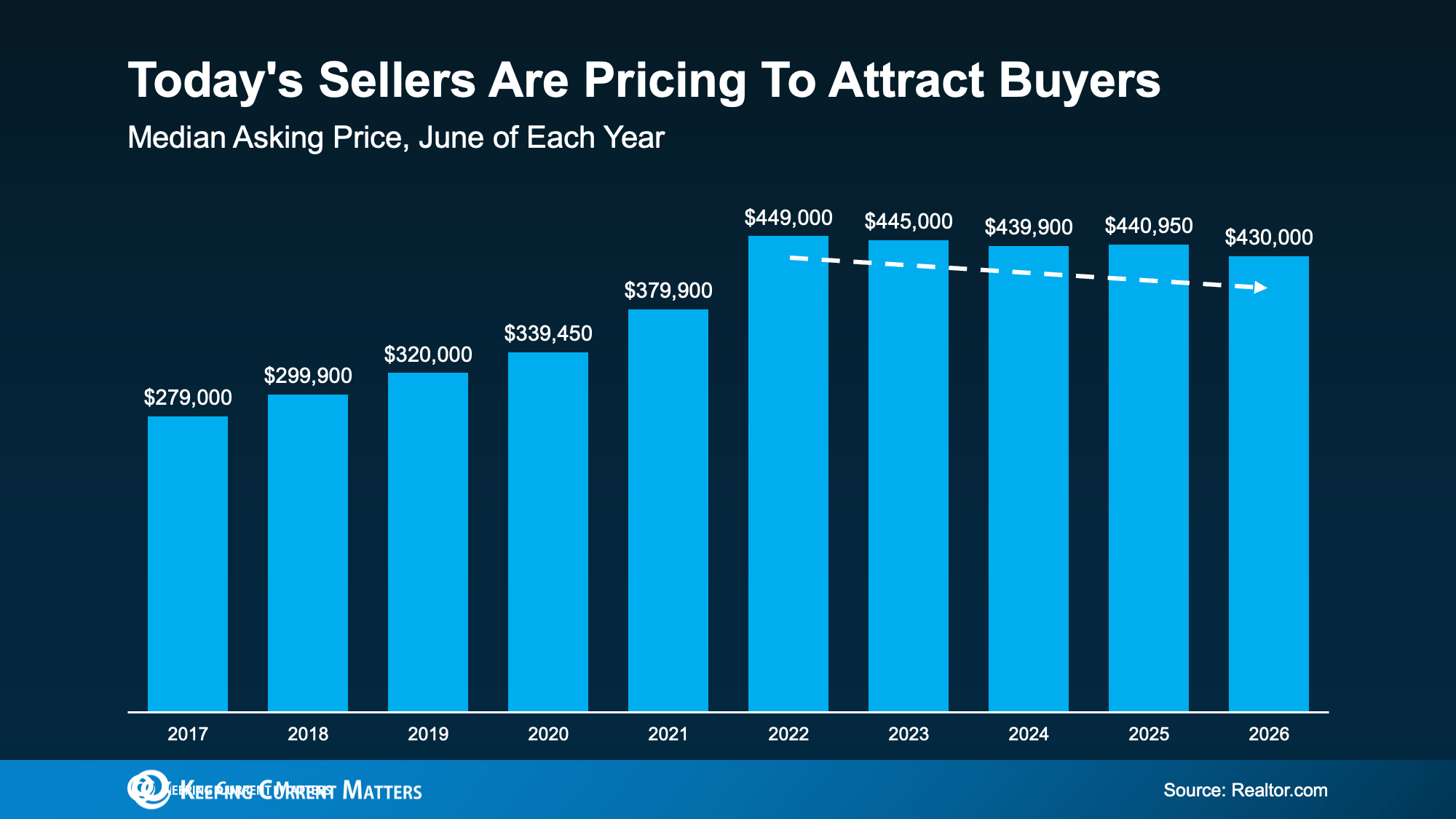
According to Realtor.com, the national median asking price was $430,000 in June, nearly $11,000 under what it was the year before (see graph below):

a graph of sales

That’s the eighth month in a row that the typical asking price has dipped below where they were the previous year, according to the same Realtor.com report.

And while falling prices can sound worrying, this isn’t a sign of an impending crash. We’re talking about asking prices, not sold prices. This is a sign that today’s sellers are meeting the market where it is and pricing to draw buyers. And that’s actually something normal we’d expect from the market. As Danielle Hale, Chief Economist at Realtor.com, puts it:

“Sellers are reading market conditions and are pricing accordingly from the start rather than listing high and cutting later, and buyers are taking note and making bids. This is a welcome sign that we are in a functioning market.”

Asking prices were never going to climb forever – now they’re just settling closer to what buyers can actually pay. That signals a healthier market, and sellers re-adjusting their expectations. 

More Homes Are Available Now

If you’ve spent the past few years watching homes disappear before you could even schedule a tour, this is for you.

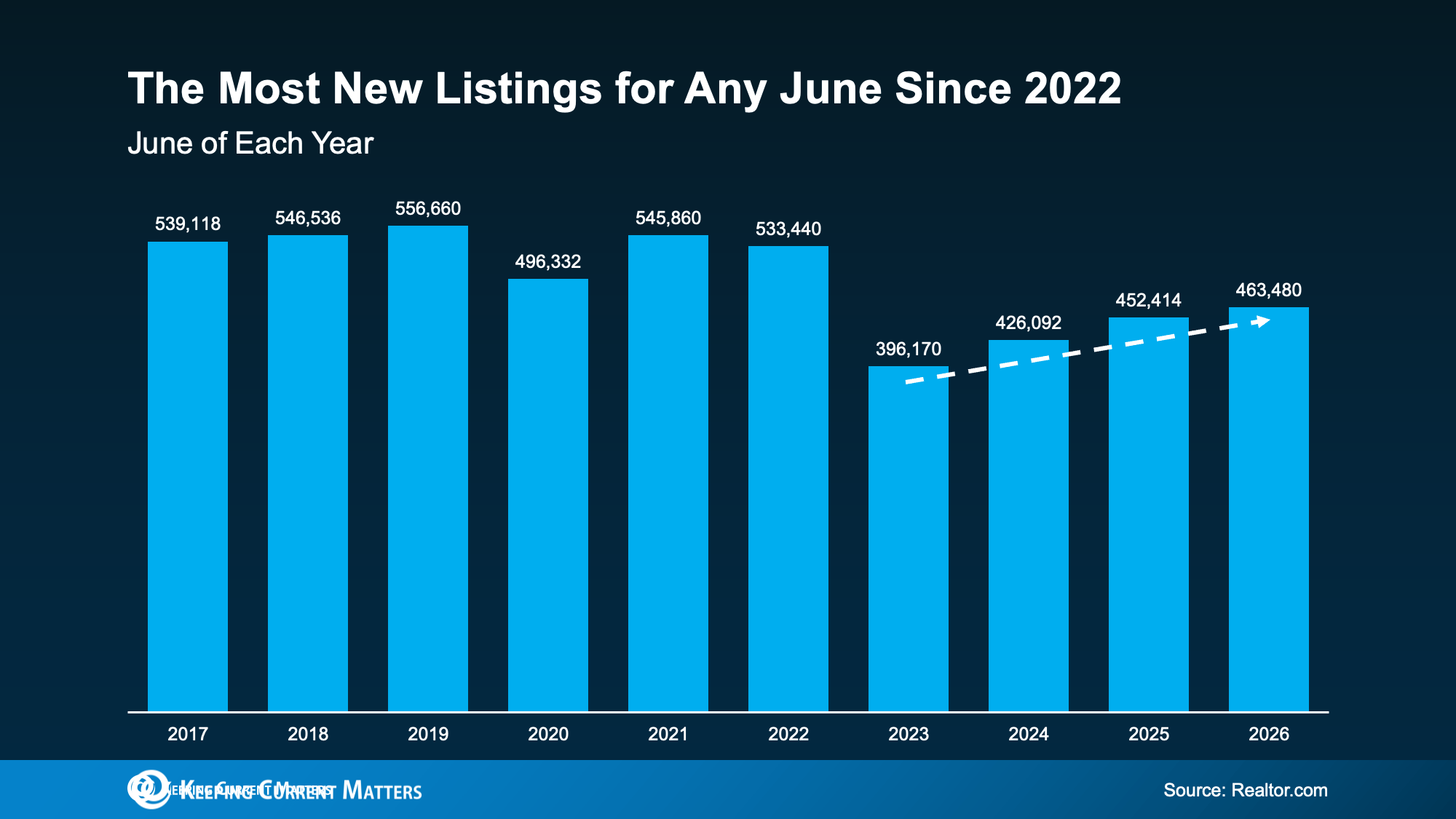
Supply is starting to catch up. According to Realtor.com, the number of homes listed for sale in June was the highest June number we’ve seen in three years (see graph below):

a graph with numbers and a number of blue bars

This means more options for you and less competition for each one.

Now, supply is not back to normal everywhere. As you can see, we’re still down from where we were back in 2017-2019. But in many places, it’s better than it’s been in a while. Here’s how that helps you.

You don’t have to rush an offer just to stay in the running, and you have better odds of finding and landing the right home, not just the one that’s available. Plus, you’ll have more room to negotiate, so you’re searching from a stronger position than buyers had even a year ago.

Why This Is Encouraging if You’re Buying Your First Home

For first-time buyers looking for lower-priced homes, these trends line up especially well. Mischa Fisher, Chief Economist at Zillow, explains:

“The lowest price tiers are exhibiting some softness in terms of price, they also had the most listing-activity growth, the first time since 2022 that’s been the case.”

So, if you’re searching for your first place or your next house, there’s a little more to choose from and a little more give on price.

Bottom Line

If a tight budget or a thin selection has kept you from buying a home, now might be the time to restart your search.

Connect with a local real estate agent to see what’s available where you’re looking.


Source link

The Brick Report at 6 months: How savvy New Yorkers use insights from this comprehensive building review


The Brick Report is fast becoming a valuable tool for buyers, renters, and agents to gain insights about a listing—plus owners and tenants who are curious about their own address.

It’s been six months since Brick Underground launched the Brick Report and in that time over 2,000 readers have created their own comprehensive residential building reports. Some are “power” users and have run dozens of reports.

When the Brick Report launched in January, it was intended for New Yorkers on the cusp of making a major real estate decision such as buying or renting. However, it’s also proving popular with tenants considering renewing a lease and looking for information on building projects. Co-op shareholders have run reports to see whether their building has any violations, according to feedback from users.

Some upgrades have gone into effect, such as a reorganization that makes the information consumers most want to see easier to find and more improvements are coming, said Justin DeMaris, advisor and minority owner of Brick Underground.

“We’ll be translating some violation records for users. A lot of this information from the city is in a form of shorthand so the Brick Report will help make it more understandable for consumers.”

Another addition will be easier-to-understand flood risk designations. “Right now, you’re shown a map and told whether your area is high risk. In the future, we’ll include more explanatory information on why this matters in terms of insurance and maintenance issues,” DeMaris said.

What brokers like about the Brick Report

Aaron Kass, a broker at Compass in Manhattan, said he appreciated the ability to pull together a wide range of information about a property for free. “Traditionally it would cost a pretty penny to get all this info on a property,” he said.

He ran a Brick Report to make sure a deal he was involved with wasn’t going to be held up by violations or any other surprises.  

“As a broker, I have to comb through ACRIS and DOB records to make sure there’s nothing that will derail our deal. The Brick Report covered both HPD and DOB violations without me having to search both systems individually,” he said.

Rachel Fiegler, co-founder and CEO of the Pinpointe Group, a boutique NYC real estate firm, had a similar experience.

“I found it helpful as it aggregates the data I’m looking for in one place rather than having to look at multiple databases. One of the main things I was looking for was violations in the building, which was clearly noted in the report. I’d definitely use it again and recommend it to agents in my firm,” she said. 

How a Brick Report can help you

Running a Brick Report can help you determine whether a listing you are considering has been issued violations for pests, plumbing, or heating problems. You’ll also be able to confirm when the building was constructed and access information about recent construction permit requests as well as energy ratings and usage. 

The report also provides neighborhood information, such as demographics, crime reports, overviews of restaurants and grocery stores, nearby schools and government institutions.  

Where the data comes from

Brick Report draws data from NYC’s Open Data portal and combines data sets from Housing and Preservation & Development, Department of Buildings, Department of Finance, 311, New York City Police Department, as well as Federal Emergency Management Agency, U.S. Census Bureau, and Open Street Maps.

Why do I have to provide my email address?

Brick Underground securely stores your email address so we can send you the report you requested. We may also contact you in the future if we find errors in the data that was used to generate your report.

Brick Underground may use this information to email you about relevant offers from Brick Underground or our sponsors in the future. Brick Underground does not publish this information, nor share this information with any of our sponsorship partners.

Brick Underground is not currently charging for Brick Report. You can try out the report for free to learn about where you live now or about places where you are considering moving. For questions, feedback, or sponsorship opportunities, reach out to [email protected].


Brick Underground reaches two million unique readers a year who are making a critical decision about renting, buying, selling, or renovating in New York City, one of the priciest and most complex real estate markets in the world. The site, which was founded by former New York Times real estate writer Teri Karush Rogers, has published more than 10,000 original articles in its 15-year history.


Source link

Priced Out? A Condo or Townhome Could Be Your Way In.


Today’s home prices have a lot of buyers – especially first-time buyers – wondering if there’s even anything out there that’s in their budget. But owning a home may be more within reach than you think. Sometimes, it just means considering a different type of home.

Condos and townhomes can be a great way to buy without stretching every last dollar. And right now, two things make them worth a serious look.

There Are More Condos and Townhomes To Choose From

Maybe you feel like there’s just nothing out there for you, and you’ve exhausted all your options. But have you considered condos or townhomes? A lot of buyers start by looking for a single-family, detached home without even realizing what that search omits from their pool of choices.

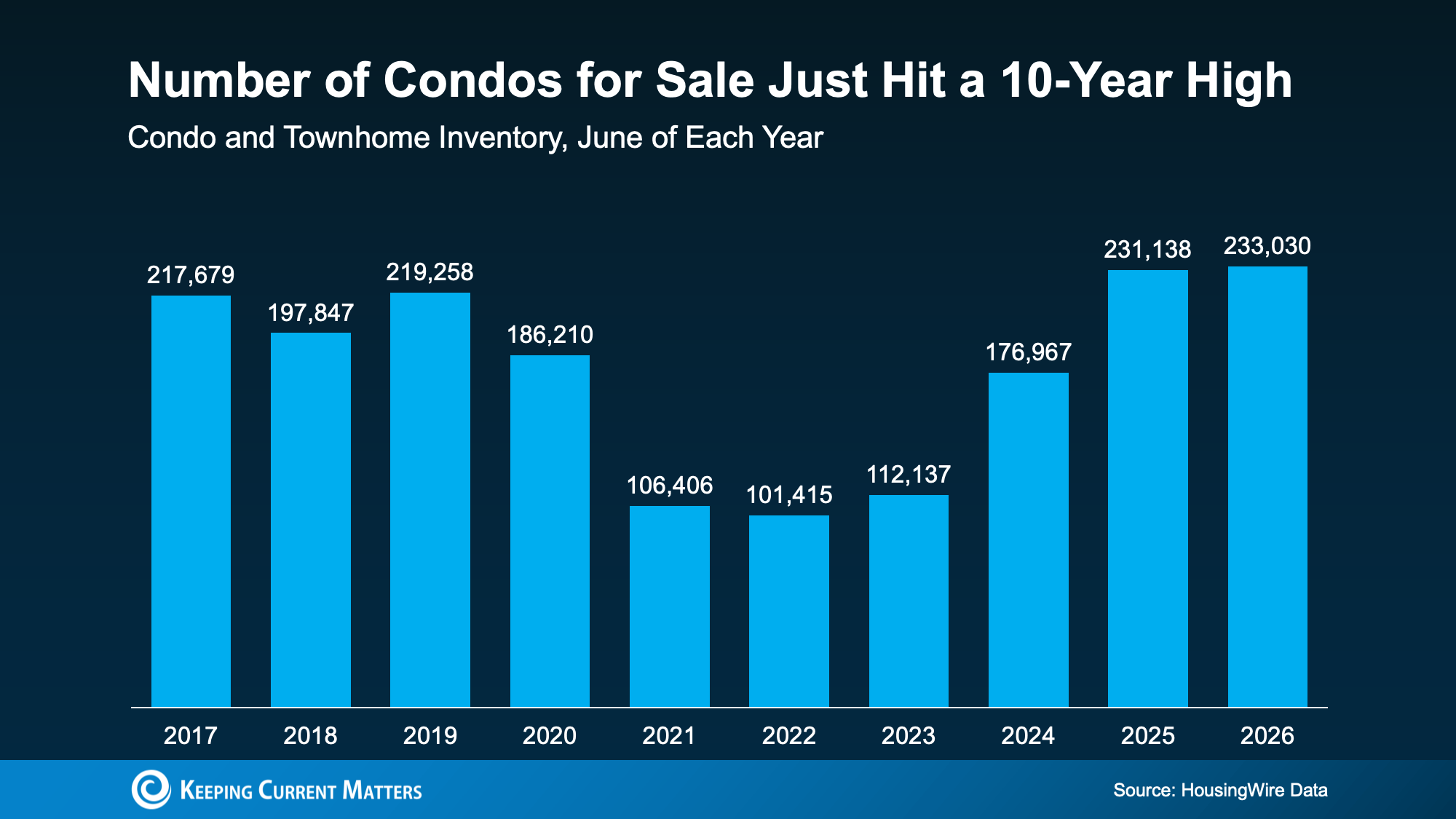
According to HousingWire Data, there were 233,030 condos and townhomes for sale this June. That’s more than any June in at least the past decade, and more than double the number available back in 2022 (see graph below):

a graph of blue bars

That means there are more options out there in this segment of the market – and that’s especially good news for first-time buyers. These types of homes can be a great way to break into the market for less.

Just remember, that’s the national number. What’s available will depend on where you’re looking. But generally speaking, more options means less competition, more time to decide, and more room to negotiate.

They Also Tend To Cost Less Than Single-Family Homes

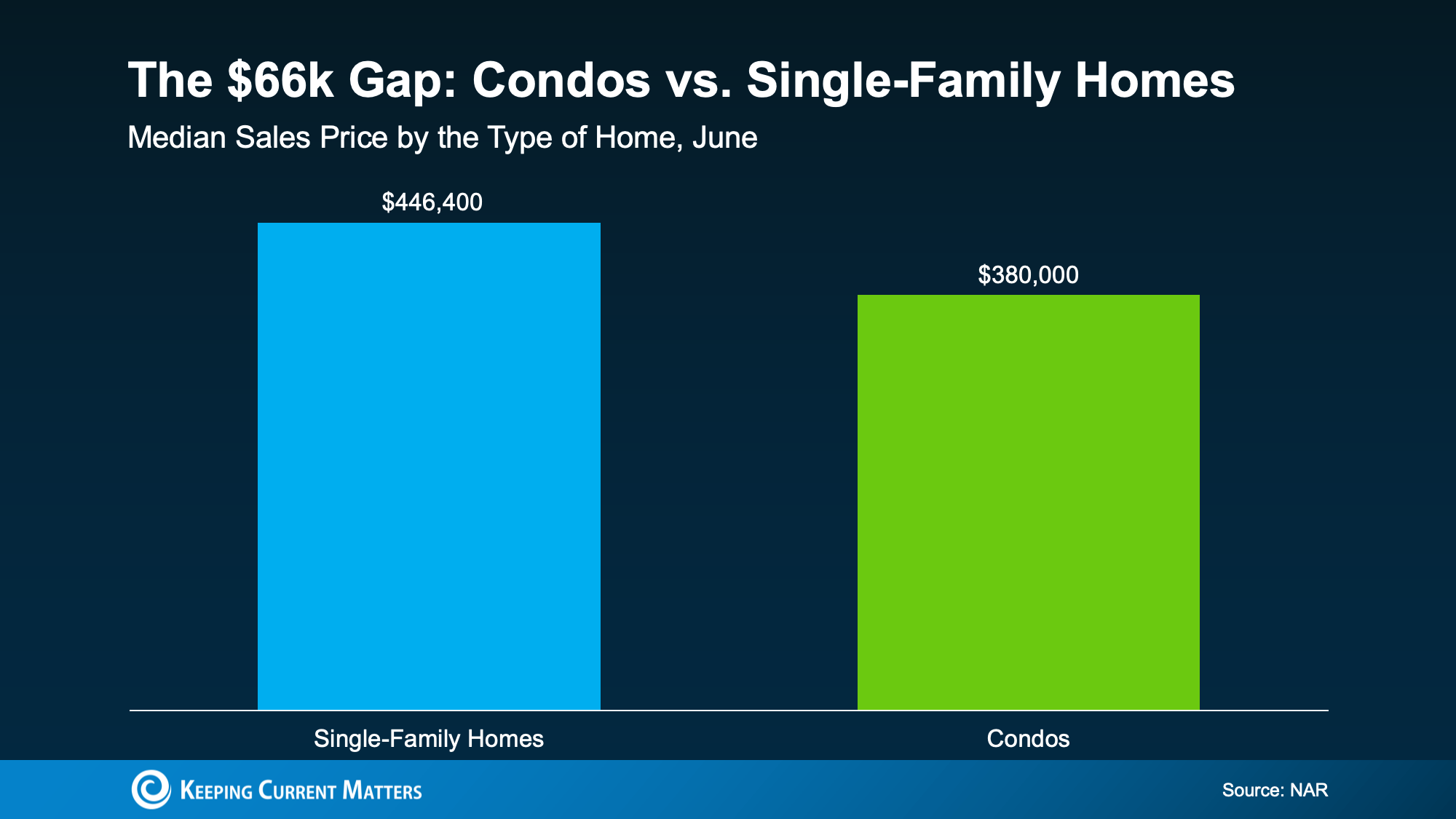
Price is the other big draw. According to the National Association of Realtors (NAR), the median condo price was $380,000 in June. In contrast, the median single-family home price was $446,400 (see graph below):

a graph of a chart

That’s a difference of more than $66,000.

A big reason why? Condos are usually smaller than single-family homes. And smaller homes can come with smaller price tags.

And if you don’t need all that extra space, that lower entry price could be exactly what gets you through the door.

Condo or Townhome? How They’re Different.

For buyers who feel priced out of the market, a condo or townhome could be a way in. But there are some things to know. Before you start checking out homes, it’s good to understand how these two compare to each other – and to a single-family home.

  • With a single-family detached home, you own the house and the land it sits on, and you don’t share any walls with neighbors. That means the most space and privacy. But it also usually comes with a higher tag, and all the maintenance is on you.

  • With a townhome, you own the building and the lot it sits on. They’re usually multi-level, so you get more space, and you share two walls at most. You’ll also have more say over how your home looks and how repairs get done, but more of that upkeep falls on you.

  • With a condo, you own just the inside of your unit and may have access to community features like a pool or gym. The building and shared space belong to everyone who lives there, which means you have less maintenance responsibilities. But you’ll also likely have more neighbors around you, less control over building decisions, and higher HOA fees since the HOA handles the exterior and common areas.

Bottom Line

A condo or townhome could be your path to owning a home without blowing your budget. Connect with a local real estate agent to see what’s for sale in your area and figure out which type of home fits your lifestyle, and your bottom line.


Source link

Microsoft Paint used as a ‘monitor’ to run Doom at up to 35 fps, project released by firm’s Azure CTO — runs actual Doom engine and loads real shareware DOOM1.WAD


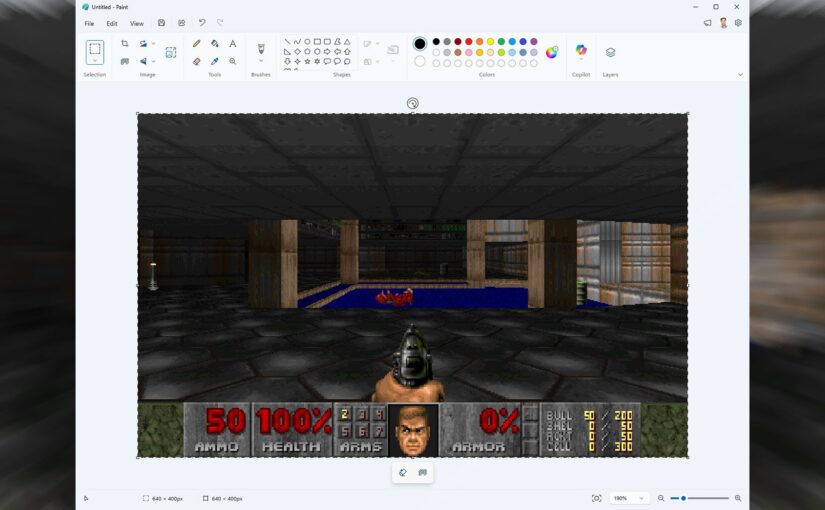
Another day another Doom port, but the new DoomPaint stands out from the crowd for a few reasons. Firstly, it has been developed by Mark Russinovich, the Microsoft Azure CTO. Secondly, DoomPaint runs the actual original shareware Doom release using MS Paint as the monitor or viewport for in-game action. That’s different, and it is remarkable to read that the OLE clipboard hack behind this latest Doom escapade allows the game to run at a fair pace, up to 35 FPS, but might also sometimes be “spreadsheet-tier,” according to the author.

“The actual Doom engine (ViZDoom) runs the real shareware DOOM1.WAD — with the BSD-licensed Freedoom WADs covering the episodes shareware doesn’t ship — and renders headlessly,” explains Russinovich on the project GitHub page. “Every frame is placed on the Windows clipboard and pasted into Paint’s canvas as a genuine document edit.” The Microsoft CTO adds that the relatively low frame rate “is part of the charm” of DoomPaint, but 35 FPS isn’t bad, if you can make it, especially in 1990s PC gaming terms.


Source link

The House That Started It All Could Kickstart What’s Next


Remember how exciting it was to buy your first place? It felt like crossing a long-awaited finish line. It gave you a place to build your life. Maybe it’s where you lived when you got married. Or where you welcomed a child or a pet into the family.

But that was just the beginning.

For most people, your first house was never meant to be your forever home. It’s a stepping stone for what comes next.

And if your life looks different today than it did when you got the keys, you’re not stuck. Moving may be more realistic than you think.

Starter Home Inventory Is Still Relatively Low

If you’ve been wondering whether now is the right time to move up, here’s something worth knowing. Starter homes remain one of the hardest types of homes to find. And that’s good news if you’re thinking about selling your first place.

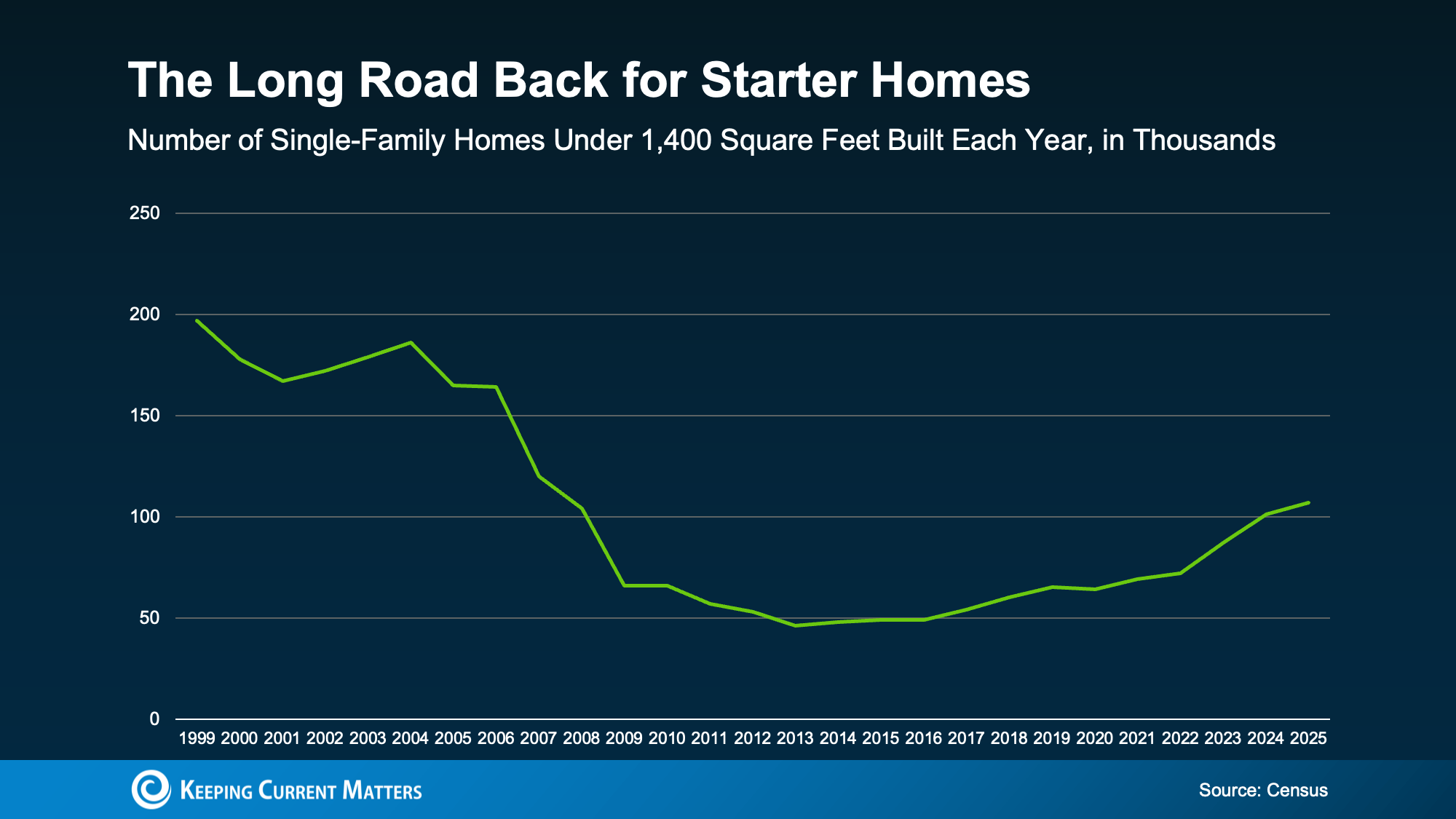
Historically, we haven’t been building enough homes for first-time buyers. And even though homebuilders have shifted more attention toward smaller, entry-level homes lately, the Census shows there’s a long way to go to re-build supply (see graph below):

a graph showing a growing trend

That means your current house is in demand – and that’s a dream scenario for sellers. But that’s only half the story. You also need somewhere to go.

There Are More Move-Up Homes on the Market

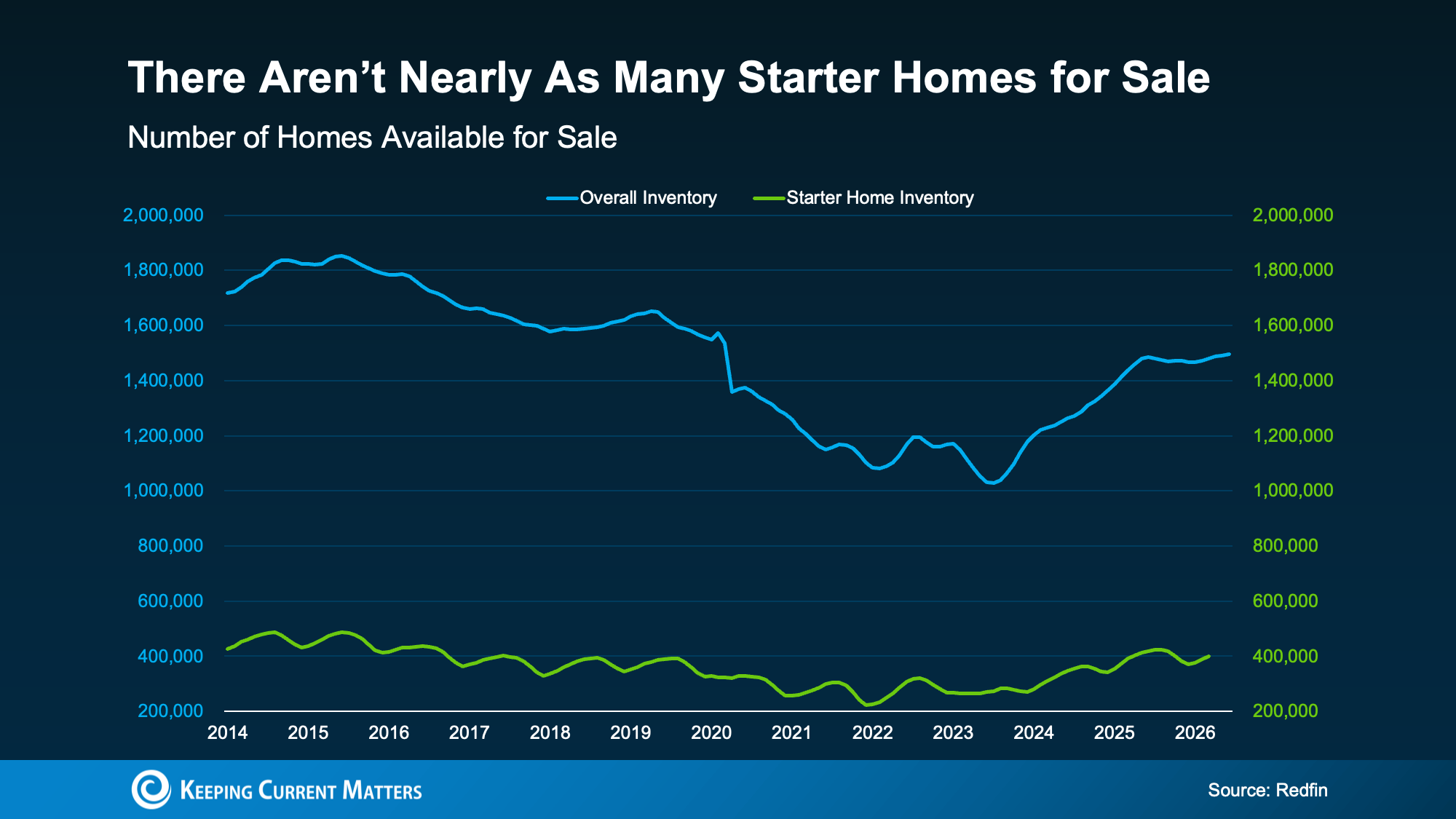
Here’s where this gets interesting. While the supply of starter homes remains tight (the green line), data from Redfin shows that the number of homes for sale has been climbing overall (the blue line):

a graph of sales and prices

As Nadia Evangelou, Principal Economist and Director of Real Estate Research at the National Association of Realtors (NAR), explains:

“Too much of the inventory available today remains concentrated at higher price points, leaving a shortage of options for entry-level and middle-income buyers.”

That means you may have more choices for your move up than you’d expect. Whether you’re hoping for another bedroom, a home office, a bigger backyard, or simply more room for this next stage of life, today’s market may finally be giving you the chance to find it.

At the same time, your current house may be exactly what someone else has been looking for because homes like yours are still in short supply. That’s a unique advantage for move-up buyers. And it could help you sell for a stronger price. As Zillow says:

“Starter home value appreciation has outpaced other types of homes nationally, mostly because they’re so in demand.”

Your Biggest Advantage May Be Your Equity

Here’s the cherry on top. There’s one more thing your first home has been doing behind the scenes, and that’s building equity. Every mortgage payment you’ve made and every year your home’s value has grown has quietly increased your ownership stake in your house.

According to Cotality, the average homeowner with a mortgage has $295k in equity built up. While your number may be different, once you sell, it could become the down payment on your next home or help reduce the amount you need to borrow at today’s rates.

Put it all together and your move up becomes a lot more realistic than you think:

  • The house you’re selling is in demand.

  • The house you’re buying may be easier to find.

  • And the equity you’ve built can help bridge the gap between the two.

Your first home did exactly what it was supposed to do. It gave you a place to start.

Now, it may be the thing that helps you take the next step.

Bottom Line

Your first home was never meant to be your forever home. It was meant to help you build a life and build the financial foundation for whatever came next.

If your current home no longer fits the life you’re living today, connect with an agent. You may be closer to your next chapter than you realize.


Source link

Errant SpaceX rocket stage set to smash into the moon at 5,400 mph, seven times the speed of sound — NASA and South Korean orbiters prepare to track 3-ton TNT impact


The upper stage of a SpaceX rocket that delivered two lunar landers in early 2025 is set to come crashing down on the lunar surface several months after it ended its mission. According to Japan Today, the large piece of rocket debris is expected to hit the moon at an estimated 5,400 mph or 8,690 kph, which is seven times the speed of sound.

While a piece of debris hitting the moon might seem like an inconsequential event for most people, scientists and astronomers are keeping a close eye on it because this will be one of the few times that an object will impact the moon while being observed. NASA’s Lunar Reconnaissance Orbiter and South Korea’s Danuri lunar orbiter will take before-and-after photos of the impact site, while the latter will also fly close to the stricken SpaceX rocket a few minutes before it begins its final descent.


Source link

The James and Euphemia Russell House at 44 West 87th St: A ‘palatial residence’ with a refined Romanesque Revival design


Have you ever passed by an interesting residential building in New York City and wanted to know more about its history? In this series, Brick Underground teams up with Tom Miller, creator of Daytonian in Manhattan, a blog about Manhattan buildings and other historic architecture. Each week, we run an excerpt from the Daytonian’s archives with a link to the full article.

The development-construction firm Charles Buek & Co. was one of the most well-known firms in the industry. In 1891, the Real Estate Record & Builders’ Guide reported that the firm was building six brick-and-limestone residences on the south side of 87th Street.

Completed in 1892, Nos. 40 through 50 West 87th St. were designed in a refined version of Romanesque Revival. No. 44 West 87th St. was 23 feet wide, and its basement and parlor levels were clad in rough cut limestone. A dog-legged box stoop mirrored that of its next door at No. 46. The two-story midsection was faced in brick. Grouped windows at the second floor were framed in limestone, distinguished by pilasters with ornate Corinthian capitals. The fourth floor sat atop an intricately carved cornice. 

James and Euphemia Russell purchased the mansion in February 1893 for $44,500. The couple had four children, Marguerite, George Dunlap, May Isabelle, and Rachel (known as Ray) MacMaster. The family’s country home, Sunny Side, was near Mount Vernon, New York.

Described by The New York Times later as the Russells’ “palatial residence,” 44 West 87th St. was filled with valuable artwork and antiques. An inventory held in 1906 described “a valuable collection of oil paintings, comprising about one hundred canvases, many by prominent American and foreign artists.” The parlor, or “salon,” was furnished in “Marie Antoinette and Louis Seize,” and the music room in Louis XVI.

Just two years after purchasing 44 West 87th St., James Russell died. The family left in 1902, although Euphemia retained possession. She leased the house for the winter social season of 1902 to author and playwright Frances Hodgson Burnett.

Born in 1848, Burnett had written the children’s novel “Little Lord Fauntleroy” in 1886. She would later produce two other popular children’s works, the 1905 “A Little Princess” and “The Secret Garden,” released in 1911.  

Euphemia Russell placed the house for sale in 1906 and it was sold to Dr. Abram Richard Stern and his wife, the former Stella Lichtenstein, in May.

The Sterns remained at 44 West 87th St. until September 1940, when they sold the house to Joseph Kamert for $40,000.  

It appears that Kamert rented rooms in the former mansion, and among his first tenant was Paul Bante. The 44-year-old iron worker was born in Germany, but was a naturalized American citizen. Bante was the subject of nationwide attention when The New York Times reported on July 1st, 1941 that he had been arrested as a member of a German spy ring. He and 32 others were indicted 15 days later, accused “of having acted as agents” for the Nazi government. The New York Sun reported on January 2nd, 1942, that he had been sentenced to 18 months in a federal penitentiary and a fine of $1,000.

A renovation completed in 2011 resulted in an office in the basement level and eight apartments on the upper floors.

For more on the property and the people that lived here, check out the full article.


Source link