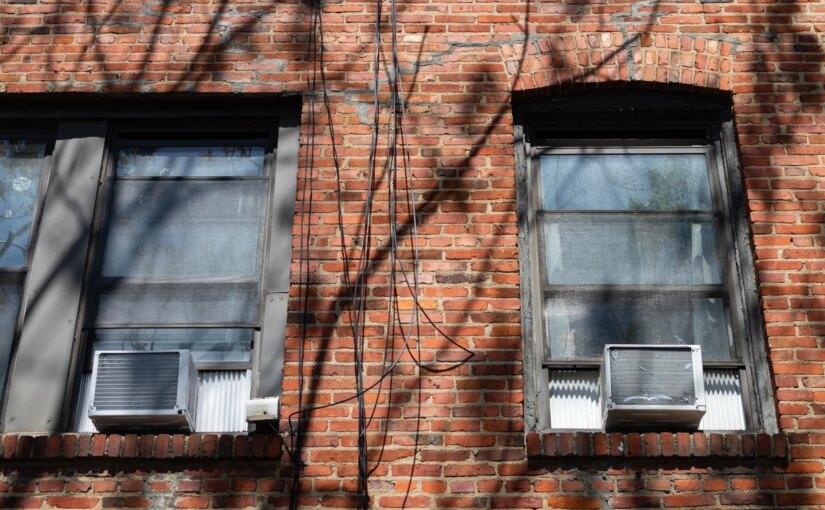
The 1881 Dr. Herman B. Sheffield House at 127 West 87th St: A narrow home with exuberant decoration


Have you ever passed by an interesting residential building in New York City and wanted to know more about its history? In this series, Brick Underground teams up with Tom Miller, creator of Daytonian in Manhattan, a blog about Manhattan buildings and other historic architecture. Each week, we run an excerpt from the Daytonian’s archives with a link to the full article.

In 1881, developer John W. Stevens acquired a 50-foot-wide parcel on West 87th Street between Ninth and Tenth avenues. (The avenues would be renamed Columbus and Amsterdam in 1890.) Rather than erect two commodious townhouses, Stevens directed his architect, William Howe, to squeeze three onto the plot. Each would be just over 16-feet-wide and would cost $8,000.

Like its identical siblings, 127 West 87th St. was faced in brownstone and designed in the neo-Grec style. Howe compensated for the home’s lack of width with exuberant decoration. The windows were flanked by paneled piers upon bracketed sills. Mimicking the doorway, the lintels were decorated with foliate designs. A complex pressed metal cornice of corbels, brackets and a paneled fascia completed the design.

The house was initially owned by Albert M. Crouter and his family. They sold it at auction on September 29, 1891. Norman and Sarah E. Macdonald placed the winning bid of $16,900.

Norman Macdonald was one of hundreds of New Yorkers who were frustrated with the city’s lack of street signs. Some residents or businessmen erected their own signs, and stone blocks on the second floor of some corner buildings were carved with the avenue and street names. In January 1901, Macdonald signed a petition that urging the city to address the issue.

Later that year, the Guggenheim Ordinance was enacted, instituting a system of standardized street signs. 

The Macdonalds sold 127 West 87th St. in April 1905 and the property changed hands several times in quick succession purchased in March 1909 by Dr. Herman B. Sheffield, a pediatrician and prolific author. His expertise was often sought by attorneys as an expert witness, such as the lunacy hearing of 22-year-old Walter Lathrop Hanson.  

Hanson’s mother, Mrs. Aimes Hanson, had multiple homes and was the niece of Leland Stanford, the founder of Leland Stanford University. Hanson’s father died in January 1912, and Walter was receiving payments from a $50,000 trust, administered by his mother. The New York Times reported that on November 5th, 1912, Walter married Henriette Keutti “without his mother’s consent.”  She cut him off from his “allowance” and sought to have him committed as a lunatic.

In the courtroom on March 5th, 1913, Dr. Herman B. Sheffield “pronounced him mentally competent,” reported The New York Times. The article added, “On the side of young Hanson sat his young bride, who returned stare for stare of her mother-in-law.”

No. 127 West 87th Street is remarkably intact after more than 140 years. Even the interior shutters survive on the upper floors.  

For more on the property and the people that lived here, check out the full article.


Source link

PC cooling outfit Arctic reverses tariff-era price hikes after US government refund — lowers prices across lineup, including coolers and case fans


Following a tariff refund from the United States government, popular PC cooling hardware manufacturer Arctic has announced a price rollback for its products sold in the U.S. The refund was made possible after a February 2026 Supreme Court ruling found that the 1977 International Emergency Economic Powers Act (IEEPA) does not grant the President unilateral authority to impose import duties without prior approval from Congress.

The reduced price will be applicable across Arctic’s direct-to-consumer sales channels in the U.S. and is claimed to be already in effect on Amazon and eBay. In its latest blog post, Arctic said, “When U.S. trade tariffs significantly increased, Arctic proactively absorbed as much of the tariffs as possible to protect our customers. While most of the product lineup remained unaffected, price adjustments became necessary for a limited number of products in the U.S. market. At the time, Arctic committed to reversing those increases if circumstances allowed. “


Source link

Manhattan gains sales listings below $1 million as luxury inventory shrinks


A new report compares Manhattan and Brooklyn sales listings in different pricing tiers and finds inventory moving in opposite directions.

Apartment listings priced under $1 million have grown in Manhattan while luxury supply has shrunk. In Brooklyn, high-end listings have more than doubled and its starter apartment supply has fallen, according to the report by John Walkup, co-founder of UrbanDigs, a New York City real estate analytics firm.

The report contrasted snapshots of Manhattan and Brooklyn sales inventory in June 2023 to June 2026 in four price ranges: under $1 million, $1-$2 million, $2-$4 million, and $4 million-plus.

“Over the past three years, Manhattan’s under-$1 million is the only price band bringing more new listings to market than it did in June 2023, up 8.9 percent, while $2-4 million new listings have shrunk 18.3 percent, the steepest drop of any tier.” Sellers in that $2-4 million band “appear to be sitting out,” he said.

Brooklyn showed a mirror image, Walkup said. Its $4 million-plus tier has more than doubled its new-listing volume, up 111.5 percent, and $2-4 million is up 31.1 percent, while under-$1 million is the only tier bringing less supply to market than three years ago, down 5.2 percent, he wrote.

Why are the markets reversed?

Walkup said the growth in listings “appears concentrated where sellers are more confident they can get their price.”

Brooklyn’s under-$1 million sector is the exception to this rule. Supply there “is slipping, and that is where the two boroughs diverge most sharply,” he wrote.

A mortgage lock-in effect may also be playing a role in Brooklyn: Sellers with low mortgage rates are reluctant to list properties if it means they must borrow at a higher rate to buy somewhere else, “particularly if prices have not fallen enough to justify a move,” Walkup wrote.

This does not mean the Brooklyn market is unhealthy, he wrote. Buyers and sellers are reacting differently across price tiers rather than one side pushing the market in a single direction, he wrote.

Manhattan properties under $1 million showed “stability,” Walkup told Brick. “It was the only Manhattan price tier to show a positive change, while the higher tiers were generally slipping.”

Most of the supply at this price level comes from resales of small co-ops and condos, namely studios and one bedrooms. The amount of new development listings under $1 million is a tiny fraction.

If there was any lock-in effect in this price range, it was likely “unlocked by life,” Walkup said. Sellers had to make a move for reasons that outweighed any other consideration.


Source link

New Micron lawsuit reignites fight over New York fab — complaint alleges ‘forever chemicals’ will flow into Oneida River


Pushback against Micron’s planned manufacturing complex in Clay, New York, which comprises four separate fabs, is once again at the center of an environmental lawsuit. Filed by Neighbors for a Better Micron and Jobs to Move America — the same groups that filed a separate lawsuit against Micron in January — filed a new complaint Friday, claiming that approved wastewater and air permits aren’t valid and will allow Micron to leak “forever chemicals” into the Oneida River.

Go deeper with TH Premium: Chipmaking

tsmc

(Image credit: tsmc)

“The Permits were issued against eh backdrop of the significant environmental consequences already acknowledged through the course of the Micro Project’s State Environmental Quality Review Act (SEQRA) review. including the release of PFAS and other highly persistent and hazardous chemicals,” the complaint reads. “Rather than fully and meaningfully evaluate and address those consequences and impose the necessary protections before granting final authorization, [the Department of Environmental Conservation] issued permits that defer essential analyses, controls and limitations, and mitigation decisions until after issuance or until future regulations and studies have been conducted.”


Source link

The Elijah B. Middlebrook House at 121 East 78th St: A regal home and 1999 crime scene


Have you ever passed by an interesting residential building in New York City and wanted to know more about its history? In this series, Brick Underground teams up with Tom Miller, creator of Daytonian in Manhattan, a blog about Manhattan buildings and other historic architecture. Each week, we run an excerpt from the Daytonian’s archives with a link to the full article.

Around 1871 developer Nicholas McCool erected a row of identical Italianate-style homes on the north side of East 78th Street between Lexington and Fourth avenues (renamed Park Avenue in 1888). Three bays wide and three stories tall above high English basements, they were intended for affluent families.

McCool sold 121 East 78th St. to Dr. Elijah B. Middlebrook, who had just relocated to New York City from Connecticut. Shortly before the purchase, he was embroiled in a court battle in Connecticut. He assaulted attorney W. K. Seller in the courtroom and openly called him a liar. Middlebrook paid a $600 fine (a significant $16,900 in 2026) and the New York Herald reported that he “exiled himself from Bridgeport rather than endure the ignominy of imprisonment.” 

Major renovations

The property was passed down to a series of inheritors until it was sold in 1933 to R. Keith Kane, according to an article in The New York Times that noted it “will be altered at a cost of $10,000.”  

The renovations (equal to a quarter of a million today) included removing the stoop and lowering the entrance to below grade, converting the original entrance to a window, and adding a new floor. Astoundingly, the architect matched the former entrance with the existing parlor openings, copied the original architraves for the top floor windows, and reinstalled the 1871 cornice.

Born on July 3rd, 1900, attorney Richmond Keith Kane was a 1926 graduate of Harvard Law School. The year before purchasing 121 East 78th St., he joined the law firm of Cadwalader, Wickersham & Taft. He and his wife, the former Amanda Stewart Bryan, had four daughters: Shelah, Anne Tennant, Hope Stewart and Constance H.  Their country home was in Wickford, Rhode Island. Amanda was highly involved in civic and social affairs. 

The family moved to Washington D.C. in 1940 after Kane became special assistant to the U.S. Attorney General “in the enforcement of new foreign-registration laws.” When relations between the French Vichy Government and America became strained the following year, the consul left East 78th Street and No. 121 was leased to Frederick S. Bailey and his family. 

R. Keith Kane was appointed assistant to the Secretary of the Navy in 1943 and in 1945 was an advisor to the United States delegation to the United Nations Conference on International Organization.

Domestic violence

Former securities executive Aftab Islam, and his wife, Theresa Havell, lived here as early as 1999 with their six children and a live-in nanny. The couple was married in 1979. Theresa was described by The New York Post as “a Wall Street wizard.” She was the founder “of the highly successful Havell Capital Management.” Islam, on the other hand, called himself a “house husband” and had not worked since 1990.  

By 1999, things were not going smoothly for the couple. According to The New York Post, they slept in separate bedrooms. Before going to bed on April 21st, Theresa told Aftab that she wanted a divorce. According to The New York Times, “she awoke just before 5 a.m. as Mr. Islam began beating her with a barbell he used to work out in their home.” 

Theresa was hospitalized with a fractured skull. Islam was taken away by the police and later sentenced to eight years in prison. 

New owners renovated in 2002. It was most likely during this remodeling that architectural elements of the ground floor, faithful reproductions of the 1871 versions, and a charming bay window were installed.

For more on the property and the families that lived here, check out the full article.


Source link

Who is responsible for fixing a clogged drain, you or your landlord?


The shower in my NYC rental apartment is starting to back up. Am I responsible for clearing a clogged bathroom drain, or is that the super’s job?

The short answer: It’s usually the super’s job, not yours. The reality, however, is not so clear-cut and depends on the circumstances.

If you own your apartment, the problem (and the fix) falls squarely on you. But one advantage of renting is that your landlord is typically required to address such issues.


[Editor’s Note: Realty Bites tackles your NYC rental questions. Have a query for our experts? Drop us an email. We respect all requests for anonymity. An earlier version of this post was published in November 2025. We are presenting it with updated information for July 2026.] 


New York’s implied warranty of habitability requires landlords to keep your unit—and the plumbing in it—safe and functional, regardless of what your lease says. Under the 2019 Housing Stability & Tenant Protection Act, this warranty was expanded to explicitly include a duty to repair, and it covers public areas of the building too. Any lease clause that tries to waive this right is void as a matter of public policy.

The exception: If you caused the clog yourself—through negligence or by putting things down the drain that don’t belong there—the landlord isn’t on the hook for that damage, and could even pass the repair cost to you.

Where our expert draws the line

Arik Lifshitz, CEO of DSA Property Group, summed it up this way: Routine upkeep that doesn’t require a “snake” or other specialized tool is, in most cases, the tenant’s job. That means both clearing minor debris yourself (using a plunger, an enzyme cleaner, or pulling out visible hair) and taking preventive steps, like installing a drain cap or mesh cover (they’re very cheap) to catch hair and debris before it goes down the drain.

“But ultimately, if a snake is needed to clean out a clog, it’s the landlord’s responsibility,” Lifshitz said. That’s because an untrained novice risks damaging the pipes by using the tool incorrectly. Additionally, it is unreasonable to expect a tenant to fix what may be—or quickly become—a building-side plumbing issue. 

“There are always exceptions to every rule, and I can imagine egregious situations on both sides that would cause one or the other party to be liable,” he said.

For example, if the drain becomes clogged due to tenant negligence or malicious intent—and there’s proof of that—a landlord could conceivably charge the tenant. A consistent pattern of clogs would also be a red flag, especially if your landlord has already explained that whatever you are doing is not allowed.

So while most landlords are understanding and know backups happen, if they pull your kid’s bath toys or other items that don’t belong out of the pipes more than once, don’t be surprised if they ask for a reimbursement—or, in extreme cases, refuse to renew your lease or even move to evict. 

Who is responsible for fixing a clogged drain?
 Landlords/supers must
  • Repair or replace structural plumbing.
  • Take steps to keep the clogged drain from causing issues elsewhere.
  • Use proper tools to make more serious repairs.
Tenants must
  • Reduce the risk, such as with a drain cover. 
  • Avoid pouring grease or other non-dissolvable items into drains. 
  • Try to fix it with a plunger or enzyme drain cleaner.
Consequences
  • Landlords can be sued for breach of habitability and forced to make repairs via housing court.
  • Tenants might be charged for repeated, preventable problems; in extreme cases, risk non-renewal or eviction.

Furthermore, you can get into trouble if you repeatedly flush items down the toilet that are not meant to be flushed, such as paper towels, “flushable” wipes, or hygiene products.

The same goes for pouring non-dissolvable items, such as grease or food fat, down the kitchen drain (or into the toilet). 

When plumbing problems go very wrong

Lest you wonder what could happen, improperly disposed of cooking grease was to blame for the infamous Queens “fatberg” of 2017, which resulted in major sewer backups.

That incident wasn’t a one-off—fatbergs are part of an ongoing, expensive problem for the city’s sewer system—and the city’s Department of Environmental Protection still runs public education about it. 

On that note, the DEP advises that the correct way to dispose of cooking grease is to let it cool, put it in a sealed container (such as a yogurt container or take-out soup container), label it “Cooking Oil—Not for Recycling,” and toss it with regular trash, or freeze it in a resealable bag first. The DEP also advises using paper towels to wipe away any residual grease or oil from your dishes, pots, and pans before washing them. And never flush it in a toilet. 

Most leases don’t contain any language regarding this situation. However, some agreements include provisions like: “Tenant shall keep drains clear and be responsible for clogs caused by tenant’s actions.”

What you can and should do

The habitability standard has real teeth. Regardless of rent regulation status, all NYC tenants—not just those in rent-stabilized units—can seek repairs and rent abatements for violations of the warranty of habitability. However, if a defect is due to the tenant’s negligence, the landlord may not be responsible for the cost, even though the landlord must still keep the premises in good repair. 

Otherwise, take these steps to protect yourself:

1. Try an easy fix: plunge it, or us an enzyme-based cleaner. Skip Draino-type chemical cleaners, which can damage older NYC pipes.

2. Document it before you report it: photos or a short video of the backup helps if this becomes a dispute later. 

3. Notify your landlord in writing: send an email or text so there’s a timestamped record. Landlords get a “reasonable time” after proper written notice to make repairs—decided on a case-by-case basis, but typically expected to wrap up within 30 days.

Landlords will often send a plumber and then bill the tenant. If this happens, request a plumber’s report showing the cause before making any payment.

Should the landlord refuse to fix it, and the clog is not your fault, tenants are advised to call 311 for “sinks, bathtubs, showers, toilets, or other plumbing fixtures that are broken or defective.” 

If a landlord ignores the problem, tenants can file a complaint with NYC’s Housing Preservation and Development (HPD) or take the matter to Housing Court, which can order repairs. For prolonged issues, courts can also award a rent abatement—a partial rent credit—proportional to the extent the condition affected livability. 

The ultimate advice

Keep a two-dollar drain cover in every shower and sink. It’s the single cheapest way to avoid clogs—and keep you on the “not my fault” side of any dispute. 

—Earlier versions of this article contained reporting and writing by Nikki M. Mascali.


Source link

Ask Altagracia: Can my landlord make me pay a surcharge for my AC unit—even if I already pay the electric bill?


I recently moved to a new building, and the landlord informed me that if I planned to use a window air conditioner—my own unit—I would have to pay an annual fee of $120. He said it’s to cover the strain on the building’s electrical system. I pay the electric bill, so I don’t understand how this makes sense or if it’s legal.

This summer’s extreme heat has been almost unbearable for New Yorkers. Between the heat dome overtaking the city leading up to July 4th weekend to the mid-month heat wave that only subsided when smoke from Canadian wildfires blew through the city, having access to an air conditioner has been a lifeline for New York tenants. And for those who don’t have AC, cooling centers opened across all five boroughs to keep New Yorkers safe. 

You’ve likely already made peace with the fact that your electricity bill is going to skyrocket this summer, even if you are planning your energy use strategically. “That doesn’t mean that you should pay this surcharge just to get your landlord off your case,” said Altagracia Pierre-Outerbridge, attorney and founder of Outerbridge Law representing residential tenants, condo owners and landlords.

Scrutinize your lease

“For most tenants in market-rate apartments, where you are paying your own electric bills, double-check the terms of your lease,” Pierre-Outerbridge said. “As long as there are no restrictions on having an AC unit outlined in the lease, a surcharge like the one you describe is illegal.” 

Pierre-Outerbridge advises tenants to refer their landlord back to the lease to contest the charge. “Don’t pay the surcharge. If there’s nothing in the lease describing an additional fee for AC, insist that the charge is not permissible,” Pierre-Outerbridge said. “We know that rental leases are written to protect the landlord, so all costs should be explicitly stated. But the lease is your source of truth too; landlords can’t suddenly insist that tenants start paying a new fee that’s not mentioned in writing.” 

However, if you install an AC unit, but your lease prohibits them, you may end up having to negotiate a fee with your landlord in exchange for permission to install it. “Landlords like to forbid tenants from having AC units because they can use it as leverage,” Pierre-Outerbridge said. “It’s unthinkable that anyone would be comfortable in this summer’s heat without air conditioning, and your landlord knows that. Sometimes, a landlord will agree to let it slide if you pay them a fee,” Pierre-Outerbridge said. 

Her advice? “Don’t make any under-the-table deals with your landlord without a lawyer,” Pierre-Outerbridge said. If you’re feeling pressured to negotiate with your lawyer, a lawyer can help you identify other options, ones that keep you protected. 

When a surcharge is legal 

One instance where a surcharge like this may be legal is if the landlord pays the electricity bill on behalf of the tenant. “If electricity is included in the rent, AC use will drive up that cost significantly in the summer,” Pierre-Outerbridge said. “In that case, landlords can implement a surcharge, but the price is set by the Division of Housing and Community Renewal and reviewed on a yearly basis.” 

For units installed between October 1st, 2025 and September 30th, 2026, landlords that pay for tenant electricity can charge $36.12 per month. And up until 2022, NYC permitted a $5 surcharge on air conditioning units in rent-stabilized, but that is no longer the case.

“That surcharge has been overturned,” Pierre-Outerbridge said. “I advise my clients to make sure that this clause is not still lingering in their lease. Landlords can be sloppy, and I wouldn’t be surprised if they left this surcharge in ongoing leases after the laws changed. And if this charge still appears in your lease, a lawyer can help you get the terms of your lease changed in accordance with the current laws.” 

But for all tenants, rent-stabilized or not, your landlord can’t evict you for not paying air conditioning surcharges. “If you think for a second that a landlord is charging you without cause, don’t pay,” Pierre-Outerbridge said. “Stall payment and force your landlord to explain the charge. If the landlord is insistent, or the terms of the lease are unclear, a lawyer can help ensure your rights and augment the pressure on your landlord.” 


Altagracia Pierre-Outerbridge, Esq. is the owner of Outerbridge Law P.C, focusing primarily on tenant representation. The firm represents all sides in landlord-tenant litigation and transactional matters such as month-to-month holdovers, nuisance cases, licensee cases, harassment claims, repair cases, tenant buyouts, succession claims, DHCR overcharges and rent reductions and more. Pierre-Outerbridge has 15 years of experience litigating in Supreme, DHCR, and Housing Court. To submit a question for this column, click here. To contact Outerbridge Law P.C. directly, call 212-364-5612 or 877-OUTERBRIDGE, or schedule a meeting today.


Source link