
Category: General


Save $300 on this 240Hz OLED gaming laptop with an RTX 5070 Ti, now just $1,899 — Acer Predator Helios rig ships with a 24-core Intel CPU, 32GB DDR5 and a 1TB SSD

A great deal on an OLED gaming laptop could be yours, if you’re quick. This Acer Predator Helios Neo 16S AI machine has dropped to just $1,899.99 right now, giving you a machine capable of X, thanks to the Nvidia GeForce RTX 5070 Ti included within. Powerful GPU aside, this 16-inch laptop also ships with 32GB of DDR5 RAM and a 1TB SSD, with this deal saving you $300 on its usual price thanks to Best Buy’s Labor Day sale.
● Check out this deal at Best Buy
The Acer Predator Helios Neo 16S AI features an Intel Core Ultra 9 275HX processor, an Nvidia GeForce RTX 5070 Ti laptop GPU with 12GB of fast GDDR7 VRAM, 32GB of RAM, and a 1TB PCIe Gen 4 SSD. This is a high-end spec sheet built with gaming in mind. The 16-inch display is one of the big MVP’s here, though, with an insanely fast 240Hz refresh rate on a gorgeous-looking OLED panel that’ll make games look stunningly vibrant.
You simply won’t find a better alternative for gaming on a laptop than an OLED panel like this one, either. OLED’s are fast, with near-instantaneous response times and infinite contrast ratios that give a depth and clarity to the colors on your screen that a traditional LCD can’t really match.
For gaming, the mobile version of the Nvidia GeForce RTX 5070 Ti is still powerful, even if it doesn’t quite match the desktop version. It still has 12GB of VRAM, however, which will mean you can easily hit high frame rates at the OLED display’s native 2,560 x 1,600 resolution, along with a pared-down count of 5,888 CUDA cores. You’ll be able to manage high and ultra graphics presets in the most intensive games, with Nvidia DLSS support helping in a crunch, thanks to multi-frame generation.
32GB of DDR5 RAM and a 1TB SSD means you’re not compromising on storage or memory with this Acer gaming laptop, despite the AI price boom affecting the entire market this year. Both are more than enough to handle the demands of modern gaming, along with any productivity work you might need to complete. You’re also getting the Intel Core Ultra 9 275HX CPU, which has 24 cores, eight of which are the best-for-gaming performance cores.
You’re getting a mix of plastic and metal with this laptop’s chassis, all-black with RGB lighting, with customizable zones all over. You’ve got longevity with this build, too, with two DDR5 RAM slots that support up to 64GB, along with two M.2 slots. It’s thin and lightweight, weighing just 5lbs with a thickness of just 19mm. You get a good amount of ports, too, including USB-C, and USB-A, along with Ethernet and HDMI. Wireless connectivity is included with Wi-Fi 6E and Bluetooth 5.4, with a 76Wh battery that Acer claims will last almost all day long.
The $1,899.99 sale price for this 16-inch Acer Predator Helios Neo 16S AI gaming laptop is a seriously good one in the current market. Less than $2,000 for an OLED gaming laptop, especially with these specs, is a deal that you’ll struggle to match elsewhere. This Best Buy Labor Day sale discount is set to run out by September 7, but with a deal this good, expect it to sell out before then.

Thinking About Tapping into Your 401(k) To Buy a Home? Read This First.
Lately, headlines have floated an eye-catching idea about tapping into your 401(k) to cover a down payment on a home. Maybe you’ve caught the buzz and wondered whether that money could get you into a home faster, especially with affordability as tough as it is.
Here’s what you need to remember. Pulling from your retirement savings is a big decision, so take time to weigh all your options first and be sure to talk with a financial expert before you do anything.
Why Dipping into a 401(k) Can Be Tempting
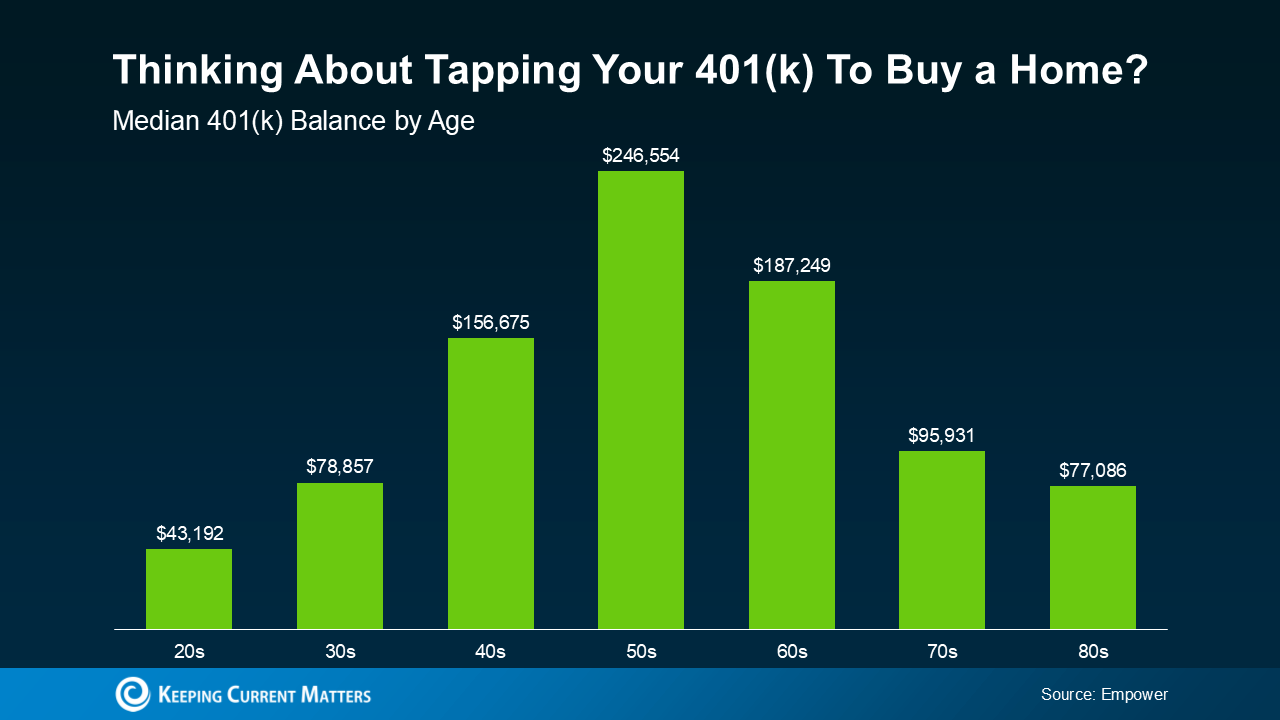
Data from Empower shows many Americans have built up considerable retirement savings. The median 401(k) amount for anyone in their 40s-60s is six figures (see graph below):
 And when you’ve got a good chunk saved and your dream home is right there, reaching for it can feel like an easy call.
But dipping into your retirement savings to buy a home could cost you a penalty and set back your finances later on. That’s why it’s a good idea to explore other options for your down payment first. As Redfin says:
“If you’re struggling to save enough for a down payment, you may be wondering if tapping into your 401(k) is the right option. While it’s possible, doing so comes with significant risks, like early withdrawal penalties and lost investment growth.“
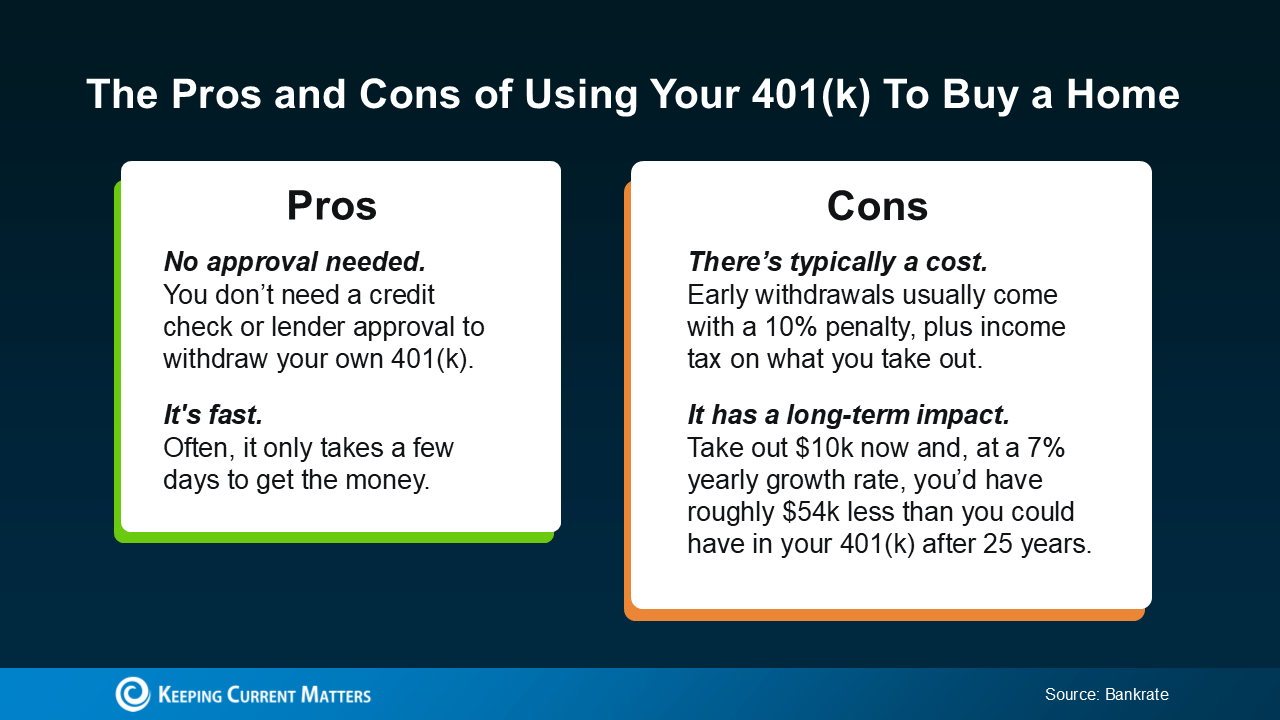
Before you decide, have a financial advisor help you compare the upsides to the risks. Bankrate points to a few of each (see visual):
Other Options Worth Exploring First
Your 401(k) isn’t the only way to finance a home purchase. Redfin outlines a few other options to look into before you decide what to do:
-
Low and No-Down Payment Loans: FHA loans, for example, allow qualified buyers to put down as little as 3.5% of the home’s price, depending on their credit scores.
-
Down Payment Assistance Programs: Many national and local programs can help reduce what you pay toward your down payment or closing costs.
Make a Plan Before You Make a Move
No matter which route you take, talk with a financial expert first. The buyers who come out ahead build a solid plan with the right professionals before starting their journey to homeownership. As NerdWallet puts it:
“Even if you’re convinced a 401(k) loan is the way to go, it’s important to understand the risks at the outset.“
Bottom Line
Affordability is definitely a challenge, but that doesn’t mean tapping your 401(k) is your only way in if you want to buy.
If you’re considering using your 401(k) savings for a down payment, weigh all your options and talk with a trusted financial advisor before you make any decisions. They’ll help you make a plan to fit your goals and your budget.

Point’s Matt Windsor breaks down the legal landscape for HEIs

Housing demand has slowed, but still stable for now

Worried About a Housing Crash? The Numbers Tell a Calmer Story.
A recent survey from Talker Research asked Americans to pick one word to describe how 2026 has felt so far. The winner? Stressful. And honestly, there’s been a lot going on.
So, it’s understandable if you’ve been putting off buying or selling a home until things settle down. But you may be waiting on something that’s already happened. While everything else has felt shaky, the housing market has become one of the steadiest things out there. Look at the data.
Home Prices Have Leveled Out
After years of fast increases, data from the National Association of Realtors (NAR) shows home prices have been remarkably steady for the past 4 years (see graph below):
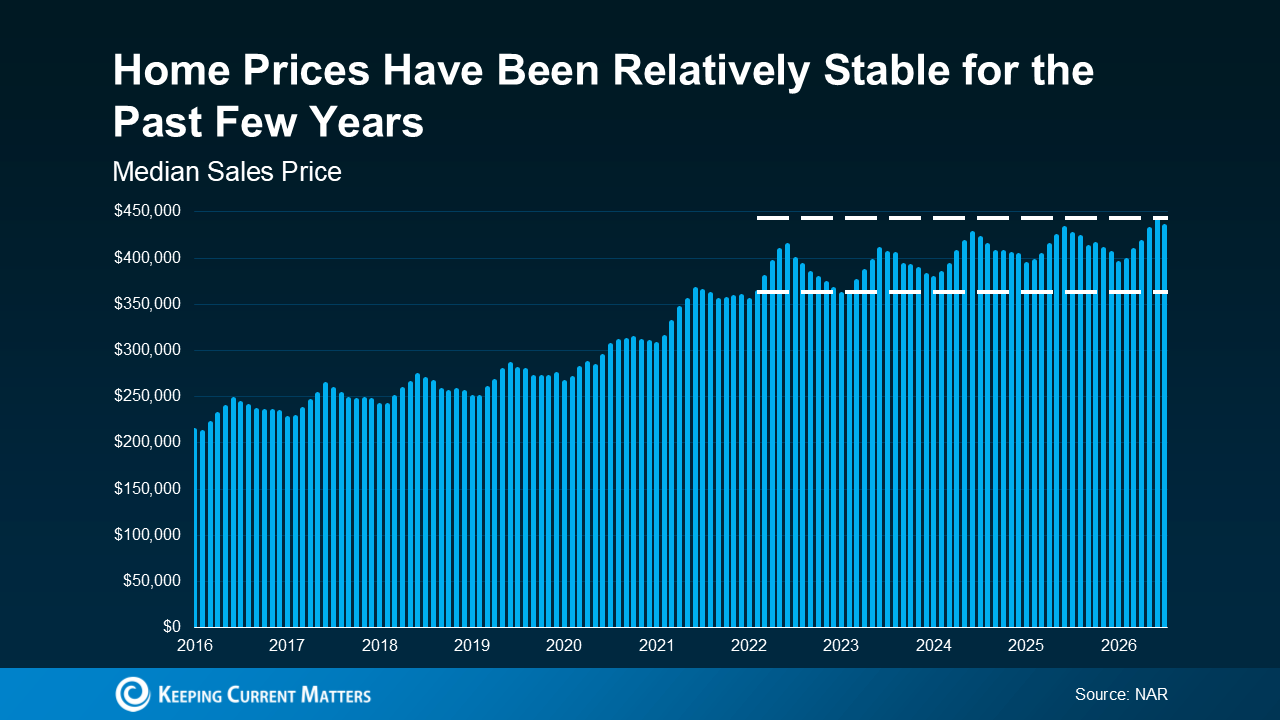 And experts say that’s what to expect going forward, too. As Selma Hepp, Chief Economist at Cotality, explains:
“In 2026, we expect home prices to remain broadly stable, with modest appreciation at a national level.”
No wild swings. Just slow, steady growth. That’s a healthy market. Of course, that pace can vary a bit depending on where you live. But nationally, steady growth like this makes it easier to plan your budget, whether you’re buying or selling.
The Supply of Homes for Sale Has Steadied
For years, the supply of homes for sale was a moving target. It dropped fast during the pandemic and has been climbing pretty reliably ever since. Now, that pace of growth has slowed down. According to Realtor.com, inventory today is very close to where it was this time last year (see graph below):
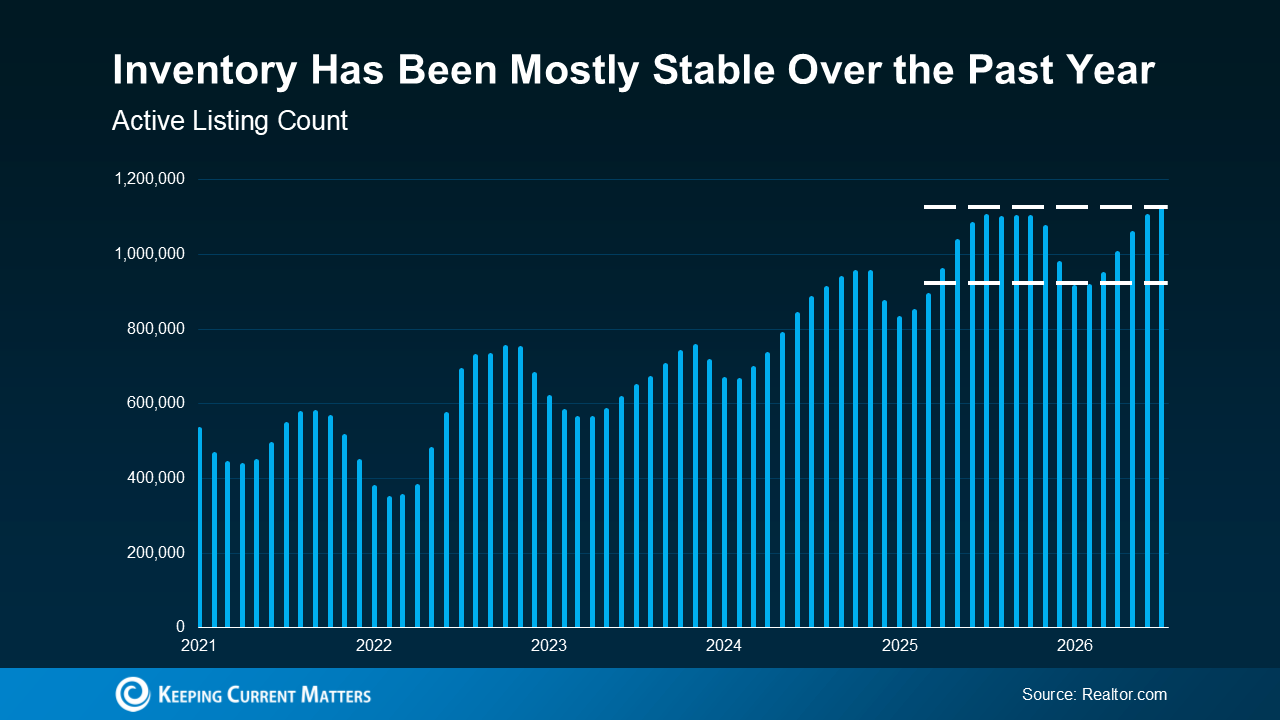 That’s helpful no matter which side you’re on. When the number of homes for sale isn’t changing much, you know what you’re walking into – how many options you’ll have as a buyer, and how much competition you’ll face as a seller.
Mortgage Rates Found Their Range
Yes, rates jumped dramatically back in 2022. But since then, Freddie Mac data shows they’ve stayed between 6% and 7% for the better part of the last 3 or so years (see graph below):
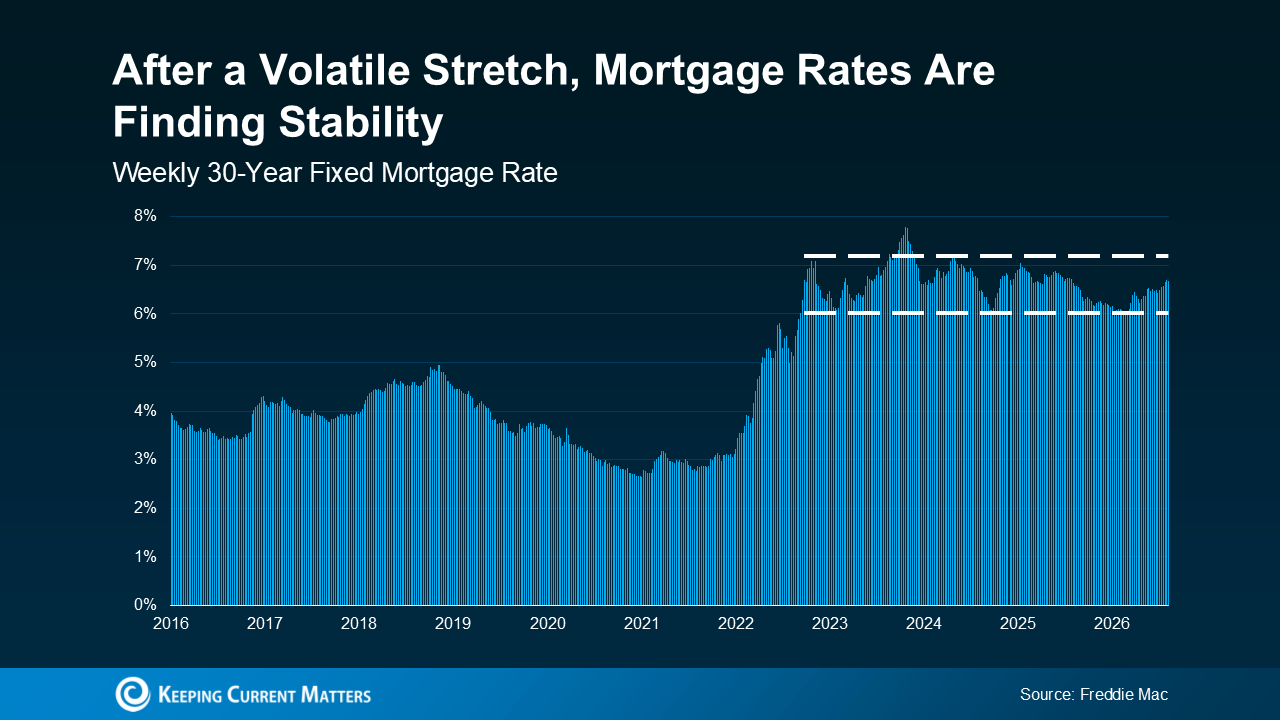 Yes, there was one brief spike above that threshold, but overall, rates have stayed in that range for a while now. That predictability helps when you’re planning a move.
And now that this seems to be a longer-term trend, people have accepted it as the new normal. Buyers have gotten comfortable purchasing in that range, and sellers have gotten just as comfortable listing in it.
That comfort’s important because when both sides know what to expect, they keep making moves. In other words, the market isn’t frozen waiting for something to change. It’s moving calmly.
Bottom Line
The rest of the world may feel unpredictable right now, but the housing market doesn’t have to. Prices, inventory, and rates have all found solid ground.
If stability is what you’ve been waiting for, it’s already here. Connect with a local real estate agent if you want to talk through what that means for your move.

Sellers Are Cutting Prices To Meet Buyers Where They’re At
You’re scrolling through listings on your phone and everything looks good until you see the price (or the estimated monthly payment). Then you close the app.
Because even if you love the house, the numbers feel impossible. But here’s the thing.
Nationally, there are more homes sitting on the market than there are people out there looking. And when sellers need buyers more than buyers need sellers, that shows up in the price.
Lower asking prices. More price cuts. And homes priced for what buyers can actually afford – not what sellers hope someone might pay.
And it may be enough to make buying more doable than you’d think.
4 Out of 10 Sellers Are Cutting Their Price
One of the clearest signs sellers are adjusting? Price cuts. HousingWire Data shows more than 40% of sellers are dropping this price.
That’s just slightly behind the volume we saw last year (see graph below):
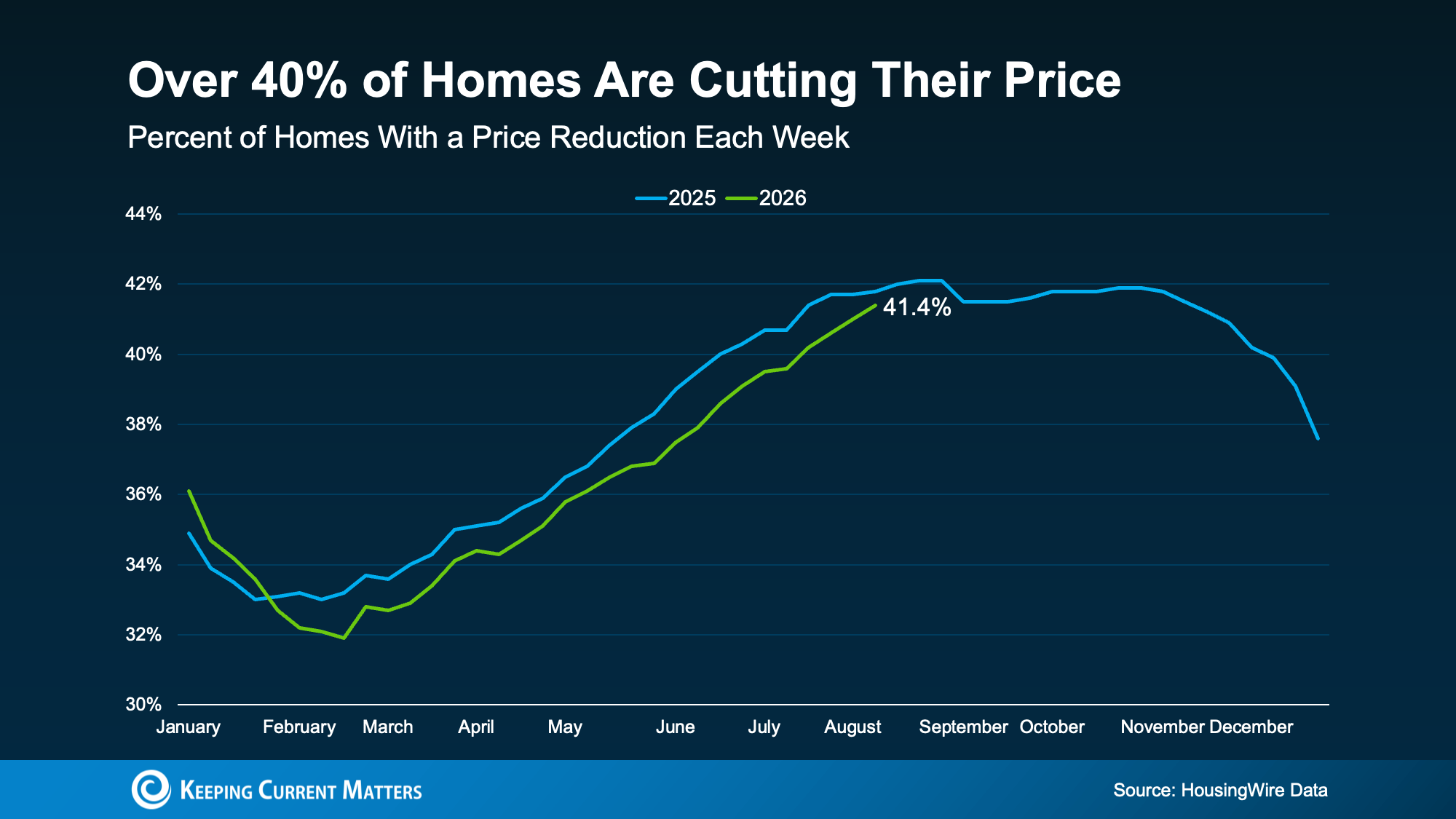
That’s more than 4 out of every 10 homes listed. Think about what that means. That’s thousands of sellers deciding they’d rather lower their asking price than keep waiting for someone willing to stretch their budget.
They know that to sell, they have to be willing to do some give and take. And when no buyers are biting, they’re pulling their biggest lever to draw buyers back in – their price. As Danielle Hale, Chief Economist at Realtor.com, explains:
“This is a market where people are adjusting and showing up rather than giving up. Sellers are meeting the market with more realistic asking prices, which is helping deals get done.”
This July Saw the Lowest Median List Price for Any July in Five Years
What about the other 6 in 10 sellers? A lot of them started with a lower asking price to begin with rather than test the higher price and get crickets from buyers.
That may be why July 2026 had the lowest median list price of any July in the past five years, according to Realtor.com (see the white line in the graph below):
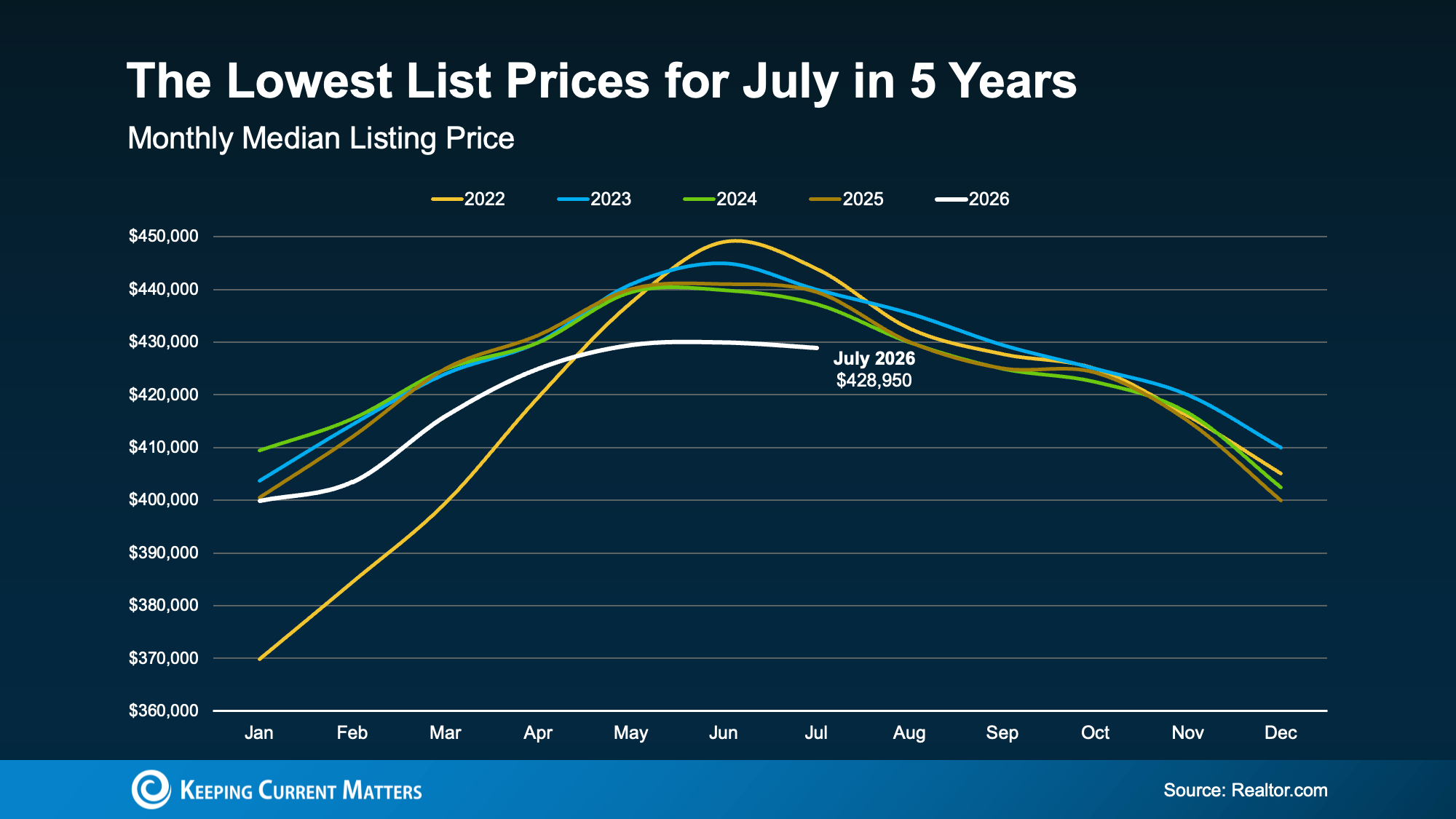
Now, that doesn’t mean home values are falling or that everything’s suddenly a steal. Prices are still above where they were before the pandemic. But what it does mean is this.
Sellers no longer banking on bidding wars or expecting buyers to pay whatever they ask. Instead, many are listing at prices that better reflect today’s market from the very beginning.
And honestly, whether they’re pricing competitively from day one or adjusting after a few weeks on the market, the message for you is the same:
Sellers are more willing to meet you where you’re at.
Because in many markets throughout the country, you’re not fighting over a house anymore. Sellers are fighting over you. And that’s information you can use to get a better deal.
Yes, affordability can be a real challenge. And the monthly payment you take on definitely does matter. But if you’ve been assuming everything is out of budget, there may be more wiggle room than you think.
Bottom Line
Right now, sellers are flexible on the price in ways they weren’t before. Reach out to a local agent to take advantage of that flexibility.
You may be surprised by what’s available – and how willing today’s sellers are to work with buyers.

Flood proofing: 3 steps owners can take to prepare for the next big storm
Five years ago, Hurricane Ida ripped through New York City, causing 13 deaths and an estimated $781 million in repair and recovery costs. This August, violent storms have flooded the subway system and even created tornadoes.
While flooding is becoming a bigger problem for NYC as a result of climate change, there are some preventative measures that homeowners can take. Three programs for homeowners administered by the nonprofit Center for NYC Neighborhoods aim to prepare NYC residents’ homes for stormwater flooding.
“Our goal is to help homeowners know their risk, know what resources are available, and help them find solutions,” said Aaron Sturm, CNYCN’s deputy director of resiliency.
These three resources work together: One website helps you determine your home’s flood risk, the next program helps you identify repairs for better flood protection, and the third helps you to pay for those improvements.
Let’s dive in (but you should never walk or drive into flood waters):
This website helps NYC homeowners and buyers determine the flood risk of a particular address. It also provides accessible resources that explain flood insurance policies and how they work.
You start by plugging in any NYC address into the site’s search bar. The result displays your risk according to four different flooding maps—FEMA’s outdated flood insurance map, a coastal flood map that is more up to date, and two stormwater flooding maps from NYC’s Department of Environmental Protection.
If you’re a renter instead of an owner, flooding should still be on your mind. Under a 2023 law, owners must disclose a building’s history of flood events. (While landlords are required to answer truthfully if you ask about past flooding, they don’t need to volunteer information about flooding from mechanical or plumbing problems, so be sure to ask.)
It’s always a good idea to look for signs of water damage or mold when touring a potential apartment. You should also keep in mind that renters’ insurance doesn’t always cover flooding from storms, so you may need to obtain flood insurance too.
Although Zillow removed flooding risk scores from its site in 2025, Redfin includes data from First Street, a real estate climate risk analytics site, and provides a flood factor score between on a scale of 1 to 10.
Under this free program, engineers inspect your property for flooding vulnerabilities and suggest changes to limit the damage from storms.
“The licensed engineer would come out, visit the home, identify any potential vulnerabilities, and then they would prepare a written report and some recommendations,” Sturm said.
If you are in the flood zone, you’ll also get an elevation certificate, which can help make sure you aren’t overpaying for flood insurance or prove to your insurance company that improvements you made have lowered your home’s flood risk.Thenyou have the option to sit down with a housing counselor to interpret the technical report and make a plan for improvements, Sturm said.
To be eligible for a free audit, homeowners must:
- Own and live in a one- to four-unit residential property as their primary residence
- Have an active home insurance policy
- Have a valid state ID
Although the program isn’t restricted by income level, you are also required to provide information about income and the number of household members to ensure lower income homeowners get first priority.
If an audit reveals expensive fixes are needed to protect your property from flooding, there might be money available to you to fund those changes.
“Being in the audit program doesn’t guarantee the financing, but it does kind of tee you up to know how you can implement some of those actionable items because some of the recommendations can be costly,” Sturm said.
Through a combination of low interest and forgivable loans, this program offers eligible homeowners financing for repairs. If you qualify, you could receive up to $50,000 for repairs, as long as at least 50 percent of the repairs make your home more flood resilient.
That can include things like flood vents or vapor barriers, but also roof repairs, if the materials and structure ensure the roof is better able to withstand flooding. “Basically, you can’t redo your kitchen or just do things that are outside the scope of making your home more resilient,” Sturm said.
To be eligible, homeowners must:
- Own a property of one- to four-units in NYC and live there as their primary residence
- Have a household income at or below 120 percent area median income, which is currently $162,840 for a two-person household
- Be up to date on property tax and mortgage payments
- Not have filed for bankruptcy in the past two years
Finally, if you live in an area that’s at high risk for flooding, you have the option to sell your home to the city and move through the city’s Resilient Acquisitions program. This summer, the Mayor’s Office of Climate & Environmental Justice began expanding outreach to new areas of Queens to gauge resident interest, although money isn’t available for buyouts just yet.

China’s YMTC aims to become the world’s largest NAND maker by the end of 2027, report says — company plans to overtake Samsung and SK hynix
Yangtze Memory Technologies Co. (YMTC) told investors and stakeholders in recent IPO preparation meetings that it aims to become the world’s largest NAND flash producer by the end of 2027, overtaking Samsung and SK hynix, according to a Financial Times report. The Wuhan-based company filed last week to raise 33 billion yuan ($4.9 billion) on the Shanghai Stock Exchange’s STAR Market, with most of the proceeds earmarked for production line upgrades and R&D.
Go deeper with TH Premium: Memory
The target would require YMTC to nearly double its market share in 16 months. Counterpoint Research put the company at around 14% of global NAND shipments in the second quarter, level with Kioxia, against roughly 25% for market leader Samsung and 22% for SK hynix and its Solidigm subsidiary combined. Analysts currently rank YMTC third globally, and first in China, by both NAND revenue and shipment volume in the first quarter.
YMTC, which has been profitable only since 2024, reported first-quarter revenue of 47.04 billion yuan ($7 billion) and net profit of 33.38 billion yuan, more than double its net profit for all of 2025. Gross margin, which sat at 5.45% in 2023, reached 35.3% in 2025 and 76.77% in the first quarter of 2026, with fabs running at 98.02% capacity utilization. The cost to get there has been significant for YMTC, which has spent 96.39 billion yuan in capital outlays on long-term assets and 15.95 billion yuan in cumulative R&D spending over the reporting period, generating depreciation and amortization charges of 50.95 billion yuan that leave margins exposed if memory prices turn.
Latest Videos FromTom’s Hardware
YMTC plans to issue between 1.98 billion and 2.43 billion A-shares, representing 10% to 12% of its post-offering capital, in a deal sponsored by CITIC Securities and CSC Financial. Of the proceeds, 20.8 billion yuan is allocated to mass production line upgrades and 12.2 billion yuan to advanced R&D. This implies a post-listing valuation of 275 to 330 billion yuan, though the Financial Times reported that the company is expected to trade well above that once its shares debut, and that pricing will likely be set conservatively under regulatory guidance.
The listing follows the template set by ChangXin Memory Technologies (CXMT), China’s leading DRAM maker, which raised $8.6 billion in July in Asia’s largest IPO this year and surged 466% on its first day of trading. By mid-August, CXMT had overtaken Tencent to become the most valuable company listed in China, and both firms are expanding output with new fabs in Shanghai and Wuhan.
That expansion is what worries investors elsewhere in the sector. Joanna Yang, a portfolio manager at Ninety One, told the FT: “For global investors, one question is how these Chinese companies’ capacity expansion is going to impact the supply-demand dynamics for memory. This is a global product — it has global pricing.”
YMTC has been on the U.S. Commerce Department’s Entity List since December 2022, cut off from advanced American fab tools. Its filing to list as the world’s third-largest NAND supplier, with 76% gross margins, shows where U.S. export controls work and where they don’t.
The sanctions regime was built to choke access to leading-edge lithography, and it has done so effectively for logic. NAND competitiveness, however, runs through a different channel, with layer counts, stacking architecture, and hybrid bonding determining bit density, and none of them depend on EUV. YMTC’s fifth-generation NAND bonds two decks of 150 and 144 layers into a 294-layer device using its Xtacking architecture, and the company has been building production lines around homegrown Chinese tools to close off the remaining dependencies.
YMTC’s listing turns that position into a funding mechanism. Margins earned at the top of the memory cycle are already paying for domestic tool development, and the IPO adds a capital source that sits outside the reach of U.S. policy entirely: Shanghai’s equity market, where CXMT’s debut has already shown how much money is waiting for exactly this kind of company.

Follow Tom’s Hardware on Google News, or add us as a preferred source, to get our latest news, analysis, & reviews in your feeds.

Resurrected RTX 3060 12GB price jumps 45% in the two months since it was revived — 2021-era GPU now costs nearly $500 across most retailers
Nvidia ostensibly brought back the RTX 3060 12GB in late June to help gamers cope with the ongoing component crisis. Since most of the world’s memory is being routed to expensive AI chips, the RTX 3060 12GB offered gamers a 12GB VRAM pool for what was supposed to be a reasonable price… if only the price remained steady. As of today, this five-year-old GPU now costs almost $500 across the world, which is just as much as the RTX 5060.
MSI’s Ventus 2X OC variant of the RTX 3060 12GB launched at just $300 on its online store and $340 on Newegg. It’s now listed for $480 in both places. That’s a 60% increase in less than two months, compared to its lowest price. Similarly, Asus’ Dual V2 OC variant was released with a $330 MSRP, which quickly rose to $360 on Newegg, and the same card is now sitting at $500, constituting a 52% price hike from launch.
The cheapest RTX 3060 12GB right now, the Gigabyte Windforce OC Rev 2.0 model, currently costs $460, up 35% from the $340 it arrived at in late June. The same GPU is listed for 417 GBP on Amazon UK, which converts to $566. In Europe, the cheapest variant is once again Asus’ Dual V2 OC, costing 386 EUR on Amazon Germany, or roughly $450; price aggregator Geizhals says it was just 330 EUR a month ago.
Latest Videos FromTom’s Hardware
In comparison, the RTX 5060, which is two generations newer, can be easily had for around $450 from a bunch of different vendors. That GPU is not only significantly faster but also more efficient, while carrying the latest features such as DLSS multi-frame gen support. In our GPU hierarchy, the 5060 is actually just as powerful as the RTX 3070 at 1080p and 1440p, and it carries the same amount of VRAM, 8GB.
That VRAM capacity is the only thing going for the 3060 12GB at this point, and even with extra memory to utilize, the GPU isn’t really capable enough to deliver better performance in games. Plus, you can find better deals on the used market, or even renewed offers from big retailers, so the re-launched RTX 3060 12GB just doesn’t make sense from any angle right now, despite its still-decent 1080p chops.
The 3060 is cheaper to produce for Nvidia, thanks to its slower GDDR6 memory compared to the GDDR7 you get on the 5060. It’s fabricated on the older, less in-demand 8nm node from Samsung, compared to TSMC’s N5, which should also help with yield. But none of those manufacturing leniencies seem to be trickling down to the customer. Even the RTX 5050, which can be had for $300, is faster than the revived RTX 3060 12GB.
Follow Tom’s Hardware on Google News, or add us as a preferred source, to get our latest news, analysis, & reviews in your feeds.