What is the tenant blacklist? Can it prevent me from renting in NYC?


Searching for an apartment in New York City is always challenging—even more so if you’ve ever been involved in a housing court case in the past. This can land you on the dreaded tenant “blacklist,” with the possibility of being shunned by prospective landlords.  

But thanks to changes to New York’s rent laws in 2019, landlords can no longer refuse to rent to someone solely based on housing court data. These changes matter for many tenants facing eviction or seeking an affordable place to live.

Read on to learn how the tenant blacklist affects NYC renters.


[Editor’s note: An earlier version of this article was published in September 2025. We are presenting it again with updated information for September 2026.]


What is the tenant blacklist? 

If you end up in NYC housing court for any reason, your name will typically come up in court data searched by tenant screening bureaus, known as TSBs. The collected data is often called the tenant blacklist, even though it isn’t actually a list. Instead, companies gather this public information and provide it, along with credit reports, to landlords when they screen tenants during the rental application process.

How can you end up on a tenant blacklist?

One lingering consequence of the pandemic is that it drove thousands of tenants into legal disputes with their landlords, leaving more New Yorkers with a housing court record in their rental history.

Another reason you could end up in housing court is nonpayment of rent, including withholding rent to force your landlord to make repairs—an essential tenant right.

The problem is the housing court record doesn’t tell the whole story. It shows that a tenant had a dispute with a landlord, but not necessarily why the case was brought, who was in the wrong, or how it was ultimately resolved. In other words, the tenant could end up flagged simply for being in housing court—even when they had a legitimate reason for being there. 

And unlike information reported by consumer reporting agencies, which is subject to time limits under the the Federal Fair Credit Reporting Act, housing court data is not limited to any particular time period. That means it could potentially remain part of the publicly available record indefinitely. 

How do you get off a rental blacklist?

Landlords can’t refuse to rent if they find out you have a complicated tenant-landlord history. When this law changed in 2019, the intention was to ensure renters would feel confident bringing legal actions against a negligent landlords. Landlords who use housing court information to screen incoming tenants now face a fine of up to $1,000 if the attorney general investigates a complaint. 

Despite the legal protection, if you think your name will come up in a NYC housing court search—either erroneously or not—there are valid reasons to try to get your name removed.

Attorney James B. Fishman, a partner at FishmanLaw Group, said it’s still possible a landlord will come up with another reason to reject you if they see your name in housing court data. He added that the law preventing discrimination for involvement in housing court only applies in New York State, so if you move elsewhere, your record is available to an out-of-state landlord.

“If you are interested in formalizing an agreement with your landlord about moving out of your apartment, be sure that it does not permit the landlord to commence a housing court proceeding unless you fail to honor the agreement,” Fishman said.

According to tenant attorney Sam Himmelstein, a partner at Himmelstein Gribben & Joseph (now retired), if the relationship between the former landlord and tenant is cordial, the settlement terms can include a condition that the landlord provide a letter of recommendation and a positive reference. You can attach this letter to future rental applications. 

How do you avoid the tenant blacklist?

If you have a lawsuit pending and an attorney lined up, you may be able to contact the landlord’s attorney and ask them to list you only as John or Jane Doe instead of your real name so the housing court information remains anonymous. According to Himmelstein, most landlords will agree to do so. 

In addition to being anonymous, you might be able to get the other side to sign an out-of-court settlement agreement whereby the landlord would only file a court case if you breach the settlement agreement. “That way, there wouldn’t even be a filing, which is the safest scenario,” he said. It can be harder to get landlords to sign such an agreement, but most will still do it, Himmelstein said. 

Instead of taking a case to housing court, another route is a tenant-initiated housing part action. This is where you sue your landlord for failing to comply with housing law, typically this is done for cases involving building repairs. A housing part action is pretty straightforward: A tenant fills out a form to request an apartment inspection for violations. The city sends an inspector, and the landlord can face steep fines if violations are found. If the court finds in the tenant’s favor, the landlord must make the repairs by a specific time.

What are my rights as a renter? 

Banning the use of publicly available data is problematic. For starters, anyone can access this information. Landlords still want to screen tenants, and some may think the benefit of weeding out troublemakers is worth the risk if they get caught. 

In fact, Fishman said landlords will use pretexts other than a housing court case to deny someone an apartment and avoid violating the law. “As a result, these tenants cannot show that they’ve been damaged by an inaccurate credit report and therefore cannot sue under the Federal Fair Credit Reporting Act,” he explained. 

The law doesn’t allow a tenant to sue a landlord for using court data to deny an application, but the Attorney General has made moves to crack down on tenant blacklisting. A settlement against Clipper Equity, a real estate company that denied applicants with past housing court records, was a recent effort to eliminate the practice. If you think you have been discriminated against in this way, you can file a complaint with the Attorney General’s office. 

If you have served time, a 2025 law that makes it illegal for most landlords and brokers to turn down renter applications based solely on conviction history. The Fair Chance for Housing Act (FCHA) aims to prevent housing discrimination against renters who have a criminal conviction and done their sentence, a bias that contributes to housing instability and homelessness. For more, read: “New law aims to give NYC renters who served time a fair chance at housing.”

What information can NY landlords ask for? 

New York landlords and property managers have been forced to adjust their screening processes and should no longer request eviction or housing court information. Instead, they will likely raise other standards, like minimum credit scores or income-to-rent ratios, to offset their risks.

Most NYC landlords require a photo ID, your last two pay stubs, three months of bank statements, and two years of tax returns, plus a letter of employment on company letterhead stating your job title, length of employment, salary, and any expected bonus. If you are self-employed, you’ll need a letter from your accountant, proof of any other funds like stocks or bonds, a reference letter from a previous landlord if applicable, and contact information for prior landlords. You may also be asked for personal or professional, reference letters. Check out “Need to rent in NYC? Here’s what to do before you even start looking at apartments” for more guidance. 


Source link

After a 20 percent maintenance hike, an Upper East Side condop renegotiated its ground lease. Here’s how they did it


When an increasingly pricey ground lease at their Upper East Side condop began to raise monthly costs and undermine property prices, shareholders at The Azure decided to renegotiate it. The 105-unit building is one of a relatively small number of New York City co-ops and condos built on leased land. 

In a land-lease building, the underlying land is owned by a landlord and leased to the building, with the ground rent passed on to shareholders or unit owners through their monthly maintenance or common charges. The lease sets the terms, including the length of the agreement and the rent increases over time.

When Max Strongin bought his $3.4 million four-bedroom apartment at The Azure in 2012, he knew the building sat on land owned by the New York City Educational Construction Fund (ECF), a public benefit corporation created to help fund new schools in mixed-use buildings. Because of the social mission tied to The Azure’s development, Strongin saw the city’s involvement in the building as a form of protection against massive price increases.

“I understood what I was getting into,” he said. He is now president of the board and has friends in Battery Park City, where many of the buildings sit on land owned and leased by the Battery Park City Authority.  

20 percent increase in maintenance

What he didn’t anticipate was that maintenance would increase by 20 percent in one year as a tax perk expired, while uncertainty over a looming 2030 reset for the ground rent would affect sale prices of units in the building. 

“We think the building was underperforming by around 32 percent in terms of price per square foot,” said Alexander Boriskin, an agent at Douglas Elliman who has done deals in the building. 

The pandemic added to the building’s woes. According to Strongin, some shareholders sold at a loss because they could not afford the monthly payments. “It began to look pretty dire,” he said. 

This prompted the board to investigate whether the ground lease could be renegotiated—something that doesn’t happen often.

“It’s pretty rare,” said Matthew Eiben, an attorney at law firm Rosenberg & Estis, who has experience with land leases but was not involved in the lease renegotiation at The Azure. 

It matters who owns the land

Land leases can run for a period of 50 to 99 years. In 2024, a change in state law gave land-lease co-ops more flexibility to renew their ground leases before the end of the term. This prevents shareholders from being in limbo in the last 30 years of the lease, unable to sell because of uncertainty over the building’s future in the next few decades. That’s because when a ground lease ends, questions arise about whether it can be renewed or whether the building reverts to being a rental building.

“There needs to be reliability and people need to know what they are buying into,” Eiben said. 

Co-ops on city, state, or federal land—like The Azure—are exempt from this law and that is largely because a government entity has different objectives from a private landlord. “They are not looking for litigation and maximizing profits,” Eiben said. 

That’s a very different setup from buildings such as Carnegie House, where lawsuits have been filed because the ground lease was acquired by private investors who wanted to hike the annual ground rent by 450 percent to $25 million. Earlier this month, the Appellate Division of the New York State Supreme Court overturned that rent increase on appeal, citing an arbitrator’s communications with the landlord’s attorney and finding an appearance of partiality.

Convincing the owner of a shared interest

ECF’s mission is to build schools, not maximize profits. The board used that distinction to make its case for renegotiating the lease. The lease term was not due to expire, but the 2030 market reset on rent was a sticking point. 

“It could have been 30 percent or 40 percent—but even if it was five percent, the point was, no one knew,” Strongin said. 

Ground leases typically give landlords significant leverage. “Even if they are not going to exert that control to the maximum amount permitted by the law they still want it as an option,” Eiben said. ECF wasn’t initially receptive to the board’s requests but negotiations finally started moving when the condop retained an attorney. 

The board’s strategy was to show ECF that uncertainty was as bad for the landlord as it was for shareholders. If apartments became harder to sell, shareholders could default and the building’s financial position could deteriorate. 

“We were able to convince ECF that this wasn’t just an issue for us but for them as well,” Strongin said. “Just like we want to maintain fair value for our units, the last thing they want is people going into default and the building to have a financial crisis.” 

Reaching a deal with a predictable payment schedule

Negotiations with ECF took three years and the end result is a ground lease running to 2082 where payments increase at a fixed rate. Shareholders at The Azure don’t pay traditional property taxes and instead make Payments in Lieu of Taxes (PILOTs) to the city. With the renegotiated lease, the combined ground rent and PILOTs now appreciate annually at 3.7 percent. 

“It is super simplified with no uncertainty,” Strongin said. 

At the end of the lease shareholders have an option to purchase the land or renew the lease for another 50 years. The agreement also provides some tax efficiency, with around 50 percent of the monthly payments being tax deductible.

Waiting for the payoff 

The co-op spent $100,000 on legal fees, and while the board considers the renegotiation a success, it has yet to see an impact on sales prices. “There’s a ton of value for a buyer in this building and at the same time sellers should be getting more money for these apartments,” Boriskin said.

Strongin bought in The Azure because he loved the apartment and was willing to roll the dice on a land-lease building. He also knew he’d be paying far more for a comparable condo. “We were happy to take it as it was,” he said. “I don’t think any of us thought the market reaction would be so negative.”

A land-lease buyer’s checklist

His experience offers a checklist for buyers considering a land-lease building. First, find out who owns the land and understand their objectives. A government entity, nonprofit or private investor may have very different reasons for owning the ground lease.

Next, look at when the lease expires and how rent is calculated. A market reset can create a very different risk from a lease with predictable annual increases. When a land lease comes to an end there may be questions about what happens to the building. Finding out whether the lease can be renewed or renegotiated before expiration is also important, and whether the building has an option to purchase the land.

Also consider how the lease could affect financing and resale. If a building has only 10 or 20 years left on its land lease, buyers may be harder to find and lenders may be reluctant to finance the purchase. 

“Either purchasers might not be interested or, if they are, they may not be able to get a loan,” Eiben said.


Source link

Balatro fan claims they trained Google fruit fly brain simulation to beat the game — reinforcement learning currently has the model at 20% success rate


Less than two weeks after Google released a mapping of the complete brain and central nervous system of an adult male fruit fly, we’ve seen enthusiasts put the structure to work everywhere from turning a fruit fly into a day trader to teaching it parallel parking. Now, one Balatro fan says they trained the structure with an algorithm to play the game, with the win rate currently sitting at a cozy 20%.

The famous Fruit Fly has beaten Balatro

 from r/balatro


Source link

Developer vibe codes a tool to let Nvidia RTX 50-series laptop owners crank up their power limits — can juice RTX 5090 mobile GPU to 225W


Folks with Nvidia-based gaming laptops can now use a new tool called NvpwrControl to unlock additional performance from their assuredly power-limited mobile GPU, as long as they’re willing to accept the risks of cranking their GPU power limit by as much as 40 watts. The tool, spotted by VideoCardz, is available for download on GitHub, and it is labeled as ‘experimental’, so you’ll want to be very sure you’re willing to damage the reliability, if not the lifespan, of your fancy discrete GPU gaming laptop before using it.

If you’ve ever had a gaming laptop, you will know that the GPU model name can be deeply misleading. Whether it’s NVIDIA using wildly different GPU configurations, AMD using confusing suffixes that don’t exist in desktop GPUs, or Intel naming integrated graphics like a discrete GPU, all three vendors do things to keep the user guessing why their new gaming laptop isn’t as fast as expected based on the name alone.


Source link

The Best Time To Buy a Home in 2026 Is Almost Here


Want to buy a house this year, but not sure if the timing’s right? Seasonally, it may actually be a better time to buy than you expect.

Yes, mortgage rates have been ticking up lately – and that’s creating some real challenges with affordability. No one’s arguing that. But there are also predictable trends that happen this time every year that can put some wind back in your sails.

According to research coming out of Realtor.com, nationally, the week of September 27 – October 3 will be the best time to buy this year for this very reason:

“The week of September 27–October 3 brings together the market conditions buyers value most—elevated inventory, less competition and prices that have eased from their seasonal high—giving prepared buyers a way to offset high rates with savings on price and room to negotiate with confidence.”

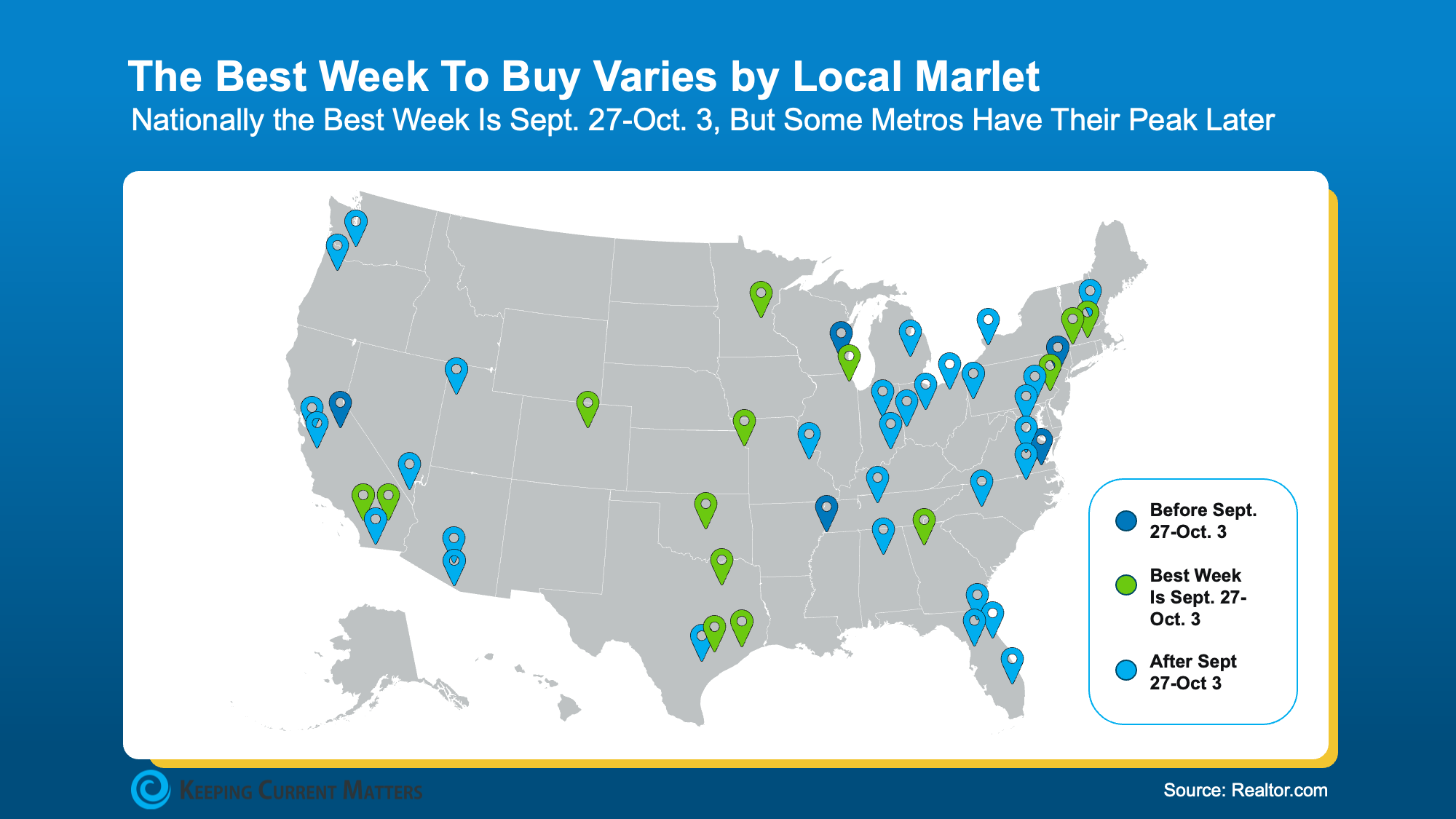
But that’s the national best week. Depending on where you live, your local sweet spot may come a little earlier or later (see map below):

a map of the united states with pins

It all depends on local trends and how inventory and buyer demand ebbs and flows seasonally where you want to live. But no matter when your market hits its peak, here are some of the perks you can expect this time of year.

More Choices, Better Prices, and Less Competition

For starters, there are more homes to choose from. In fact, data from the National Association of Realtors (NAR) shows the number of homes for sale recently reached its highest level in more than 10 years:

“NAR’s data does show a strong uptick in for-sale inventory at the end of the summer, reaching the highest level in more than 10 years.”

That means you may have a better shot at finding something you love and can afford without making as many compromises. And that’s not the only advantage.

Realtor.com says buyers during this window could see home prices about $14,000 lower than the summer peak, along with 30% less competition from other buyers. Plus, homes tend to stay on the market almost 2 weeks longer (13 days), giving you a little more breathing room to make a decision. 

  • More choices.

  • Better pricing.

  • Less competition.

That combination could be enough to ease some of the pressure higher mortgage rates are putting on your budget.

The Window Doesn’t Close After This One Week

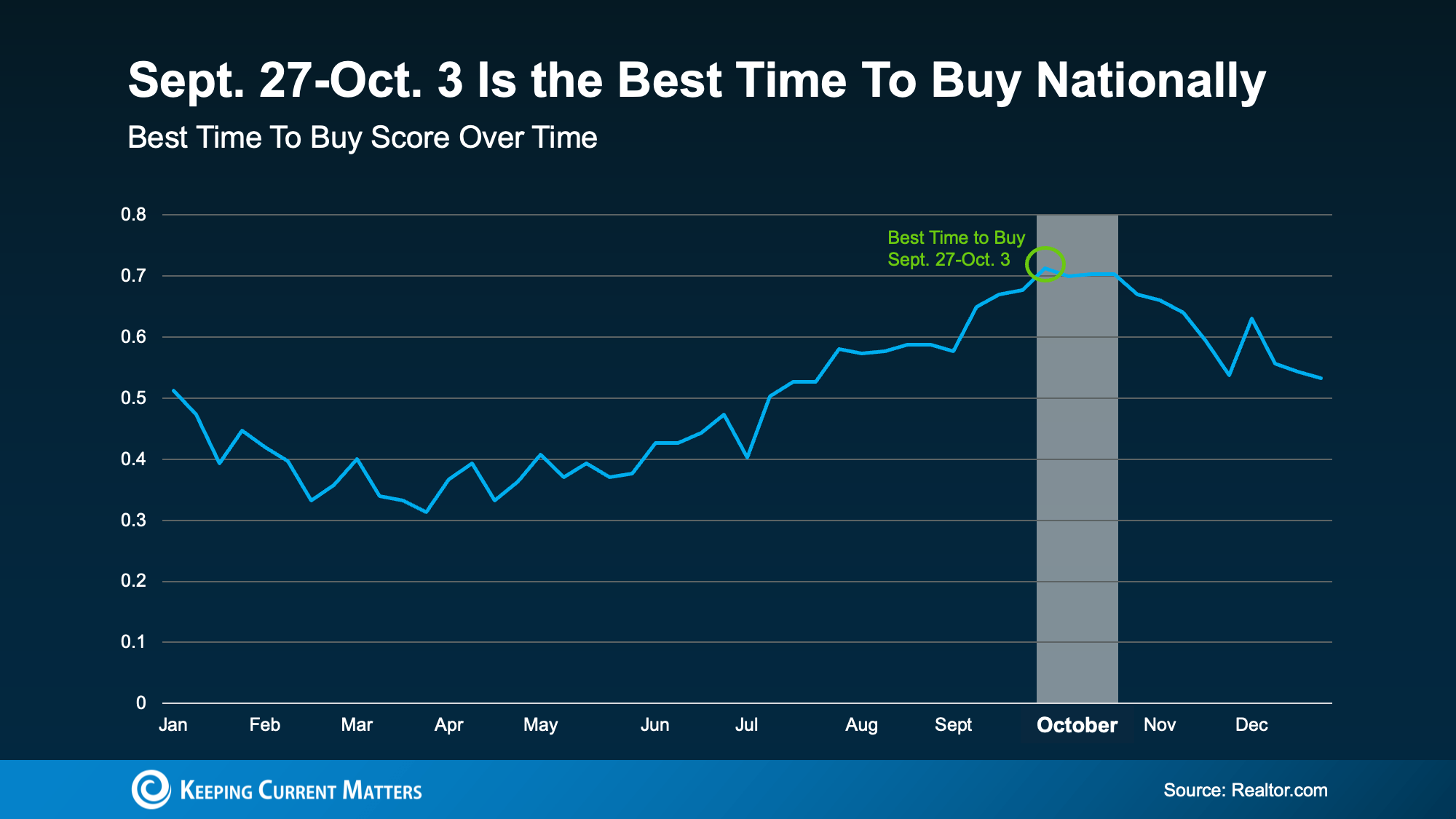
But you certainly don’t have to buy during that very specific window. This isn’t a one-week-only opportunity. History tells us conditions should be tipped in your favor for the entire month of October:

a graph on a dark background

In fact, Realtor.com says 42 of the 50 largest metros see their best week to buy fall sometime during October. So, don’t feel like you have to rush to hit one specific date. Use the time now to get things lined up, then jump in when the timing is right for you. As Guaranteed Rate explains: 

“The best time to buy a home depends on your needs. Certain seasons can give you an advantage when starting your homebuying journey.”

Bottom Line

If you want to buy a house this year, there’s still a way to make it happen, even with today’s rates. This fall gives you the chance to get some of the best seasonal perks the market has to offer.

Want help figuring out when those advantages typically show up in your market?

Have a quick conversation with a lender and a local agent about how your market works and the steps you’ll need to take to get ready. 


Source link

Ask Altagracia: I’m breaking my lease, and the landlord listed the apartment for a higher rent. Does this protect me from being sued?


I’m relocating for a new job and have to break my lease. The landlord listed the apartment at a higher rent ($200 more than what I pay). Does this mean I’m off the hook for paying the remainder of my lease?

Many New Yorkers don’t know how to go about breaking their lease. So when life comes along with other plans, like a new job forcing a relocation, breaking a lease can feel daunting and spark fears of being dragged to housing court.

But there’s no need to assume the worst-case scenario, said Altagracia Pierre-Outerbridge, attorney and founder of Outerbridge Law representing residential tenants, condo owners and landlords. “What most renters don’t know is that the law actually incentivizes New York landlords to work with their tenants to find someone to take over the lease.”

In New York, landlords are required to mitigate damages when a tenant breaks a lease. This means that they have to make a good faith effort to rent out the apartment at either the same rent or at the current market value, whichever one is lower. 

“But if your landlord listed the apartment at a higher rent, they can’t then sue you for damages,” Pierre-Outerbridge said. “It’s a clear violation of the mitigation statute. They’d be directly benefitting from your choice to vacate, so I’d balk at any lawsuit.” Pierre-Outerbridge recommends documenting the listing as proof should a lawsuit come to pass. It could help you get a suit dismissed quickly without having to go to housing court. 

How to fulfill your duty

However, that alone doesn’t absolve you of your duty to fulfill the remainder of your lease, and vacating without any communication with your landlord would be a big risk. “It’s still in your best interest to remain cooperative so you don’t have to pay more than is necessary, because you are still on the hook until a new tenant takes over,” Pierre-Outerbridge said.

One of the best ways to show cooperation is to help find another tenant to take over the lease. “Especially if you have to relocate quickly, it’s in your best interest to find someone that can move in as soon as possible so you aren’t stuck paying rent for an apartment you aren’t living in for several months,” Pierre-Outerbridge said. “Your landlord will want to approve the new tenant, so make sure they can provide clear proof of income and financial history. ”

From there, the landlord can assign the lease to the new tenant or you can request a sublease. “Make sure you understand which type of agreement you are entering into, as a sublet keeps you responsible to meet lease obligations,” Pierre-Outerbridge said. 

Check your lease for other fees

Even if you are able to find someone to take over your lease, it’s worth further inquiry into other charges that you may owe. The rent laws passed in 2019 “help protect tenants as far as the remainder of the monthly rent payments are concerned. It does not however specify how other potential fees may be handled,”  Pierre-Outerbridge said. 

Though most leases are unlikely to include specific language that penalizes breaking the lease, Pierre-Outerbridge still suggests that tenants review their lease to see whether it outlines any additional fees, or how your security deposit may be impacted. “Since landlords are required to mitigate damages and find a tenant, they can’t exactly withhold the security deposit, but they may argue that they can use it to cover fees that they incur to re-rent the apartment, like repainting or hiring a brokerage,” Pierre-Outerbridge said. 

Ultimately, your goal is to pay as little as possible to get out of your lease, so do what you can to find a new tenant that can take over monthly rent payments. “You want to get your landlord out of your hair as quickly as possible, and presenting them with a new tenant will make that easier,”  Pierre-Outerbridge said. 


Altagracia Pierre-Outerbridge, Esq. is the owner of Outerbridge Law P.C, focusing primarily on tenant representation. The firm represents all sides in landlord-tenant litigation and transactional matters such as month-to-month holdovers, nuisance cases, licensee cases, harassment claims, repair cases, tenant buyouts, succession claims, DHCR overcharges and rent reductions and more. Pierre-Outerbridge has 15 years of experience litigating in Supreme, DHCR, and Housing Court. To submit a question for this column, click here. To contact Outerbridge Law P.C. directly, call 212-364-5612 or 877-OUTERBRIDGE, or schedule a meeting today.


Source link

Asus’ ludicrous 20th anniversary bundle is now the cheapest way to buy an RTX 5090 — Nvidia’s flagship GPU stock is so limited that this $10,850 bundle with a 3000W PSU, X870E board, and open-frame case is actually cheaper than some scalper listings


We’ve reviewed Asus’ ROG Edition 20 anniversary kit. We’ve built a PC with it. It’s about as premium as a gaming PC build can get. Right now, you can pick up the same kit for a whopping $10,849.96 on Newegg in a combo deal. To put it mildly, this is one expensive deal, but it’s actually hiding a secret gem: it’s the cheapest RTX 5090 graphics card on sale right now.

● Check out this deal at Newegg


Source link