What to know before buying a pied-à-terre in New York City


Buying a pied-à-terre in New York City sounds dreamy—you get all the comforts of home when visiting rather than feeling like a tourist. Yet this type of purchase is distinct from buying a primary residence.

For starters, condo and co-op buildings typically have rules about second-home ownership, and financing a second home is not the same as financing a primary residence. Then there are taxes—including the newly enacted and currently contested pied-à-terre tax—that can add significantly to the cost.

Still, you don’t have to navigate this process alone. NYC brokers regularly work with people who want a part-time stake in the city, and they can help you identify buildings and neighborhoods that are best.

Whether you go it alone or enlist some help (highly recommended), here are some common questions about buying a pied-à-terre in NYC. 


[Editor’s note: An earlier version of this post was published in March 2020. We are presenting it again with updated information for September 2026.]


Who is a pied-à-terre for?

The stereotypical second-home buyer is someone who spends tens of millions on a prestige apartment on Park Avenue that sits empty much of the year—and that buyer certainly exists, confirmed Vicky Barron, a broker at Compass. 

But according to Peter Zaitzeff, a broker at SERHANT, the buyer pool is more diverse than people assume. He listed international buyers, suburban commuters, executives, and empty nesters. “Many are not seeking trophy apartments; they want a convenient, secure, low-maintenance home in the city,” he said.

Barron echoed that idea, citing a former client who moved to Florida 22 years ago and, now in her 70s, wanted to spend more time here. “Amazingly, she found a modest one bedroom in the very building she used to live in,” Barron said. 

Both brokers said parents visiting their adult children and grandchildren are another common demographic. “This being NYC, their kids’ apartments often can’t accommodate them, so an alcove studio or small one bedroom gives the parents a place to stay while spending time with family—and without always needing prior clearance,” Barron said. 

Last are investors—often foreign—who want a place to offer to their friends (more on this idea below). NYC is still one of the most desirable places to invest in real estate. 

The takeaway: There isn’t one typical pied-à-terre buyer—or one typical reason for buying one.

What’s better for a pied-à-terre: a co-op or condo? 

Condos are usually much more flexible in allowing pied-à-terre buyers.

With co-ops, however, “it’s really building-specific,” Barron noted. Some explicitly prohibit pieds-à-terre; others consider them on a case-by-case basis, which often means they’ve allowed pied-à-terre owners in the past, had problems, and now have concerns.

A good broker with experience navigating these types of purchases can be a game-changer, so do your homework, including looking at listing agents for properties marketed as a pied-à-terre.

Finding the right building is only part of the equation. Zaitzeff said demand is strongest in well-connected Manhattan neighborhoods near businesses, restaurants, shopping, and cultural institutions, while Barron said Brooklyn is especially popular and some recent clients bought in Queens. 

For the board and management, two general concerns are how often you plan to be at the apartment and who will have access when you’re not.

According to Steven Wagner, an attorney at Adam Bailey Lietman, buyers should be crystal clear about their intentions and make clear that this is for their use—and not anyone else’s without prior approval. “The board is going to be very sensitive to this, particularly in a part-time situation,” he said.

Robert Braverman, an attorney at Braverman Greenspun, who practices co-op and condo law, said most buildings will allow only immediate family to stay in your absence. “And some, particularly co-ops, are even more restrictive and require co-occupancy with the owner of record, regardless of the relationship,” he added.

For a real-world example, Barron recalled a client who had to sign an agreement stipulating that his children could not stay at the apartment unless he was there. 

Boards have a vested interest in knowing how you plan to use the apartment while you’re there, too. Working remotely from a pied-à-terre is generally different from running a business out of it, particularly if your work brings clients or other regular visitors into the building. In a co-op, such activity may be subject to board rules or approval, and even in a condo, restrictions on commercial use, building activity, or zoning may apply.

Zaitzeff summed it up this way: “Every building has different rules. Buyers should disclose their intended use and have their attorney review the building’s policies before purchasing.”

Can I sublet a pied-à-terre?

Short-term rentals should never be assumed to be permitted, Zaitzeff said. “Condos are typically more flexible than co-ops, although minimum lease terms and board applications may apply.” 

“Regardless of whether the building is a co-op or condo, it almost always has specific rules in place about subletting or renting,” Braverman said. 

And among co-ops, those rules can vary considerably. “You have some that always permit it, and others that never do,” Barron said. Those that do often require owners to wait one to three years before subletting, and may follow the so-called “two/five” policy, which allows a unit to be sublet for a total of two years during any rolling five-year period. 

The rules can be counterintuitive. For example, she pointed to one building that prohibits an owner’s sister from staying in the apartment while the owner is away, yet allows the apartment to be rented out.

The lesson? If you may want to sublet your pied-à-terre—even occasionally—make that part of your criteria from the start and find out exactly what the building permits.

Can I bring pets?

Not all buildings are pet-friendly, so let your broker know if you plan to bring your four-legged friend(s) to your NYC pied-à-terre—and whether it’s near a dog run or other green space. 

Even pet-friendly buildings can impose restrictions, such as allowing only cats or dogs of a certain breed or size, as well as limits on the total number of animals. 

Also consider how your pooch will handle the cacophony of city streets and being left alone in an unfamiliar place (with unfamiliar noises). Barking dogs will likely draw complaints. 

Will I be able to renovate?

Generally speaking, you don’t have carte blanche when it comes to updating an apartment—whether you are a primary or second-home owner. People used to living in a private home might be surprised by this because they’re accustomed to doing things on their own. 

While both condos and co-ops have rules about renovations, co-ops tend to be more restrictive. Always ask the management agent about the building’s rules and have your attorney carefully review the alteration agreement. Condos, for instance, have governing documents that can require approval for updates, particularly those affecting common elements.

Barron said some co-ops impose a waiting period of one to three years after purchasing an apartment. Others, especially high-end co-ops, restrict construction to specific working hours and time of year—for example, only during the summer months, when presumably more residents are away.

And Zaitzeff said buyers should be prepared for the possibility that updating an older apartment could require costly electrical or plumbing work.

So before buying a fixer-upper, find out not only whether the building permits renovations but when you can do the work and how you’ll manage it when you’re not in town.

What amenities can I get? 

Buying an apartment in a full-service building can afford you a sense of security that may be difficult to put a price tag on.

Specifically, having a doorman who can accept packages—and a dedicated storage room for them—are important factors for pied-à-terre clients. 

The convenience of an on-site health club means you don’t have to join a gym that you’re not around to use (or have to pay daily fees to use). Plus, you may not want to schlep your stuff without a locker. 

Can I get financing?

Even though a significant share of her pied-à-terre buyers pay cash, Barron said some cash offers are ultimately financed in part. 

Financing a pied-à-terre purchase in NYC can be more complicated than for a primary residence. Lenders generally want to make sure the apartment is genuinely a second home rather than an investment property, and borrowers who live within 60 miles may face additional scrutiny or different loan terms. In some cases, however, a buyer may qualify for second-home financing by demonstrating a legitimate personal need for the apartment—known as the pied-à-terre exception—but lenders may impose higher interest rates or stricter underwriting requirements.

The tax treatment on either the purchase or sale of the property can differ too, which is why prospective buyers should always consult their financial advisor first to make sure it’s feasible. 

Another significant hurdle: Co-ops have much stricter financial requirements than condos, though at least some boards are becoming more flexible. 

On the flip side, carrying costs in a condo are higher than in a co-op, which can be a turnoff if you are only here a few weeks or months a year. 

Are there additional taxes?

NYC has a new pied-à-terre tax for non-primary residences. The surcharge tax takes effect for the 2026 tax year, with first payments due on Jan. 1st 2027. It applies to one- to three-family homes with a market value at least $5 million and condos and co-ops with a market value of at least $1 million.

Rollout of the new tax is proceeding while it faces a lawsuit, so prospective buyers at this price point will want to monitor the progress of the case. 

Regardless, you still need to budget for a one-time mansion tax levied on properties of $1 million or more. The scaled fee is based on the sales prices and it starts at 1 percent of the purchase price. The tax rate for properties above $2 million is 1.25 percent. For properties above $3 million, it is 1.5 percent.

Who will handle repairs and emergencies?

Another thing to weigh carefully is who will handle repairs while you’re away. 

The most frequent types of damage that occur in pieds-à-terre are the same as in full-time residences, said insurance broker Jeff Schneider, president of Gotham Brokerage. These include water damage from broken pipes or an overflowing bathtub, sink, or dishwasher. “But the issue in a pied-à-terre is that damage can be quite severe before you discover there’s a problem,” he said.

This is where living in a building with a 24-hour super can be essential, so problems can be addressed quickly. (Aim for one of these pied-à-terre-friendly buildings.)

In addition, make sure the management company has your contact information (and a friend or neighbor has an extra key) in case of an emergency. 

Barron said owners often develop a rapport with the building super, who can keep an eye on the apartment while they’re away. That might mean checking in periodically for signs of a problem—or even bringing in the mail.

“That’s common, especially during winter,” Barron said, when an apartment may sit empty for months and a plumbing problem can go unnoticed.

She also suggested hiring a company that help pieds-à-terre owners keep eyes on their properties—this can be particularly important for townhouses that may be empty for periods of time. This management company is one option.

And if your apartment is ever rented out, Schneider said you need to notify the insurance company to avoid having your coverage voided.  

—Earlier versions of this article contained reporting and writing by Tripp Whetsell.


Source link

Australian PM says OpenAI took 84 days to email agency after agent hacked its national health care portal — incident is believed to be the first known case of AI breaching a government site


Australia has ordered an “urgent and immediate review” after saying an OpenAI agent discovered a way around blocks on its Medicare statistics portal, BBC News reported. Prime Minister Anthony Albanese made the announcement at the UN General Assembly in New York, referring to a hack that happened in June. OpenAI became aware of the hack in August but did not report it to the government agency’s public inbox until September.


Source link

Why So Many Sellers Are Cutting Their Price Right Now


Price cuts are turning up everywhere right now, and they read very differently depending on which side of the deal you’re on.

Sellers tend to worry a cut means walking away with less than they hoped. Sometimes that’s true, but more often it just means the market moved faster than the listing did.

Buyers, for their part, often assume a cut means something’s wrong with the house. Most of the time, that’s not it.

This is what’s actually driving all those price cuts, and why it matters no matter which side of the deal you’re on.

42% of Homes for Sale Are Now Carrying a Price Cut

According to HousingWire Data, the share of sellers cutting their asking price has climbed every month for 7 straight months (see chart below):

a graph showing the growth of a straight month 

Today, more than 4 in 10 active listings have had at least 1 price cut, and the typical seller is cutting about $17,560 off their original number. 

Here’s why that’s happening. With rates still elevated and more homes to choose from, buyers can afford to wait for the right number. So, sellers who don’t start there often end up adjusting anyway.

What does that mean for you?

  • If you’re selling, this isn’t a red flag. But it is a sign that pricing it right from day 1 is your best bet. Just know that the market’s been shifting fast enough this year that sometimes even a well-priced house can fall behind within a matter of weeks. If that happens to you, dropping your price to catch up to where pricing actually stands today tends to bring in more buyers and helps you sell closer to true market value.

  • If you’re buying, it’s easy to assume a price cut means something’s wrong with the house. But with cuts happening on more than 4 in 10 homes right now, the reality is sellers are just catching up to where the market already is. And with affordability still tight, that’s exactly the kind of opening you need to get a better deal.

Why Sellers Are Adjusting Faster than Before

HousingWire Data also shows list prices are trending down nationally. That’s often a sign sellers are pricing more realistically from the start instead of listing high and getting stuck cutting later. List prices have fallen about $26,000 from last year’s peak.

Some of that decline is seasonal, since list prices typically soften each winter before rebounding in the spring. So, expect asking prices to keep drifting a little lower before turning back around (see chart below):

a graph of a number of people 

Jake Krimmel, Senior Economist at Realtor.com, explains: 

“That is good news for buyers, who are seeing lower asking prices and more room to negotiate, but it is also good news for sellers: Pricing to today’s demand is helping homes move and keeping more transactions alive in a high-rate environment.”

Translation – with rates still elevated, buyers can only stretch so far. Sellers who meet them where they are instead of holding out for unrealistic prices are the ones actually getting to closing. And doing that up front is always better than chasing the market later.

Buyers, You’ve Got Room To Negotiate Again

At the same time, Redfin data shows sellers now outnumber buyers by about 58%, the widest gap on record (see chart below):

a graph of sales 

That changes the power dynamics of the market – and impacts how homeowners should price their house. Nationally, about 7 in 10 markets now favor buyers or are trending that way.

  • For sellers, that means standing out matters as much as pricing. With more homes to choose from, buyers are comparing you directly against the competition. So, a little flexibility, like covering closing costs or being open on timing, can be what gets your house picked over another.

  • For buyers, it means more room to ask for a lower price, help with closing costs, repairs after inspection, or some combination of all 3. That’s especially true for homes that have already sat for weeks, where sellers are often the most willing to talk.

Bottom Line

Price cuts are a normal part of today’s housing market, and both buyers and sellers can use them to their advantage. Connect with a local real estate agent to look at what’s actually happening with prices in your neighborhood, so you know exactly where you stand before you list or make an offer.


Source link

There Are 4 Types of Housing Markets Right Now. Which 1 Are You In?


Today’s housing market splits into four distinct types. You’ve got cash buyers, buyers financing a purchase, owners who feel locked into a low rate, and builders with homes to sell. Which type you’re in changes how you should buy or sell. Ryan Serhant, CEO of SERHANT agrees:

“There is no longer a housing market . . . There are four Americas.”

Here’s what each looks like, and what it means for you.

Cash Buyers: 1 in 4 Buyers Are Paying with Cash

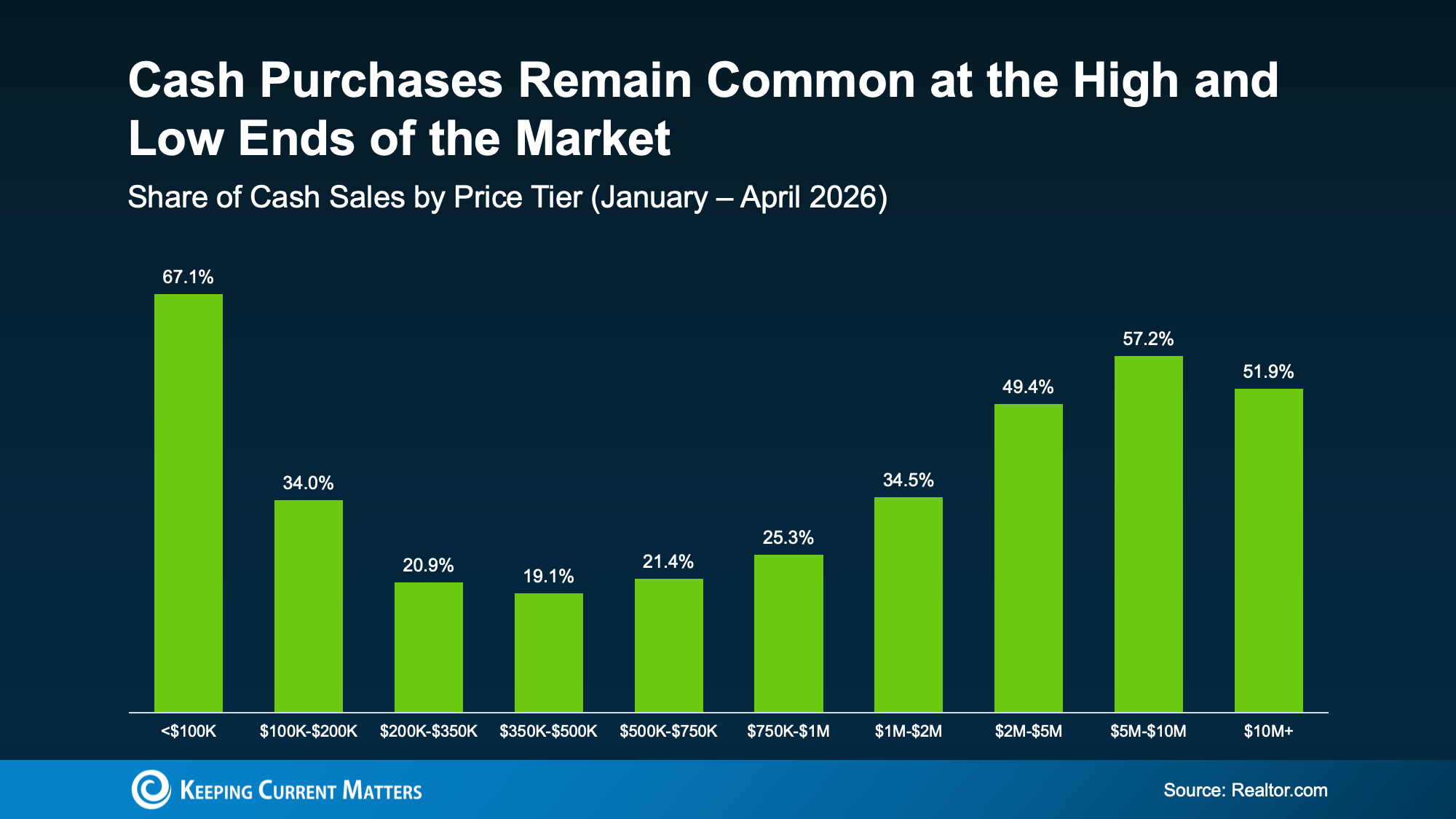
If you already own a home, you may be able to buy your next place in cash thanks to your equity. In fact, 26% of existing home sales this summer were all-cash, according to the National Association of Realtors (NAR). That’s roughly 1 in 4 buyers skipping a home loan entirely.

Data from Realtor.com shows most are at the very top and very bottom of the market by price point (see graph below):

a graph of green bars

For Buyers: If you’re able to buy in cash too, having no financing contingency means your offer is going to look really appealing to sellers. You may get a faster close and more room to negotiate.

For Sellers: A cash offer can mean less risk of the deal falling through, but that certainty sometimes comes with a lower number attached. Compare the whole picture before deciding it’s automatically your best offer.

Buyers Using Financing: They’re Not Getting Help from Rates, But They Are from Sellers

If you’re looking to take out a mortgage, you should know mortgage rates aren’t likely to come down anytime soon. Data from Fannie Mae shows nearly half of experts actually raised their long-term rate forecast this year (see graphs below):

a graph of growth and growth

That’s tough for homebuyers relying on a mortgage, especially first-time buyers. But it’s not all bad news.

While buyers may not be getting the lower rates they want, at least there’s help to be had if you ask sellers for what you really need. Redfin data shows almost half of May sales included a concession like a rate buydown or closing-cost credit from the homeowner.

For Buyers: Stop waiting on rates to drop. Negotiate the concession instead. If the payment works today, that’s your signal.

For Sellers: Expect to negotiate. Build a concession into your pricing strategy from the start could be the thing that gets a deal done.

Rate-Locked Homeowners: Most Are Sitting on a Rate Below 5%

If you own a home already, you might not want to move and take on a higher rate than the one you’ve got. That’s the case for a lot of people. About 2 in 3 homeowners have a mortgage rate under 5%, according to Federal Housing Finance Agency (FHFA) data (see graph below).

When a homeowner has a rate that low, it’s harder for them to want to move and leave behind that ultra-low rate. Because, they’d likely have to take on a higher one on their next home. Hence “rate locked” – they feel locked in.

a graph of a graph with text

And, according to Fannie Mae data, most experts think that lock-in will stick around another 3-5 years. That means this will continue to be a factor in how many homes come up for sale.

For Buyers: Fewer homeowners are listing, but the ones who do usually have a real reason to move. They’re often more flexible, motivated sellers.

For Sellers: Run the math on what your equity actually buys before ruling out a move. Got an FHA or VA loan? Ask about making it assumable. It’s rare, but it’s a real selling point.

Homebuilders: They’re Negotiating More Than You Think

If you’re looking at new construction, this might be your moment. According to the latest Census data, builders have more unsold new homes sitting around than usual, enough that it would take nearly 10 months to sell them all at the current pace (well above the normal 4-6 months pace). That’s pushing builders toward price cuts and rate buydowns.

For Buyers: That’s where the deals are right now. Just be sure to use your own agent and compare the whole incentive package, not only the price tag.

For Sellers: Lead with what a builder can’t offer – mature landscaping, an established neighborhood, and a house that’s ready today, not in 8 months. That can help your house seem like a better optiona

Bottom Line

Four different housing markets are running at once: cash buyers, financed buyers, locked-in owners, and builders. Each one plays by its own rules, and the right move for one is exactly the wrong move for another.

Connect with a local real estate agent to figure out which one you’re actually in and build your next move from there.


Source link

I cleared out my elderly neighbor’s townhouse to sell it. Here’s how I dealt with mountains of stuff


When my elderly neighbor, who I’ll refer to as Susan, moved to assisted living following a bad fall, her niece reached out to discuss the sale of Susan’s Carroll Gardens townhouse; a home that had been in their family for nearly a century. 

As the owner’s friend and neighbor, and a real estate agent at CORE, I was happy to help. I agreed to swing by the house to meet with the niece and her husband, trustees of the estate, while they assessed the condition of a home they had not been invited inside for years.

The couple, we’ll call them Terri and Jim, expressed different priorities. He wanted to sell the property “as is” without removing any of the copious personal contents from Susan’s long life.

“It’s a gutter,” he said. “Let the buyer deal with the junk.” 

Terri said she wanted “to do right by” her aunt, and was looking for advice. She needed to sell, but how to get from here to there was overwhelming to her. “Please, take anything you can use! There’s so much good stuff.” She held up a shirt to show me. “You’d look cute in this!’ she said.


[Editor’s Note: Brick Underground’s Inside Stories feature first-person accounts of interesting, real-life New York City real estate experiences. Have a story to share? Drop us an email. We respect all requests for anonymity.]


Nudging aside piles of clothes, linens and pillows, I found a small patch of bedspread where I parked myself as I met with them. There were dusty photos, scattered broaches, and an old rabbit-eared tv within my immediate sight. The rest of the three-story, two-family townhouse was equally cluttered with possessions from generations that lived there over the years.

The sale would pay for Susan’s assisted living, and the trustees were anxious to dispose of the property as quickly as possible. As retired snowbirds managing two homes in two states, the responsibility of executing this additional transaction was daunting.

Caption

Among the vintage finds given away were, from left to right, a U.S. army uniform, Susan’s signature floral housecoats, and her 1950s wedding dress.

Earning their trust

Susan, who recently turned 90, had been my neighbor for a dozen years. I’ve known her since before I was married and became a mom. My daughter and I would visit with her as she swept her stoop, or painted her fence, wearing one of her signature floral housecoats—she had about 30 of them.

We endured the covid pandemic together and had watched our Carroll Gardens neighborhood transform: Whole Foods arrived, landmark businesses shuttered, and a waterfront promenade rose on the banks of the Gowanus. I wanted to do right by her too.

I had relevant experience: I had dissolved two estates for my own aging family members and brokered an estate purchase on the Upper West Side. I presented Terri and Jim with an offer. 

“If you sell this home without emptying, staging and photographing it properly, you will leave tens of thousands of dollars on the table at sale,” I explained. “I’ll make it easy for you to say yes. Take what you want and leave the rest to me.” 

They agreed.

Caption

A view of the dining table mid-clean out.

Clearing the cache

From my work as an agent, I know that major life transitions don’t always line up with market trends. It’s a tough market for unrenovated properties, and yet demand for services involved in preparing an estate sale in NYC are on the rise.

According to Attom Data, transactions involving trusts jumped 17 percent in three years accounting for approximately 28 percent of Manhattan sales in 2024. Property Shark reported that 38 percent of all NYC real estate is owned by seniors, 65 years and older. And NAR noted that failing to declutter a property for sale costs sellers an average of three times the days-on-market and up to 10 percent of the sale price.

Entire industries have cropped up around estate-turnovers: junk removers, salvage and consignment shops, and non-profit organizations have moved mountains of once-loved furniture, clothing, technology and household items from NYC estates into the local community, and unfortunately, into landfills. 

A two-week deadline

I gave myself two weeks to clear the house, scheduling repairs, cleaning, photography, and listing activation to keep me on task. Once every drawer had been opened, cabinet scoured, and closet overturned, I bid out the job of “junking” it all to three local businesses who came back with comparable quotes—all in the $5,000 range. 

That felt steep and the waste was a bit heartbreaking, so I challenged myself to rehome as much of it as possible, aspiring to keep the gently used household goods out of a landfill. How many free donation pickups could I arrange without losing valuable time? It was worth a try, and the results surprised me.

How to give things away

I turned to Facebook Marketplace, BoCoCa’s Buy Nothing group, Etsy creators, Ebay collectors, and even passers-by to move truckloads of stuff to anyone who could pick up. Individuals, businesses, and non-profits turned up to cart away free items, one-by-one, by the bag, by appointment, and from the curb. 

A five-piece, mid-century bedroom suite went to a Park Slope neighbor who figured the cost of renting a U-haul to move it was worth the two-hour investment. A seven-piece dining set appealed to a Queens-based Facebook Marketplace shopper, though getting it out through the window proved to be a feat of amateur engineering. A garden statue of St. Anthony required two people to carry to the curb, where it attracted the attention of a local photographer before disappearing under cover of night. I later found a black-and-white photo of my client’s father posed beside the statue, bursting with pride.

On Instagram I discovered a Missouri-based Etsy Store that refurbishes and resells wedding fashions. They covered the shipping for a 1950s wedding dress and beaded headpiece. An Ebay seller came to collect a vintage army uniform. A kitchen table and appliances were re-homed by CHIPS. Pounds of clothes, linens, purses and shoes were collected by St. Mary’s clothing drive. An antique radio credenza was repurposed for an Alexis Bittar commercial. Religious relics, dishes, cookware and utensils, card tables and games, power tools, grill and more moved swiftly out of the home and into the community. 

Setting up an on-site office made things infinitely easier. I greeted pickup appointments and groused at the ghosters and flakes. Yes, the flake-rate was high. If you’re doing something similar, set your expectations accordingly and advertise as a “first-come, first-served” operation. It’s wild to discover how many people will actively engage with you on Facebook Marketplace and then never show. 

The bulk of the estate found new homes across the neighborhood where my client’s family set down roots and lived out generations. When I close my eyes, I can picture her floral housecoats peppering the landscape of BoCoCa’s stoop sweepers, her armoire storing costumes at a Greenpoint community theatre, her holiday decorations rewarding students in district elementary schools, and on and on. 

Reaping rewards

In the end, Junkluggers carted away 1.5 trucks worth of stuff, instead of the six originally estimated, of obsolete technology, a defunct bar fridge, some broken irreparable furnishings, opened pantry items, and hazardous waste (like paint cans and unlabeled cleaners).

Dissolving a few estates has taught me the benefit of re-homing gently used things. The effort is rewarded not only in dollars; it expanded my community, introducing me to local organizers, volunteers, artists, designers, teachers, residents, and business owners. 

The house went to market on schedule and was under contract within two weeks. It sold for more than $2 million—all cash—because once the property was cleared, buyers could easily see its potential. 

By thrift and resourcefulness, collaboration and expertise, I helped secure my client’s future, breathed new life into treasured possessions, and deepened my appreciation for this unique place, where one person’s collection of “junk” finds its way to a hundred to treasure it.


Source link

Upgrade your gaming experience with this 27-inch Acer 1440p 270Hz panel that’s an incredible 45% off — just $179 buys an awesome IPS monitor with AMD FreeSync Premium and 1ms response time


While RAM, video cards, and storage have become the most expensive parts of a PC build or upgrade, monitors haven’t really flinched price-wise. They can still offer a tangible upgrade, whether for gaming or productivity, for your PC. After all, you are staring at it the entire time you use your PC. Acer is currently offering an incredible deal on the Nitro (XV270U). Just $179 (a whopping 45%/$150 off the $239.99 MSRP) buys a 27-inch 2560×1440 IPS panel with a wicked-fast 270 Hz refresh rate without breaking the bank.


Source link